
[ACM_搜索] POJ 1096 Space Station Shielding (搜索 + 洪泛算法Flood_Fill)
Description
Input
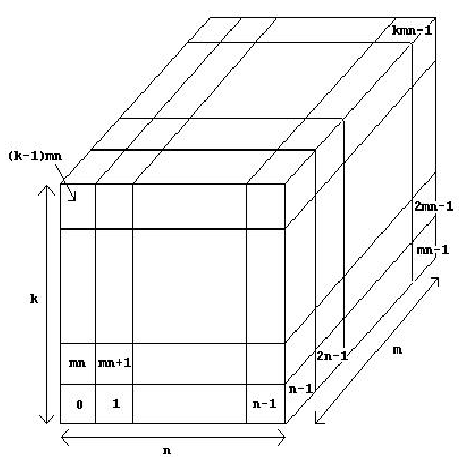
Output
The number of faces needing shielding is s.
Sample Input
2 2 1 3

0 1 3

3 3 3 26

0 1 2 3 4 5 6 7 8 9

10 11 12 14 15 16 17 18 19 20

21 22 23 24 25 26

0 0 0 0
Sample Output
The number of faces needing shielding is 14.

The number of faces needing shielding is 54.
Source
题目大意:给你一个正长方体,长宽高分别为n、m、k,这个长方体由n*m*k个1*1*1的小立方体组成,把这些小立方体编号为0-(n*m*k-1),再给l个编号,表示这些小立方体是存在的,否则就是不存在的。求最总整个图形的外表面积。
解题思路:首先想到,以其中一个存在的小立方体开始,往上下左右前后六个方向搜索,如果这个方向上有小方块,就转移到这个小方块上继续搜索,如果没有,则表面积+1,但是这个方法求出来的包含内表面积!!!于是采用反向思维,在这个立方体周围包一层不存在立方体(这里的不存在就是标记该位置单位立方体tab[i][j][k]=0,存在为1),然后再按上面的方法改成搜索“不存在的小立方体”,只搜索最外圈,那么我们得到的结果就是最外圈那些“不存在的小立方体”所构成的部分的内外表面积之和,它的内表面积就是我们要求的“存在的小立方体组成的物体”的外表面积了。而它的外表面积就是(n*m+m*k+n*k)*2,其实可以不用算,在搜索的时候如果是边界不用+1就行了。注意要用BFS,刚开始用DFS栈溢出了。
知识扩展:这题是标准的洪泛算法的题目,记得勘测油田的那道简单搜索题吗?还有某些画图软件上的把图像上相连的某种颜色换成其他的,你点一块其他全部变化啦。这些都是洪泛算法的应用。本题意思是有一个由单位立方体组成的长方体,有些单位立方体内有宇航员,而外太空的毒气可以渗入没有贴防护膜的房间,所以要在某些必要的位置贴防护膜来防止毒气进入太空站空间。
相关链接:维基百科——洪泛算法:http://zh.wikipedia.org/zh-cn/Flood_fill
图像处理之泛洪填充算法(Flood Fill Algorithm) :http://blog.csdn.net/jia20003/article/details/8908464
洪泛算法讲解:http://www.nocow.cn/index.php/Flood_Fill
 #include<iostream>

 #include<string.h>

 #include<queue>

 using namespace std;

 int n,m,k,l;

 bool tab[][][],visit[][][];

 int face_num;

 class W3{

 public:

     int x,y,z;

     W3& set(int xx,int yy,int zz){

         x=xx;y=yy;z=zz;

         return *this;

     }

 };

 void bfs(){

     face_num=;

     queue<W3> Q;

     W3 temp;

     Q.push(temp.set(,,));

     while(!Q.empty()){

         W3 Top=Q.front();Q.pop();

         if(visit[Top.x][Top.y][Top.z])continue;

         visit[Top.x][Top.y][Top.z]=;

         if(Top.x->=){

             if(tab[Top.x-][Top.y][Top.z]==){

                 if(!visit[Top.x-][Top.y][Top.z])Q.push(temp.set(Top.x-,Top.y,Top.z));

             }

             else face_num++;

         }//左走一格

         if(Top.x<=n){

             if(tab[Top.x+][Top.y][Top.z]==){

                 if(!visit[Top.x+][Top.y][Top.z])Q.push(temp.set(Top.x+,Top.y,Top.z));

             }

             else face_num++;

         }//右走一格

         if(Top.y->=){

             if(tab[Top.x][Top.y-][Top.z]==){

                 if(!visit[Top.x][Top.y-][Top.z])Q.push(temp.set(Top.x,Top.y-,Top.z));

             }

             else face_num++;

         }//后走一格

         if(Top.y<=m){

             if(tab[Top.x][Top.y+][Top.z]==){

                 if(!visit[Top.x][Top.y+][Top.z])Q.push(temp.set(Top.x,Top.y+,Top.z));

             }

             else face_num++;

         }//前走一格

         if(Top.z->=){

             if(tab[Top.x][Top.y][Top.z-]==){

                 if(!visit[Top.x][Top.y][Top.z-])Q.push(temp.set(Top.x,Top.y,Top.z-));

             }

             else face_num++;

         }//下走一格

         if(Top.z<=k){

             if(tab[Top.x][Top.y][Top.z+]==){

                 if(!visit[Top.x][Top.y][Top.z+])Q.push(temp.set(Top.x,Top.y,Top.z+));

             }

             else face_num++;

         }//上走一格

     }

 }

 int main(){

     while(cin>>n>>m>>k>>l){

         if(!n && !m && !k && !l)break;

         memset(tab,,sizeof(tab));

         memset(visit,,sizeof(visit));

         int temp1;

         for(int i=;i<l;i++){

             cin>>temp1;

             tab[temp1%(m*n)%n+][temp1%(m*n)/n+][temp1/(n*m)+]=;

         }//输入数据并转换为tab[][][]的3维矩阵(这里从1,1,1开始,最外层相当于无人方块)

         bfs();

         cout<<"The number of faces needing shielding is "<<face_num<<".\n";

     }return ;

 }
[ACM_搜索] POJ 1096 Space Station Shielding (搜索 + 洪泛算法Flood_Fill)的更多相关文章
- poj 2031 Building a Space Station【最小生成树prime】【模板题】
Building a Space Station Time Limit: 1000MS Memory Limit: 30000K Total Submissions: 5699 Accepte ...
- (最小生成树) Building a Space Station -- POJ -- 2031
链接: http://poj.org/problem?id=2031 Time Limit: 1000MS Memory Limit: 30000K Total Submissions: 6011 ...
- POJ 3126 Prime Path 广度优先搜索 难度:0
http://poj.org/problem?id=3126 搜索的时候注意 1:首位不能有0 2:可以暂时有没有出现在目标数中的数字 #include <cstdio> #include ...
- POJ 2031 Building a Space Station【经典最小生成树】
链接: http://poj.org/problem?id=2031 http://acm.hust.edu.cn/vjudge/contest/view.action?cid=22013#probl ...
- Building a Space Station POJ - 2031
Building a Space Station POJ - 2031 You are a member of the space station engineering team, and are ...
- Building a Space Station POJ 2031 【最小生成树 prim】
http://poj.org/problem?id=2031 Description You are a member of the space station engineering team, a ...
- POJ 2031 Building a Space Station
3维空间中的最小生成树....好久没碰关于图的东西了..... Building a Space Station Time Limit: 1000MS Memory Li ...
- POJ 2031 Building a Space Station (最小生成树)
Building a Space Station Time Limit: 1000MS Memory Limit: 30000K Total Submissions: 5173 Accepte ...
- POJ 2031 Building a Space Station (最小生成树)
Building a Space Station 题目链接: http://acm.hust.edu.cn/vjudge/contest/124434#problem/C Description Yo ...
随机推荐
- 为窗体设置背景图片-UI界面编辑器(SkinStudio)教程
1.1. 为窗体设置背景图片 在窗体的Background属性中选择图片设置为窗体背景图片
- The certificate used to sign “AppName” has either expired or has been revoked. An updated certificate is required to sign and install the application解决
问题 The certificate used to sign "AppName" has either expired or has been revoked. An updat ...
- UIScrollViewDelegate
一.执行顺序:(scrollView加后面的)willBeginDragging // 将要开始拖拽,手指已经放在view上并准备拖动的那一刻 DidScroll ...
- 使用max() 函数
/********************************* 代码功能:使用串口输出a和b的最大值 使用函数:max(a,b); 创作时间:2016*11*04 作者邮箱:jikexianfe ...
- codeforces 732/D 二分
给出考试时间和考试需要准备的时间,问最早考完所有科目的时间 二分答案 NlogN 二分抄神犇的写法 感觉挺舒服的嘻嘻嘻 #include<bits/stdc++.h> using name ...
- PHP验证码参考页面
http://blog.sina.com.cn/s/blog_95ee14340100z8q9.html http://www.jb51.net/article/44951.htm
- ZERO 笔试
1.大多考到了 计算机网络 tcpip 和 操作系统 多线程的知识 直接 懵逼 2. 考到了 递归的全排列 #include<iostream> using namespace s ...
- mysql 字符串处理优化
周五下午,同事突然说有个存储过程要帮忙优化,就拿来看看,大概看了下: 数据库端需求:数据库中要存储一个AppID字段,对应一个Account可以自行设置自己的AppID(我就不从业务上多说了), 以前 ...
- ADO.NET Entity Framework学习笔录(一)
今天开始学习了EF的相关内容,以前只知道ADO.NET,今天学习后觉得有必要写个相关的学习心得,今天就先写第一篇. 我们的再学习的过程中所用到的环境是Windows7+SQLServer2008+VS ...
- (Python )控制流语句if、for、while
这一节,我们将学习Python的控制流语句,主要包括if.for.while.break.continue 和pass语句 1. If语句 if语句也许是我们最熟悉的语句.其使用方法如下: x=inp ...