
【译】Spring 4 基于TaskScheduler实现定时任务(注解)
前言
译文链接:http://websystique.com/spring/spring-job-scheduling-with-scheduled-enablescheduling-annotations/
本文展示如何使用Spring的@Scheduled和@EnableScheduling注解来实现任务调度功能。
涉及技术及开发工具
- Spring 4.0.6.RELEASE
- Maven 3
- JDK 1.6
- Eclipse JUNO Service Release 2
工程目录结构
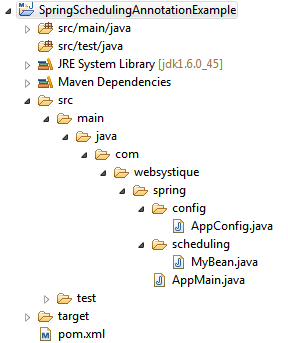
步骤一:往pom.xml中添加依赖
<project xmlns="http://maven.apache.org/POM/4.0.0" xmlns:xsi="http://www.w3.org/2001/XMLSchema-instance"

    xsi:schemaLocation="http://maven.apache.org/POM/4.0.0 http://maven.apache.org/xsd/maven-4.0.0.xsd">

    <modelVersion>4.0.0</modelVersion>

    <groupId>com.websystique.spring</groupId>

    <artifactId>SpringSchedulingAnnotationExample</artifactId>

    <version>1.0.0</version>

    <packaging>jar</packaging>

    <name>SpringSchedulingAnnotationExample</name>

    <properties>

        <springframework.version>4.0.6.RELEASE</springframework.version>

    </properties>

    <dependencies>

        <dependency>

            <groupId>org.springframework</groupId>

            <artifactId>spring-core</artifactId>

            <version>${springframework.version}</version>

        </dependency>

        <dependency>

            <groupId>org.springframework</groupId>

            <artifactId>spring-context</artifactId>

            <version>${springframework.version}</version>

        </dependency>

    </dependencies>

    <build>

        <pluginManagement>

            <plugins>

                <plugin>

                    <groupId>org.apache.maven.plugins</groupId>

                    <artifactId>maven-compiler-plugin</artifactId>

                    <version>3.2</version>

                    <configuration>

                        <source>1.6</source>

                        <target>1.6</target>

                    </configuration>

                </plugin>

            </plugins>

        </pluginManagement>

    </build>

</project>
步骤二:创建Spring配置类
Spring配置类是指用@Configuration注解标注的类,这些类包含了用@Bean标注的方法。这些被@Bean标注的方法可以生成bean并交由spring容器管理。
package com.websystique.spring.config;

import org.springframework.context.annotation.Bean;

import org.springframework.context.annotation.Configuration;

import org.springframework.scheduling.annotation.EnableScheduling;

import com.websystique.spring.scheduling.MyBean;

@Configuration

@EnableScheduling

public class AppConfig {

    @Bean

    public MyBean bean() {

        return new MyBean();

    }

}
这里要注意下@EnableScheduling注解,该注解开启了Spring的定时任务能力,使用该注解后,所有被@Scheduler标注的bean方法将会被注册用于调度。
如下是bean类:
package com.websystique.spring.scheduling;

import org.springframework.scheduling.annotation.Scheduled;

public class MyBean {

    @Scheduled(fixedRate=5000)

    public void printMessage() {

        System.out.println("I am called by Spring scheduler");

    }

}
以上被@Scheduled标注的方法会每隔五秒调用一次;
注意被@Scheduled标注的方法返回值是void且不能有参数,当然你可以注入其它bean,然后在printMessage方法内部实现其它额外功能。
@Scheduled注解提供若干种属性配置用于指定不同的调度时间:
initialDelay:在方法第一次执行之前等待的毫秒数;
fixedRate:方法每次开始执行的毫秒间隔,与该方法什么时候执行结束无关;
fixedDelay:上一次方法执行结束到下一次方法开始执行的毫秒间隔;
cron:提供更加详细的控制,如@Scheduled(cron=*/5 * * * * MON-FRI")表示在工作日每隔五秒执行一次
步骤三:创建main方法执行
package com.websystique.spring;

import org.springframework.context.annotation.AnnotationConfigApplicationContext;

import org.springframework.context.support.AbstractApplicationContext;

import com.websystique.spring.config.AppConfig;

public class AppMain {

    @SuppressWarnings({ "unused", "resource" })

    public static void main(String args[]){

        AbstractApplicationContext  context = new AnnotationConfigApplicationContext(AppConfig.class);

    }

}
注意这里我们并没有显式的调用任何调度类或方法,仅仅简单的注册了我们的配置类;
但是,由于我们使用了@EnableScheduling注解,被@Scheduler标注的bean方法会自动注册为计划任务去执行。
运行以上程序,结果如下:
I am called by Spring scheduler
I am called by Spring scheduler
I am called by Spring scheduler
I am called by Spring scheduler
I am called by Spring scheduler
.....
最后,假如你的任务需要花费很长的时间去完成,而且频率很高,你可以使用指定大小的线程池去处理各个方法中的任务,如下所示:
package com.websystique.spring.config;

import java.util.concurrent.Executor;

import java.util.concurrent.Executors;

import org.springframework.context.annotation.Bean;

import org.springframework.context.annotation.Configuration;

import org.springframework.scheduling.annotation.EnableScheduling;

import org.springframework.scheduling.annotation.SchedulingConfigurer;

import org.springframework.scheduling.config.ScheduledTaskRegistrar;

import com.websystique.spring.scheduling.MyBean;

@Configuration

@EnableScheduling

public class AppConfig implements SchedulingConfigurer {

    @Bean

    public MyBean bean() {

        return new MyBean();

    }

    @Override

    public void configureTasks(ScheduledTaskRegistrar taskRegistrar) {

        taskRegistrar.setScheduler(taskExecutor());

    }

    @Bean(destroyMethod="shutdown")

    public Executor taskExecutor() {

        return Executors.newScheduledThreadPool(10);

    }

}
以上配置使用的线程池大小为10,运行以上程序,可以得到相同的结果。
工程源码
http://websystique.com/?smd_process_download=1&download_id=811
【译】Spring 4 基于TaskScheduler实现定时任务(注解)的更多相关文章
- Spring 中基于 AOP 的 @AspectJ注解实例
@AspectJ 作为通过 Java 5 注释注释的普通的 Java 类,它指的是声明 aspects 的一种风格.通过在你的基于架构的 XML 配置文件中包含以下元素,@AspectJ 支持是可用的 ...
- Spring 3.1新特性之二:@Enable*注解的源码,spring源码分析之定时任务Scheduled注解
分析SpringBoot的自动化配置原理的时候,可以观察下这些@Enable*注解的源码,可以发现所有的注解都有一个@Import注解.@Import注解是用来导入配置类的,这也就是说这些自动开启的实 ...
- spring boot集成swagger,自定义注解,拦截器,xss过滤,异步调用,guava限流,定时任务案例, 发邮件
本文介绍spring boot集成swagger,自定义注解,拦截器,xss过滤,异步调用,定时任务案例 集成swagger--对于做前后端分离的项目,后端只需要提供接口访问,swagger提供了接口 ...
- Spring @Bean注解 (基于java的容器注解)
基于java的容器注解,意思就是使用Java代码以及一些注解,就可以取代spring 的 xml配置文件. 1-@Configuration & @Bean的配合 @Configuration ...
- Spring:基于注解的Spring MVC
什么是Spring MVC Spring MVC框架是一个MVC框架,通过实现Model-View-Controller模式来很好地将数据.业务与展现进行分离.从这样一个角度来说,Spring MVC ...
- 【Spring】Spring的定时任务注解@Scheduled原来如此简单
1 简介 定时任务的实现非常多,JDK的Timer.Spring提供的轻量级的Scheduled Task.QuartZ和Linux Cron等,还有一些分布式的任务调度框架.本文主要介绍Schedu ...
- Spring基于SchedulingConfigurer实现定时任务
Spring 基于 SchedulingConfigurer 实现定时任务,代码如下: import org.springframework.scheduling.annotation.Schedul ...
- Spring boot 基于注解方式配置datasource
Spring boot 基于注解方式配置datasource 编辑 Xml配置 我们先来回顾下,使用xml配置数据源. 步骤: 先加载数据库相关配置文件; 配置数据源; 配置sqlSessionF ...
- Spring boot 基于Spring MVC的Web应用和REST服务开发
Spring Boot利用JavaConfig配置模式以及"约定优于配置"理念,极大简化了基于Spring MVC的Web应用和REST服务开发. Servlet: package ...
随机推荐
- [异常解决] JLINK 与STM32的SWD连接接线方式
如果我们的板子上只留了4个接口:V3.3,SWDIO,SWDCLK,GND.那么和JTAG的连接关系参见下图: 注意缺口方向.然后GND可以接左边任何一个pin(除了最底下这个PIN). FROM: ...
- 如何在 Visual Studio 中使用 Git 同步代码到 CodePlex
开源社区不管在国内还是国外都很火热,微软也曾因为没有开源而倍受指责,但是随着 .Net framework.ASP.Net MVC等框架的逐渐开源,也让大家看到了微软开源的步伐.CodePlex 则是 ...
- OAuth认证原理及HTTP下的密码安全传输
很多人都会问这样一个问题,我们在登录的时候,密码会不会泄露?随便进一个网站,登录时抓包分析,可以看到自己的密码都是明文传输的,在如此复杂的web环境下,我们没有百分的把握保证信息在传输过程中不被截获, ...
- React Native 环境搭建
1,安装 HomeBrew /usr/bin/ruby -e "$(curl -fsSL https://raw.githubusercontent.com/Homebrew/install ...
- iOS开发中静态库之".framework静态库"的制作及使用篇
iOS开发中静态库之".framework静态库"的制作及使用篇 .framework静态库支持OC和swift .a静态库如何制作可参照上一篇: iOS开发中静态库之" ...
- pod Spec管理配置
pod Spec 为自己的项目添加pod管理功能.前言: 上一篇文章中提到,因为自己在操作的时候遇到很多坑,所在在此做一个记录,同样也希望可以帮到在这个操作上遇到坑的人. 本文将采用配图和加文字的方式 ...
- iOS App引导页功能实现
一.写作原因 以前都没有想着来写点东西,今天遇到件事情让我决定每次还是要做记录.因为以前自己可以轻松的完成pod spec的配置,但是今天在做的时候还是忘了遇到了很多坑.pod spec配置遇到的坑不 ...
- SQL Server-聚焦强制索引查询条件和Columnstore Index(九)
前言 本节我们再来穿插讲讲索引知识,后续再讲数据类型中的日期类型,简短的内容,深入的理解,Always to review the basics. 强制索引查询条件 前面我们也讲了一点强制索引查询的知 ...
- DotNet生成随机数的一些方法
在项目开发中,一般都会使用到“随机数”,但是在DotNet中的随机数并非真正的随机数,可在一些情况下生成重复的数字,现在总结一下在项目中生成随机数的方法. 1.随机布尔值: /// <summa ...
- 【分布式】Zookeeper在大型分布式系统中的应用
一.前言 上一篇博文讲解了Zookeeper的典型应用场景,在大数据时代,各种分布式系统层出不穷,其中,有很多系统都直接或间接使用了Zookeeper,用来解决诸如配置管理.分布式通知/协调.集群管理 ...