
[LeetCode] Find Eventual Safe States 找到最终的安全状态
In a directed graph, we start at some node and every turn, walk along a directed edge of the graph. If we reach a node that is terminal (that is, it has no outgoing directed edges), we stop.
Now, say our starting node is eventually safe if and only if we must eventually walk to a terminal node. More specifically, there exists a natural number K so that for any choice of where to walk, we must have stopped at a terminal node in less than K steps.
Which nodes are eventually safe? Return them as an array in sorted order.
The directed graph has N nodes with labels 0, 1, ..., N-1, where N is the length of graph. The graph is given in the following form: graph[i] is a list of labels j such that (i, j) is a directed edge of the graph.
Example:

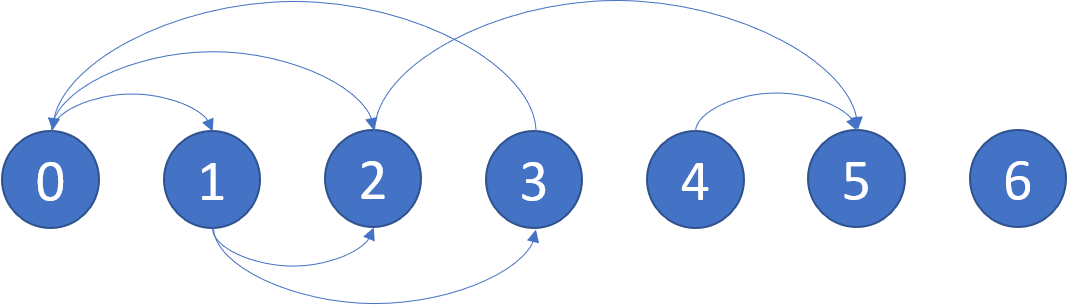
Input: graph = [[1,2],[2,3],[5],[0],[5],[],[]]

Output: [2,4,5,6]

Here is a diagram of the above graph.
Note:
graphwill have length at most10000.- The number of edges in the graph will not exceed
32000. - Each
graph[i]will be a sorted list of different integers, chosen within the range[0, graph.length - 1].
这道题给了我们一个有向图,然后定义了一种最终安全状态的结点,就是说该结点要在自然数K步内停止,所谓停止的意思,就是再没有向外的边,即没有出度,像上面例子中的结点5和6就是出度为0,因为graph[5]和graph[6]均为空。那么我们分析题目中的例子,除了没有出度的结点5和6之外,结点2和4也是安全状态结点,为啥呢,我们发现结点2和4都只能到达结点5,而结点5本身就是安全状态点,所以2和4也就是安全状态点了,所以我们可以得出的结论是,若某结点唯一能到达的结点是安全状态结点的话,那么该结点也同样是安全状态结点。那么我们就可以从没有出度的安全状态往回推,比如结点5,往回推可以到达结点4和2,先看结点4,此时我们先回推到结点4,然后将这条边断开,那么此时结点4出度为0,则标记结点4也为安全状态结点,同理,回推到结点2,断开边,此时结点2虽然入度仍为2,但是出度为0了,标记结点2也为安全状态结点。
分析到这里,思路应该比较明朗了,由于我们需要回推边,所以需要建立逆向边,用一个集合数组来存,由于题目要求返回的结点有序,我们可以利用集合TreeSet的自动排序的特性,由于需要断开边,为了不修改输入数据,所以我们干脆再建一个顺向边得了,即跟输入数据相同。还需要一个safe数组,布尔型的,来标记哪些结点是安全状态结点。在遍历结点的时候,直接先将出度为0的安全状态结点找出来,排入一个队列queue中,方便后续的处理。后续的处理就有些类似BFS的操作了,我们循环非空queue,取出队首元素,标记safe中该结点为安全状态结点,然后遍历其逆向边的结点,即可以到达当前队首结点的所有结点,我们在正向边集合中删除对应的边,如果此时结点出度为0了,将其加入队列queue中等待下一步处理,这样while循环退出后,所有的安全状态结点都已经标记好了,我们直接遍历safe数组,将其存入结果res中即可,参见代码如下:
解法一:
class Solution {

public:

    vector<int> eventualSafeNodes(vector<vector<int>>& graph) {

        vector<int> res;

        int n = graph.size();

        vector<bool> safe(n, false);

        vector<set<int>> g(n, set<int>()), revg = g;

        queue<int> q;

        for (int i = ; i < n; ++i) {

            if (graph[i].empty()) q.push(i);

            for (int j : graph[i]) {

                g[i].insert(j);

                revg[j].insert(i);

            }

        }

        while (!q.empty()) {

            auto t = q.front(); q.pop();

            safe[t] = true;

            for (int i : revg[t]) {

                g[i].erase(t);

                if (g[i].empty()) q.push(i);

            }

        }

        for (int i = ; i < n; ++i) {

            if (safe[i]) res.push_back(i);

        }

        return res;

    }

};
我们再来看一种DFS遍历有向图的解法。仔细分析题目中的例子,不难发现,之所以某些结点不是安全状态,因为有环的存在,而环经过的所有结点,一定不是安全状态结点,所以我们可以通过DFS遍历有向图来找出环即可。在大多数的算法中,经典的DFS遍历法对于结点都有三种状态标记,white,gray,和black,其中white表示结点还未遍历,gray表示正在遍历邻结点,black表示已经结束该结点的遍历。那么我们可以对每个结点都调用递归函数,在递归函数中,如果当前结点不是white,表示该结点已经访问过了,那么如果当前结点是black,直接返回true,如果是gray,直接返回false,因为遇到gray的结点,表示一定有环存在。否则我们给结点标记gray,然后开始遍历所有邻接结点,如果某个邻结点是black,直接跳过该结点。如果某个邻结点是gray,或者对该邻结点调用递归返回false了,说明当前结点是环结点,返回false。如果循环结束了,当前结点标记为black,并且返回true,参见代码如下:
解法二:
class Solution {

public:

    vector<int> eventualSafeNodes(vector<vector<int>>& graph) {

        int n = graph.size();

        vector<int> res, color(n); // 0 white, 1 gray, 2 black

        for (int i = ; i < n; ++i) {

            if (helper(graph, i, color)) res.push_back(i);

        }

        return res;

    }

    bool helper(vector<vector<int>>& graph, int cur, vector<int>& color) {

        if (color[cur] > ) return color[cur] == ;

        color[cur] = ;

        for (int i : graph[cur]) {

            if (color[i] == ) continue;

            if (color[i] ==  || !helper(graph, i, color)) {

                return false;

            }

        }

        color[cur] = ;

        return true;

    }

};
参考资料:
https://leetcode.com/problems/find-eventual-safe-states/solution/
LeetCode All in One 题目讲解汇总(持续更新中...)
[LeetCode] Find Eventual Safe States 找到最终的安全状态的更多相关文章
- [LeetCode] 802. Find Eventual Safe States 找到最终的安全状态
In a directed graph, we start at some node and every turn, walk along a directed edge of the graph. ...
- 【LeetCode】802. Find Eventual Safe States 解题报告(Python)
[LeetCode]802. Find Eventual Safe States 解题报告(Python) 作者: 负雪明烛 id: fuxuemingzhu 个人博客: http://fuxuemi ...
- LC 802. Find Eventual Safe States
In a directed graph, we start at some node and every turn, walk along a directed edge of the graph. ...
- Java实现 LeetCode 802 找到最终的安全状态 (DFS)
802. 找到最终的安全状态 在有向图中, 我们从某个节点和每个转向处开始, 沿着图的有向边走. 如果我们到达的节点是终点 (即它没有连出的有向边), 我们停止. 现在, 如果我们最后能走到终点,那么 ...
- [Swift]LeetCode802. 找到最终的安全状态 | Find Eventual Safe States
In a directed graph, we start at some node and every turn, walk along a directed edge of the graph. ...
- 【leetcode】802. Find Eventual Safe States
题目如下: 解题思路:本题大多数人采用DFS的方法,这里我用的是另一种方法.我的思路是建立一次初始值为空的safe数组,然后遍历graph,找到graph[i]中所有元素都在safe中的元素,把i加入 ...
- LeetCode 802. Find Eventual Safe States
原题链接在这里:https://leetcode.com/problems/find-eventual-safe-states/ 题目: In a directed graph, we start a ...
- 802. Find Eventual Safe States
https://leetcode.com/problems/find-eventual-safe-states/description/ class Solution { public: vector ...
- [LeetCode] Cracking the Safe 破解密码
There is a box protected by a password. The password is n digits, where each letter can be one of th ...
随机推荐
- 携程apollo系列-客户端集成
本文讲解如何在 Java 程序中集成 Apollo 配置, 主要涉及到一些基础用法. 对于一些高级用法, 比如如何加密/解密配置项 (可用于数据库密码配置), 如何动态切换数据源地址,如何动态切换日志 ...
- 携程apollo系列-个人开发环境搭建
本博客讲详细讲解如何在 Windows 搭建携程 Apollo 服务器 (用户个人开发). 开发服务器有多种搭建方式:(1) docker, 搭建过程非常简单, 推荐有 docker 环境(2) 部署 ...
- ios打包 上架 了解
苹果开发者中心 https://developer.apple.com/account 上架收费相关了解 https://www.jianshu.com/p/681f00a561ca ios打包 上 ...
- [物理学与PDEs]第5章第2节 变形的描述, 应变张量 2.2 Cauchy - Green 应变张量
1. 引理 (极分解): 设 $|{\bf F}|\neq 0$, 则存在正交阵 ${\bf R}$ 及对称正定阵 ${\bf U},{\bf V}$ 使得 $$\bex {\bf F}={\bf ...
- [物理学与PDEs]第2章第2节 粘性流体力学方程组 2.2 应力张量
1. 在有粘性的情形, 外界流体对 $\Omega$ 的作用力, 不仅有表面上的压力 (正压力), 也有表面上的内摩擦力 (切应力). 2. 于 $M$ 处以 ${\bf n}$ 为法向的单位面积 ...
- Java Swing实现一个简单而优美的记事本( 较详细注释 )
Java Swing实现具有基本功能的记事本 目前实现了: 文件 新建 打开 保存 退出前保存询问 编辑 剪切 复制 粘贴 清除 撤销 格式 字体选择 字体颜色选择 帮助 关于 (样式采用了css与h ...
- eclipse工程的jdk从1.7升到1.8后报错解决办法
报的错误信息: org.apache.jasper.JasperException: Unable to compile class for JSP 讲Tomcat从7.0升到apache-tomca ...
- 002_soa_zk处理经验总结
一. 遇到这种情况直接把当前目录下的acceptedEpoch和currentEpoch挪走,重启publisher即可. cat /data/zookeeper/data/version-2/acc ...
- mysql 动态sql的拼接以及执行、分页
1:建立存储过程,标记参数: ),),)) BEGIN DECLARE start integer; )*limitz; set @sql = 'select * from dsos_vot_drug ...
- sublime代码整理
1. 2.输入: { "keys":["ctrl+shift+z"], (快捷键自定义,只要不冲突就可以了) "command":" ...