
asp.net core之配置
简介
配置在asp.net core中可以说是我们必不可少一部分。
ASP.NET Core 中的应用程序配置是使用一个或多个配置提供程序执行的。 配置提供程序使用各种配置源从键值对读取配置数据,普通最常用的应该是下面几种:
- 设置文件,例如 appsettings.json
- 环境变量
- 命令行参数
- 已安装或已创建的自定义提供程序
- 内存中的 .NET 对象
配置优先级
不同的配置提供程序有不同优先级,相同的配置项高优先级的会覆盖低优先级的配置内容。
默认的优先级顺序如下(从最高优先级到最低优先级):
- 使用命令行配置提供程序通过命令行参数提供。
- 使用非前缀环境变量配置提供程序通过非前缀环境变量提供。
- 应用在 环境中运行时的用户机密。
- 使用 JSON 配置提供程序通过 appsettings.{Environment}.json 提供。 例如,appsettings.Production.json 和 appsettings.Development.json。
- 使用 JSON 配置提供程序通过 appsettings.json 提供。
- 主机(Host)配置。
接下来我们来实操一下。
新建一个WebApi项目,查看lunchSettings.json文件,可以看到默认端口地址为http://localhost:5085。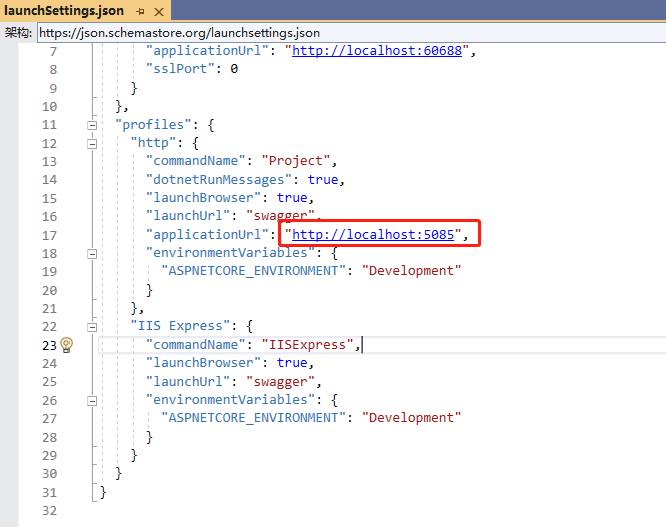
启动项目也可以看到端口地址是对应的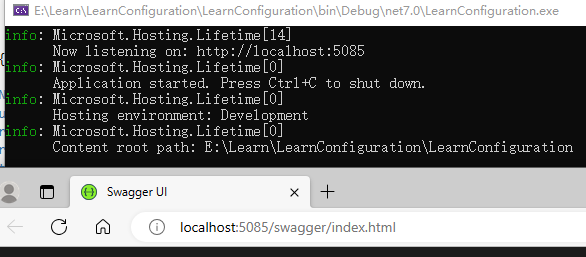
接下来我们在环境变量中添加一个ASPNETCORE_URLS变量,把端口改成5555,启动项目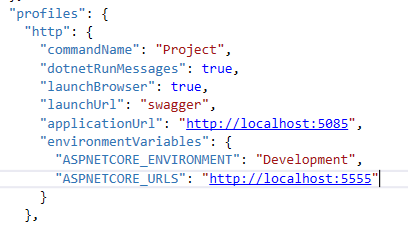
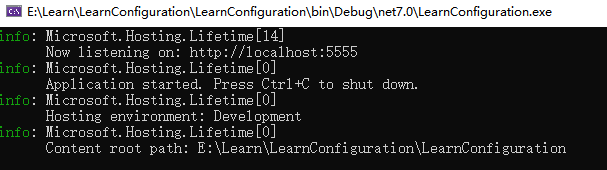
可以发现监听端口已经变成5555了。
接下来我们不删除上面改动的环境变量,在appsettings.json中添加一个urls配置,配置端口改成6666。
{

  "Logging": {

    "LogLevel": {

      "Default": "Information",

      "Microsoft.AspNetCore": "Warning"

    }

  },

  "AllowedHosts": "*",

  "urls": "http://localhost:6666"

}
再次启动项目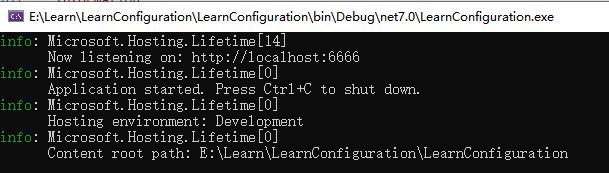
现在监听的端口变成了6666
接下来我们再次添加一个环境变量,叫做URLS,把端口改成7777,启动项目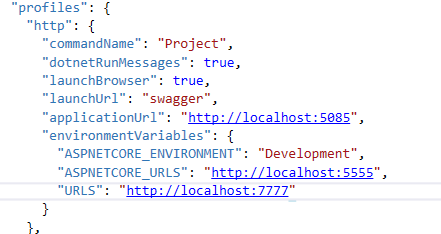
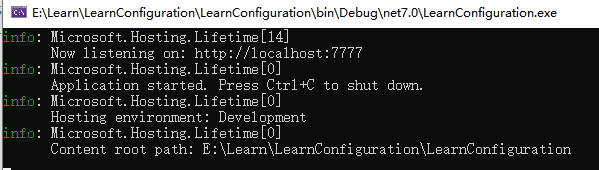
可以看到端口变成了7777。
接下来再试试用命令行启动,打开项目目录CMD,用dotnet run --urls=http://localhost:8888启动项目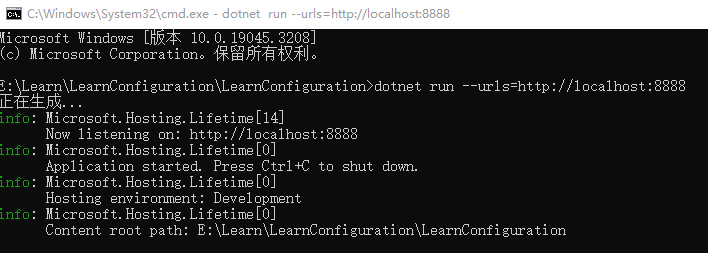
可以看到,我们端口又变成8888了。
很明显可以看到,相同配置会有不同的优先级。这里稍微提一下非前缀环境变量就是指不是以ASPNETCORE_ 或 DOTNET_ 为前缀的环境变量。
在我们上面两个环境变量中,ASPNETCORE_URLS的优先级没有URLS高,因为URLS就是非前缀环境变量。
其他的配置方式优先级 这里就不一一演示了,感兴趣的可以自行测试。
所以当我们有相同配置但使用不同配置提供程序时,需要注意配置的优先级,不然可能导致程序读取的配置内容不对。
配置提供程序
ASP.NET Core自带的配置提供程序有很多个,如下图: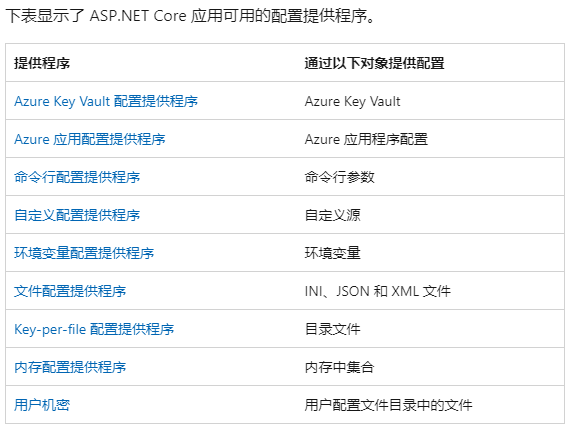
这里简单挑几个来了解一下。
MemoryConfigurationProvider
MemoryConfigurationProvider是内存配置提供程序,使用内存中集合作为配置键值对。
下面来测试一下,在Program中添加如下代码。
var builder = WebApplication.CreateBuilder(args);

var dict = new Dictionary<string, string>

        {

           {"TestMemoryKey", "Memory"},

        };

builder.Configuration.AddInMemoryCollection(dict);
在控制器中注入IConfiguration,并在API中获取TestMemoryKey的值。
private readonly ILogger<WeatherForecastController> _logger;

private readonly IConfiguration Configuration;

public WeatherForecastController(ILogger<WeatherForecastController> logger, IConfiguration configuration)

{

    _logger = logger;

    Configuration = configuration;

}

[HttpGet(Name = "GetWeatherForecast")]

public IEnumerable<WeatherForecast> Get()

{

    var testMemory = Configuration["TestMemoryKey"];

    return Enumerable.Range(1, 5).Select(index => new WeatherForecast

    {

        Date = DateOnly.FromDateTime(DateTime.Now.AddDays(index)),

        TemperatureC = Random.Shared.Next(-20, 55),

        Summary = Summaries[Random.Shared.Next(Summaries.Length)]

    })

    .ToArray();

}
启动项目并调用接口。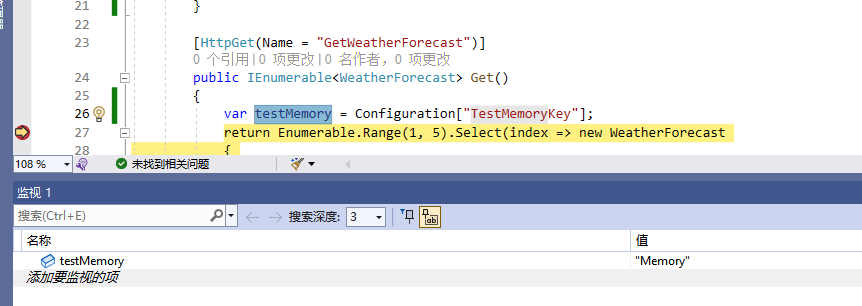
通过DEBUG可以看到,我们成功获取到了值。
FileConfigurationProvider
FileConfigurationProvider是文件配置提供程序,也是我们最常用到的一种,就是我们的appsettings.json文件配置。
除了json文件,Asp.netCore还支持INI和XML文件的配置提供程序
他们分别是
JsonConfigurationProvider 从 JSON 文件键值对加载配置。
IniConfigurationProvider 在运行时从 INI 文件键值对加载配置。
XmlConfigurationProvider 在运行时从 XML 文件键值对加载配置。
我们来添加appsettings.ini和appsettings.xml文件。
appsettings.ini
TestIniKey="Ini Value"
appsettings.xml
<?xml version="1.0" encoding="utf-8" ?>

<configuration>

	<TestXmlKey>XML Value</TestXmlKey>

</configuration>
在Program中添加配置文件
builder.Configuration.AddIniFile("appsettings.ini");

builder.Configuration.AddXmlFile("appsettings.xml");
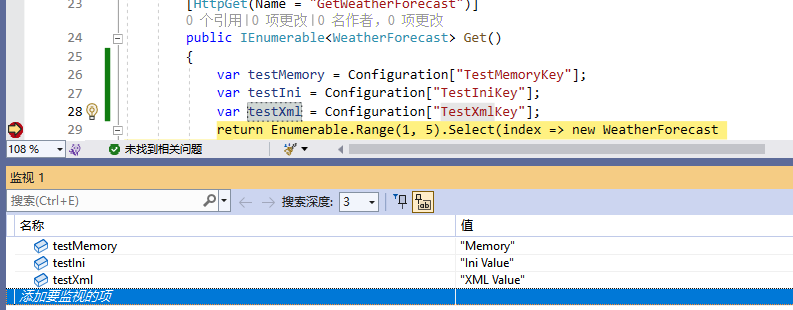
在控制器中测试读取配置。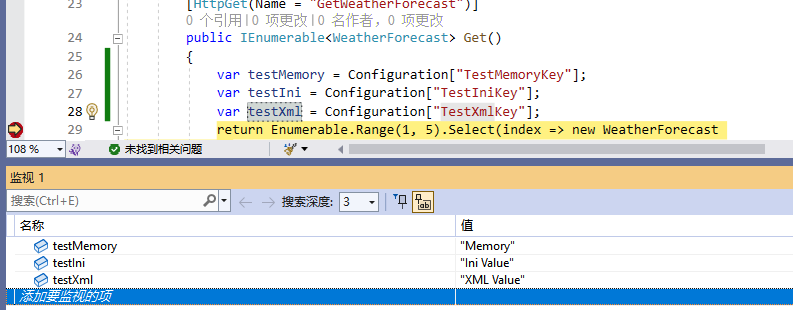
可以看到我们也成功读取了ini和xml文件中的配置内容。
自定义配置提供程序
除了上面自带的配置提供程序以外,我们还可以自定义属于自己的配置提供程序。
自定义配置提供程序可以用于对接我们的一些配置中心,从配置中心读取/更新配置文件,常见的有我们熟悉的阿波罗配置中心,其中的SDK就提供了阿波罗配置提供程序。
我们可以通过实现IConfigurationSource接口和继承ConfigurationProvider来创建自定义配置提供程序。
这里我们就不自己写了,直接看看apollo.net中ApolloConfigurationProvider源码的实现。
using Com.Ctrip.Framework.Apollo.Core.Utils;

using Com.Ctrip.Framework.Apollo.Internals;

namespace Com.Ctrip.Framework.Apollo;

public class ApolloConfigurationProvider : ConfigurationProvider, IRepositoryChangeListener, IConfigurationSource, IDisposable

{

    internal string? SectionKey { get; }

    internal IConfigRepository ConfigRepository { get; }

    private Task? _initializeTask;

    private int _buildCount;

    public ApolloConfigurationProvider(string? sectionKey, IConfigRepository configRepository)

    {

        SectionKey = sectionKey;

        ConfigRepository = configRepository;

        ConfigRepository.AddChangeListener(this);

        _initializeTask = ConfigRepository.Initialize();

    }

    public override void Load()

    {

        Interlocked.Exchange(ref _initializeTask, null)?.ConfigureAwait(false).GetAwaiter().GetResult();

        SetData(ConfigRepository.GetConfig());

    }

    protected virtual void SetData(Properties properties)

    {

        var data = new Dictionary<string, string>(StringComparer.OrdinalIgnoreCase);

        foreach (var key in properties.GetPropertyNames())

        {

            if (string.IsNullOrEmpty(SectionKey))

                data[key] = properties.GetProperty(key) ?? string.Empty;

            else

                data[$"{SectionKey}{ConfigurationPath.KeyDelimiter}{key}"] = properties.GetProperty(key) ?? string.Empty;

        }

        Data = data;

    }

    void IRepositoryChangeListener.OnRepositoryChange(string namespaceName, Properties newProperties)

    {

        SetData(newProperties);

        OnReload();

    }

    IConfigurationProvider IConfigurationSource.Build(IConfigurationBuilder builder)

    {

        Interlocked.Increment(ref _buildCount);

        return this;

    }

    public void Dispose()

    {

        if (Interlocked.Decrement(ref _buildCount) == 0)

            ConfigRepository.RemoveChangeListener(this);

    }

    public override string ToString() => string.IsNullOrEmpty(SectionKey)

        ? $"apollo {ConfigRepository}"

        : $"apollo {ConfigRepository}[{SectionKey}]";

}
可以看到这里是通过IConfigRepository去获取和监听阿波罗配置中心中的配置,获取和监听到配置时,调用SetData更新配配置内容。
我们看一下IConfigRepository的实现。
using Com.Ctrip.Framework.Apollo.Util.Http;

#if NET40

using System.Reflection;

#else

using System.Runtime.ExceptionServices;

using System.Web;

#endif

namespace Com.Ctrip.Framework.Apollo.Internals;

internal class RemoteConfigRepository : AbstractConfigRepository

{

    private static readonly Func<Action<LogLevel, string, Exception?>> Logger = () => LogManager.CreateLogger(typeof(RemoteConfigRepository));

    private static readonly TaskFactory ExecutorService = new(new LimitedConcurrencyLevelTaskScheduler(5));

    private readonly ConfigServiceLocator _serviceLocator;

    private readonly HttpUtil _httpUtil;

    private readonly IApolloOptions _options;

    private readonly RemoteConfigLongPollService _remoteConfigLongPollService;

    private volatile ApolloConfig? _configCache;

    private volatile ServiceDto? _longPollServiceDto;

    private volatile ApolloNotificationMessages? _remoteMessages;

    private ExceptionDispatchInfo? _syncException;

    private readonly Timer _timer;

    public RemoteConfigRepository(string @namespace,

        IApolloOptions configUtil,

        HttpUtil httpUtil,

        ConfigServiceLocator serviceLocator,

        RemoteConfigLongPollService remoteConfigLongPollService) : base(@namespace)

    {

        _options = configUtil;

        _httpUtil = httpUtil;

        _serviceLocator = serviceLocator;

        _remoteConfigLongPollService = remoteConfigLongPollService;

        _timer = new(SchedulePeriodicRefresh);

    }

    public override async Task Initialize()

    {

        await SchedulePeriodicRefresh(true).ConfigureAwait(false);

        _timer.Change(_options.RefreshInterval, _options.RefreshInterval);

        _remoteConfigLongPollService.Submit(Namespace, this);

    }

    public override Properties GetConfig()

    {

        _syncException?.Throw();

        return TransformApolloConfigToProperties(_configCache);

    }

    private async void SchedulePeriodicRefresh(object _) => await SchedulePeriodicRefresh(false).ConfigureAwait(false);

    private async Task SchedulePeriodicRefresh(bool isFirst)

    {

        try

        {

            Logger().Debug($"refresh config for namespace: {Namespace}");

            await Sync(isFirst).ConfigureAwait(false);

        }

        catch (Exception ex)

        {

            _syncException = ExceptionDispatchInfo.Capture(ex);

            Logger().Warn($"refresh config error for namespace: {Namespace}", ex);

        }

    }

    private async Task Sync(bool isFirst)

    {

        var previous = _configCache;

        var current = await LoadApolloConfig(isFirst).ConfigureAwait(false);

        //reference equals means HTTP 304

        if (!ReferenceEquals(previous, current))

        {

            Logger().Debug("Remote Config refreshed!");

            _configCache = current;

            _syncException = null;

            FireRepositoryChange(Namespace, GetConfig());

        }

    }

    private async Task<ApolloConfig?> LoadApolloConfig(bool isFirst)

    {

        var appId = _options.AppId;

        var cluster = _options.Cluster;

        var dataCenter = _options.DataCenter;

        var configServices = await _serviceLocator.GetConfigServices().ConfigureAwait(false);

        Exception? exception = null;

        Uri? url = null;

        var notFound = false;

        for (var i = 0; i < (isFirst ? 1 : 2); i++)

        {

            IList<ServiceDto> randomConfigServices = configServices.OrderBy(_ => Guid.NewGuid()).ToList();

            //Access the server which notifies the client first

            var longPollServiceDto = Interlocked.Exchange(ref _longPollServiceDto, null);

            if (longPollServiceDto != null)

            {

                randomConfigServices.Insert(0, longPollServiceDto);

            }

            foreach (var configService in randomConfigServices)

            {

                url = AssembleQueryConfigUrl(configService.HomepageUrl, appId, cluster, Namespace, dataCenter, _remoteMessages!, _configCache!);

                Logger().Debug($"Loading config from {url}");

                try

                {

                    var response = await _httpUtil.DoGetAsync<ApolloConfig?>(url).ConfigureAwait(false);

                    if (response.StatusCode == HttpStatusCode.NotModified)

                    {

                        Logger().Debug("Config server responds with 304 HTTP status code.");

                        return _configCache!;

                    }

                    var result = response.Body;

                    Logger().Debug($"Loaded config for {Namespace}: {result?.Configurations?.Count ?? 0}");

                    return result;

                }

                catch (ApolloConfigStatusCodeException ex)

                {

                    var statusCodeException = ex;

                    //config not found

                    if (ex.StatusCode == HttpStatusCode.NotFound)

                    {

                        notFound = true;

                        var message = $"Could not find config for namespace - appId: {appId}, cluster: {cluster}, namespace: {Namespace}, please check whether the configs are released in Apollo!";

                        statusCodeException = new(ex.StatusCode, message);

                    }

                    Logger().Warn(statusCodeException);

                    exception = statusCodeException;

                }

                catch (Exception ex)

                {

                    Logger().Warn("Load apollo config fail from " + configService, ex);

                    exception = ex;

                }

            }

#if NET40

            await TaskEx.Delay(1000).ConfigureAwait(false);

#else

            await Task.Delay(1000).ConfigureAwait(false);

#endif

        }

        if (notFound)

            return null;

        var fallbackMessage = $"Load Apollo Config failed - appId: {appId}, cluster: {cluster}, namespace: {Namespace}, url: {url}";

        throw new ApolloConfigException(fallbackMessage, exception!);

    }

    private Uri AssembleQueryConfigUrl(string uri,

        string appId,

        string cluster,

        string? namespaceName,

        string? dataCenter,

        ApolloNotificationMessages? remoteMessages,

        ApolloConfig? previousConfig)

    {

        if (!uri.EndsWith("/", StringComparison.Ordinal))

        {

            uri += "/";

        }

        //Looks like .Net will handle all the url encoding for me...

        var path = $"configs/{appId}/{cluster}/{namespaceName}";

        var uriBuilder = new UriBuilder(uri + path);

#if NETFRAMEWORK

        //不要使用HttpUtility.ParseQueryString(),.NET Framework里会死锁

        var query = new Dictionary<string, string>();

#else

        var query = HttpUtility.ParseQueryString("");

#endif

        if (previousConfig != null)

        {

            query["releaseKey"] = previousConfig.ReleaseKey;

        }

        if (!string.IsNullOrEmpty(dataCenter))

        {

            query["dataCenter"] = dataCenter!;

        }

        var localIp = _options.LocalIp;

        if (!string.IsNullOrEmpty(localIp))

        {

            query["ip"] = localIp;

        }

        if (remoteMessages != null)

        {

            query["messages"] = JsonUtil.Serialize(remoteMessages);

        }

#if NETFRAMEWORK

        uriBuilder.Query = QueryUtils.Build(query);

#else

        uriBuilder.Query = query.ToString();

#endif

        return uriBuilder.Uri;

    }

    private static Properties TransformApolloConfigToProperties(ApolloConfig? apolloConfig) =>

        apolloConfig?.Configurations == null ? new() : new Properties(apolloConfig.Configurations);

    public void OnLongPollNotified(ServiceDto longPollNotifiedServiceDto, ApolloNotificationMessages remoteMessages)

    {

        _longPollServiceDto = longPollNotifiedServiceDto;

        _remoteMessages = remoteMessages;

        ExecutorService.StartNew(async () =>

        {

            try

            {

                await Sync(false).ConfigureAwait(false);

            }

            catch (Exception ex)

            {

                Logger().Warn($"Sync config failed, will retry. Repository {GetType()}, reason: {ex.GetDetailMessage()}");

            }

        });

    }

    private bool _disposed;

    protected override void Dispose(bool disposing)

    {

        if (_disposed)

            return;

        if (disposing)

        {

            _timer.Dispose();

        }

        //释放非托管资源

        _disposed = true;

    }

    public override string ToString() => $"remote {_options.AppId} {Namespace}";

}

#if NET40

internal sealed class ExceptionDispatchInfo

{

    private readonly object _source;

    private readonly string _stackTrace;

    private const BindingFlags PrivateInstance = BindingFlags.Instance | BindingFlags.NonPublic;

    private static readonly FieldInfo RemoteStackTrace = typeof(Exception).GetField("_remoteStackTraceString", PrivateInstance)!;

    private static readonly FieldInfo Source = typeof(Exception).GetField("_source", PrivateInstance)!;

    private static readonly MethodInfo InternalPreserveStackTrace = typeof(Exception).GetMethod("InternalPreserveStackTrace", PrivateInstance)!;

    private ExceptionDispatchInfo(Exception source)

    {

        SourceException = source;

        _stackTrace = SourceException.StackTrace + Environment.NewLine;

        _source = Source.GetValue(SourceException);

    }

    public Exception SourceException { get; }

    public static ExceptionDispatchInfo Capture(Exception source)

    {

        if (source == null) throw new ArgumentNullException(nameof(source));

        return new(source);

    }

    public void Throw()

    {

        try

        {

            throw SourceException;

        }

        catch

        {

            InternalPreserveStackTrace.Invoke(SourceException, new object[0]);

            RemoteStackTrace.SetValue(SourceException, _stackTrace);

            Source.SetValue(SourceException, _source);

            throw;

        }

    }

}

#endif
可以看到这里就是通过API从阿波罗拉取配置。
如果我们自己想实现一个配置中心,可以参考他实现一个自己的配置提供程序。
配置绑定
通过Configuration Binding可以将配置值绑定到.NET对象的属性上,通过配置绑定,你可以将配置数据直接映射到应用程序中的对象,而不需要手动解析和转换配置值。
我们新建一个类
    public class TestConfig

    {

        public string TestConfigKey { get; set; }

    }
在appsettings.json中添加一个配置
  "TestConfig": {

    "TestConfigKey": "TEST"

  }
使用Configuration.Bind()进行我们的配置绑定。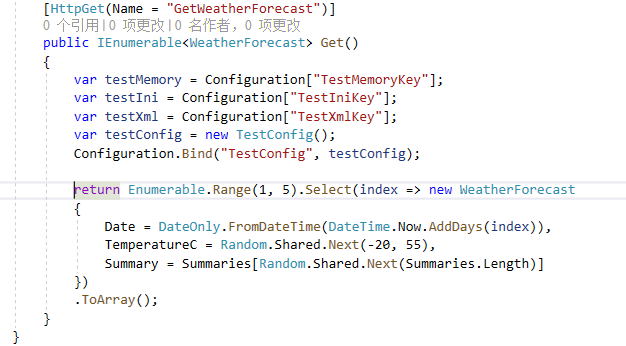
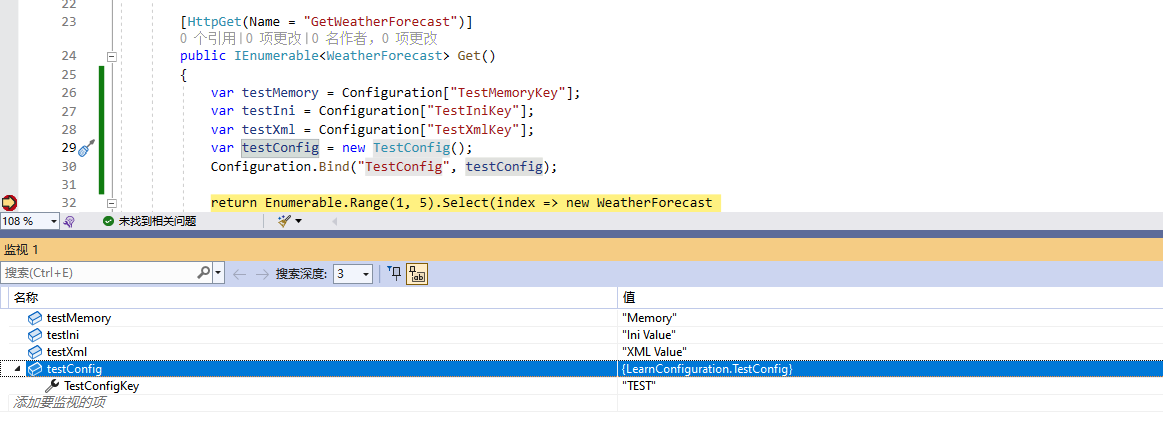
通过Debug我们可以清楚看到appsettings.json中的TestConfigKey的值已经成功绑定到我们的类实例中。
总结
通过使用ASP.NET Core的Configuration组件,你可以轻松地管理应用程序的配置数据,并在不同环境中进行灵活的配置。它提供了一种统一的方式来加载、访问和更新配置数据,使得应用程序的配置变得更加简单和可维护。
欢迎进群催更。

asp.net core之配置的更多相关文章
- ASP.NET Core的配置(5):配置的同步[设计篇]
本节所谓的"配置同步"主要体现在两个方面:其一,如何监控配置源并在其变化的时候自动加载其数据,其目的是让应用中通过Configuration对象承载的配置与配置源的数据同步:其二. ...
- ASP.NET Core的配置(5):配置的同步[ 实例篇]
ConfigurationBuilder在生成以Configuration对象的时候会利用注册其中的ConfigurationProvider加载原始的配置数据,那么一旦配置源中的数据发生变化,应用程 ...
- ASP.NET Core的配置(4):多样性的配置来源[下篇]
我们在上篇和中篇对配置模型中默认提供的各种ConfigurationProvider进行了深入详尽的介绍,如果它们依然不能满足项目中的配置需求,我们可以还可以通过自定义ConfigurationPro ...
- ASP.NET Core的配置(4):多样性的配置来源[中篇]
我们在本篇文章中会介绍三种针对物理文件的ConfiguationProvider,它们分别是针对JSON文件的JsonConfiguationProvider,针对XML文件的XmlConfiguat ...
- ASP.NET Core的配置(4):多样性的配置来源[上篇]
较之传统通过App.config和Web.config这两个XML文件承载的配置系统,ASP.NET Core采用的这个全新的配置模型的最大一个优势就是针对多种不同配置源的支持.我们可以将内存变量.命 ...
- ASP.NET Core的配置(3): 将配置绑定为对象[下篇]
我们在<读取配置信息>通过实例的形式演示了如何利用Options模型以依赖注入的方式直接获取由指定配置节绑定生成的Options对象,我们再次回顾一下当初我们编写的程序.如下面的代码片段所 ...
- ASP.NET Core的配置(3): 将配置绑定为对象[上篇]
出于编程上的便利,我们通常不会直接利用ConfigurationBuilder创建的Configuration对象读取某个单一配置项的值,而是倾向于将一组相关的配置绑定为一个对象,我们将后者称为Opt ...
- ASP.NET Core的配置(2):配置模型详解
在上面一章我们以实例演示的方式介绍了几种读取配置的几种方式,其中涉及到三个重要的对象,它们分别是承载结构化配置信息的Configuration,提供原始配置源数据的ConfigurationProvi ...
- ASP.NET Core的配置(1):读取配置信息
提到"配置"二字,我想绝大部分.NET开发人员脑海中会立马浮现出两个特殊文件的身影,那就是我们再熟悉不过的app.config和web.config,多年以来我们已经习惯了将结构化 ...
- ASP.NET Core - 各项配置
之前搭建好了各项开发环境,现在来说说ASP.NET Core的各项配置.项目结构.以及在请求管道中挂载的各式各样的中间件.今天先来探讨探讨其各项配置及其项目结构 ASP.NET Core和上一代F ...
随机推荐
- 第4章. 安装reco主题
大家可以按照我的教程来安装,也可以访问 reco_luan 大佬的 官方教程 根据自己的电脑类型和开发环境配置,来选择合适的安装方式. 一.快速开始 npx # 初始化,并选择 2.x npx @vu ...
- 笔记七:进程间的通信(IPC通信之信号灯)
信号量 定义信号变量: sem_t sem1 sem2 初始化信号量 P操作 V操作 功能 信号量(POSOX) 信号量灯(IPC) 定义信号变量 sem_t sem1 ...
- ArcGIS Desktop发布地形高程服务(DEM/DSM)
在做ArcGIS三维时,地形服务的发布与普通地图服务的发布不一样,需要发布成ImageServer,切片格式选择LERC. 本文示例使用软件: ArcGIS Desktop10.3.1 注:ArcGI ...
- 中国剩余定理(CRT)学习笔记
约定 \(A\perp B\) 表示 \(\gcd(A,B)=1\). \(A\mid B\) 表示 \(B\equiv 0\pmod{A}(A\neq0)\). 引入 考虑以下这道题: 有物不知其數 ...
- LeetCode刷题之652寻找重复的子树
继续每日分享一道算法题,监督自己学习,不落下算法,有需要一起打卡的uu,可以一起加油呀! 好了,现在开始看题了哈: 给定一棵二叉树 root,返回所有重复的子树. 对于同一类的重复子树,你只需要返回其 ...
- Linux 内存管理 pt.2
哈喽大家好我是咸鱼,在<Linux 内存管理 pt.1>中我们学习了什么是物理内存.虚拟内存,了解了内存映射.缺页异常等内容 那么今天我们来接着学习 Linux 内存管理中的多级页表和大页 ...
- 知乎问题:如何说服技术老大用 Redis ?
这个问题很微妙,可能这位同学内心深处,觉得 Redis 是所有应用缓存的标配. 缓存的世界很广阔,对于应用系统来讲,我们经常将缓存划分为本地缓存和分布式缓存. 本地缓存 :应用中的缓存组件,缓存组件和 ...
- JVM面试和学习中需要注意的部分
内存结构 1.方法区用来存储类加载的数据,例如类的名称,方法入口 2.JVM虚拟机栈用于存储线程,包括局部变量和方法参数 3.堆内存用来存储对象 4.方法区的规范实现:永久代和元空间 5.方法区 JV ...
- 2022-04-30:在无限的平面上,机器人最初位于 (0, 0) 处,面朝北方。注意: 北方向 是y轴的正方向。 南方向 是y轴的负方向。 东方向 是x轴的正方向。 西方向 是x轴的负方向。 机器人
2022-04-30:在无限的平面上,机器人最初位于 (0, 0) 处,面朝北方.注意: 北方向 是y轴的正方向. 南方向 是y轴的负方向. 东方向 是x轴的正方向. 西方向 是x轴的负方向. 机器人 ...
- vue全家桶进阶之路44:Vue3 Element Plus el_row和el_col组件
在 Vue 3 中,Element Plus 也提供了 ElRow 和 ElCol 组件,用于实现栅格布局. ElRow 组件的常用属性: gutter:栅格间距,默认为 0. type:布局模式,可 ...