
线程池技术之:ThreadPoolExecutor 源码解析
java中的所说的线程池,一般都是围绕着 ThreadPoolExecutor 来展开的。其他的实现基本都是基于它,或者模仿它的。所以只要理解 ThreadPoolExecutor, 就相当于完全理解了线程池的精髓。
其实要理解一个东西,一般地,我们最好是要抱着自己的疑问或者理解去的。否则,往往收获甚微。
理解 ThreadPoolExecutor, 我们可以先理解一个线程池的意义: 本质上是提供预先定义好的n个线程,供调用方直接运行任务的一个工具。
线程池解决的问题:
1. 提高任务执行的响应速度,降低资源消耗。任务执行时,直接立即使用线程池提供的线程运行,避免了临时创建线程的CPU/内存开销,达到快速响应的效果。
2. 提高线程的可管理性。线程总数可预知,避免用户主动创建无限多线程导致死机风险,还可以进行线程统一的分配、调优和监控。
3. 避免对资源的过度使用。在超出预期的请求任务情况,响应策略可控。
线程池提供的核心接口:
要想使用线程池,自然是要理解其接口的。一般我们使用 ExecotorService 进行线程池的调用。然而,我们并不针对初学者。
整体的接口如下:
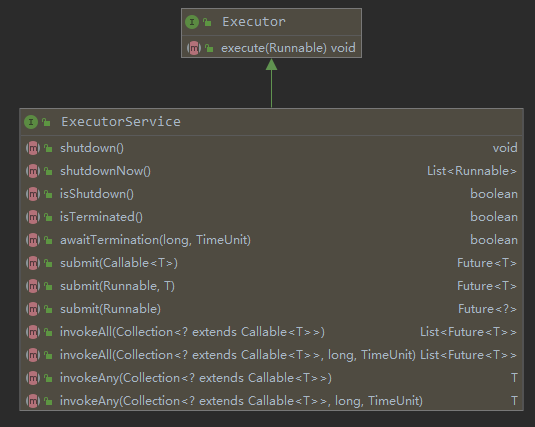
我们就挑几个常用接口探讨下:
submit(Runnable task): 提交一个无需返回结果的任务。
submit(Callable<T> task): 提交一个有返回结果的任务。
invokeAll(Collection<? extends Callable<T>> tasks, long, TimeUnit): 同时执行n个任务并返回结果列表。
shutdown(): 关闭线程程池。
awaitTermination(long timeout, TimeUnit unit): 等待关闭结果,最长不超过timeout时间。
以上是ThreadPoolExector 提供的特性,针对以上特性。
我们应该要有自己的几个实现思路或疑问:
1. 线程池如何接受任务?
2. 线程如何运行任务?
3. 线程池如何关闭?
接下来,就让我们带着疑问去看实现吧。
ThreadPoolExecutor 核心实现原理
1. 线程池的处理流程
我们首先重点要看的是,如何执行提交的任务。我可以通过下图来看看。
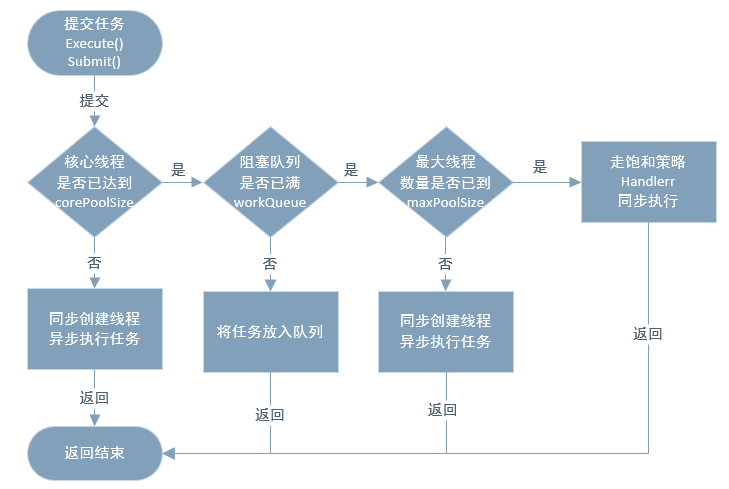
总结描述下就是:
1. 判断核心线程池是否已满,如果不是,则创建线程执行任务
2. 如果核心线程池满了,判断队列是否满了,如果队列没满,将任务放在队列中
3. 如果队列满了,则判断线程池是否已满,如果没满,创建线程执行任务
4. 如果线程池也满了,则按照拒绝策略对任务进行处理
另外,我们来看一下 ThreadPoolExecutor 的构造方法,因为这里会体现出每个属性的含义。
    /**

     * Creates a new {@code ThreadPoolExecutor} with the given initial

     * parameters.

     *

     * @param corePoolSize the number of threads to keep in the pool, even

     *        if they are idle, unless {@code allowCoreThreadTimeOut} is set

     * @param maximumPoolSize the maximum number of threads to allow in the

     *        pool

     * @param keepAliveTime when the number of threads is greater than

     *        the core, this is the maximum time that excess idle threads

     *        will wait for new tasks before terminating.

     * @param unit the time unit for the {@code keepAliveTime} argument

     * @param workQueue the queue to use for holding tasks before they are

     *        executed.  This queue will hold only the {@code Runnable}

     *        tasks submitted by the {@code execute} method.

     * @param threadFactory the factory to use when the executor

     *        creates a new thread

     * @param handler the handler to use when execution is blocked

     *        because the thread bounds and queue capacities are reached

     * @throws IllegalArgumentException if one of the following holds:<br>

     *         {@code corePoolSize < 0}<br>

     *         {@code keepAliveTime < 0}<br>

     *         {@code maximumPoolSize <= 0}<br>

     *         {@code maximumPoolSize < corePoolSize}

     * @throws NullPointerException if {@code workQueue}

     *         or {@code threadFactory} or {@code handler} is null

     */

    public ThreadPoolExecutor(int corePoolSize,

                              int maximumPoolSize,

                              long keepAliveTime,

                              TimeUnit unit,

                              BlockingQueue<Runnable> workQueue,

                              ThreadFactory threadFactory,

                              RejectedExecutionHandler handler) {

        if (corePoolSize < 0 ||

            maximumPoolSize <= 0 ||

            maximumPoolSize < corePoolSize ||

            keepAliveTime < 0)

            throw new IllegalArgumentException();

        if (workQueue == null || threadFactory == null || handler == null)

            throw new NullPointerException();

        this.corePoolSize = corePoolSize;

        this.maximumPoolSize = maximumPoolSize;

        this.workQueue = workQueue;

        this.keepAliveTime = unit.toNanos(keepAliveTime);

        this.threadFactory = threadFactory;

        this.handler = handler;

    }
从构造方法可以看出 ThreadPoolExecutor 的主要参数 7 个,在其注释上也有说明功能,咱们翻译下每个参数的功能:
    corePoolSize: 线程池核心线程数(平时保留的线程数),使用时机: 在初始时刻,每次请求进来都会创建一个线程直到达到该size

    maximumPoolSize: 线程池最大线程数,使用时机: 当workQueue都放不下时,启动新线程,直到最大线程数,此时到达线程池的极限

    keepAliveTime/unit: 超出corePoolSize数量的线程的保留时间,unit为时间单位

    workQueue: 阻塞队列,当核心线程数达到或者超出后,会先尝试将任务放入该队列由各线程自行消费;

        ArrayBlockingQueue: 构造函数一定要传大小

        LinkedBlockingQueue: 构造函数不传大小会默认为65536(Integer.MAX_VALUE ),当大量请求任务时,容易造成 内存耗尽。

        SynchronousQueue: 同步队列,一个没有存储空间的阻塞队列 ,将任务同步交付给工作线程。

        PriorityBlockingQueue: 优先队列

    threadFactory:线程工厂,用于线程需要创建时,调用其newThread()生产新线程使用

    handler: 饱和策略,当队列已放不下任务,且创建的线程已达到 maximum 后,则不能再处理任务,直接将任务交给饱和策略

        AbortPolicy: 直接抛弃(默认)

        CallerRunsPolicy: 用调用者的线程执行任务

        DiscardOldestPolicy: 抛弃队列中最久的任务

        DiscardPolicy: 抛弃当前任务
2. submit 流程详解
当调用 submit 方法,就是向线程池中提交一个任务,处理流程如步骤1所示。但是我们需要更深入理解。
submit 方法是定义在 AbstractExecutorService 中,最终调用 ThreadPoolExecutor 的 execute 方法,即是模板方法模式的应用。
    // java.util.concurrent.AbstractExecutorService#submit(java.lang.Runnable, T)

    /**

     * @throws RejectedExecutionException {@inheritDoc}

     * @throws NullPointerException       {@inheritDoc}

     */

    public <T> Future<T> submit(Runnable task, T result) {

        if (task == null) throw new NullPointerException();

        // 封装任务和返回结果为 RunnableFuture, 统一交由具体的子类执行

        RunnableFuture<T> ftask = newTaskFor(task, result);

        // execute 将会调用 ThreadPoolExecutor 的实现,是我们讨论的重要核心

        execute(ftask);

        return ftask;

    }

    // FutureTask 是个重要的线程池组件,它承载了具体的任务执行流

    /**

     * Returns a {@code RunnableFuture} for the given runnable and default

     * value.

     *

     * @param runnable the runnable task being wrapped

     * @param value the default value for the returned future

     * @param <T> the type of the given value

     * @return a {@code RunnableFuture} which, when run, will run the

     * underlying runnable and which, as a {@code Future}, will yield

     * the given value as its result and provide for cancellation of

     * the underlying task

     * @since 1.6

     */

    protected <T> RunnableFuture<T> newTaskFor(Runnable runnable, T value) {

        return new FutureTask<T>(runnable, value);

    }

    // ThreadPoolExecutor 的任务提交过程

    // java.util.concurrent.ThreadPoolExecutor#execute

    /**

     * Executes the given task sometime in the future.  The task

     * may execute in a new thread or in an existing pooled thread.

     *

     * If the task cannot be submitted for execution, either because this

     * executor has been shutdown or because its capacity has been reached,

     * the task is handled by the current {@code RejectedExecutionHandler}.

     *

     * @param command the task to execute

     * @throws RejectedExecutionException at discretion of

     *         {@code RejectedExecutionHandler}, if the task

     *         cannot be accepted for execution

     * @throws NullPointerException if {@code command} is null

     */

    public void execute(Runnable command) {

        if (command == null)

            throw new NullPointerException();

        /*

         * Proceed in 3 steps:

         *

         * 1. If fewer than corePoolSize threads are running, try to

         * start a new thread with the given command as its first

         * task.  The call to addWorker atomically checks runState and

         * workerCount, and so prevents false alarms that would add

         * threads when it shouldn't, by returning false.

         *

         * 2. If a task can be successfully queued, then we still need

         * to double-check whether we should have added a thread

         * (because existing ones died since last checking) or that

         * the pool shut down since entry into this method. So we

         * recheck state and if necessary roll back the enqueuing if

         * stopped, or start a new thread if there are none.

         *

         * 3. If we cannot queue task, then we try to add a new

         * thread.  If it fails, we know we are shut down or saturated

         * and so reject the task.

         */

        // ctl 是一个重要的控制全局状态的数据结构,定义为一个线程安全的 AtomicInteger

        // ctl = new AtomicInteger(ctlOf(RUNNING, 0));

        int c = ctl.get();

        // 当还没有达到核心线程池的数量时,直接添加1个新线程,然后让其执行任务即可

        if (workerCountOf(c) < corePoolSize) {

            // 2.1. 添加新线程,且执行command任务

            // 添加成功,即不需要后续操作了,添加失败,则说明外部环境变化了

            if (addWorker(command, true))

                return;

            c = ctl.get();

        }

        // 当核心线程达到后,则尝试添加到阻塞队列中,具体添加方法由阻塞队列实现

        // isRunning => c < SHUTDOWN;

        if (isRunning(c) && workQueue.offer(command)) {

            int recheck = ctl.get();

            // 2.2. 添加队列成功后,还要再次检测线程池的运行状态,决定启动线程或者状态过期

            // 2.2.1. 当线程池已关闭,则将刚刚添加的任务移除,走reject策略

            if (! isRunning(recheck) && remove(command))

                reject(command);

            // 2.2.2. 当一个worker都没有时,则添加worker

            else if (workerCountOf(recheck) == 0)

                addWorker(null, false);

        }

        // 当队列满后,则直接再创建新的线程运行,如果不能再创建线程了,则 reject

        else if (!addWorker(command, false))

            // 2.3. 拒绝策略处理

            reject(command);

    }
通过上面这一小段代码,我们就已经完整地看到了。通过一个 ctl 变量进行全局状态控制,从而保证了线程安全性。整个框架并没有使用锁,但是却是线程安全的。
整段代码刚好完整描述了线程池的执行流程:
1. 判断核心线程池是否已满,如果不是,则创建线程执行任务;
2. 如果核心线程池满了,判断队列是否满了,如果队列没满,将任务放在队列中;
3. 如果队列满了,则判断线程池是否已满,如果没满,创建线程执行任务;
4. 如果线程池也满了,则按照拒绝策略对任务进行处理;
2.1. 添加新的worker
一个worker,即是一个工作线程。
    /**

     * Checks if a new worker can be added with respect to current

     * pool state and the given bound (either core or maximum). If so,

     * the worker count is adjusted accordingly, and, if possible, a

     * new worker is created and started, running firstTask as its

     * first task. This method returns false if the pool is stopped or

     * eligible to shut down. It also returns false if the thread

     * factory fails to create a thread when asked.  If the thread

     * creation fails, either due to the thread factory returning

     * null, or due to an exception (typically OutOfMemoryError in

     * Thread.start()), we roll back cleanly.

     *

     * @param firstTask the task the new thread should run first (or

     * null if none). Workers are created with an initial first task

     * (in method execute()) to bypass queuing when there are fewer

     * than corePoolSize threads (in which case we always start one),

     * or when the queue is full (in which case we must bypass queue).

     * Initially idle threads are usually created via

     * prestartCoreThread or to replace other dying workers.

     *

     * @param core if true use corePoolSize as bound, else

     * maximumPoolSize. (A boolean indicator is used here rather than a

     * value to ensure reads of fresh values after checking other pool

     * state).

     * @return true if successful

     */

    private boolean addWorker(Runnable firstTask, boolean core) {

        // 为确保线程安全,进行CAS反复重试

        retry:

        for (;;) {

            int c = ctl.get();

            // 获取runState , c 的高位存储

            // c & ~CAPACITY;

            int rs = runStateOf(c);

            // Check if queue empty only if necessary.

            // 已经shutdown, firstTask 为空的添加并不会成功

            if (rs >= SHUTDOWN &&

                ! (rs == SHUTDOWN &&

                   firstTask == null &&

                   ! workQueue.isEmpty()))

                return false;

            for (;;) {

                int wc = workerCountOf(c);

                // 如果超出最大允许创建的线程数,则直接失败

                if (wc >= CAPACITY ||

                    wc >= (core ? corePoolSize : maximumPoolSize))

                    return false;

                // CAS 更新worker+1数,成功则说明占位成功退出retry,后续的添加操作将是安全的,失败则说明已有其他线程变更该值

                if (compareAndIncrementWorkerCount(c))

                    break retry;

                c = ctl.get();  // Re-read ctl

                // runState 变更,则退出到 retry 重新循环

                if (runStateOf(c) != rs)

                    continue retry;

                // else CAS failed due to workerCount change; retry inner loop

            }

        }

        // 以下为添加 worker 过程

        boolean workerStarted = false;

        boolean workerAdded = false;

        Worker w = null;

        try {

            // 使用 Worker 封闭 firstTask 任务,后续运行将由 Worker 接管

            w = new Worker(firstTask);

            final Thread t = w.thread;

            if (t != null) {

                final ReentrantLock mainLock = this.mainLock;

                // 添加 worker 的过程,需要保证线程安全

                mainLock.lock();

                try {

                    // Recheck while holding lock.

                    // Back out on ThreadFactory failure or if

                    // shut down before lock acquired.

                    int rs = runStateOf(ctl.get());

                    // SHUTDOWN 情况下还是会创建 Worker, 但是后续检测将会失败

                    if (rs < SHUTDOWN ||

                        (rs == SHUTDOWN && firstTask == null)) {

                        // 既然是新添加的线程,就不应该是 alive 状态

                        if (t.isAlive()) // precheck that t is startable

                            throw new IllegalThreadStateException();

                        // workers 只是一个工作线程的容器,使用 HashSet 承载

                        // private final HashSet<Worker> workers = new HashSet<Worker>();

                        workers.add(w);

                        int s = workers.size();

                        // 维护一个全局达到过的最大线程数计数器

                        if (s > largestPoolSize)

                            largestPoolSize = s;

                        workerAdded = true;

                    }

                } finally {

                    mainLock.unlock();

                }

                // worker 添加成功后,进行将worker启起来,里面应该是有一个 死循环,一直在获取任务

                // 不然怎么运行添加到队列里的任务呢?

                if (workerAdded) {

                    t.start();

                    workerStarted = true;

                }

            }

        } finally {

            // 如果任务启动失败,则必须进行清理,返回失败

            if (! workerStarted)

                addWorkerFailed(w);

        }

        return workerStarted;

    }

    // 大概添加 worker 的框架明白了,重点对象是 Worker, 我们稍后再讲

    // 现在先来看看,添加失败的情况,如何进行

    /**

     * Rolls back the worker thread creation.

     * - removes worker from workers, if present

     * - decrements worker count

     * - rechecks for termination, in case the existence of this

     *   worker was holding up termination

     */

    private void addWorkerFailed(Worker w) {

        final ReentrantLock mainLock = this.mainLock;

        mainLock.lock();

        try {

            if (w != null)

                workers.remove(w);

            // ctl 中的 workerCount - 1 , CAS 实现

            decrementWorkerCount();

            // 尝试处理空闲线程

            tryTerminate();

        } finally {

            mainLock.unlock();

        }

    }

    /**

     * Decrements the workerCount field of ctl. This is called only on

     * abrupt termination of a thread (see processWorkerExit). Other

     * decrements are performed within getTask.

     */

    private void decrementWorkerCount() {

        do {} while (! compareAndDecrementWorkerCount(ctl.get()));

    }

    // 停止可能启动的 worker

    /**

     * Transitions to TERMINATED state if either (SHUTDOWN and pool

     * and queue empty) or (STOP and pool empty).  If otherwise

     * eligible to terminate but workerCount is nonzero, interrupts an

     * idle worker to ensure that shutdown signals propagate. This

     * method must be called following any action that might make

     * termination possible -- reducing worker count or removing tasks

     * from the queue during shutdown. The method is non-private to

     * allow access from ScheduledThreadPoolExecutor.

     */

    final void tryTerminate() {

        for (;;) {

            int c = ctl.get();

            // 线程池正在运行、正在清理、已关闭但队列还未处理完,都不会进行 terminate 操作

            if (isRunning(c) ||

                // c >= TIDYING

                runStateAtLeast(c, TIDYING) ||

                (runStateOf(c) == SHUTDOWN && ! workQueue.isEmpty()))

                return;

            if (workerCountOf(c) != 0) { // Eligible to terminate

                // 停止线程的两个方式之一,只中断一个 worker

                interruptIdleWorkers(ONLY_ONE);

                return;

            }

            // 以下为整个线程池的后置操作

            final ReentrantLock mainLock = this.mainLock;

            mainLock.lock();

            try {

                // 设置正在清理标识

                if (ctl.compareAndSet(c, ctlOf(TIDYING, 0))) {

                    try {

                        // 线程池已终止的钩子方法,默认实现为空

                        terminated();

                    } finally {

                        ctl.set(ctlOf(TERMINATED, 0));

                        // 此处 termination 为唤醒等待关闭的线程

                        termination.signalAll();

                    }

                    return;

                }

            } finally {

                mainLock.unlock();

            }

            // else retry on failed CAS

        }

    }

    /**

     * Interrupts threads that might be waiting for tasks (as

     * indicated by not being locked) so they can check for

     * termination or configuration changes. Ignores

     * SecurityExceptions (in which case some threads may remain

     * uninterrupted).

     *

     * @param onlyOne If true, interrupt at most one worker. This is

     * called only from tryTerminate when termination is otherwise

     * enabled but there are still other workers.  In this case, at

     * most one waiting worker is interrupted to propagate shutdown

     * signals in case all threads are currently waiting.

     * Interrupting any arbitrary thread ensures that newly arriving

     * workers since shutdown began will also eventually exit.

     * To guarantee eventual termination, it suffices to always

     * interrupt only one idle worker, but shutdown() interrupts all

     * idle workers so that redundant workers exit promptly, not

     * waiting for a straggler task to finish.

     */

    private void interruptIdleWorkers(boolean onlyOne) {

        final ReentrantLock mainLock = this.mainLock;

        mainLock.lock();

        try {

            // 迭代所有 worker

            for (Worker w : workers) {

                Thread t = w.thread;

                // 获取到 worker 的锁之后,再进行 interrupt

                if (!t.isInterrupted() && w.tryLock()) {

                    try {

                        t.interrupt();

                    } catch (SecurityException ignore) {

                    } finally {

                        w.unlock();

                    }

                }

                // 只中断一个 worker, 立即返回, 不保证 interrupt 成功

                if (onlyOne)

                    break;

            }

        } finally {

            mainLock.unlock();

        }

    }
2.2. 当添加队列成功后,发现线程池状态变更,需要进行移除队列操作
    /**

     * Removes this task from the executor's internal queue if it is

     * present, thus causing it not to be run if it has not already

     * started.

     *

     * <p>This method may be useful as one part of a cancellation

     * scheme.  It may fail to remove tasks that have been converted

     * into other forms before being placed on the internal queue. For

     * example, a task entered using {@code submit} might be

     * converted into a form that maintains {@code Future} status.

     * However, in such cases, method {@link #purge} may be used to

     * remove those Futures that have been cancelled.

     *

     * @param task the task to remove

     * @return {@code true} if the task was removed

     */

    public boolean remove(Runnable task) {

        // 此移除不一定能成功

        boolean removed = workQueue.remove(task);

        // 上面已经看过,它会尝试停止一个 worker 线程

        tryTerminate(); // In case SHUTDOWN and now empty

        return removed;

    }
3. 添加失败进行执行拒绝策略
    /**

     * Invokes the rejected execution handler for the given command.

     * Package-protected for use by ScheduledThreadPoolExecutor.

     */

    final void reject(Runnable command) {

        // 拒绝策略是在构造方法时传入的,默认为 RejectedExecutionHandler

        // 即用户只需实现 rejectedExecution 方法,即可以自定义拒绝策略了

        handler.rejectedExecution(command, this);

    }
4. Worker 的工作机制
从上面的实现中,我们可以看到,主要是对 Worker 的添加和 workQueue 的添加,所以具体的工作是由谁完成呢?自然就是 Worker 了。
        // Worker 的构造方法,主要是接受一个 task, 可以为 null, 如果非null, 将在不久的将来被执行

        // private final class Worker extends AbstractQueuedSynchronizer implements Runnable

        /**

         * Creates with given first task and thread from ThreadFactory.

         * @param firstTask the first task (null if none)

         */

        Worker(Runnable firstTask) {

            setState(-1); // inhibit interrupts until runWorker

            this.firstTask = firstTask;

            // 将 Worker 自身当作一个 任务,绑定到 worker.thread 中

            // thread 启动时,worker 就启动了

            this.thread = getThreadFactory().newThread(this);

        }

        // Worker 的主要工作实现,通过一个循环扫描实现

        /** Delegates main run loop to outer runWorker  */

        public void run() {

            // 调用 ThreadPoolExecutor 外部实现的 runWorker 方法

            runWorker(this);

        }

    /**

     * Main worker run loop.  Repeatedly gets tasks from queue and

     * executes them, while coping with a number of issues:

     *

     * 1. We may start out with an initial task, in which case we

     * don't need to get the first one. Otherwise, as long as pool is

     * running, we get tasks from getTask. If it returns null then the

     * worker exits due to changed pool state or configuration

     * parameters.  Other exits result from exception throws in

     * external code, in which case completedAbruptly holds, which

     * usually leads processWorkerExit to replace this thread.

     *

     * 2. Before running any task, the lock is acquired to prevent

     * other pool interrupts while the task is executing, and then we

     * ensure that unless pool is stopping, this thread does not have

     * its interrupt set.

     *

     * 3. Each task run is preceded by a call to beforeExecute, which

     * might throw an exception, in which case we cause thread to die

     * (breaking loop with completedAbruptly true) without processing

     * the task.

     *

     * 4. Assuming beforeExecute completes normally, we run the task,

     * gathering any of its thrown exceptions to send to afterExecute.

     * We separately handle RuntimeException, Error (both of which the

     * specs guarantee that we trap) and arbitrary Throwables.

     * Because we cannot rethrow Throwables within Runnable.run, we

     * wrap them within Errors on the way out (to the thread's

     * UncaughtExceptionHandler).  Any thrown exception also

     * conservatively causes thread to die.

     *

     * 5. After task.run completes, we call afterExecute, which may

     * also throw an exception, which will also cause thread to

     * die. According to JLS Sec 14.20, this exception is the one that

     * will be in effect even if task.run throws.

     *

     * The net effect of the exception mechanics is that afterExecute

     * and the thread's UncaughtExceptionHandler have as accurate

     * information as we can provide about any problems encountered by

     * user code.

     *

     * @param w the worker

     */

    final void runWorker(Worker w) {

        Thread wt = Thread.currentThread();

        Runnable task = w.firstTask;

        w.firstTask = null;

        w.unlock(); // allow interrupts

        boolean completedAbruptly = true;

        try {

            // 不停地从 workQueue 中获取任务,然后执行,就是这么个逻辑

            // getTask() 会阻塞式获取,所以 Worker 往往不会立即退出

            while (task != null || (task = getTask()) != null) {

                // 执行过程中是不允许并发的,即同时只能一个 task 在运行,此时也不允许进行 interrupt

                w.lock();

                // If pool is stopping, ensure thread is interrupted;

                // if not, ensure thread is not interrupted.  This

                // requires a recheck in second case to deal with

                // shutdownNow race while clearing interrupt

                // 检测是否已被线程池是否停止 或者当前 worker 被中断

                // STOP = 1 << COUNT_BITS;

                if ((runStateAtLeast(ctl.get(), STOP) ||

                     (Thread.interrupted() &&

                      runStateAtLeast(ctl.get(), STOP))) &&

                    !wt.isInterrupted())

                    // 中断信息传递

                    wt.interrupt();

                try {

                    // 任务开始前 切点,默认为空执行

                    beforeExecute(wt, task);

                    Throwable thrown = null;

                    try {

                        // 直接调用任务的run方法, 具体的返回结果,会被 FutureTask 封装到 某个变量中

                        // 可以参考以前的文章 (FutureTask是怎样获取到异步执行结果的? https://www.cnblogs.com/yougewe/p/11666284.html)

                        task.run();

                    } catch (RuntimeException x) {

                        thrown = x; throw x;

                    } catch (Error x) {

                        thrown = x; throw x;

                    } catch (Throwable x) {

                        thrown = x; throw new Error(x);

                    } finally {

                        // 任务开始后 切点,默认为空执行

                        afterExecute(task, thrown);

                    }

                } finally {

                    task = null;

                    w.completedTasks++;

                    w.unlock();

                }

            }

            // 正常退出,有必要的话,可能重新将 Worker 添加进来

            completedAbruptly = false;

        } finally {

            // 处理退出后下一步操作,可能重新添加 Worker

            processWorkerExit(w, completedAbruptly);

        }

    }

    /**

     * Performs cleanup and bookkeeping for a dying worker. Called

     * only from worker threads. Unless completedAbruptly is set,

     * assumes that workerCount has already been adjusted to account

     * for exit.  This method removes thread from worker set, and

     * possibly terminates the pool or replaces the worker if either

     * it exited due to user task exception or if fewer than

     * corePoolSize workers are running or queue is non-empty but

     * there are no workers.

     *

     * @param w the worker

     * @param completedAbruptly if the worker died due to user exception

     */

    private void processWorkerExit(Worker w, boolean completedAbruptly) {

        if (completedAbruptly) // If abrupt, then workerCount wasn't adjusted

            decrementWorkerCount();

        final ReentrantLock mainLock = this.mainLock;

        mainLock.lock();

        try {

            completedTaskCount += w.completedTasks;

            workers.remove(w);

        } finally {

            mainLock.unlock();

        }

        tryTerminate();

        int c = ctl.get();

        if (runStateLessThan(c, STOP)) {

            // 在 Worker 正常退出的情况下,检查是否超时导致,维持最小线程数

            if (!completedAbruptly) {

                int min = allowCoreThreadTimeOut ? 0 : corePoolSize;

                if (min == 0 && ! workQueue.isEmpty())

                    min = 1;

                // 如果满足最小线程要求,则直接返回

                if (workerCountOf(c) >= min)

                    return; // replacement not needed

            }

            // 否则再添加一个Worker到线程池中备用

            // 非正常退出,会直接再添加一个Worker

            addWorker(null, false);

        }

    }

    /**

     * Performs blocking or timed wait for a task, depending on

     * current configuration settings, or returns null if this worker

     * must exit because of any of:

     * 1. There are more than maximumPoolSize workers (due to

     *    a call to setMaximumPoolSize).

     * 2. The pool is stopped.

     * 3. The pool is shutdown and the queue is empty.

     * 4. This worker timed out waiting for a task, and timed-out

     *    workers are subject to termination (that is,

     *    {@code allowCoreThreadTimeOut || workerCount > corePoolSize})

     *    both before and after the timed wait, and if the queue is

     *    non-empty, this worker is not the last thread in the pool.

     *

     * @return task, or null if the worker must exit, in which case

     *         workerCount is decremented

     */

    private Runnable getTask() {

        boolean timedOut = false; // Did the last poll() time out?

        for (;;) {

            int c = ctl.get();

            int rs = runStateOf(c);

            // Check if queue empty only if necessary.

            // 如果进行了 shutdown, 且队列为空, 则需要将 worker 退出

            if (rs >= SHUTDOWN && (rs >= STOP || workQueue.isEmpty())) {

                // do {} while (! compareAndDecrementWorkerCount(ctl.get()));

                decrementWorkerCount();

                return null;

            }

            int wc = workerCountOf(c);

            // Are workers subject to culling?

            boolean timed = allowCoreThreadTimeOut || wc > corePoolSize;

            // 线程数据大于最大允许线程,需要删除多余的 Worker

            if ((wc > maximumPoolSize || (timed && timedOut))

                && (wc > 1 || workQueue.isEmpty())) {

                if (compareAndDecrementWorkerCount(c))

                    return null;

                continue;

            }

            try {

                // 如果开户了超时删除功能,则使用 poll, 否则使用 take() 进行阻塞获取

                Runnable r = timed ?

                    workQueue.poll(keepAliveTime, TimeUnit.NANOSECONDS) :

                    workQueue.take();

                // 获取到任务,则可以进行执行了

                if (r != null)

                    return r;

                // 如果有超时设置,则会在下一循环时退出

                timedOut = true;

            }

            // 忽略中断异常

            // 在这种情况下,Worker如何响应外部的中断请求呢??? 思考

            catch (InterruptedException retry) {

                timedOut = false;

            }

        }

    }
所以,Worker的作用就体现出来了,一个循环取任务执行任务过程:
1. 有一个主循环一直进行任务的获取;
2. 针对有超时的设置,会使用poll进行获取任务,如果超时,则 Worker 将会退出循环结束线程;
3. 无超时的设置,则会使用 take 进行阻塞式获取,直到有值;
4. 获取任务执行前置+业务+后置任务;
5. 当获取到null的任务之后,当前Worker将会结束;
6. 当前Worker结束后,将会判断是否有必要维护最低Worker数,从而决定是否再添加Worker进来。
还是借用一个网上同学比较通用的一个图来表述下 Worker/ThreadPoolExecutor 的工作流程吧(已经很完美,不需要再造这轮子了)

5. shutdown 操作实现
ThreadPoolExecutor 是通过 ctl 这个变量进行全局状态维护的,shutdown 在线程池中也是表现为一个状态,所以应该是比较简单的。
    /**

     * Initiates an orderly shutdown in which previously submitted

     * tasks are executed, but no new tasks will be accepted.

     * Invocation has no additional effect if already shut down.

     *

     * <p>This method does not wait for previously submitted tasks to

     * complete execution.  Use {@link #awaitTermination awaitTermination}

     * to do that.

     *

     * @throws SecurityException {@inheritDoc}

     */

    public void shutdown() {

        // 为保证线程安全,使用 mainLock

        final ReentrantLock mainLock = this.mainLock;

        mainLock.lock();

        try {

            // SecurityManager 检查

            checkShutdownAccess();

            // 设置状态为 SHUTDOWN

            advanceRunState(SHUTDOWN);

            // 中断空闲的 Worker, 即相当于依次关闭每个空闲线程

            interruptIdleWorkers();

            // 关闭钩子,默认实现为空操作,为方便子类实现自定义清理功能

            onShutdown(); // hook for ScheduledThreadPoolExecutor

        } finally {

            mainLock.unlock();

        }

        // 再

        tryTerminate();

    }

    /**

     * Transitions runState to given target, or leaves it alone if

     * already at least the given target.

     *

     * @param targetState the desired state, either SHUTDOWN or STOP

     *        (but not TIDYING or TERMINATED -- use tryTerminate for that)

     */

    private void advanceRunState(int targetState) {

        for (;;) {

            int c = ctl.get();

            // 自身CAS更新成功或者被其他线程更新成功

            if (runStateAtLeast(c, targetState) ||

                ctl.compareAndSet(c, ctlOf(targetState, workerCountOf(c))))

                break;

        }

    }

    // 关闭空闲线程(非 running 状态)

    /**

     * Common form of interruptIdleWorkers, to avoid having to

     * remember what the boolean argument means.

     */

    private void interruptIdleWorkers() {

        // 上文已介绍, 此处 ONLY_ONE 为 false, 即是最大可能地中断所有 Worker

        interruptIdleWorkers(false);

    }

    与 shutdown 对应的,有一个 shutdownNow, 其语义是 立即停止所有任务。

    /**

     * Attempts to stop all actively executing tasks, halts the

     * processing of waiting tasks, and returns a list of the tasks

     * that were awaiting execution. These tasks are drained (removed)

     * from the task queue upon return from this method.

     *

     * <p>This method does not wait for actively executing tasks to

     * terminate.  Use {@link #awaitTermination awaitTermination} to

     * do that.

     *

     * <p>There are no guarantees beyond best-effort attempts to stop

     * processing actively executing tasks.  This implementation

     * cancels tasks via {@link Thread#interrupt}, so any task that

     * fails to respond to interrupts may never terminate.

     *

     * @throws SecurityException {@inheritDoc}

     */

    public List<Runnable> shutdownNow() {

        List<Runnable> tasks;

        final ReentrantLock mainLock = this.mainLock;

        mainLock.lock();

        try {

            checkShutdownAccess();

            // 与 shutdown 的差别,设置的状态不一样

            advanceRunState(STOP);

            // 强行中断线程

            interruptWorkers();

            // 将未完成的任务返回

            tasks = drainQueue();

        } finally {

            mainLock.unlock();

        }

        tryTerminate();

        return tasks;

    }

    /**

     * Interrupts all threads, even if active. Ignores SecurityExceptions

     * (in which case some threads may remain uninterrupted).

     */

    private void interruptWorkers() {

        final ReentrantLock mainLock = this.mainLock;

        mainLock.lock();

        try {

            for (Worker w : workers)

                // 调用 worker 的提供的中断方法

                w.interruptIfStarted();

        } finally {

            mainLock.unlock();

        }

    }

        // ThreadPoolExecutor.Worker#interruptIfStarted

        void interruptIfStarted() {

            Thread t;

            if (getState() >= 0 && (t = thread) != null && !t.isInterrupted()) {

                try {

                    // 直接调用任务的 interrupt

                    t.interrupt();

                } catch (SecurityException ignore) {

                }

            }

        }
6. invokeAll 的实现方式
invokeAll, 望文生义,即是调用所有给定的任务。想来应该是一个个地添加任务到线程池队列吧。
    // invokeAll 的方法直接在抽象方便中就实现了,它的语义是同时执行n个任务,并同步等待结果返回

    // java.util.concurrent.AbstractExecutorService#invokeAll(java.util.Collection<? extends java.util.concurrent.Callable<T>>)

    public <T> List<Future<T>> invokeAll(Collection<? extends Callable<T>> tasks)

        throws InterruptedException {

        if (tasks == null)

            throw new NullPointerException();

        ArrayList<Future<T>> futures = new ArrayList<Future<T>>(tasks.size());

        boolean done = false;

        try {

            for (Callable<T> t : tasks) {

                RunnableFuture<T> f = newTaskFor(t);

                futures.add(f);

                // 依次调用各子类的实现,添加任务

                execute(f);

            }

            for (int i = 0, size = futures.size(); i < size; i++) {

                Future<T> f = futures.get(i);

                if (!f.isDone()) {

                    try {

                        // 依次等待执行结果

                        f.get();

                    } catch (CancellationException ignore) {

                    } catch (ExecutionException ignore) {

                    }

                }

            }

            done = true;

            return futures;

        } finally {

            if (!done)

                for (int i = 0, size = futures.size(); i < size; i++)

                    futures.get(i).cancel(true);

        }

    }
实现很简单,都是些外围调用。
7. ThreadPoolExecutor 的状态值的设计
通过上面的过程,可以看到,整个ThreadPoolExecutor 非状态的依赖是非常强的。所以一个好的状态值的设计就显得很重要了,runState 代表线程池或者 Worker 的运行状态。如下:
    // runState is stored in the high-order bits

    // 整个状态使值使用 ctl 的高三位值进行控制, COUNT_BITS=29

    // 1110 0000 0000 0000

    private static final int RUNNING    = -1 << COUNT_BITS;

    // 0000 0000 0000 0000

    private static final int SHUTDOWN   =  0 << COUNT_BITS;

    // 0010 0000 0000 0000

    private static final int STOP       =  1 << COUNT_BITS;

    // 0100 0000 0000 0000

    private static final int TIDYING    =  2 << COUNT_BITS;

    // 0110 0000 0000 0000

    private static final int TERMINATED =  3 << COUNT_BITS;

    // 整个状态值的大小顺序主: RUNNING < SHUTDOWN < STOP < TIDYING < TERMINATED

    // 而低 29位,则用来保存 worker 的数量,当worker增加时,只要将整个 ctl 增加即可。

    // 0001 1111 1111 1111, 即是最大的 worker 数量

    private static final int CAPACITY   = (1 << COUNT_BITS) - 1;

    // 整个 ctl 描述为一个 AtomicInteger, 功能如下:

    /**

     * The main pool control state, ctl, is an atomic integer packing

     * two conceptual fields

     *   workerCount, indicating the effective number of threads

     *   runState,    indicating whether running, shutting down etc

     *

     * In order to pack them into one int, we limit workerCount to

     * (2^29)-1 (about 500 million) threads rather than (2^31)-1 (2

     * billion) otherwise representable. If this is ever an issue in

     * the future, the variable can be changed to be an AtomicLong,

     * and the shift/mask constants below adjusted. But until the need

     * arises, this code is a bit faster and simpler using an int.

     *

     * The workerCount is the number of workers that have been

     * permitted to start and not permitted to stop.  The value may be

     * transiently different from the actual number of live threads,

     * for example when a ThreadFactory fails to create a thread when

     * asked, and when exiting threads are still performing

     * bookkeeping before terminating. The user-visible pool size is

     * reported as the current size of the workers set.

     *

     * The runState provides the main lifecycle control, taking on values:

     *

     *   RUNNING:  Accept new tasks and process queued tasks

     *   SHUTDOWN: Don't accept new tasks, but process queued tasks

     *   STOP:     Don't accept new tasks, don't process queued tasks,

     *             and interrupt in-progress tasks

     *   TIDYING:  All tasks have terminated, workerCount is zero,

     *             the thread transitioning to state TIDYING

     *             will run the terminated() hook method

     *   TERMINATED: terminated() has completed

     *

     * The numerical order among these values matters, to allow

     * ordered comparisons. The runState monotonically increases over

     * time, but need not hit each state. The transitions are:

     *

     * RUNNING -> SHUTDOWN

     *    On invocation of shutdown(), perhaps implicitly in finalize()

     * (RUNNING or SHUTDOWN) -> STOP

     *    On invocation of shutdownNow()

     * SHUTDOWN -> TIDYING

     *    When both queue and pool are empty

     * STOP -> TIDYING

     *    When pool is empty

     * TIDYING -> TERMINATED

     *    When the terminated() hook method has completed

     *

     * Threads waiting in awaitTermination() will return when the

     * state reaches TERMINATED.

     *

     * Detecting the transition from SHUTDOWN to TIDYING is less

     * straightforward than you'd like because the queue may become

     * empty after non-empty and vice versa during SHUTDOWN state, but

     * we can only terminate if, after seeing that it is empty, we see

     * that workerCount is 0 (which sometimes entails a recheck -- see

     * below).

     */

    private final AtomicInteger ctl = new AtomicInteger(ctlOf(RUNNING, 0));
8. awaitTermination 等待关闭完成
从上面的 shutdown, 可以看到,只是写了 SHUTDOWN 标识后,尝试尽可能地中断停止Worker线程,但并不保证中断成功。要想保证停止完成,需要有另外的机制来保证。从 awaitTermination 的语义来说,它是能保证任务停止完成的,那么它是如何保证的呢?
    // ThreadPoolExecutor.awaitTermination()

    public boolean awaitTermination(long timeout, TimeUnit unit)

        throws InterruptedException {

        long nanos = unit.toNanos(timeout);

        final ReentrantLock mainLock = this.mainLock;

        mainLock.lock();

        try {

            for (;;) {

                // 只是循环 ctl 状态, 只要 状态为 TERMINATED 状态,则说明已经关闭成功

                // 此处 termination 的状态触发是在 tryTerminate 中触发的

                if (runStateAtLeast(ctl.get(), TERMINATED))

                    return true;

                if (nanos <= 0)

                    return false;

                nanos = termination.awaitNanos(nanos);

            }

        } finally {

            mainLock.unlock();

        }

    }
看起来, awaitTermination 并没有什么特殊操作,而是一直在等待。所以 TERMINATED 是 Worker 自行发生的动作。
那是在哪里做的操作呢?其实是在获取任务的时候,会检测当前状态是否是 SHUTDOWN, 如果是SHUTDOWN且 队列为空,则会触发获取任务的返回null.从而结束当前 Worker.
Worker 在结束前会调用 processWorkerExit() 方法,里面会再次调用 tryTerminate(), 当所有 Worker 都运行到这个点后, awaitTermination() 就会收到通知了。(注意: processWorkerExit() 会在每次运行后进行 addWorker() 尝试,但是在 SHUTDOWN 状态的添加操作总是失败的,所以不用考虑)
到此,你是否可以解答前面的几个问题了呢?
线程池技术之:ThreadPoolExecutor 源码解析的更多相关文章
- Java 多线程(五)—— 线程池基础 之 FutureTask源码解析
FutureTask是一个支持取消行为的异步任务执行器.该类实现了Future接口的方法. 如: 取消任务执行 查询任务是否执行完成 获取任务执行结果(”get“任务必须得执行完成才能获取结果,否则会 ...
- 并发编程(十二)—— Java 线程池 实现原理与源码深度解析 之 submit 方法 (二)
在上一篇<并发编程(十一)—— Java 线程池 实现原理与源码深度解析(一)>中提到了线程池ThreadPoolExecutor的原理以及它的execute方法.这篇文章是接着上一篇文章 ...
- Java并发指南12:深度解读 java 线程池设计思想及源码实现
深度解读 java 线程池设计思想及源码实现 转自 https://javadoop.com/2017/09/05/java-thread-pool/hmsr=toutiao.io&utm_ ...
- ThreadPoolExecutor系列<三、ThreadPoolExecutor 源码解析>
本文系作者原创,转载请注明出处:http://www.cnblogs.com/further-further-further/p/7681826.html 在源码解析前,需要先理清线程池控制的运行状态 ...
- ThreadPoolExecutor系列三——ThreadPoolExecutor 源码解析
ThreadPoolExecutor 源码解析 本文系作者原创,转载请注明出处:http://www.cnblogs.com/further-further-further/p/7681826.htm ...
- 【转载】深度解读 java 线程池设计思想及源码实现
总览 开篇来一些废话.下图是 java 线程池几个相关类的继承结构: 先简单说说这个继承结构,Executor 位于最顶层,也是最简单的,就一个 execute(Runnable runnable) ...
- Java并发包源码学习系列:线程池ThreadPoolExecutor源码解析
目录 ThreadPoolExecutor概述 线程池解决的优点 线程池处理流程 创建线程池 重要常量及字段 线程池的五种状态及转换 ThreadPoolExecutor构造参数及参数意义 Work类 ...
- 【Java并发编程】21、线程池ThreadPoolExecutor源码解析
一.前言 JUC这部分还有线程池这一块没有分析,需要抓紧时间分析,下面开始ThreadPoolExecutor,其是线程池的基础,分析完了这个类会简化之后的分析,线程池可以解决两个不同问题:由于减少了 ...
- 第十三章 ThreadPoolExecutor源码解析
ThreadPoolExecutor使用方式.工作机理以及参数的详细介绍,请参照<第十二章 ThreadPoolExecutor使用与工作机理 > 1.源代码主要掌握两个部分 线程池的创建 ...
- Java 1.7 ThreadPoolExecutor源码解析
Java中使用线程池技术一般都是使用Executors这个工厂类,它提供了非常简单方法来创建各种类型的线程池: public static ExecutorService newFixedThread ...
随机推荐
- windows7下mysql8.0.18部署安装
一.前期准备(windows7+mysql-8.0.18-winx64) 1.下载地址:https://dev.mysql.com/downloads/ 2.选择直接下载不登录账号,下载的压缩包大概两 ...
- 语言篇:Java环境
语言篇:Java环境 Java是什么? Java 是一项用于开发应用程序的技术语言,可以让 Web 变得更有意思和更实用.使用 Java 可以玩游戏.上载照片.联机聊天以及参与虚拟体验,并能够使用联机 ...
- 【C++】CCFCSP201803-1跳一跳
// // main.cpp // CCFCSP20180318_1_跳一跳 // // Created by T.P on 2018/3/23. // Copyright © 2018年 T.P. ...
- SpringBoot中SpringMVC的自动配置以及扩展
一.问题引入 我们在SSM中使用SpringMVC的时候,需要由我们自己写SpringMVC的配置文件,需要用到什么就要自己配什么,配置起来也特别的麻烦.我们使用SpringBoot的时候没有进行配置 ...
- Q&A系列一:DataPipeline常见问题回答
不知不觉中,大家已经陪伴DataPipeline走过了3年时间.在这期间,得益于客户们的积极反馈和沟通,我们总结了一些日常工作中比较常见的问题,并基于这些问题进行了总结. 为避免突兀,我们会先从比较基 ...
- spring-boot第一章:快速开始
快速开始 创建pom.xml文件 <?xml version="1.0" encoding="UTF-8"?> <project xmlns= ...
- 简单聊一聊JS中的循环引用及问题
本文主要从 JS 中为什么会出现循环引用,垃圾回收策略中引用计数为什么有很大的问题,以及循环引用时的对象在使用 JSON.stringify 时为什么会报错,怎样解决这个问题简单谈谈自己的一些理解. ...
- FlashFXP中文破解 指南
flashfxp是一款使用非常广泛,功能非常更强大的FXP/FTP软件.它拥有显示彩色文字.比较CuteFTP的目录.上传和下载文件.共享文件等众多功能,其中深受用户喜爱的便是目录比较功能,它能够有效 ...
- OpenStack Identity API v3
Table Of Contents OpenStack Identity API v3 What’s New in Version 3.7 What’s New in Version 3.6 What ...
- 在IIS上发布netcore项目
保证电脑上有.net core sdk或者.net core runtime; 需要安装AspNetCoreModule托管模块:DotNetCore.2.0.5-WindowsHosting.exe ...