
Importing Swift into Objective-C
Overview
You can work with types declared in Swift from within the Objective-C code in your project by importing an Xcode-generated header file. This file is an Objective-C header that declares the Swift interfaces in your target, and you can think of it as an umbrella header for your Swift code. You don’t need to do anything special to create the generated header—just import it to use its contents in your Objective-C code.
The header's name is generated from your product module name, followed by "-Swift.h". By default, this name is the same as your product name, with any nonalphanumeric characters replaced with an underscore (_). If the name begins with a number, the first digit is replaced with an underscore.
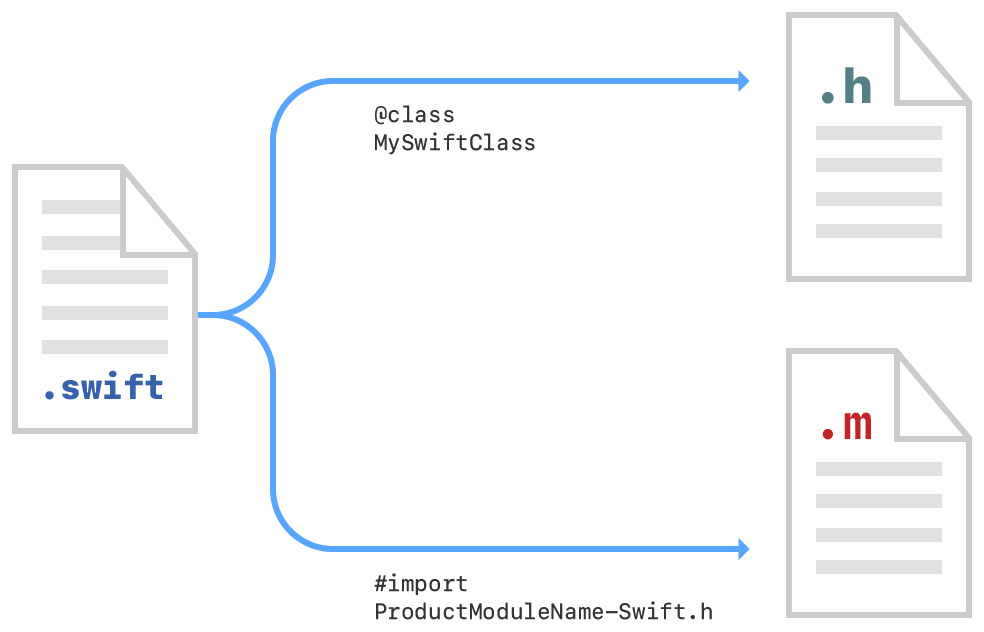
The process for importing Swift declarations into Objective-C code differs slightly depending on whether you’re writing an app or a framework. Both processes are described below.
Import Code Within an App Target
When you're building an app target, you can import your Swift code into any Objective-C .m file within that same target using this syntax and substituting the appropriate name:
By default, the generated header contains interfaces for Swift declarations marked with the public or open modifier. If your app target has an Objective-C bridging header, the generated header also includes interfaces marked with the internal modifier. Declarations marked with the private or fileprivate modifier don't appear in the generated header, and aren't exposed to the Objective-C runtime unless they are explicitly marked with a @IBAction, @IBOutlet, or @objc attribute. Inside unit test targets, you can access imported internal declarations as if they were public by prepending @testable to the product module import statement.
The Swift interfaces in the generated header include references to all of the Objective-C types used in them, so make sure to import the Objective-C headers for those types first.
When building an app target, you can provide a custom name for the product module by changing the Product Module Name build setting. Xcode uses this name when naming the generated header file.
Import Code Within a Framework Target
To import a set of Swift files in the same framework target as your Objective-C code, import the Xcode-generated header for your Swift code into any Objective-C .m file where you want to use your Swift code.
Because the generated header is part of the framework’s public interface, only declarations marked with the public or open modifier appear in the generated header for a framework target. Methods and properties that are marked with the internal modifier and declared within a class that inherits from an Objective-C class are accessible to the Objective-C runtime. However, they're inaccessible at compile time and don't appear in the generated header for a framework target.
Import Swift code into Objective-C within the same framework:
Under Build Settings, in Packaging, make sure the Defines Module setting for that framework target is set to Yes.
Import the Swift code from that framework target into any Objective-C
.mfile within that target using this syntax and substituting the appropriate names:
Include Swift Classes in Objective-C Headers Using Forward Declarations
When declarations in an Objective-C header file refer to a Swift class or protocol that comes from the same target, importing the generated header creates a cyclical reference. To avoid this, use a forward declaration of the Swift class or protocol to reference it in an Objective-C interface.
Forward declarations of Swift classes and protocols can be used only as types for method and property declarations.
https://developer.apple.com/documentation/swift/imported_c_and_objective-c_apis/importing_swift_into_objective-c
Importing Swift into Objective-C的更多相关文章
- IOS-Swift、Objective-C、C++混合编程
1.Objective-C调用C++代码 后缀为m文件的是Objective-C的执行文件,而后缀为mm文件的是Objective-C++文件. 直接在Objective-C中是无法调用C++代码的, ...
- Swift与Objective-C中的闭包
Swift Code: func makeIncrementor(forIncrement amount: Int) -> (() -> Int,() -> Int) { func ...
- Swift调用Objective C的FrameWork
很多Github的库经过很多年的发展,源码都是OC写的,,所以,用Swift调用OC的库就是开发中难免遇到的的一个问题,本文以AFNetworking为例,讲解如何跨语言调用. 第一步 创建一个空的工 ...
- Swift和Objective C关于字符串的一个小特性
一.Unicode的一个小特性 首先,Unicode规定了许多code point,每一个code point表示一个字符.如\u0033表示字符"3",\u864e表示字符&qu ...
- 在项目里交叉使用Swift和OC【转】
Swift and Objective-C in the Same Project在项目里交叉使用Swift和OC Swift与OC的兼容性使得你可以在项目里使用Swift+OC的方式编写应用程序,称 ...
- 在项目里交叉使用Swift和OC
Swift and Objective-C in the Same Project 在项目里交叉使用Swift和OC Swift与OC的兼容性使得你能够在项目里使用Swift+OC的方式编写应用程序, ...
- 开发 Swift 和 Objective-C 混编的 Framework
来源:黄文臣 blog.csdn.net/hello_hwc/article/details/58320433 前言 为什么要写这样一篇文章,因为昨天和一个朋友讨论到Swift和Objective C ...
- 使用命令行工具运行Xcode 7 UI Tests
原文:Run Xcode 7 UI Tests from the command line 苹果在Xcode 7中引入了一项新技术UI Tests,允许开发者使用Swift或Objective C代码 ...
- 手把手教你从Core Data迁移到Realm
来源:一缕殇流化隐半边冰霜 (@halfrost ) 链接:http://www.jianshu.com/p/d79b2b1bfa72 前言 看了这篇文章的标题,也许有些人还不知道Realm是什么,那 ...
随机推荐
- Windows平台cocos2d-x 3.0 android开发环境
cocos2d-x升级到3.0后变化不小,除了API的变化(主要是函数和类名称变化,以及使用了C++11的不少特性.function/bind, lamda, std::thread-),创建和编译p ...
- 20170111 ABAP技术小结(全半角转换)
DATA: it_po LIKE it_alv OCCURS 0 WITH HEADER LINE.************************************************** ...
- Android Studio集成Genymotion 及Genymotion 配置ADB
1.打开 Android Studio,依次[File]-[Settings],快捷键 Ctrl + Alt + S 2.在打开的 settings 界面里找到 plugins 设置项,点击右侧的“ ...
- SQL语句--常用
一.基础 1.说明:创建数据库CREATE DATABASE database-name 2.说明:删除数据库drop database dbname3.说明:备份sql server--- 创建 备 ...
- Linux shell 脚本中变量的数学计算【转】
本文转载自:http://blog.csdn.net/qinghezhen/article/details/9194287 首先从一个例子说起: x=1+1 echo $x 你是不是期待着输出2啊?让 ...
- The type exists in both DLLs
2>C:\Windows\Microsoft.NET\Framework\v4.0.30319\Temporary ASP.NET Files\root\c0b37647\aaceda91\Ap ...
- Android ConstraintLayout的基本使用
升级Android studio到2.3版本之后,发现新建Activity或fragment时,xml布局默认布局由RelativeLayout更改为ConstraintLayout了,既然已经推荐使 ...
- 一步一步学Silverlight 2系列(4):鼠标事件处理
一步一步学Silverlight 2系列(4):鼠标事件处理 概述 Silverlight 2 Beta 1版本发布了,无论从Runtime还是Tools都给我们带来了很多的惊喜,如支持框架语言V ...
- vertical-align 和line-height 以及baseline的解析
line-height是相对于font-size来计算的,vertical-align的百分比值是相对于line-height来计算的,vertical-align的默认是baseline; demo ...
- TCP/IP协议与Http协议的区别
转自:https://www.cnblogs.com/xianlei/p/tcpip_http.html TPC/IP协议是传输层协议,主要解决数据如何在网络中传输,而HTTP是应用层协议,主要解决如 ...