
poj----(1470)Closest Common Ancestors(LCA)
| Time Limit: 2000MS | Memory Limit: 10000K | |
| Total Submissions: 15446 | Accepted: 4944 |
Description
Input
nr_of_vertices
vertex:(nr_of_successors) successor1 successor2 ... successorn
...
where vertices are represented as integers from 1 to n ( n <= 900
). The tree description is followed by a list of pairs of vertices, in
the form:
nr_of_pairs
(u v) (x y) ...
The input file contents several data sets (at least one).
Note that white-spaces (tabs, spaces and line breaks) can be used freely in the input.
Output
each common ancestor the program prints the ancestor and the number of
pair for which it is an ancestor. The results are printed on the
standard output on separate lines, in to the ascending order of the
vertices, in the format: ancestor:times
For example, for the following tree:
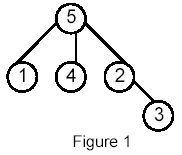
Sample Input
5

5:(3) 1 4 2

1:(0)

4:(0)

2:(1) 3

3:(0)

6

(1 5) (1 4) (4 2)

      (2 3)

(1 3) (4 3)
Sample Output
2:1

5:5
Hint
Source
 /*poj 1470*/

 #include<iostream>

 #include<vector>

 #include<cstdio>

 #include<cstring>

 #include<cstdlib>

 using namespace std;

 const int maxn=;

 vector<int> tree[maxn],qus[maxn];

 int rank[maxn],father[maxn];

 bool vis[maxn];

 int rudu[maxn];

 int lroot[maxn];

 int ans[maxn];

 void init(int n){

      memset(vis,,sizeof(char)*(n+));

      memset(rudu,,sizeof(int)*(n+));

      memset(lroot,,sizeof(int)*(n+));

      memset(ans,,sizeof(int)*(n+));

     for(int i=;i<=n;i++){

         father[i]=i;

         rank[i]=;

         tree[i].clear();

         qus[i].clear();

     }

 }

 int find(int a){

    while(a!=father[a])

          a=father[a];

     return a;

 }

 void Union(int a,int b)

 {

     int x=find(a);

     int y=find(b);

     if(x==y) return ;

     if(rank[x]<rank[y]){

       rank[y]+=rank[x];

       father[x]=y;

     }

     else {

      rank[x]+=rank[y];

      father[y]=x;

     }

 }

 void LCA(int u)

 {

   lroot[u]=u;

   //vis[u]=1; 不能放在这里

   int len=tree[u].size();

   for(int i=;i<len;i++){

       LCA(tree[u][i]);

       Union(u,tree[u][i]);

       lroot[find(u)]=u;

   }

   vis[u]=;

   int ss=qus[u].size();

   for(int i=;i<ss;i++){

         if(vis[qus[u][i]]){

             ans[lroot[find(qus[u][i])]]++;

             //return ;

         }

   }

 }

 int main()

 {

     int n,m,t,u1,u2;

     freopen("test.in","r",stdin);

     while(scanf("%d",&n)!=EOF){

           init(n);

       for(int i=;i<n;i++){

             getchar();

         scanf("%d:(%d))",&u1,&m);

          for(int j=;j<m;j++){

              scanf("%d",&u2);

              tree[u1].push_back(u2);

              rudu[u2]++;

          }

         }

       scanf("%d",&t);

       for(int i=;i<t;i++)

       {

           scanf("%*1s%d%d%*1s",&u1,&u2);

           qus[u1].push_back(u2);

           qus[u2].push_back(u1);

       }

       for(int i=;i<=n;i++)

       {

           if(rudu[i]==)

         {

             LCA(i);

             break;

         }

       }

       for(int i=;i<=n;i++){

           if(!=ans[i])

             printf("%d:%d\n",i,ans[i]);

       }

     }

 return ;

 }
poj----(1470)Closest Common Ancestors(LCA)的更多相关文章
- POJ 1470 Closest Common Ancestors(最近公共祖先 LCA)
POJ 1470 Closest Common Ancestors(最近公共祖先 LCA) Description Write a program that takes as input a root ...
- POJ 1470 Closest Common Ancestors (LCA,离线Tarjan算法)
Closest Common Ancestors Time Limit: 2000MS Memory Limit: 10000K Total Submissions: 13372 Accept ...
- POJ 1470 Closest Common Ancestors (LCA, dfs+ST在线算法)
Closest Common Ancestors Time Limit: 2000MS Memory Limit: 10000K Total Submissions: 13370 Accept ...
- ZOJ 1141:Closest Common Ancestors(LCA)
Closest Common Ancestors Time Limit: 10 Seconds Memory Limit: 32768 KB Write a program that tak ...
- POJ 1470 Closest Common Ancestors 【LCA】
任意门:http://poj.org/problem?id=1470 Closest Common Ancestors Time Limit: 2000MS Memory Limit: 10000 ...
- poj1470 Closest Common Ancestors [ 离线LCA tarjan ]
传送门 Closest Common Ancestors Time Limit: 2000MS Memory Limit: 10000K Total Submissions: 14915 Ac ...
- POJ - 1470 Closest Common Ancestors(离线Tarjan算法)
1.输出测试用例中是最近公共祖先的节点,以及这个节点作为最近公共祖先的次数. 2.最近公共祖先,离线Tarjan算法 3. /* POJ 1470 给出一颗有向树,Q个查询 输出查询结果中每个点出现次 ...
- POJ 1470 Closest Common Ancestors (最近公共祖先LCA 的离线算法Tarjan)
Tarjan算法的详细介绍,请戳: http://www.cnblogs.com/chenxiwenruo/p/3529533.html #include <iostream> #incl ...
- poj1330Nearest Common Ancestors 1470 Closest Common Ancestors(LCA算法)
LCA思想:http://www.cnblogs.com/hujunzheng/p/3945885.html 在求解最近公共祖先为问题上,用到的是Tarjan的思想,从根结点开始形成一棵深搜树,非常好 ...
随机推荐
- CodeForces 483C Diverse Permutation
Diverse Permutation Time Limit:1000MS Memory Limit:262144KB 64bit IO Format:%I64d & %I64 ...
- git泄漏原理
之前做过git的加固 但是这东西还是没办法避免的 之前看了乌云的提交的git泄漏,但是都没有详细的原理,去了lijiejie的博客(字太难打了,大师傅别打我 哈哈) 如果一个网站存在git泄漏,git ...
- Java反序列化漏洞通用利用分析
原文:http://blog.chaitin.com/2015-11-11_java_unserialize_rce/ 博主也是JAVA的,也研究安全,所以认为这个漏洞非常严重.长亭科技分析的非常细致 ...
- T-SQL Apply的用法
SQL Server 2005 新增 cross apply 和 outer apply 联接语句,增加这两个东东有啥作用呢? 我们知道有个 SQL Server 2000 中有个 cross joi ...
- 展讯DTS路径及编译
DTS路径:/kernel/arch/arm/boot/dts 如何查找修改当前TP的DTS配置(分辨率)的文件:1.查找make file,找关键字都包含CONFIG_MACH,在/kernel/a ...
- (转)Java + Excel 接口自动化
最近项目比较悠闲,想找点事干,写了个 Excel 接口测试的 "框架" 以前用 python 写过一个,这次用 java, 应该说框架都不算,反正就是写了,能帮我解决问题就行. 当 ...
- 这个算asp.net的一个bug吗?
asp.net设置按钮Enabled="false"后OnClientClick中添加的验证脚本消失了 下面的确可以 <asp:Button ID="btnRegi ...
- hibernate Criteria查询多对多(Set集合)条件筛选
PO public class UserPO implements java.io.Serializable { /** 用户唯一标识ID */ private String id; /** 状态(在 ...
- Javascript 弱类型:除法结果是小数
由于javascript是弱类型,只有一种var类型,所以在运算时不会自动强制转换,所以计算的结果是多少就是多少,但java中的17/10的结果就是1(强类型与弱类型)比如:console.log(M ...
- Android控件之ImageView(显示图片的控件)
一.ImageView属性: android:src = "@drawable/ic_launcher"——ImageView的内容图像(可以和android:background ...