
High Voltage Boost Supply
http://learn.adafruit.com/ice-tube-clock-kit/design
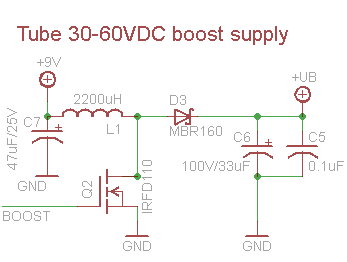
Tubes such as VFDs, Nixies, Decatrons, etc require high voltage to light the gas in the tube. For nixies, this iabout 170VDC. VFDs aren't as bad they only need about 30-50VDC. In order to reduce cost, we use the microconrtoller to make a boost converter and avoid paying $5 for a seperate chip. We can do this because we don't need a precision output and the current draw is mostly constant. The boost regulator is run open-loop there is no feedback resistor divider as it isn't necessary as long as the input voltage is within a reasonable range.
The boost circuit works by connecting the power inductor L1 to ground that current can flow through it by turning on Q2. After a little bit of time, we disconnect the from ground (by turning off Q2) this means that there is no longer a path for the current in L1 to flow to ground. When this happens, the voltage across the inductor increases (this is the electric property of inductors) and charges up C6 . When the voltage increases to the level we want it to be (30V+) we turn on Q2 again which allows the current in L1 to flow back to ground. If we do this fast enough, and C6 large enough, the voltage on C6 is smoothed out and we get a nice steady high voltage.
The timing of turning off/on Q2 allows us to modify the output voltage. Normally there is a feedback resistor to the microcontroller but it is not here because we are running it open-loop. To drive Q2 we use the PWM output from the microcontroller and adjust the duty cycle to vary brightness.
- The voltage in is nominally 9 to 12VDC
- The current draw for the IV-18 tubes is about 8mA per digit and 11mA for the grid. Remember, though, that we only light up one digit at a time! So we need about 20mA total (we also meaured this in-circuit to verify)
- The voltage output is going to be between 30V-50V (its really much too bright after that point)
- The PWM output speed of the microcontroller is F_CPU / 256 = 8 MHz / 256 = 31.25KHz (period of 32 useconds)
With this information we can calculate the inductor size and capacity!
The optimal transfer between Vin and Vout is:
Vo/Vi = 1 / (1-D) where D is the duty cycle.
Solving for D = 1 - (Vi/Vo) and plugging in numbers:
For Vo = 50V and Vi = 9V, D = 82% (maximum)
For Vo = 30V and Vi = 12V D = 60% (minimum)
So the duty range will be between 60% and 82%. That would correspond to between ~150 and 220 out of 256, but note that when the PWM signal islow the switch is on so we need to invert that to a range of about 36 to 106 (in the code we actually use about 20 to 90).
OK so our PWM range is good, we just want to keep it between around 10% and 90% which we do.
Next, we need to make sure that the inductor continuously dumps current into C6 the entire time Q2 is off (continuous conduction mode). This is dependant on a lot of variables:
D*T*Vin/(2*L) < iout/(1-D)
Note that T is period time and is = 1/frequency. Solving for L, we choose the lowest duty cycle which will give us the upper bound for the inductor:
D*Vin * (1-D) / (freq * 2 * Iout ) < L
D = 60% (0.6)
iout = 20mA (0.02 Amp)
Vin = 12V nominal
1/T = freq = 31250 HzL > 0.6 * 12 * (1 - 0.6) / (31250* 2 * 0.02)
L > 2304 uH
This is our upper limit, so lets just say L = 2200uH (a standard value). Note that for 9V->60 we need L > 918uH which is our lower bound and our average case is a duty cycle of about 70% which is 1500uH.
We also want to make sure that we have a enough current capacity, so lets calculate the maximum current that builds up in the inductor. We now have to pick this for the -smallest- inductor, in the case of 9V boosting to 50V, an 82% duty cycle.
Ipk = (Vin * D)/(f * L)
Ipk = (9 * 0.82)/(31250 * .001) = 0.24 Amp
So! We want to make sure our inductor is > 2200 uH and will not saturate below 0.24 A.
The important thing to note here is that, for a given package (size) of inductor, the higher the inductance the lower the current capability.
Since this is a through-hole kit, we have to stick with a radial/axial inductor.
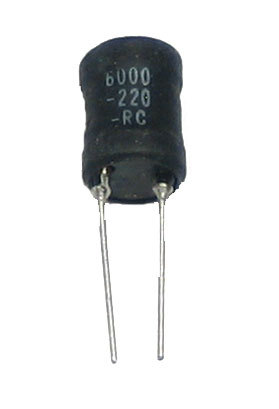
Searching Mouser for power inductors, we find the RLB9012 family (datasheet) which is the same type used in the mintyboost. This is a good inductor family, lets check out the range.
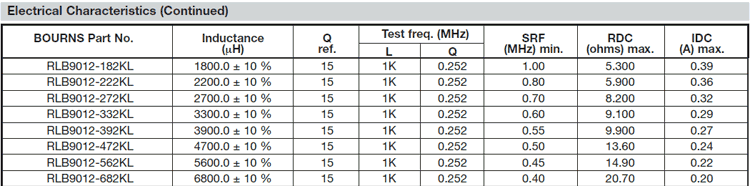
t looks like we're good to go with this group of inductors as the max current capacity of the 2200uH is well above our minimum 0.25 Any value higher than that will be OK as the Ipk will fall faster than the IDCmax
In reality, you don't need such high inductances because our system is not running on a battery and doesn't require a great power supply with low ripple and good efficiency. Inducances 270uH and lower worked just fine, the converter is operating in discontinuous mode which is not as efficient. Its also not as easy to calculate the precise specifications. Luckily this is a very indiscriminate tube and is cool with ripple and voltage fluctuations.
The diode is a schottky type, and needs to have a breakdown voltage larger than the maximum boost voltage (in this case 60V) we're usingMBR160 with 60V breakdown.
One way to improve the design to reduce the size and power requirements of the inductor is to increase the frequency. Doubling the frequency halves the required inductance and current requirements of the inductor!
I have a nice little calculator if you want to design your own basic boost converter
Thanks tons to Riad at jfet.org for the idea and calculations! (He has some great clock designs, so check them out)
For more information on boost converters see this article on wikipedia.
http://en.wikipedia.org/wiki/Boost_converter
A boost converter (step-up converter) is a DC-to-DC power converter with an output voltage greater than its input voltage. It is a class of switched-mode power supply (SMPS) containing at least two semiconductor switches (a diode and a transistor) and at least one energy storage element, a capacitor, inductor, or the two in combination. Filters made of capacitors (sometimes in combination with inductors) are normally added to the output of the converter to reduce output voltage ripple.
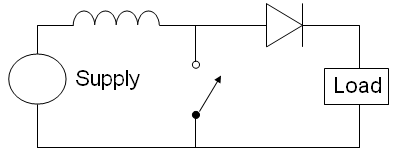
The basic schematic of a boost converter. The switch is typically a MOSFET, IGBT, or BJT.
http://learn.adafruit.com/diy-boost-calc
For many small projects, its cheaper and easier to DIY a boost converter than to buy a specialty chip. DIY converters are usually not as efficient but they're quick & cheap!
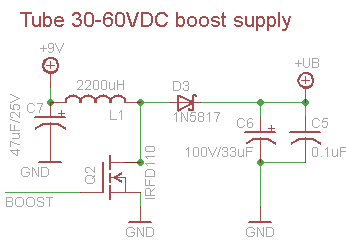
The above schematic section shows how I designed a 30-60V vacuum fluorescent tube display driven from a microcontroller pin.
Tubes such as VFDs, Nixies, Decatrons, etc require high voltage to light the gas in the tube. In order to reduce cost, we use a microconrtoller to make a boost converter and avoid paying $5 for a seperate chip. We can do this because we don't need a precision output and the current draw is mostly constant. The boost regulator is run open-loop there is no feedback resistor divider as it isn't necessary as long as the input voltage is within a reasonable range
The microcontroller runs at 8MHz so the 8-bit PWM output is 31250 Hz. The inductor and output capacitor is calculated below. The diode is a standard Schottkey type, but make sure you specify one that can handle the full voltage difference and peak current. The switch just has to be able to handle the max voltage plus some for safety. Note that this design is meant for 'static' output currents, not for variable current draw designs. There is no feedback and its very approximate! This is not for precision electronics!
The boost circuit works by connecting the power inductor L1 to ground that current can flow through it by turning on Q2. After a little bit of time, we disconnect the inductor from ground (by turning off Q2) this means that there is no longer a path for the current in L1 to flow to ground. When this happens, the voltage across the inductor increases (this is the electric property of inductors) and charges up C6 . When the voltage increases to the level we want it to be (30V+) we turn on Q2 again which allows the current in L1 to flow back to ground. If we do this fast enough, and C6 large enough, the voltage on C6 is smoothed out and we get a nice steady high voltage
The timing of turning off/on Q2 allows us to modify the output voltage. Normally there is a feedback resistor to the microcontroller but it is not here because we are running it open-loop. To drive Q2we use the PWM output from the microcontroller and adjust the duty cycle to vary brightness.
These sorts of designs can be easily made with a 555, once you have the PWM output, connect it up toQ2!
http://learn.adafruit.com/diy-boost-calc/the-calculator
http://learn.adafruit.com/downloads/pdf/diy-boost-calc.pdf
High Voltage Boost Supply的更多相关文章
- OpAmp Voltage Follower/Regulator
LDO Regulator High accuracy voltage regulator Vout = 2.5V * (1 + ( 5.6 / 6.8 ) ) = 4.55V Recently th ...
- OBD Experts OBD II Software OBD II Protocol Stack
http://www.obdexperts.co.uk/stack.html OBD II Software OBD Experts can provide you with ready to use ...
- 【转】linux设备驱动之MMC SD卡——核心层简单分析
原文网址:http://blog.chinaunix.net/uid-28685940-id-3889878.html /*************************************** ...
- An Isolated DAC Using PWM Output
An Isolated DAC Using PWM Output Arduino‘s (ATmega328P) PWM outputs via analogWrite can be convenien ...
- RF layout check list
Analog-digital circuit 1. Insure C36 and C33 placed next to each other to avoid open stubs 2. Keep U ...
- Use two picogate devices for bidirectional level-shifting
In new mixed-voltage systems, it is often necessary to level-shift a control signal from a high leve ...
- PatentTips - Integrated circuit well bias circuitry
1. Field of the Invention This invention relates in general to an integrated circuit and more specif ...
- Get just enough boost voltage - current-mirror circuit - VOUT tracks VIN varies
Adding a current-mirror circuit to a typical boost circuit allows you to select the amount of boost ...
- BOOST Converter Analog/Digital Adjusted Output Voltage TPS61045 MAX1932
DIGITALLY ADJUSTABLE BOOST CONVERTER The TPS61045 is a high frequency boost converter with digitally ...
随机推荐
- Nginx - Header详解
1. 前言 通过 HttpHeadersModule 模块可以设置HTTP头,但是不能重写已经存在的头,比如可能相对server头进行重写,可以添加其他的头,例如:Cache-Control,设置生存 ...
- 浅谈js变量作用域
变量的作用域也是前端面试题常考的一个问题,掌握下面几个规律可以帮你更好的理解js的作用域. 1.作用域优先级遵循就近原则,函数内部的作用域优先级大于外部 var a=456; var b=111; f ...
- Extjs 基础篇—— Function 能在定义时就能执行的方法的写法 function(){...}()
Ext.js 中 Function能在定义时就能执行的方法的写法 function(){...}() /** * 第二部分Function:能在定义时就能执行的方法的写法 function(){... ...
- 汇编看C函数调用
http://blog.csdn.net/wishfly/article/details/5022008 简单的函数调用,通过简单的函数调用反汇编可以清楚了解如下 1.栈到底是什么,如何操纵栈的? ...
- 集合栈计算机(UVa12096)
题目具体描述见:https://uva.onlinejudge.org/index.php?option=com_onlinejudge&Itemid=8&page=show_prob ...
- PHP 统计数据合并
将不同的统计结果整合在一起,如图,根据年级统计出不同成绩段人数(此处只为举例),然后写了一个方法来处理这些统计数组 <?php /** * 合并统计数据 * @param $key_column ...
- thinkphp数据查询方法总结select ,find,getField,query
thinkphp已经封装好了常用的查询方法,且都比较实用,对于不常用的查询框架也保留了原始查询方法query. 1 2 $Model = new Model() // 实例化一个model对象 没有对 ...
- Springboot listener
在启动流程中,会出发许多ApplicationEvent.这时会调用对应的listener的onApplicationEvent方法.ApplicationEvent时观察者模式, (1) 实体继承A ...
- 【原创】记一次MySQL大表高并发写入引发CPU飙升的排障过程
目录 一.故障现象... 1 二.初步分析... 2 三.排障过程... 2 1.排查是否QPS或insert并发请求上升导致问题发生... 2 2.排查是否锁资源等待或block导致了insert变 ...
- Moo University - Financial Aid POJ 2010 优先队列(最大堆)
题目:http://poj.org/problem?id=2010 题目大意: 奶牛上大学.因为经济问题,每头奶牛都需要一定的补助需求,学校会提供一定的资金用于补助 每头牛都有自己的分数,学校招收的名 ...