
POJ 1145 Tree Summing
| Time Limit: 1000MS | Memory Limit: 10000K | |
| Total Submissions: 7698 | Accepted: 1737 |
Description
This problem deals with determining whether binary trees represented as LISP S-expressions possess a certain property.
Given a binary tree of integers, you are to write a program that determines whether there exists a root-to-leaf path whose nodes sum to a specified integer. For example, in the tree shown below there are exactly four root-to-leaf paths. The sums of the paths are 27, 22, 26, and 18. 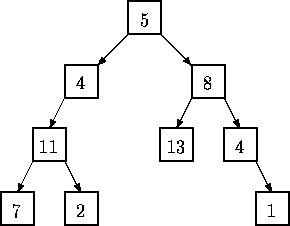
Binary trees are represented in the input file as LISP S-expressions having the following form.
empty tree ::= ()

tree 	   ::= empty tree (integer tree tree)
The tree diagrammed above is represented by the expression (5 (4 (11 (7 () ()) (2 () ()) ) ()) (8 (13 () ()) (4 () (1 () ()) ) ) )
Note that with this formulation all leaves of a tree are of the form (integer () () )
Since an empty tree has no root-to-leaf paths, any query as to whether a path exists whose sum is a specified integer in an empty tree must be answered negatively.
Input
Output
Sample Input
22 (5(4(11(7()())(2()()))()) (8(13()())(4()(1()()))))

20 (5(4(11(7()())(2()()))()) (8(13()())(4()(1()()))))

10 (3

     (2 (4 () () )

        (8 () () ) )

     (1 (6 () () )

        (4 () () ) ) )

5 ()
Sample Output
yes

no

yes

no
题目大意:输入一个整数sum,后面是一串字符,代表一颗二叉树,二叉树结点类型为(integer () () ),问是否存在一条从根节点到叶子节点的路径上数字之和为sum.
解题方法:先通过字符串构造一颗二叉树,然后通过二叉树的非递归后序遍历判断是否存在解,这道题费了我九牛二虎之力,终于AC了。
#include <stdio.h>

#include <iostream>

#include <string.h>

using namespace std;

char str[];

typedef struct node

{

    int data;

    node *lchild;

    node *rchild;

    bool bleftvisted;//用于标记左孩子是否访问过

    node()

    {

        lchild = rchild = NULL;

        bleftvisted = false;

    }

}TreeNode;

//删除二叉树

void DeleteNode(TreeNode *pRoot)

{

    if (pRoot != NULL)

    {

        DeleteNode(pRoot->lchild);

        DeleteNode(pRoot->rchild);

    }

    delete pRoot;

}

//创建一颗二叉树

void CreateTree(TreeNode *&pRoot)

{

    TreeNode *StackNode[], *p;//StackNode为保存二叉树节点的栈

    char StackCh[];//保存字符的栈

    int topnode = -, topch = -, num, flag = , j = ;

    bool isnum = false;

    char ch;

    num = ;

    isnum = false ;

    while(str[j] != '\0')

    {

        ch = str[j];

        switch(ch)

        {

        case ')'://如果是右括号则把相应配对的左括号和他们之间的数字出栈

            {

                bool bflag = false;

                while(StackCh[topch] != '(')

                {

                    //如果遇见了数字,则必须让保存二叉树节点的栈退栈,

                    //表明该节点已经构造完了

                    if (isdigit(StackCh[topch]))

                    {

                        bflag = true;

                    }

                    --topch;

                }

                if (bflag)

                {

                    --topnode;

                }

                j++;

                --topch;

                //如果某个节点的左孩子节点为空,则把左孩子访问标记为true

                if (topnode >= )

                {

                    StackNode[topnode]->bleftvisted = true;

                }

                break;

            }

        case '('://遇到左括号,直接入栈

            StackCh[++topch] = ch;

            j++;

            break;

        case '-':

            flag = -;

            j++;

            break;

        default://遇到数字,新建一个节点,然后插入到相应的位置

            num = num *  + (ch - '');

            StackCh[++topch] = ch;

            while(isdigit(ch = str[++j]))

            {

                num = num *  + (ch - '');

                StackCh[++topch] = ch;

            }

            p = new TreeNode;

            p->data = num * flag;

            flag = ;

            num = ;

            if (pRoot == NULL)//如果根节点为空,则把新节点赋给根节点

            {

                pRoot = p;

            }

            else

            {

                //如果左孩子节点未被访问,则先插入左孩子节点

                if (StackNode[topnode]->bleftvisted == false)

                {

                    StackNode[topnode]->lchild = p;

                    StackNode[topnode]->bleftvisted = true;

                }

                else//否则插入到右孩子节点

                {

                    StackNode[topnode]->rchild = p;

                }

            }

            StackNode[++topnode] = p;//新节点入栈

            break;

        }

    }

}

//二叉树的非递归后序遍历查找是否满足条件

bool Postorder(TreeNode *pRoot, int sum)

{

    TreeNode *Stack[];

    int top = -;

    TreeNode *p = pRoot, *q;

    if (pRoot != NULL)

    {

        do

        {

            while(p != NULL)

            {

                Stack[++top] = p;

                p = p->lchild;

            }

            q = NULL;

            while(top != -)

            {

                p = Stack[top];

                //如果q == NULL则表示p的右孩子不存在,而左子树不存在或者已经访问,所以可以访问p节点,

                //如果q != NULL则表示p的右子树已经被访问了,所以访问p节点

                if (q == p->rchild)

                {

                    if (p->lchild == NULL && p->rchild == NULL)

                    {

                        int temp = ;

                        //因为在后序遍历中,栈中保存的节点即为当前节点和它的所有父节点,

                        //所以便利一遍相加所得的和就是根节点到当前节点路径上所有节点之和

                        for (int i = ; i <= top; i++)

                        {

                            temp += Stack[i]->data;

                        }

                        if (temp == sum)

                        {

                            return true;

                        }

                    }

                    top--;

                    q = p;

                }

                else

                {

                    p = p->rchild;

                    break;

                }

            }

        } while (top != -);

    }

    return false;

}

int main()

{

    int sum;

    while(scanf("%d", &sum) != EOF)

    {

        TreeNode *pRoot = NULL;

        char ch;

        int nCount = -;

        while ((ch = getchar()) != '(');

        str[++nCount] = ch;

        int mark = ;

        while(mark != )

        {

            ch = getchar();

            switch(ch)

            {

            case ')':

                mark--;

                str[++nCount] = ch;

                break;

            case '(':

                mark++;

                str[++nCount] = ch;

                break;

            case '-':

                str[++nCount] = ch;

                break;

            case ' ':

                break;

            case '\0':

                break;

            case '\n':

                break;

            default:

                str[++nCount] = ch;

                break;

            }

        }

        str[nCount + ] = '\0';

        CreateTree(pRoot);

        if (pRoot == NULL)

        {

            printf("no\n");

            continue;

        }

        if (Postorder(pRoot, sum))

        {

            printf("yes\n");

        }

        else

        {

            printf("no\n");

        }

        DeleteNode(pRoot);

    }

    return ;

}
POJ 1145 Tree Summing的更多相关文章
- POJ 题目1145/UVA题目112 Tree Summing(二叉树遍历)
Tree Summing Time Limit: 1000MS Memory Limit: 10000K Total Submissions: 8132 Accepted: 1949 Desc ...
- UVa 112 - Tree Summing(树的各路径求和,递归)
题目来源:https://uva.onlinejudge.org/index.php?option=com_onlinejudge&Itemid=8&category=3&pa ...
- poj 3237 Tree [LCA] (树链剖分)
poj 3237 tree inline : 1. inline 定义的类的内联函数,函数的代码被放入符号表中,在使用时直接进行替换,(像宏一样展开),没有了调用的开销,效率也很高. 2. 很明显,类 ...
- poj 3237 Tree(树链拆分)
题目链接:poj 3237 Tree 题目大意:给定一棵树,三种操作: CHANGE i v:将i节点权值变为v NEGATE a b:将ab路径上全部节点的权值变为相反数 QUERY a b:查询a ...
- POJ 1741 Tree 求树上路径小于k的点对个数)
POJ 174 ...
- POJ 2378 Tree Cutting 3140 Contestants Division (简单树形dp)
POJ 2378 Tree Cutting:题意 求删除哪些单点后产生的森林中的每一棵树的大小都小于等于原树大小的一半 #include<cstdio> #include<cstri ...
- poj 1741 Tree(树的点分治)
poj 1741 Tree(树的点分治) 给出一个n个结点的树和一个整数k,问有多少个距离不超过k的点对. 首先对于一个树中的点对,要么经过根结点,要么不经过.所以我们可以把经过根节点的符合点对统计出 ...
- POJ 3723 Tree(树链剖分)
POJ 3237 Tree 题目链接 就多一个取负操作,所以线段树结点就把最大和最小值存下来,每次取负的时候,最大和最小值取负后.交换就可以 代码: #include <cstdio> # ...
- POJ 1741.Tree and 洛谷 P4178 Tree-树分治(点分治,容斥版) +二分 模板题-区间点对最短距离<=K的点对数量
POJ 1741. Tree Time Limit: 1000MS Memory Limit: 30000K Total Submissions: 34141 Accepted: 11420 ...
随机推荐
- HDU 4283 You Are the One (区间DP,经典)
题意: 某校举行一场非诚勿扰,给定一个出场序列,表示n个人的屌丝值,如果他是第k个出场的,他的不满意度为(k-1)*diao[i].为了让所有人的屌丝值之和更小,导演设置一个栈,可以将部分人装进栈中, ...
- This implementation is not part of the Windows Platform FIPS validated cryptographic algorithms while caching
今天运行自己的网站时报了这样一个错误,很是纳闷,这个网站运行了这么久,怎么报这个错呢,原来是做缓存的时候用到了基于windows平台的加密算法.解决方法如下: 删除注册表下的这个节点即可.删除HKEY ...
- UVA 714 Copying Books 抄书 (二分)
题意:把一个包含m个正整数的序列划分成k个非空的连续子序列.使得所有连续子序列的序列和Si的最大值尽量小. 二分,每次判断一下当前的值是否满足条件,然后修改区间.注意初始区间的范围,L应该为所有正整数 ...
- Kubernetes之pod的属性
属性名称 取值类型 是否必选 取值说明 version String Required(必) 版本号,例如v1 kind String Required pod m ...
- pycharm 使用技巧
格式化代码为pep8: ctrl+alt+l http://edu.51cto.com//index.php?do=lession&id=163794
- [BZOJ4327]:[JZOI2012]玄武密码(AC自动机)
题目传送门 题目描述: 在美丽的玄武湖畔,鸡鸣寺边,鸡笼山前,有一块富饶而秀美的土地,人们唤作进香河.相传一日,一缕紫气从天而至,只一瞬间便消失在了进香河中.老人们说,这是玄武神灵将天书藏匿在此. ...
- Java中的List接口特有的方法
import java.util.ArrayList; import java.util.List; /* List接口中特有方法: 添加 add(int index, E element) addA ...
- Dapper学习总结
看了<Dapper从入门到精通>后的总结 (1)Dapper 是直接扩展 IDBConnection,而且是单独一个文件,可以直接嵌入到项目中使用. (2)通过手写sql语句,调用exec ...
- iOS应用架构谈part4-本地持久化方案及动态部署
前言 嗯,你们要的大招.跟着这篇文章一起也发布了CTPersistance和CTJSBridge这两个库,希望大家在实际使用的时候如果遇到问题,就给我提issue或者PR或者评论区.每一个issue和 ...
- GCD和NSThread延时执行对比
1.NSThread: [self performSelector:@selector(performSome:) withObject:self afterDelay:.f]; [[self cla ...