
TF_RNNCell
参考:链接。
RNNCell
- BasicRNNCell
- GRUCell
- BasicLSTMCell
- LSTMCell
- MultiRNNCell
抽象类RNNCell
所有的rnncell均继承于RNNCell, RNNCell主要定义了几个抽象方法:
 def __call__(self, inputs, state, scope=None):

     raise NotImplementedError("Abstract method")

 @property

 def state_size(self):

     raise NotImplementedError("Abstract method")

 @property

 def output_size(self):

     raise NotImplementedError("Abstract method")
上述方法,__call__在对象被使用时调用,其他可以看做属性方法,主要用作获取状态state的大小,cell的输出大小。既然对象使用时会调用__call__,那么各类RNN的操作都定义在这个方法中。接下来,我们就针对各个不同的cell来详细介绍各类RNN。
BasicRNNCell
这个cell是最基础的一个RNNCell,可以看做是对一般全连接层的拓展,除了在水平方向加入时序关系,可以用下图表示:
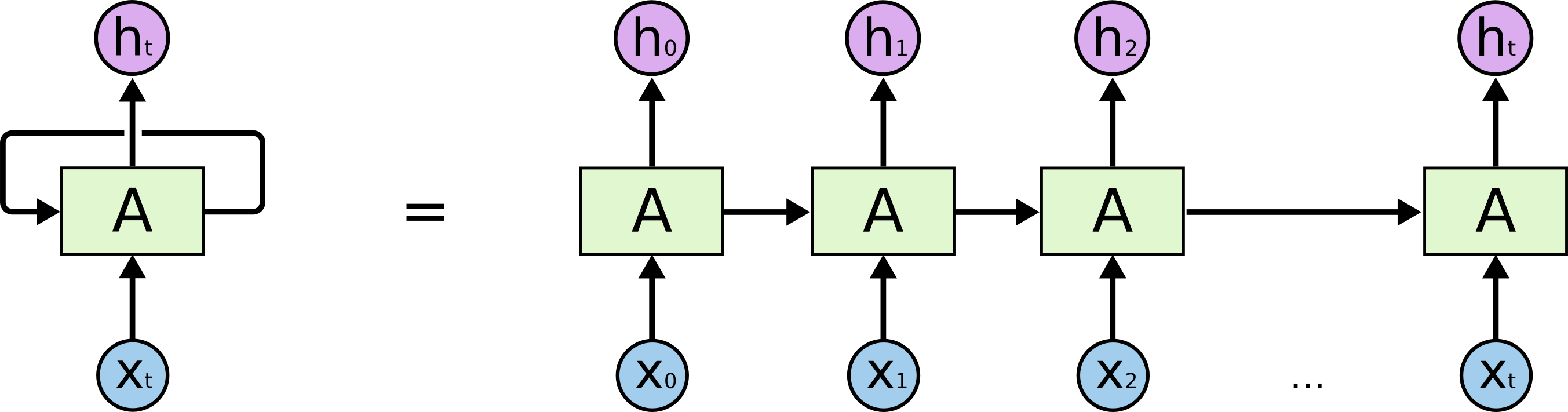
而BasicRNNCell的初始化方法可如代码所示:
 def __init__(self, num_units, input_size=None, activation=tanh):

     if input_size is not None:

       logging.warn("%s: The input_size parameter is deprecated.", self)

     self._num_units = num_units

     self._activation = activation
初始化只需要给出num_units,用来指有多少个隐藏层单元;而activation指使用哪种激活函数用作激活输出。而对应的RNN操作定义在__call__方法中:
 def __call__(self, inputs, state, scope=None):

     """Most basic RNN: output = new_state = activation(W * input + U * state + B)."""

     with vs.variable_scope(scope or type(self).__name__):  # "BasicRNNCell"

       output = self._activation(_linear([inputs, state], self._num_units, True))

     return output, output
很清晰,inputs表示隐藏层的输入,state表示上个时间的隐藏层状态,也可以说是上一次隐藏层向自身的输出,对于第一次输入,则需要初始化state,对应初始化方法有很多种,可以使用tensorflow提供的各种初始化函数。在__call__中,对输入inputs和state进行activation(wx+b),用作下次的输入。
GRUCell
GRU是对RNN的一种改进,相比LSTM来说,也可以看做是对LSTM的一种简化,是Bengio在14年提出来的,用作机器翻译。先看一下GRU的基本结构:
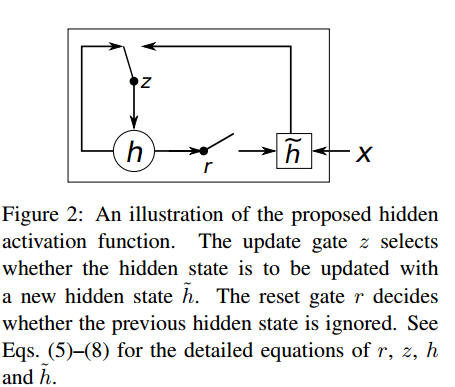
这里我们结合代码来看原理:
def __call__(self, inputs, state, scope=None):

  """Gated recurrent unit (GRU) with nunits cells."""

  with vs.variable_scope(scope or type(self).__name__):  # "GRUCell"

    with vs.variable_scope("Gates"):  # Reset gate and update gate.

      # We start with bias of 1.0 to not reset and not update.

      r, u = array_ops.split(1, 2, _linear([inputs, state],

                                           2 * self._num_units, True, 1.0))

      r, u = sigmoid(r), sigmoid(u)

    with vs.variable_scope("Candidate"):

      c = self._activation(_linear([inputs, r * state],

                                   self._num_units, True))

    new_h = u * state + (1 - u) * c

  return new_h, new_h
GRUCell的初始化与RNN一样,给出输入和初始化的state,在使用对象时,利用输入和前一个时间的隐藏层状态,得到对应的Gates: r, u, 然后利用r更新cell状态,最后利用u得到新的隐藏层状态。对于RNN的改进,最厉害的莫过于下面的,而且有很多变种,这里tensorflow中只有几个简单常见的cell。接下来,我们开始看看LSTM。
BasicLSTMCell
这个cell可以看做是最简单的LSTM,在每个连接中没有额外的连接,即其他变种在连接中加入各种改进。对于BasicLSTMCell,可以如下图所示:
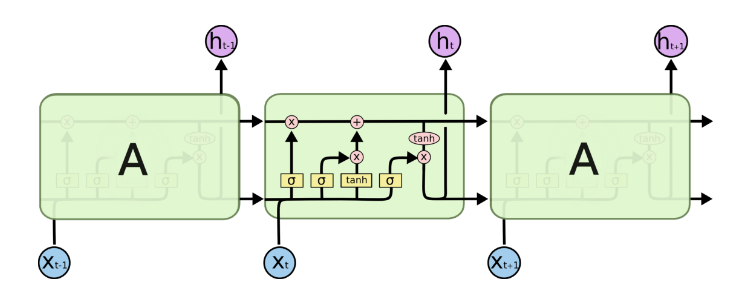
同样的,我们结合代码来看它的原理:
 def __call__(self, inputs, state, scope=None):

   """Long short-term memory cell (LSTM)."""

   with vs.variable_scope(scope or type(self).__name__):  # "BasicLSTMCell"

     # Parameters of gates are concatenated into one multiply for efficiency.

     if self._state_is_tuple:

       c, h = state

     else:

       c, h = array_ops.split(1, 2, state)

     concat = _linear([inputs, h], 4 * self._num_units, True)

     # i = input_gate, j = new_input, f = forget_gate, o = output_gate

     i, j, f, o = array_ops.split(1, 4, concat)

     new_c = (c * sigmoid(f + self._forget_bias) + sigmoid(i) *

              self._activation(j))

     new_h = self._activation(new_c) * sigmoid(o)

     if self._state_is_tuple:

       new_state = LSTMStateTuple(new_c, new_h)

     else:

       new_state = array_ops.concat(1, [new_c, new_h])

     return new_h, new_state
lstm有三个门,inputs, forget, output, 而中间cell用来管理结合他们生产需要的输出。在初始化结束之后,利用输入分别得到对应的门的输出,然后利用这三个门的信息分别更新cell和当前隐藏层状态。f 用来控制遗忘之前的信息和记忆当前信息的比例,进而更新cell,lstm可以看做是一种复杂的激活函数,它的存在依赖RNN的递归性。BasicLSTMCell只是个最基本的LSTM,而完整的LSTM可能比这个复杂,可以参看blog。
MultiRNNCell
对于MultiRNNCell,只能贴出完整代码来分析了:
 class MultiRNNCell(RNNCell):

   """RNN cell composed sequentially of multiple simple cells."""

   def __init__(self, cells, state_is_tuple=False):

     """Create a RNN cell composed sequentially of a number of RNNCells.

     Args:

       cells: list of RNNCells that will be composed in this order.

       state_is_tuple: If True, accepted and returned states are n-tuples, where

         `n = len(cells)`.  By default (False), the states are all

         concatenated along the column axis.

     Raises:

       ValueError: if cells is empty (not allowed), or at least one of the cells

         returns a state tuple but the flag `state_is_tuple` is `False`.

     """

     if not cells:

       raise ValueError("Must specify at least one cell for MultiRNNCell.")

     self._cells = cells

     self._state_is_tuple = state_is_tuple

     if not state_is_tuple:

       if any(nest.is_sequence(c.state_size) for c in self._cells):

         raise ValueError("Some cells return tuples of states, but the flag "

                          "state_is_tuple is not set.  State sizes are: %s"

                          % str([c.state_size for c in self._cells]))

   @property

   def state_size(self):

     if self._state_is_tuple:

       return tuple(cell.state_size for cell in self._cells)

     else:

       return sum([cell.state_size for cell in self._cells])

   @property

   def output_size(self):

     return self._cells[-1].output_size

   def __call__(self, inputs, state, scope=None):

     """Run this multi-layer cell on inputs, starting from state."""

     with vs.variable_scope(scope or type(self).__name__):  # "MultiRNNCell"

       cur_state_pos = 0

       cur_inp = inputs

       new_states = []

       for i, cell in enumerate(self._cells):

         with vs.variable_scope("Cell%d" % i):

           if self._state_is_tuple:

             if not nest.is_sequence(state):

               raise ValueError(

                   "Expected state to be a tuple of length %d, but received: %s"

                   % (len(self.state_size), state))

             cur_state = state[i]

           else:

             cur_state = array_ops.slice(

                 state, [0, cur_state_pos], [-1, cell.state_size])

             cur_state_pos += cell.state_size

           cur_inp, new_state = cell(cur_inp, cur_state)

           new_states.append(new_state)

     new_states = (tuple(new_states) if self._state_is_tuple

                   else array_ops.concat(1, new_states))

     return cur_inp, new_states
创建对象时,可以看到初始化函数中不再是输入,而是变成了cells,,即一个cell是一层,多个cell便有多层RNNcell。而在使用对象时,单层可以看做多层的特例,对于输入inputs和state,同时得到多个cell的当前隐藏层状态,用作下个时间步。看似麻烦,其实很简洁,就是加入了对多个cell的计算,最后得到的新的隐藏层状态即每个cell的上个时间步的输出。
TF_RNNCell的更多相关文章
随机推荐
- SpringCloud学习(SPRINGCLOUD微服务实战)一
SpringCloud学习(SPRINGCLOUD微服务实战) springboot入门 1.配置文件 1.1可以自定义参数并在程序中使用 注解@component @value 例如 若配置文件为a ...
- button与subit区别
submit介绍 submit是button的一个特例,也是button的一种,它把提交这个动作自动集成了.如果表单在点击提交按钮后需要用JS进行处理(包括输入验证)后再提交的话,通常都必须把su ...
- 【图像算法OpenCV】几何不变矩--Hu矩
原文地址 http://blog.csdn.NET/daijucug/article/details/7535370 [图像算法OpenCV]几何不变矩--Hu矩 一 原理 几何矩是由Hu(Visu ...
- 【Web网站服务器开发】apache和tomcat 阿帕奇和汤姆猫
经常在用apache和tomcat等这些服务器,可是总感觉还是不清楚他们之间有什么关系,在用tomcat的时候总出现apache,总感到迷惑,到底谁是主谁是次,因此特意在网上查询了一些这方面的资料,总 ...
- 【VS开发】VC++ 获取系统时间、程序运行时间(精确到秒,毫秒)的五种方法
1.使用CTime类(获取系统当前时间,精确到秒) CString str; //获取系统时间 CTime tm; tm=CTime::GetCurrentTime();//获取系统日期 str=tm ...
- Stream系列(十)Count方法使用
计数器 视频讲解: https://www.bilibili.com/video/av77905733/ EmployeeTestCase.java package com.example.demo; ...
- SpringBoot中使用aop-测试
面向切面编程(AOP),该种方式主要是为了弥补面向对象编程(OOP)的不足,通过配置切面以及关注点.通知等我们可以在程序的任意位置对我们的代码进行增强(执行一些代码),AOP是Spring的特性之一, ...
- 基于模板匹配的目标跟踪(OpenCV)
基于VS2010+ OpenCV2.代码可以读入视频,也可以读摄像头,两者的选择只需要在代码中稍微修改即可.对于视频来说,运行会先显示第一帧,然后我们用鼠标框选要跟踪的目标,然后跟踪器开始跟踪每一帧. ...
- uboot传递参数'console=ttyXXX'的作用
转载于:http://blog.csdn.net/jgdu1981/article/details/8643057 linux启动时uboot传递进console=ttyS0,115200n8的参数 ...
- 【Python】【demo实验7】【练习实例】【完全平方数相关】
题目:一个整数,它加上100后是一个完全平方数,再加上168又是一个完全平方数,请问该数是多少? 程序分析:可填在百位.十位.个位的数字都是1.2.3.4.组成所有的排列后再去 掉不满足条件的排列. ...