
tflearn tensorflow LSTM predict sin function
from __future__ import division, print_function, absolute_import

import tflearn

import numpy as np

import math

import matplotlib

matplotlib.use('Agg')

import matplotlib.pyplot as plt

import tensorflow as tf

step_radians = 0.001

steps_of_history = 10

steps_in_future = 5

learning_rate = 0.003

def getData(x):

    seq = []

    next_val = []

    for i in range(0, len(x) - steps_of_history - steps_in_future, steps_in_future):

        seq.append(x[i: i + steps_of_history])

        next_val.append(x[i + steps_of_history + steps_in_future -1])

    seq = np.reshape(seq, [-1, steps_of_history, 1])

    next_val = np.reshape(next_val, [-1, 1])

    X = np.array(seq)

    Y = np.array(next_val)

    return X,Y

def myRNN(activator,optimizer):

    tf.reset_default_graph()

    # Network building

    net = tflearn.input_data(shape=[None, steps_of_history, 1])

    net = tflearn.lstm(net, 32, dropout=0.8,bias=True)

    net = tflearn.fully_connected(net, 1, activation=activator)

    net = tflearn.regression(net, optimizer=optimizer, loss='mean_square', learning_rate=learning_rate)

    # Training Data

    trainVal = np.sin(np.arange(0, 20*math.pi, step_radians))

    trainX,trainY = getData(trainVal)

    print(np.shape(trainX))

    # Training

    model = tflearn.DNN(net)

    model.fit(trainX, trainY, n_epoch=10, validation_set=0.1, batch_size=128)

    # Testing Data

    testVal = np.sin(np.arange(20*math.pi, 24*math.pi, step_radians))

    testX,testY = getData(testVal)

    # Predict the future values

    predictY = model.predict(testX)

    print("---------TEST ERROR-----------")

    expected = np.array(testY).flatten()

    predicted = np.array(predictY).flatten()

    error = sum(((expected - predicted) **2)/len(expected))

    print(error)

    # Plot and save figure

    plotFig(testY, np.array(predictY).flatten(), error, activator+"_"+optimizer)

def plotFig(actual,predicted,error,filename):

    # Plot the results

    plt.figure(figsize=(20,4))

    plt.suptitle('Prediction')

    plt.title('History = '+str(steps_of_history)+', Future = '+str(steps_in_future)+', Error= '+str(error*100)+'%')

    plt.plot(actual, 'r-', label='Expected')

    plt.plot(predicted, 'g.', label='Predicted')

    plt.legend()

    plt.savefig(filename+'.png')

def main():

    activators = ['linear', 'tanh', 'sigmoid', 'softmax', 'softplus', 'softsign', 'relu', 'relu6', 'leaky_relu', 'prelu', 'elu']

    optimizers = ['sgd', 'rmsprop', 'adam', 'momentum', 'adagrad', 'ftrl', 'adadelta']

    for activator in activators:

        for optimizer in optimizers:

            print ("Running for : "+ activator + " & " + optimizer)

            myRNN(activator, optimizer)

            break

        break

main()
效果:

备注:steps_in_future = 5 仅仅是采样数据用,每5个点采集一次数据,用于训练,后续绘图也是。修改为1,就没有采样过程了!steps_of_history = 10 使用历史的10个数据点来预测。实验表明,数据点越多,模型预测效果越好。为1的时候,效果比10的时候差些。
其他参考代码:
# Simple example using recurrent neural network to predict time series values

from __future__ import division, print_function, absolute_import

import tflearn

from tflearn.layers.normalization import batch_normalization

import numpy as np

import math

import matplotlib

matplotlib.use('Agg')

import matplotlib.pyplot as plt

step_radians = 0.01

steps_of_history = 200

steps_in_future = 1

index = 0

x = np.sin(np.arange(0, 20*math.pi, step_radians))

seq = []

next_val = []

for i in range(0, len(x) - steps_of_history, steps_in_future):

    seq.append(x[i: i + steps_of_history])

    next_val.append(x[i + steps_of_history])

seq = np.reshape(seq, [-1, steps_of_history, 1])

next_val = np.reshape(next_val, [-1, 1])

print(np.shape(seq))

trainX = np.array(seq)

trainY = np.array(next_val)

# Network building

net = tflearn.input_data(shape=[None, steps_of_history, 1])

net = tflearn.simple_rnn(net, n_units=32, return_seq=False)

net = tflearn.fully_connected(net, 1, activation='linear')

net = tflearn.regression(net, optimizer='sgd', loss='mean_square', learning_rate=0.1)

# Training

model = tflearn.DNN(net, clip_gradients=0.0, tensorboard_verbose=0)

model.fit(trainX, trainY, n_epoch=15, validation_set=0.1, batch_size=128)

# Testing

x = np.sin(np.arange(20*math.pi, 24*math.pi, step_radians))

seq = []

for i in range(0, len(x) - steps_of_history, steps_in_future):

    seq.append(x[i: i + steps_of_history])

seq = np.reshape(seq, [-1, steps_of_history, 1])

testX = np.array(seq)

# Predict the future values

predictY = model.predict(testX)

print(predictY)

# Plot the results

plt.figure(figsize=(20,4))

plt.suptitle('Prediction')

plt.title('History='+str(steps_of_history)+', Future='+str(steps_in_future))

plt.plot(x, 'r-', label='Actual')

plt.plot(predictY, 'gx', label='Predicted')

plt.legend()

plt.savefig('sine.png')
效果:

参考:
https://github.com/tflearn/tflearn/issues/121
https://mourafiq.com/2016/05/15/predicting-sequences-using-rnn-in-tensorflow.html
https://blog.csdn.net/weiwei9363/article/details/78904383
摘录tensorflow处理的做法:
RNN - 预测正弦函数
- 参考《TensorFlow实战Google深度学习框架》。不使用TFLearn,只使用TensorFlow
- 完整代码看这里
- 如果对RNN不理解,请看RNN递归神经网络的直观理解:基于TensorFlow的简单RNN例子
import tensorflow as tf

import numpy as np

import matplotlib.pyplot as plt

%matplotlib inline
数据准备
# 训练数据个数

training_examples = 10000

# 测试数据个数

testing_examples = 1000

# sin函数的采样间隔

sample_gap = 0.01

# 每个训练样本的长度

timesteps = 20
def generate_data(seq):
'''
生成数据,seq是一序列的连续的sin的值
'''
X = []
y = []
# 用前 timesteps 个sin值,估计第 timesteps+1 个
# 因此, 输入 X 是一段序列,输出 y 是一个值
for i in range(len(seq) - timesteps -1):
X.append(seq[i : i+timesteps])
y.append(seq[i+timesteps])
return np.array(X, dtype=np.float32), np.array(y, dtype=np.float32)
test_start = training_examples*sample_gap

test_end = test_start + testing_examples*sample_gap

train_x, train_y = generate_data( np.sin( np.linspace(0, test_start, training_examples) ) )

test_x, test_y = generate_data( np.sin( np.linspace(test_start, test_end, testing_examples) ) )
建立RNN模型
设置模型参数
lstm_size = 30

lstm_layers = 2

batch_size = 64
定义输入输出
x = tf.placeholder(tf.float32, [None, timesteps, 1], name='input_x')

y_ = tf.placeholder(tf.float32, [None, 1], name='input_y')

keep_prob = tf.placeholder(tf.float32, name='keep_prob')
建立LSTM层
# 有lstm_size个单元

lstm = tf.contrib.rnn.BasicLSTMCell(lstm_size)

# 添加dropout

drop = tf.contrib.rnn.DropoutWrapper(lstm, output_keep_prob=keep_prob)

# 一层不够,就多来几层

def lstm_cell():

    return tf.contrib.rnn.BasicLSTMCell(lstm_size)

cell = tf.contrib.rnn.MultiRNNCell([ lstm_cell() for _ in range(lstm_layers)])

# 进行forward,得到隐层的输出

outputs, final_state = tf.nn.dynamic_rnn(cell, x, dtype=tf.float32)

# 在本问题中只关注最后一个时刻的输出结果,该结果为下一个时刻的预测值

outputs = outputs[:,-1]

# 定义输出层, 输出值[-1,1],因此激活函数用tanh

predictions = tf.contrib.layers.fully_connected(outputs, 1, activation_fn=tf.tanh)

# 定义损失函数

cost = tf.losses.mean_squared_error(y_, predictions)

# 定义优化步骤

optimizer = tf.train.AdamOptimizer().minimize(cost)
训练
# 获取一个batch_size大小的数据

def get_batches(X, y, batch_size=64):

    for i in range(0, len(X), batch_size):

        begin_i = i

        end_i = i + batch_size if (i+batch_size) < len(X) else len(X)

        yield X[begin_i:end_i], y[begin_i:end_i]
epochs = 20
session = tf.Session()
with session.as_default() as sess:
# 初始化变量
tf.global_variables_initializer().run()
iteration = 1
for e in range(epochs):
for xs, ys in get_batches(train_x, train_y, batch_size):
# xs[:,:,None] 增加一个维度,例如[64, 20] ==> [64, 20, 1],为了对应输入
# 同理 ys[:,None]
feed_dict = { x:xs[:,:,None], y_:ys[:,None], keep_prob:.5 }
loss, _ = sess.run([cost, optimizer], feed_dict=feed_dict)
if iteration % 100 == 0:
print('Epochs:{}/{}'.format(e, epochs),
'Iteration:{}'.format(iteration),
'Train loss: {:.8f}'.format(loss))
iteration += 1Epochs:0/20 Iteration:100 Train loss: 0.01009926
Epochs:1/20 Iteration:200 Train loss: 0.02012673
Epochs:1/20 Iteration:300 Train loss: 0.00237983
Epochs:2/20 Iteration:400 Train loss: 0.00029798
Epochs:3/20 Iteration:500 Train loss: 0.00283409
Epochs:3/20 Iteration:600 Train loss: 0.00115144
Epochs:4/20 Iteration:700 Train loss: 0.00130756
Epochs:5/20 Iteration:800 Train loss: 0.00029282
Epochs:5/20 Iteration:900 Train loss: 0.00045034
Epochs:6/20 Iteration:1000 Train loss: 0.00007531
Epochs:7/20 Iteration:1100 Train loss: 0.00189699
Epochs:7/20 Iteration:1200 Train loss: 0.00022669
Epochs:8/20 Iteration:1300 Train loss: 0.00065262
Epochs:8/20 Iteration:1400 Train loss: 0.00001342
Epochs:9/20 Iteration:1500 Train loss: 0.00037799
Epochs:10/20 Iteration:1600 Train loss: 0.00009412
Epochs:10/20 Iteration:1700 Train loss: 0.00110568
Epochs:11/20 Iteration:1800 Train loss: 0.00024895
Epochs:12/20 Iteration:1900 Train loss: 0.00287319
Epochs:12/20 Iteration:2000 Train loss: 0.00012025
Epochs:13/20 Iteration:2100 Train loss: 0.00353661
Epochs:14/20 Iteration:2200 Train loss: 0.00045697
Epochs:14/20 Iteration:2300 Train loss: 0.00103393
Epochs:15/20 Iteration:2400 Train loss: 0.00045038
Epochs:16/20 Iteration:2500 Train loss: 0.00022164
Epochs:16/20 Iteration:2600 Train loss: 0.00026206
Epochs:17/20 Iteration:2700 Train loss: 0.00279484
Epochs:17/20 Iteration:2800 Train loss: 0.00024887
Epochs:18/20 Iteration:2900 Train loss: 0.00263336
Epochs:19/20 Iteration:3000 Train loss: 0.00071482
Epochs:19/20 Iteration:3100 Train loss: 0.00026286
测试
with session.as_default() as sess:

    ## 测试结果

    feed_dict = {x:test_x[:,:,None], keep_prob:1.0}

    results = sess.run(predictions, feed_dict=feed_dict)

    plt.plot(results,'r', label='predicted')

    plt.plot(test_y, 'g--', label='real sin')

    plt.legend()

    plt.show()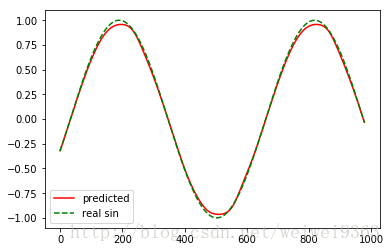
tflearn tensorflow LSTM predict sin function的更多相关文章
- Tensorflow LSTM实现
Tensorflow[LSTM] 0.背景 通过对<tensorflow machine learning cookbook>第9章第3节"implementing_lstm ...
- TensorFlow LSTM 注意力机制图解
TensorFlow LSTM Attention 机制图解 深度学习的最新趋势是注意力机制.在接受采访时,现任OpenAI研究主管的Ilya Sutskever提到,注意力机制是最令人兴奋的进步之一 ...
- TensorFlow-Bitcoin-Robot:一个基于 TensorFlow LSTM 模型的 Bitcoin 价格预测机器人
简介 TensorFlow-Bitcoin-Robot:一个基于 TensorFlow LSTM 模型的 Bitcoin 价格预测机器人. 文章包括一下几个部分: 1.为什么要尝试做这个项目? 2.为 ...
- TensorFlow-Bitcoin-Robot:一个基于 TensorFlow LSTM 模型的 Bitcoin 价格预测机器人。
简介 TensorFlow-Bitcoin-Robot:一个基于 TensorFlow LSTM 模型的 Bitcoin 价格预测机器人. 文章包括一下几个部分: 1.为什么要尝试做这个项目? 2.为 ...
- Tensorflow[LSTM]
0.背景 通过对<tensorflow machine learning cookbook>第9章第3节"implementing_lstm"进行阅读,发现如下形式可以 ...
- 芝麻HTTP:TensorFlow LSTM MNIST分类
本节来介绍一下使用 RNN 的 LSTM 来做 MNIST 分类的方法,RNN 相比 CNN 来说,速度可能会慢,但可以节省更多的内存空间. 初始化 首先我们可以先初始化一些变量,如学习率.节点单元数 ...
- Tensorflow 损失函数(loss function)及自定义损失函数(三)
版权声明:本文为博主原创文章,遵循 CC 4.0 BY-SA 版权协议,转载请附上原文出处链接和本声明. 本文链接:https://blog.csdn.net/limiyudianzi/article ...
- tensorflow LSTM+CTC使用详解
最近用tensorflow写了个OCR的程序,在实现的过程中,发现自己还是跳了不少坑,在这里做一个记录,便于以后回忆.主要的内容有lstm+ctc具体的输入输出,以及TF中的CTC和百度开源的warp ...
- TensorFlow——LSTM长短期记忆神经网络处理Mnist数据集
1.RNN(Recurrent Neural Network)循环神经网络模型 详见RNN循环神经网络:https://www.cnblogs.com/pinard/p/6509630.html 2. ...
随机推荐
- 使用 Visual Studio 将 ASP.NET Web 应用部署到 Azure
原文地址:https://www.azure.cn/zh-cn/documentation/articles/web-sites-dotnet-get-started 配置新的 Web 项目 下一步是 ...
- Linux知识总汇
Linux相关教程 Linux的安装以及基础配置 Linux上安装Python3 Linux上安装pip以及setuptools Linux上安装MySQL Linux上安装Django Linux上 ...
- pssh批量远程管理工具
Linux下批量管理工具pssh使用记录 pssh是一款开源的软件,使用python实现,用于批量ssh操作大批量机器:pssh是一个可以在多台服务器上执行命令的工具,同时支持拷贝文件,是同类工具 ...
- (转)Spring Boot中使用AOP统一处理Web请求日志
AOP为Aspect Oriented Programming的缩写,意为:面向切面编程,通过预编译方式和运行期动态代理实现程序功能的统一维护的一种技术.AOP是Spring框架中的一个重要内容,它通 ...
- Python:笔记(7)——yield关键字
Python:笔记(7)——yield关键字 yield与生成器 所谓生成器是一个函数,它可以生成一个值的序列,以便在迭代中使用.函数使用yield关键字可以定义生成器对象. 一个例子 我们调用该函数 ...
- 20155239 2016-2017-2 《Java程序设计》第7周学习总结
教材学习内容总结 1.了解Lambda语言 "Lambda 表达式"(lambda expression)是一个匿名函数,Lambda表达式基于数学中的λ演算得名,直接对应于其中的 ...
- bzoj1620 / P2920 [USACO08NOV]时间管理Time Management
P2920 [USACO08NOV]时间管理Time Management 显然的贪心. 按deadline从大到小排序,然后依次填充时间. 最后时间为负的话那么就是无解 #include<io ...
- poj3071 Football(概率dp)
poj3071 Football 题意:有2^n支球队比赛,每次和相邻的球队踢,两两淘汰,给定任意两支球队相互踢赢的概率,求最后哪只球队最可能夺冠. 我们可以十分显然(大雾)地列出转移方程(设$f[ ...
- Python3:pyecharts数据可视化插件
Python3:pyecharts数据可视化插件 一.简介 pyecharts 是一个用于生成 Echarts 图表的类库. Echarts 是百度开源的一个数据可视化 JS 库.主要用于数据可视化. ...
- 20145106 《Java程序设计》第5周学习总结
教材学习内容总结 个人认为本周的学习在很大程度上是作为之前学习内容的补充.之前编译的程序相信所有人都会失败过,error算是我程序的老主顾了. 第八章名为"异常处理".本章中,我们 ...