
【LeetCode题解】232_用栈实现队列(Implement-Queue-using-Stacks)
更多 LeetCode 题解笔记可以访问我的 github。
描述
使用栈实现队列的下列操作:
- push(x) -- 将一个元素放入队列的尾部。
- pop() -- 从队列首部移除元素。
- peek() -- 返回队列首部的元素。
- empty() -- 返回队列是否为空。
示例:
MyQueue queue = new MyQueue();

queue.push(1);

queue.push(2);

queue.peek();  // 返回 1

queue.pop();   // 返回 1

queue.empty(); // 返回 false
说明:
- 你只能使用标准的栈操作 -- 也就是只有
push to top,peek/pop from top,size, 和is empty操作是合法的。 - 你所使用的语言也许不支持栈。你可以使用 list 或者 deque(双端队列)来模拟一个栈,只要是标准的栈操作即可。
- 假设所有操作都是有效的 (例如,一个空的队列不会调用 pop 或者 peek 操作)。
解法一:在一个栈中维持所有元素的出队顺序
思路
队列是一种先入先出(first in first out, FIFO)的数据结构,而栈是一种后入先出(last in first out, LIFO)的数据结构。因此,如果要使用栈来达到队列的效果,即用有后入先出性质的数据结构来实现先入先出的效果,需要借用两个栈来改变元素的出队顺序。当然,借用两个栈来实现队列也有不同的实现方式,这一节介绍第一种实现方式,在下一小节介绍第二种方式。
第一种方式是在一个栈中维持所有元素的出队顺序,即所有的元素在入队操作完成后只会保存在一个栈中,且其出栈的顺序和出队的顺序是一致的。下面对入队、出队等操作的底层实现分别进行讲解。
入队(push)
为了实现出栈顺序和出队顺序是一致的,入栈时必须将新的元素压入栈底。为了实现这种效果,在入队时,首先将栈1(假设栈1中保存所有的元素)中所有的元素弹出并压入栈2中,接着将新的元素压入栈1中,最后再将栈2中的所有弹出并压入栈1中。详细的步骤如图1所示。
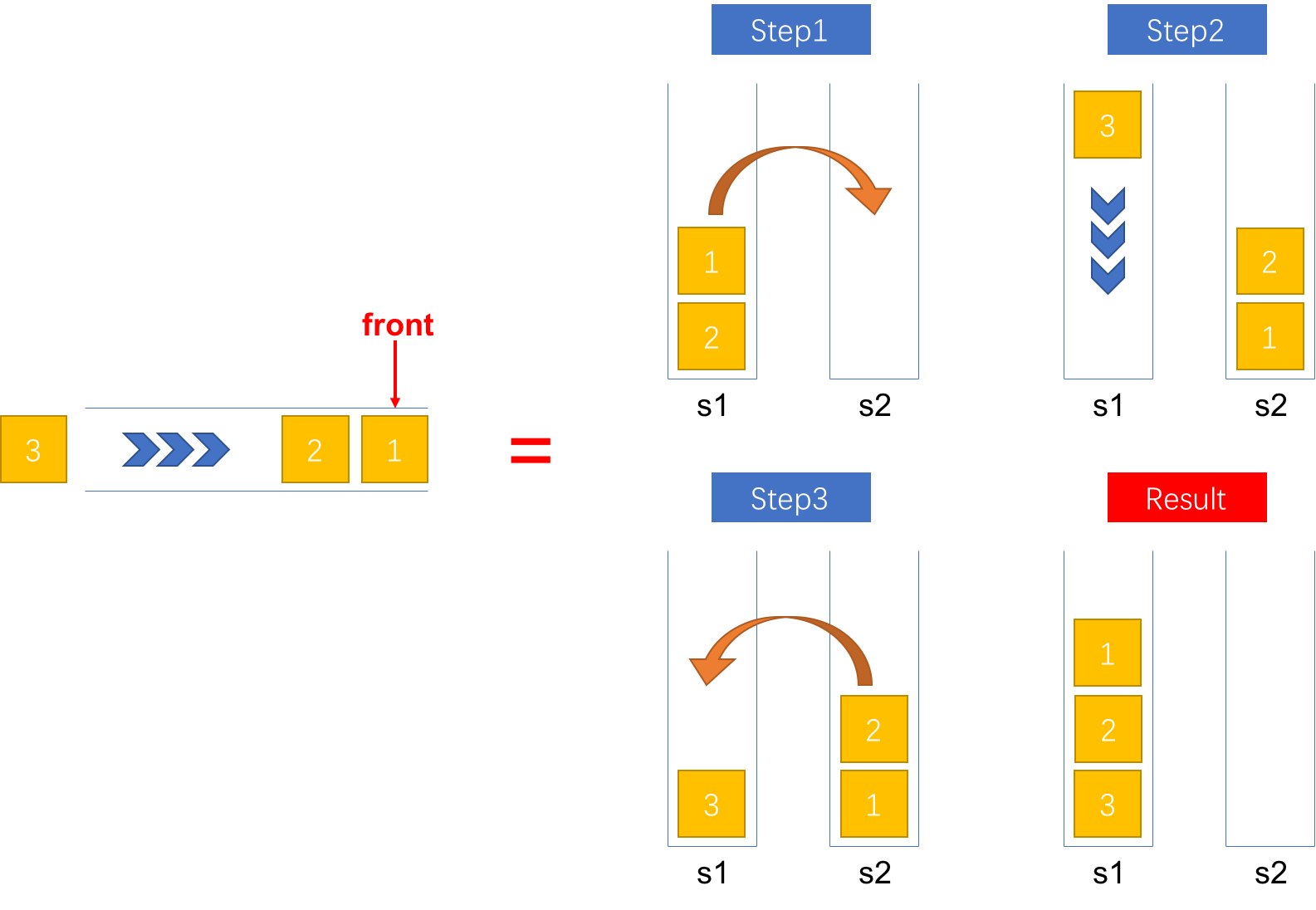
图1:将一个元素入队
代码(Java)实现如下。
public void push(int x) {

    // 将栈1中的所有元素弹出并压入栈2中

    while (!s1.isEmpty()) {

        s2.push(s1.pop());

    }

    // 将新的元素压入栈1

    s1.push(x);

    // 将栈2的所有元素弹出并压入栈1

    while (!s2.isEmpty()) {

        s1.push(s2.pop());

    }

}
复杂度分析如下:
- 时间复杂度:\(O(n)\),其中 \(n\) 表示入队时队列元素的数目,即栈1中元素的数目。入队时,栈1中的元素需要进行出栈和入栈两次,需要 \(4n\) 次操作,再加上新的元素的一次入栈操作,总的操作次数为 \(4n + 1\) 次。由于栈的入栈和出栈的时间复杂度是 \(O(1)\) 的,因此,入队的时间复杂度是 \(O(n)\) 的
- 空间复杂度:\(O(n)\)
出队(pop)
出队操作比较简单,由于栈1中元素的出栈顺序和队列的出队顺序一致,因此,只需要弹出栈顶元素即可完成出队操作。
public int pop() {

    if (s1.isEmpty()) {

        throw new IllegalArgumentException("[ERROR] The queue is empty!");

    }

    return s1.pop();

}
复杂度分析如下:
- 时间复杂度:\(O(1)\)
- 空间复杂度:\(O(1)\)
查看队首(peek)
与出队操作类似,只需要查看栈1栈顶的元素即可完成查看队首的操作。
public int peek() {

    if (s1.isEmpty()) {

        throw new IllegalArgumentException("[ERROR] The queue is empty!");

    }

    return s1.peek();

}
复杂度分析如下:
- 时间复杂度:\(O(1)\)
- 空间复杂度:\(O(1)\)
是否为空(empty)
由于栈1中保存队列的所有元素,因此只需要判断栈1是否为空即可知道队列是否为空。
public boolean empty() {

    return s1.isEmpty();

}
复杂度分析如下:
- 时间复杂度:\(O(1)\)
- 空间复杂度:\(O(1)\)
Java 实现
class MyQueue {

    private Stack<Integer> s1;

    private Stack<Integer> s2;

    /** Initialize your data structure here. */

    public MyQueue() {

        s1 = new Stack<>();

        s2 = new Stack<>();

    }

    /** Push element x to the back of queue. */

    public void push(int x) {

        while (!s1.isEmpty()) {

            s2.push(s1.pop());

        }

        s1.push(x);

        while (!s2.isEmpty()) {

            s1.push(s2.pop());

        }

    }

    /** Removes the element from in front of queue and returns that element. */

    public int pop() {

        if (s1.isEmpty()) {

            throw new IllegalArgumentException("[ERROR] The queue is empty!");

        }

        return s1.pop();

    }

    /** Get the front element. */

    public int peek() {

        if (s1.isEmpty()) {

            throw new IllegalArgumentException("[ERROR] The queue is empty!");

        }

        return s1.peek();

    }

    /** Returns whether the queue is empty. */

    public boolean empty() {

        return s1.isEmpty();

    }

}
Python 实现
class MyQueue:

    def __init__(self):

        """

        Initialize your data structure here.

        """

        self._s1, self._s2 = [], []

    def push(self, x):

        """

        Push element x to the back of queue.

        :type x: int

        :rtype: void

        """

        while self._s1:

            self._s2.append(self._s1.pop())

        self._s1.append(x)

        while self._s2:

            self._s1.append(self._s2.pop())

    def pop(self):

        """

        Removes the element from in front of queue and returns that element.

        :rtype: int

        """

        return self._s1.pop()

    def peek(self):

        """

        Get the front element.

        :rtype: int

        """

        return self._s1[-1]

    def empty(self):

        """

        Returns whether the queue is empty.

        :rtype: bool

        """

        return not self._s1
解法二:一个栈入,一个栈出
思路
解法二的实现方式与解法一有点不同,按照功能的不同,解法二将两个栈一个用于入队,一个用于出队。假设栈 inStack 用于实现入队操作,栈 outStack 用于实现出队操作。下面对入队、出队等操作的底层实现分别进行讲解。
入队(push)
入队操作比较简单,直接将新的元素压入栈 inStack 中,同时,对于第一个进入栈中的元素,我们用一个变量 front 保存起来,用于表示栈 inStack 这个队列的队首。
/** Push element x to the back of queue. */

public void push(int x) {

    if (inStack.empty()) {

        front = x;

    }

    inStack.push(x);

}
复杂度分析如下:
- 时间复杂度:\(O(1)\)
- 空间复杂度:\(O(n)\),需要额外的空间用于存储队列元素
出队(pop)
在入队时,由于先入的元素处于输入栈 inStack 的栈底,因此,为了能够弹出栈底的元素实现出队操作,需要将输入栈 inStack 中的元素弹出并压入到输出栈 outStack 中。此时,输出栈 outStack 中元素的出栈顺序和队列的出队顺序是一致的。只要输出栈 outStack 中还有元素,每次执行出队操作只需要将栈 outStack 的栈顶元素弹出即可。当输出栈 outStack 为空时,执行出队操作则需要先将输入栈 inStack 中的元素弹出并压入输出栈。详细的步骤如图2所示。
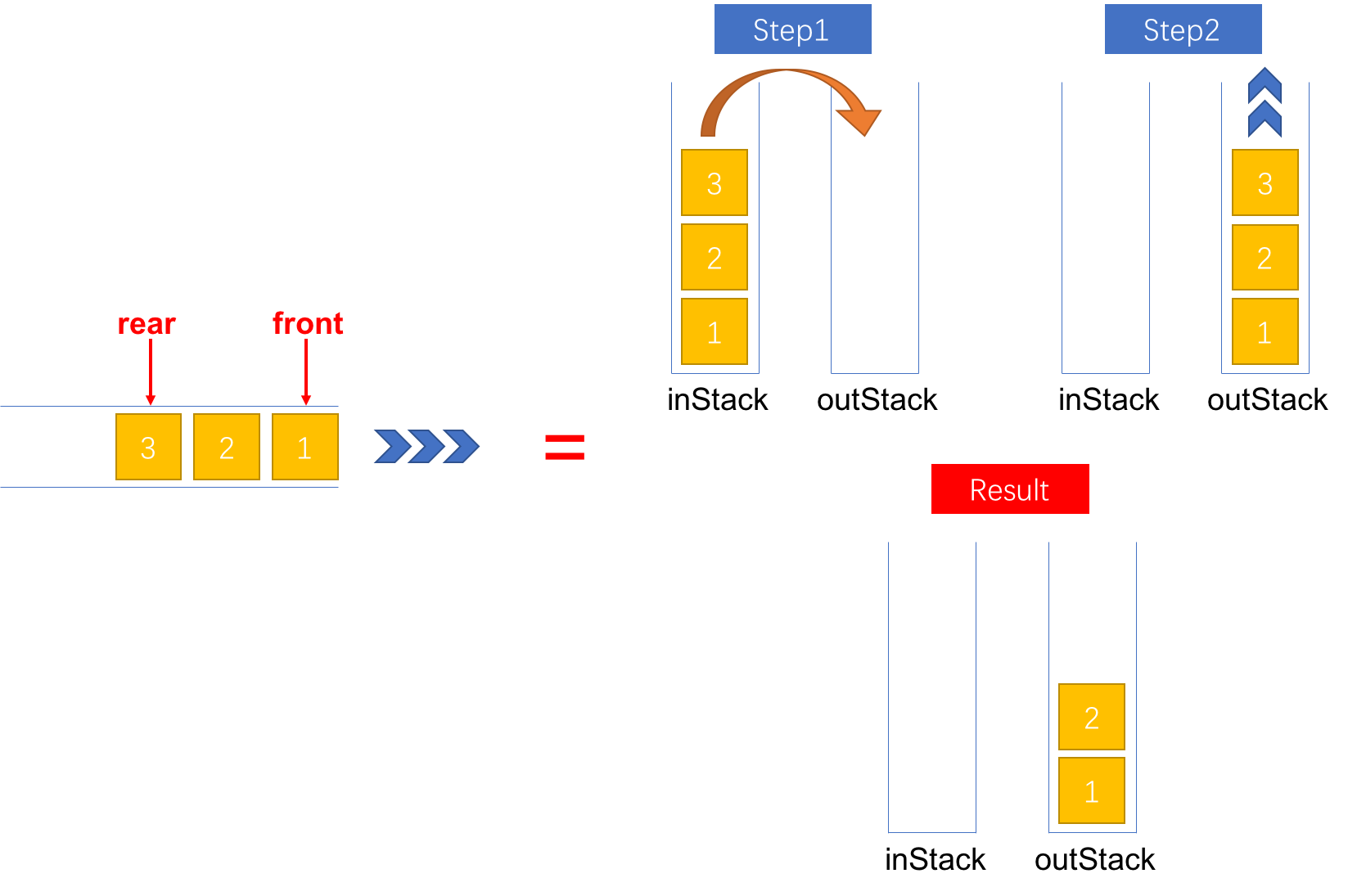
图2:将一个元素出队
代码(Java)实现如下。
/** Removes the element from in front of queue and returns that element. */

public int pop() {

    if (empty()) {

        throw new IllegalArgumentException("[ERROR] The queue is empty!");

    }

    if (outStack.isEmpty()) {

        while (!inStack.isEmpty()) {

            outStack.push(inStack.pop());

        }

    }

    return outStack.pop();

}
复杂度分析如下:
- 时间复杂度:均摊时间复杂度为 \(O(1)\),最坏情况下,时间复杂度为 \(O(n)\),更为详细的均摊复杂度分析可以查看官网的文章
- 空间复杂度:\(O(1)\)
查看队首(peek)
与出队操作类似,当输出栈 outStack 不为空时,只需要返回输出栈 outStack 的栈顶元素即可。不同的是,由于我们用变量 front 存储了输入栈最先进入的元素,因此,当输出栈 outStack 为空时,不需要再将输入栈 inStack 的元素弹出并压入到输出栈 outStack 中便可以得到当前队首的元素。
/** Get the front element. */

public int peek() {

    if (empty()) {

        throw new IllegalArgumentException("[ERROR] The queue is empty!");

    }

    if (!outStack.isEmpty()) {

        return outStack.peek();

    } else {

        return front;

    }

}
复杂度分析如下:
- 时间复杂度:\(O(1)\),借助于变量
front,可以使得peek操作在任意情况下都是 \(O(1)\) 的时间复杂度 - 空间复杂度:\(O(1)\)
是否为空(empty)
由于两个都有可以存在元素,因此,要判断队列是否为空,需要同时判断两个栈。
/** Returns whether the queue is empty. */

public boolean empty() {

    return inStack.isEmpty() && outStack.isEmpty();

}
复杂度分析如下:
- 时间复杂度:\(O(1)\)
- 空间复杂度:\(O(1)\)
Java 实现
class MyQueue {

    /**

     * The stack used to implement enqueue functionality

     */

    private Stack<Integer> inStack;

    /**

     * The stack used to implement dequeue functionality

     */

    private Stack<Integer> outStack;

    /**

     * The front element in the stack `inStack` 's queue

     */

    private int front;

    /** Initialize your data structure here. */

    public MyQueue2() {

        inStack = new Stack<>();

        outStack = new Stack<>();

    }

    /** Push element x to the back of queue. */

    public void push(int x) {

        if (inStack.empty()) {

            front = x;

        }

        inStack.push(x);

    }

    /** Removes the element from in front of queue and returns that element. */

    public int pop() {

        if (empty()) {

            throw new IllegalArgumentException("[ERROR] The queue is empty!");

        }

        if (outStack.isEmpty()) {

            while (!inStack.isEmpty()) {

                outStack.push(inStack.pop());

            }

        }

        return outStack.pop();

    }

    /** Get the front element. */

    public int peek() {

        if (empty()) {

            throw new IllegalArgumentException("[ERROR] The queue is empty!");

        }

        if (!outStack.isEmpty()) {

            return outStack.peek();

        } else {

            return front;

        }

    }

    /** Returns whether the queue is empty. */

    public boolean empty() {

        return inStack.isEmpty() && outStack.isEmpty();

    }

}
Python 实现
class MyQueue:

    def __init__(self):

        """

        Initialize your data structure here.

        """

        self._in_stack, self._out_stack, self._front = [], [], None

    def push(self, x):

        """

        Push element x to the back of queue.

        :type x: int

        :rtype: void

        """

        if not self._in_stack:

            self._front = x

        self._in_stack.append(x)

    def pop(self):

        """

        Removes the element from in front of queue and returns that element.

        :rtype: int

        """

        if self.empty():

            raise Exception("[ERROR] The queue is empty!")

        if not self._out_stack:

            while self._in_stack:

                self._out_stack.append(self._in_stack.pop())

        return self._out_stack.pop()

    def peek(self):

        """

        Get the front element.

        :rtype: int

        """

        if self.empty():

            raise Exception("[ERROR] The queue is empty!")

        if not self._out_stack:

            return self._front

        else:

            return self._out_stack[-1]

    def empty(self):

        """

        Returns whether the queue is empty.

        :rtype: bool

        """

        return not self._in_stack and not self._out_stack
【LeetCode题解】232_用栈实现队列(Implement-Queue-using-Stacks)的更多相关文章
- LeetCode 232:用栈实现队列 Implement Queue using Stacks
题目: 使用栈实现队列的下列操作: push(x) -- 将一个元素放入队列的尾部. pop() -- 从队列首部移除元素. peek() -- 返回队列首部的元素. empty() -- 返回队列是 ...
- LeetCode 232. 用栈实现队列(Implement Queue using Stacks) 4
232. 用栈实现队列 232. Implement Queue using Stacks 题目描述 使用栈实现队列的下列操作: push(x) -- 将一个元素放入队列的尾部. pop() -- 从 ...
- [Swift]LeetCode232. 用栈实现队列 | Implement Queue using Stacks
Implement the following operations of a queue using stacks. push(x) -- Push element x to the back of ...
- leetcode:Implement Stack using Queues 与 Implement Queue using Stacks
一.Implement Stack using Queues Implement the following operations of a stack using queues. push(x) - ...
- Leetcode 232 Implement Queue using Stacks 和 231 Power of Two
1. 232 Implement Queue using Stacks 1.1 问题描写叙述 使用栈模拟实现队列.模拟实现例如以下操作: push(x). 将元素x放入队尾. pop(). 移除队首元 ...
- leetcode 155. Min Stack 、232. Implement Queue using Stacks 、225. Implement Stack using Queues
155. Min Stack class MinStack { public: /** initialize your data structure here. */ MinStack() { } v ...
- 【LeetCode】232 & 225 - Implement Queue using Stacks & Implement Stack using Queues
232 - Implement Queue using Stacks Implement the following operations of a queue using stacks. push( ...
- Lintcode: Implement Queue by Stacks 解题报告
Implement Queue by Stacks 原题链接 : http://lintcode.com/zh-cn/problem/implement-queue-by-stacks/# As th ...
- 232. Implement Queue using Stacks,225. Implement Stack using Queues
232. Implement Queue using Stacks Total Accepted: 27024 Total Submissions: 79793 Difficulty: Easy Im ...
随机推荐
- spark的shuffle机制
对于大数据计算框架而言,Shuffle阶段的设计优劣是决定性能好坏的关键因素之一.本文将介绍目前Spark的shuffle实现,并将之与MapReduce进行简单对比.本文的介绍顺序是:shuffle ...
- express package.json解析
教程:http://www.tuicool.com/articles/vuiyIz
- 微赞微擎V0.8以上版本:【数据库读写分离】实战教程 [复制链接]
http://www.efwww.com/forum.php?mod=viewthread&tid=4870 马上注册,下载更多源码,让你轻松玩转微信公众平台. 您需要 登录 才可以下载或查看 ...
- 机器学习实战-ch2-有标签的聚类算法
本书中的这个聚类算法多少有些让人意外.通常的聚类算法是这样的: 给定一堆点: 给定一个距离计算的算法: 给定一个cluster之间的距离d,或者最小的cluster数目k: 初始化,每个点作为初始集群 ...
- ASP .Net C# ---Excel导入导出方法
导入导出的方法以及引用,可以自行创建一个帮助类 using System;using NPOI.SS.UserModel;using NPOI.XSSF.UserModel;using NPOI.HS ...
- node.js实现WebSocket
最近在学习“HTML5游戏开发实战”,其中第8章内容是使用WebSocket来构建多人游戏---<你画我猜>.然而在实现过程中,却一直出错: 客户端请求时,服务器端会报错并终止: 而浏览器 ...
- vue.js - 2
最近开发公司vue前端项目,做一下笔记,偶尔上来查漏补缺 组件操作: 使用flag标识符结合v-if和v-else切换组件 页面结构: <div id="app"> & ...
- 协程 coroutine
参考链接: http://manual.luaer.cn/2.11.html http://www.cnblogs.com/riceball/archive/2008/01/03/1025158.ht ...
- 大众点评Cat--架构分析
转自:http://blog.csdn.net/szwandcj/article/details/51025669 Cat功能强大且多,光日志的报表和图表分析就有十几种,但文档却很少,寥寥无几找到一些 ...
- Swift5 语言指南(二十四) 泛型
通用代码使您能够根据您定义的要求编写可以使用任何类型的灵活,可重用的函数和类型.您可以编写避免重复的代码,并以清晰,抽象的方式表达其意图. 泛型是Swift最强大的功能之一,Swift标准库的大部分内 ...