
.NET:CLR via C# The CLR’s Execution Model
The CLR’s Execution Model
The core features of the CLR
- memory management.
- assembly loading.
- security.
- exception handling.
- thread synchronization.
Managed Module
Parts of a Managed Module:
- PE32 or PE32+ header:The standard Windows PE file header, which is similar to the Common Object File Format (COFF) header. If the header uses the PE32 format, the file can run on a 32-bit or 64-bit version of Windows. If the header uses the PE32+ format, the file requires a 64-bit version of Windows to run. This header also indicates the type of file: GUI, CUI, or DLL, and contains a time stamp indicating when the file was built. For modules that contain only IL code, the bulk of the information in the PE32(+) header is ignored. For modules that contain native CPU code, this header contains information about the native CPU code.
- CLR header:Contains the information (interpreted by the CLR and utilities) that makes this a managed module. The header includes the version of the CLR required, some flags, the MethodDef metadata token of the managed module’s entry point method (Main method), and the location/size of the module’s metadata, resources, strong name, some flags, and other less interesting stuff.
- Metadata:Every managed module contains metadata tables. There are two main types of tables: tables that describe the types and members defined in your source code and tables that describe the types and members referenced by your source code.
- IL code:Code the compiler produced as it compiled the source code. At run time, the CLR compiles the IL into native CPU instructions.
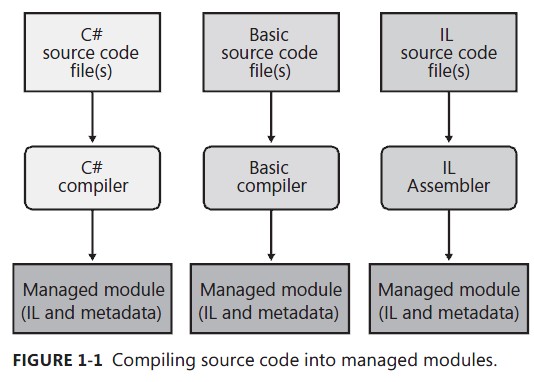
In addition to emitting IL, every compiler targeting the CLR is required to emit full metadata into every managed module. In brief, metadata is a set of data tables that describe what is defined in the module, such as types and their members. In addition, metadata also has tables indicating what the managed module references, such as imported types and their members.
Metadata has many uses. Here are some of them:
- Metadata removes the need for native C/C++ header and library files when compiling because all the information about the referenced types/members is contained in the file that has the IL that implements the type/members. Compilers can read metadata directly from managed modules.
- Microsoft Visual Studio uses metadata to help you write code. Its IntelliSense feature parses metadata to tell you what methods, properties, events, and fields a type offers, and in the case of a method, what parameters the method expects.
- The CLR’s code verification process uses metadata to ensure that your code performs only “type-safe” operations. (I’ll discuss verification shortly.)
- Metadata allows an object’s fields to be serialized into a memory block, sent to another machine, and then deserialized, re-creating the object’s state on the remote machine.
- Metadata allows the garbage collector to track the lifetime of objects. For any object, the garbage collector can determine the type of the object and, from the metadata, know which fields within that object refer to other objects.
Combining Managed Modules into Assemblies
First, an assembly is a logical grouping of one or more modules or resource files. Second, an assembly is the smallest unit of reuse, security, and versioning. Depending on the choices you make with your compilers or tools, you can produce a single-file or a multifile assembly. In the CLR world, an assembly is what we would call a component.
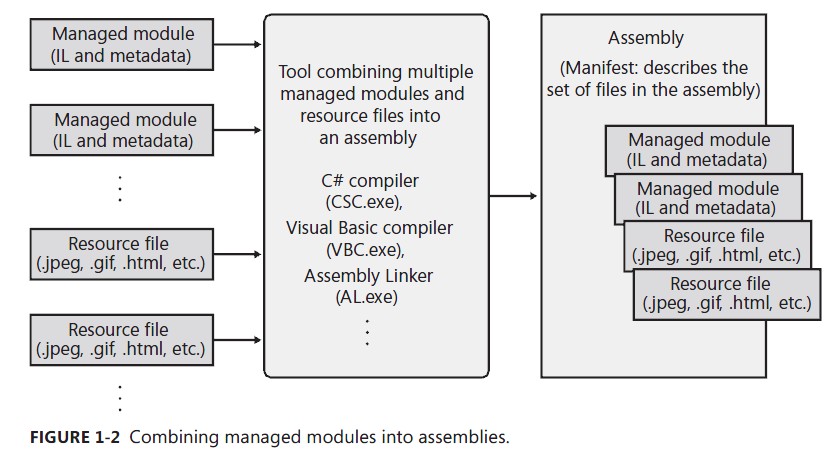
The manifest is simply another set of metadata tables. These tables describe the files that make up the assembly, the publicly exported types implemented by the files in the assembly, and the resource or data files that are associated with the assembly.
An assembly allows you to decouple the logical and physical notions of a reusable, securable, versionable component. How you partition your code and resources into different files is completely up to you. For example, you could put rarely used types or resources in separate files that are part of an assembly. The separate files could be downloaded on demand from the web as they are needed at run time. If the files are never needed, they’re never downloaded, saving disk space and reducing installation time. Assemblies allow you to break up the deployment of the files while still treating all of the files as a single collection.
An assembly’s modules also include information about referenced assemblies (including their version numbers). This information makes an assembly self-describing.
Loading the Common Language Runtime
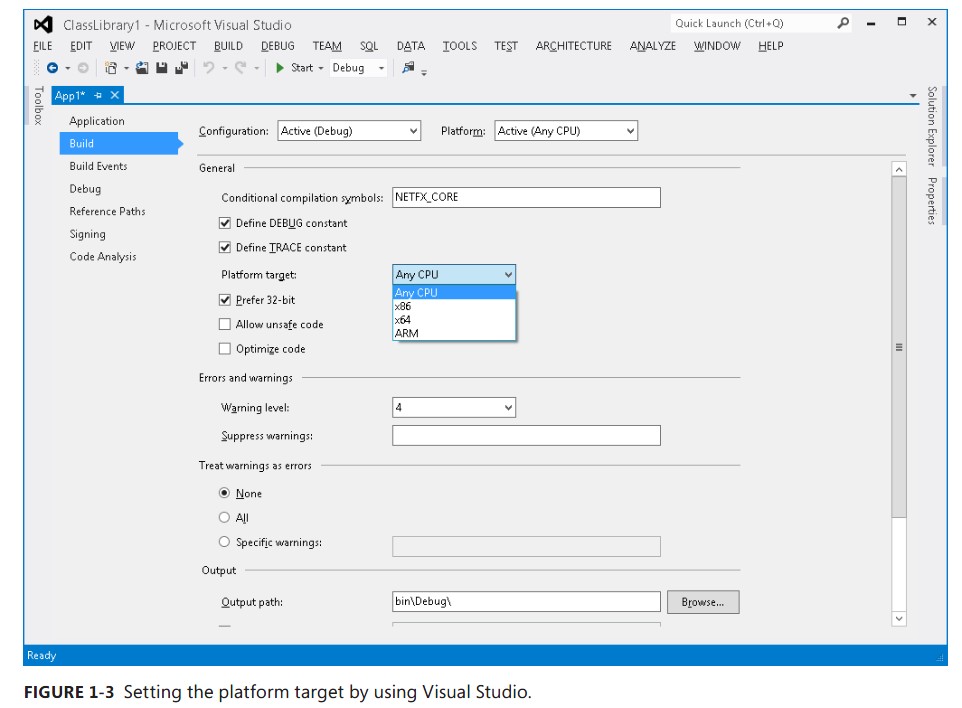
When running an executable file, Windows examines this EXE file’s header to determine whether the application requires a 32-bit or 64-bit address space. A file with a PE32 header can run with a 32- bit or 64-bit address space, and a file with a PE32+ header requires a 64-bit address space. Windows also checks the CPU architecture information embedded inside the header to ensure that it matches the CPU type in the computer. Lastly, 64-bit versions of Windows offer a technology that allows 32-bit Windows applications to run. This technology is called WoW64 (for Windows on Windows 64).
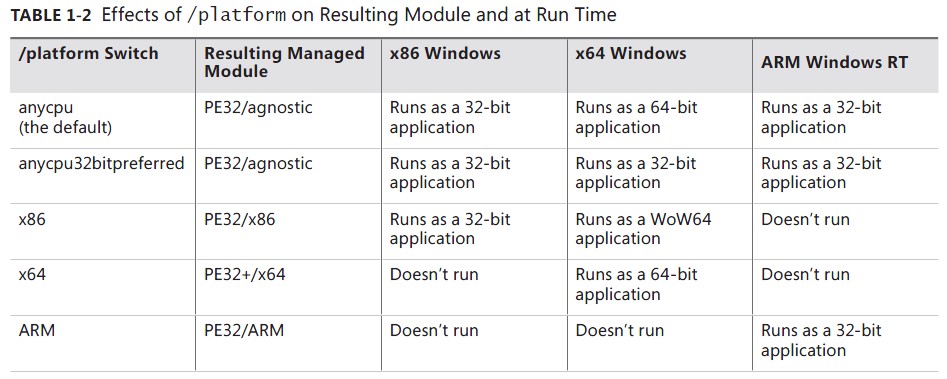
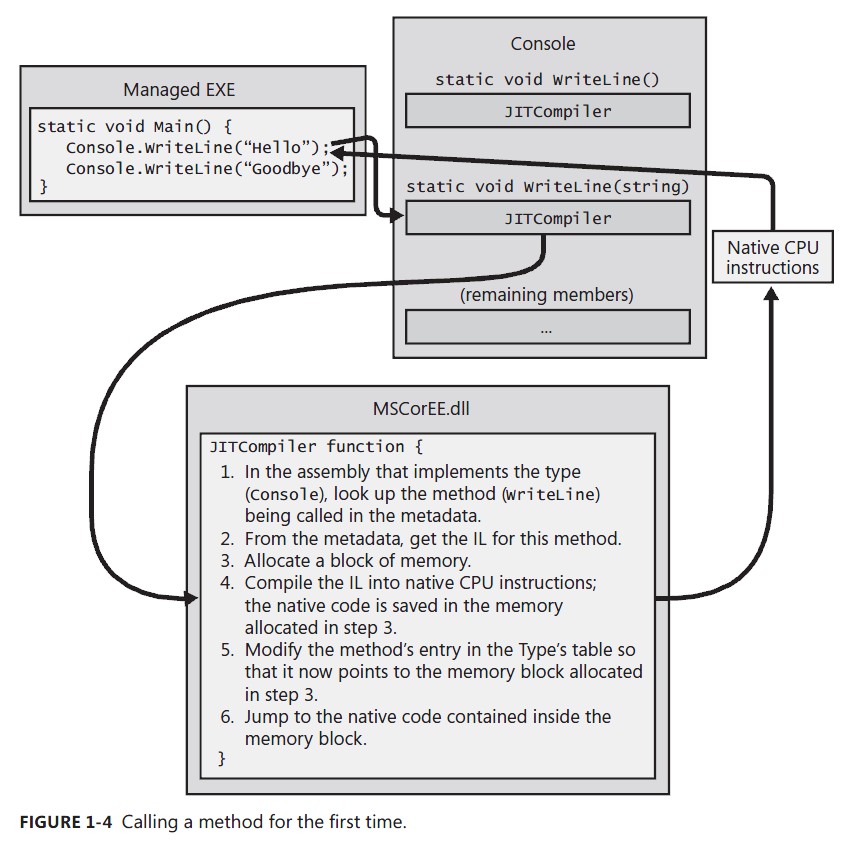
After Windows has examined the EXE file’s header to determine whether to create a 32-bit or 64- bit process, Windows loads the x86, x64, or ARM version of MSCorEE.dll into the process’s address space. On an x86 or ARM version of Windows, the 32-bit version of MSCorEE.dll can be found in the %SystemRoot%\System32 directory. On an x64 version of Windows, the x86 version of MSCorEE.dll can be found in the %SystemRoot%\SysWow64 directory, whereas the 64-bit version can be found in the %SystemRoot%\System32 directory (for backward compatibility reasons). Then, the process’s primary thread calls a method defined inside MSCorEE.dll. This method initializes the CLR, loads the EXE assembly, and then calls its entry point method (Main). At this point, the managed application is up and running.
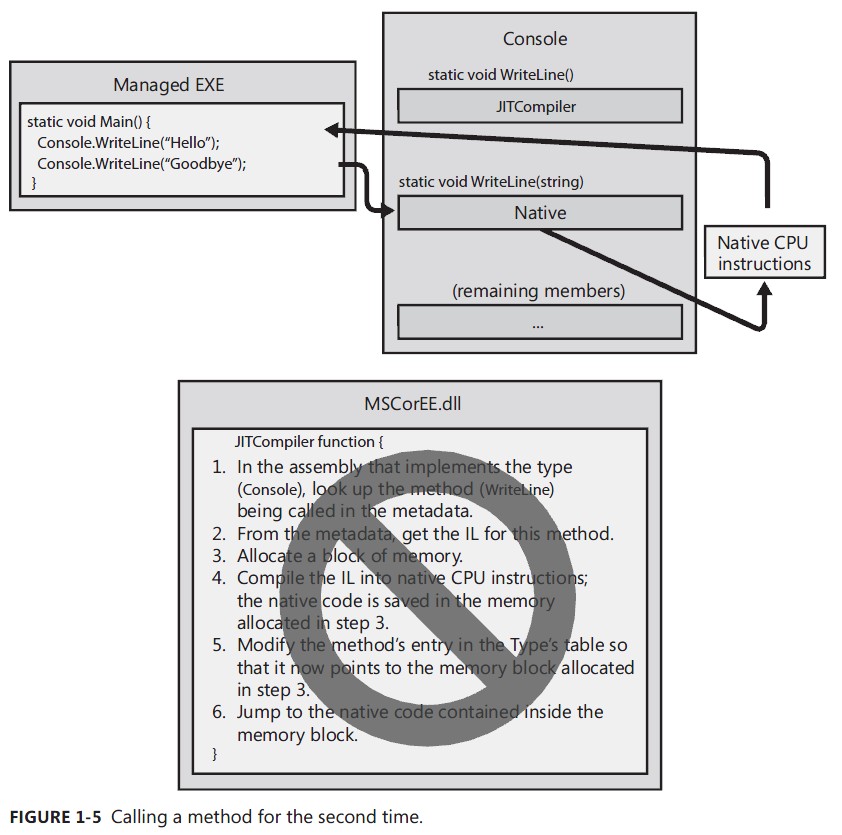
Executing Your Assembly’s Code
.NET:CLR via C# The CLR’s Execution Model的更多相关文章
- CLR学习之初识CLR
一.什么是CLR? CLR即公共语言运行时(Common Language Runtime,简称CRL),就是微软为.net产品构建的运行环境,与java的JVM类似,通俗的讲就是.net虚拟机.CL ...
- 【读书笔记】【CLR via C#】【第一章】The CLR’s Execution Model
内容提要 本章的目的是对.Net 框架的设计做一个总体的介绍,包括介绍框架中使用的一些技术.定义一些术语.同时会展示从源代码生成应用程序(或者一些包含了一些自定义类型的可以发布的组件),并且会解释程序 ...
- 01.由浅入深学习.NET CLR 基础系列之CLR 的执行模型
.Net 从代码生成到执行,这中间的一些列过程是一个有别于其他的新技术新概念,那么这是一个什么样的过程呢,有什么样的机制呢,清楚了这些基本的东西我们做.Net的东西方可心中有数.那么,CLR的执行模型 ...
- CLR基础之一---认识CLR [《CLR via C#》读书笔记]
<CLR via C#>读书笔记 什么是CLR CLR的基本概念 通用语言运行平台(Common Language Runtime,简称CLR)是微软为他们的.Net虚拟机所选用的名称.这 ...
- 【CLR】详解CLR中的程序集
目录结构: contents structure [+] 程序集的简介 为程序集分配强名称 如何指定程序集的版本资源信息 如何对程序集签名 全局程序集缓存 如何查看程序集的信息 强命名程序集防串改 1 ...
- 重温CLR(一)CLR基础
如果一个C#developer,对CLR没有了解,那就只能是入门级别.未来.NET CORE是趋势,但是.NET CORE 也是基于CoreCLR的,而CLR和CoreCLR其实差别不大,从runti ...
- C++手动加载CLR运行托管程序(CLR Hosting)
转载自:http://www.linuxidc.com/Linux/2012-10/72293.htm 机制介绍 有些时候主程序是通过C/C++实现的,但是我们希望通过托管代码来扩展非托管程序,从而也 ...
- CLR via C# 3rd - 01 - The CLR's Execution Model
1. Assemly A managed module is a standard 32-bit Microsoft Windoes portable executable (PE32) ...
- The CLR's Execution Model
the native code generator tool:NGen.exe optimization tool:MPGO.exe 所有类型最终都继承自System.Object.则所有类型都有如下 ...
随机推荐
- plsql例子
create or replace procedure find_difference(db_link in varchar2) is /* 比对两套环境建表脚本差异,以224环境为主 当前环境,db ...
- 记一次测试环境下PXC集群问题《经验总结》
1.问题描述 当PXC集群节点全部宕机的,导致集群几点启动失败.报错导致无法启动 [ERROR] WSREP: It may not be safe to boo ...
- Delphi 中的自动释放策略
来自万一老师的博客:http://www.cnblogs.com/del/archive/2011/12/21/2295794.html ------------------------------- ...
- Effective STL 阅读笔记: Item 4 ~ 5: Call empty instead of checking size() against zero.
Table of Contents 1 Item 4: Call empty instead of checking size() against zero 2 Item 5: Prefer rang ...
- char *总结
#include <iostream> using namespace std; int main() { char *p[] = {"one","two&q ...
- APS高级计划排程系统应该支持的企业应用场景
APS高级计划排程系统应该支持的企业应用场景 面对工业4.0智能制造的挑战,很多企业希望能够引进APS高级计划排程系统,全自动的.快速的制定精细化的生产计划,准确的计算产线/设备上各种产品型号的加工顺 ...
- Windows 如何远程登陆 Server 的 jupyter
jupyter 安装就不用赘述了,本示例以 Putty 为例,展示如何从本地 windows 系统调用远程的 jupyter notebook 并且在本地 Chrome 中打开的方法 1. 首先,ss ...
- kotlin 类 接口 抽象类 子类类型有限的class 。sealed class
韩梦飞沙 韩亚飞 313134555@qq.com yue31313 han_meng_fei_sha 用 private 封装,可以防止别人修改. 就好像 内有高压,危险,不让碰.
- 【期望DP】BZOJ4008- [HNOI2015]亚瑟王
题目大意 有\(n\)张卡牌,\(r\)轮游戏.每张卡牌只能用至多一次,每张卡牌被用到的概率为\(p_i\).现在从左往右轮,直到最右一张卡片或者某张卡片被用到.如果某张卡牌被用到,产生\(d_i\) ...
- AGC026D Histogram Coloring
link 题意: 给定n列的方块,第i列高度$h_i$.现在要把它染成红蓝两色,要求满足:对于任意一个$2\times 2$的区域,恰有2个蓝色,2个红色.问方案数. $n\leq 100,h_i\l ...