
poj 1330 Nearest Common Ancestors lca 在线rmq
Description
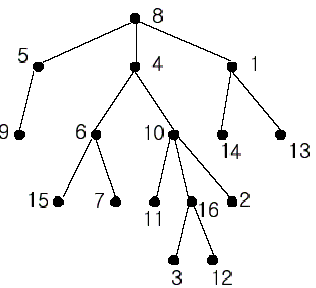
In the figure, each node is labeled with an integer from {1, 2,...,16}. Node 8 is the root of the tree. Node x is an ancestor of node y if node x is in the path between the root and node y. For example, node 4 is an ancestor of node 16. Node 10 is also an ancestor of node 16. As a matter of fact, nodes 8, 4, 10, and 16 are the ancestors of node 16. Remember that a node is an ancestor of itself. Nodes 8, 4, 6, and 7 are the ancestors of node 7. A node x is called a common ancestor of two different nodes y and z if node x is an ancestor of node y and an ancestor of node z. Thus, nodes 8 and 4 are the common ancestors of nodes 16 and 7. A node x is called the nearest common ancestor of nodes y and z if x is a common ancestor of y and z and nearest to y and z among their common ancestors. Hence, the nearest common ancestor of nodes 16 and 7 is node 4. Node 4 is nearer to nodes 16 and 7 than node 8 is.
For other examples, the nearest common ancestor of nodes 2 and 3 is node 10, the nearest common ancestor of nodes 6 and 13 is node 8, and the nearest common ancestor of nodes 4 and 12 is node 4. In the last example, if y is an ancestor of z, then the nearest common ancestor of y and z is y.
Write a program that finds the nearest common ancestor of two distinct nodes in a tree.
Input
Output
Sample Input
2

16

1 14

8 5

10 16

5 9

4 6

8 4

4 10

1 13

6 15

10 11

6 7

10 2

16 3

8 1

16 12

16 7

5

2 3

3 4

3 1

1 5

3 5
Sample Output
4

3
题意:n组数据,y-1条边,最后一个求lca;
博客:http://blog.csdn.net/barry283049/article/details/45842247;我的代码思路根据最后的在线算法得出;
#include<iostream>

#include<cstdio>

#include<cmath>

#include<string>

#include<queue>

#include<algorithm>

#include<stack>

#include<cstring>

#include<vector>

#include<list>

#include<set>

#include<map>

using namespace std;

#define ll long long

#define mod 1000000007

#define inf 999999999

//#pragma comment(linker, "/STACK:102400000,102400000")

int scan()

{

    int res =  , ch ;

    while( !( ( ch = getchar() ) >= '' && ch <= '' ) )

    {

        if( ch == EOF ) return  <<  ;

    }

    res = ch - '' ;

    while( ( ch = getchar() ) >= '' && ch <= '' )

        res = res *  + ( ch - '' ) ;

    return res ;

}

struct is

{

    int u,v;

    int next;

}edge[];

int head[];

int deep[];

int rudu[];

int first[];

int dfn[];//存深搜的数组

int dp[][];

int point,jiedge;

int minn(int x,int y)

{

    return deep[x]<=deep[y]?x:y;

}

void update(int u,int v)

{

    jiedge++;

    edge[jiedge].u=u;

    edge[jiedge].v=v;

    edge[jiedge].next=head[u];

    head[u]=jiedge;

}

void dfs(int u,int step)

{

    dfn[++point]=u;

    deep[point]=step;

    if(!first[u])

    first[u]=point;

    for(int i=head[u];i;i=edge[i].next)

    {

        int v=edge[i].v;

        dfs(v,step+);

        dfn[++point]=u;

        deep[point]=step;

    }

}

void st(int len)

{

    for(int i=;i<=len;i++)

    dp[i][]=i;

    for(int j=;(<<j)<=len;j++)

    for(int i=;i+(<<j)-<=len;i++)

    {

        dp[i][j]=minn(dp[i][j-],dp[i+(<<(j-))][j-]);

    }

}

int query(int l,int r)

{

    int lll=first[l];

    int rr=first[r];

    if(lll>rr) swap(lll,rr);

    int x=(int)(log((double)(rr-lll+))/log(2.0));

    return dfn[minn(dp[lll][x],dp[rr-(<<x)+][x])];

}

int main()

{

    int x,y,z,i,t;

    scanf("%d",&x);

    while(x--)

    {

        memset(head,,sizeof(head));

        memset(rudu,,sizeof(rudu));

        memset(first,,sizeof(first));

        point=;

        jiedge=;

        scanf("%d",&y);

        for(i=;i<y;i++)

        {

            int u,v;

            scanf("%d%d",&u,&v);

            update(u,v);

            rudu[v]++;

        }

        for(i=;i<=y;i++)

        if(!rudu[i])

        {

                dfs(i,);

                break;

        }

        st(point);

        int u,v;

        scanf("%d%d",&u,&v);

        printf("%d\n",query(u,v));

    }

    return ;

}
poj 1330 Nearest Common Ancestors lca 在线rmq的更多相关文章
- POJ.1330 Nearest Common Ancestors (LCA 倍增)
POJ.1330 Nearest Common Ancestors (LCA 倍增) 题意分析 给出一棵树,树上有n个点(n-1)条边,n-1个父子的边的关系a-b.接下来给出xy,求出xy的lca节 ...
- POJ 1330 Nearest Common Ancestors LCA题解
Nearest Common Ancestors Time Limit: 1000MS Memory Limit: 10000K Total Submissions: 19728 Accept ...
- POJ 1330 Nearest Common Ancestors (LCA,倍增算法,在线算法)
/* *********************************************** Author :kuangbin Created Time :2013-9-5 9:45:17 F ...
- poj 1330 Nearest Common Ancestors LCA
题目链接:http://poj.org/problem?id=1330 A rooted tree is a well-known data structure in computer science ...
- POJ 1330 Nearest Common Ancestors(LCA模板)
给定一棵树求任意两个节点的公共祖先 tarjan离线求LCA思想是,先把所有的查询保存起来,然后dfs一遍树的时候在判断.如果当前节点是要求的两个节点当中的一个,那么再判断另外一个是否已经访问过,如果 ...
- POJ 1330 Nearest Common Ancestors / UVALive 2525 Nearest Common Ancestors (最近公共祖先LCA)
POJ 1330 Nearest Common Ancestors / UVALive 2525 Nearest Common Ancestors (最近公共祖先LCA) Description A ...
- POJ 1330 Nearest Common Ancestors 倍增算法的LCA
POJ 1330 Nearest Common Ancestors 题意:最近公共祖先的裸题 思路:LCA和ST我们已经很熟悉了,但是这里的f[i][j]却有相似却又不同的含义.f[i][j]表示i节 ...
- POJ - 1330 Nearest Common Ancestors(基础LCA)
POJ - 1330 Nearest Common Ancestors Time Limit: 1000MS Memory Limit: 10000KB 64bit IO Format: %l ...
- POJ 1330 Nearest Common Ancestors(lca)
POJ 1330 Nearest Common Ancestors A rooted tree is a well-known data structure in computer science a ...
随机推荐
- There are 2 missing blocks. The following files may be corrupted
There are 2 missing blocks. The following files may be corrupted: 步骤1,检查文件缺失情况 可以看到, blk_1074785806 ...
- POJ:2528(Mayor's posters)离散化成段更新+简单哈希
http://poj.org/problem?id=2528 Description The citizens of Bytetown, AB, could not stand that the ca ...
- pycharm进行调试[转载]
转自:https://blog.csdn.net/william_hehe/article/details/80898031 1.首先设置断点. 2.Step into(F7):进入 若函数A内存在子 ...
- JavaWeb 服务启动时,在后台启动加载一个线程
JavaWeb 服务启动时,在后台启动加载一个线程. 目前,我所掌握的一共有两种方法,第一种是监听(Listener),第二种是配置随项目启动而启动的Servlet. 下面对这两种方法做一简单的介绍, ...
- 共用tableview一个继承类里面有
里面的复用cell会不会混在一起呢?
- (转)使用XCode6打开项目以后再用XCode5出现的问题fatal error: malformed or corrupted AST file: 'Unable to load module
使用不同版本的XCode出现的问题: fatal error: malformed or corrupted AST file: 'Unable to load module "/Users ...
- Leetcode: Binary Tree Level Order Transversal
Given a binary tree, return the level order traversal of its nodes' values. (ie, from left to right, ...
- entity framework 新增,更新,事务
protected void Button1_Click(object sender, EventArgs e) { yyEntities _db; _db = new yyEntities(); t ...
- Multinoulli distribution
https://www.statlect.com/probability-distributions/multinoulli-distribution3 Multinoulli distributio ...
- Java求解迷宫问题:栈与回溯算法
摘要: 使用栈的数据结构及相应的回溯算法实现迷宫创建及求解,带点JavaGUI 的基础知识. 难度: 中级 迷宫问题是栈的典型应用,栈通常也与回溯算法连用. 回溯算法的基本描述是: (1) 选择一个 ...