
现代C++实现多种print
学习C++的朋友会遇到这样的问题,有char,int,double等对象,我们想把它们打印出来看看,初学者会通过cout或者传统C语言的printf函数来打印这些对象。
例如:
int i = 1;

char c = 'f';

double d = 3.14;

//cout

cout << i << endl;

cout << c << endl;

cout << d << endl;

//printf

printf("%d\n%c\n%f", i, c, d);
传统C中的printf 函数,虽然也能达成不定个数的形参的调用,但其并非类别安全,写输出格式也不方便,而且支持的是基础类型。使用cout缺点在于代码量会比较多,不好看。所以,能不能很简单地打印出每一个元素呢?
Print Version1
幸运的是,有更好的解决方案,那就是使用C++11引入的variadic template,先来看看第一个版本的print,并介绍variadic template,代码如下:
#include <iostream>

#include <bitset>

using namespace std;

// version1

void print1() {};

template <typename T, typename... Types>

void print1(const T& firstArg, const Types&... args)

{

    cout << firstArg << endl;

    print1(args...);

}

int main()

{

    print1(7.5, "hello", bitset<16>(377), 42);

    return 0;

}
运行结果:
7.5

hello

0000000101111001

42
Variadic Template: 是指数量不定,类型不定的模板,如上所示的print函数,可以看到接受了不同类型的参数,调用的函数就是拥有Variadic Template的函数,print(7.5, "hello", bitset<16>(377), 42)运行的时候,首先会7.5作为firstArg,剩余部分就是一包,然后在函数内部,继续递归调用print函数,然后把"hello"作为firstArg, 其余的作为一包,一直递归直到一包中没有数据,调用边界条件的print(空函数)结束。
函数的...表示一个包,可以看到,用在三个地方,
第一个地方是模板参数
typename...,这代表模板参数包。第二个就是函数参数类型包(
Type&...), 指代函数参数类型包。第三个就是函数参数包
args...,指的是函数参数包。另外,还可以使用
sizeof...(args)得到包的长度。
总的来说,上面是一种递归解决方案,依次展开参数包,然后进行操作。
Print Version2
你可能觉得上述边界条件的print函数有些多余,比version1更简洁的就是下面的version2:
template < typename T , typename ... Types>

void print2 (const T& firstArg , const Types&... args)

{

    cout << firstArg << endl;

    if constexpr ( sizeof ...(args) > 0) print2 (args...) ;

}
上述函数能够实现version1一样的功能,通过判断args的长度来选择是否结束递归,constexpr可以确保在编译期间去创建空的print边界条件以及print函数。
Print Version3
除了递归,还有一种通过逗号表达式和初始化列表的方式来解开参数包。
template < typename T , typename ... Types>

void print3 (const T& firstArg , const Types&... args)

{

    cout << firstArg << endl ;

    initializer_list <T> { ( [&args] {cout << args << endl;}(), firstArg )...};

}
其中的[&args] {cout << args << endl;}()是构建了一个lambda表达式,并直接运行,没有]和{之间省略了(),所谓逗号表达式展开是指initializer_list会将( [&args] {cout << args << endl;}(), firstArg )...展开为([&args1] {cout << args1 << endl;}(), firstArg),.... ,([&argsN] {cout << argsN << endl;}(), firstArg),内部的lambda表达式只会生成临时对象,所以最后的initializer_list变为了N个firstArg,也就是类型为T,所以initializer_list后面才会接上<T>。当然也可以将initializer_list打印出来看看:
template < typename T , typename ... Types>

void prin3_test (const T& firstArg , const Types&... args)

{

    cout << firstArg << endl ;

    auto i_l = initializer_list <T> { ( [&args] {cout << args << endl;}(), firstArg )...};

    for (auto i : i_l)

        cout << i << endl;

}
另外, 逗号表达式可以接上多个,不限于一个:
initializer_list <T> {

            ( [&args] {cout << args << endl;}(), [&args] {cout << args << endl;}(), firstArg)...};
Print Version4
知道上面的initializer_list的解包方式, 还可以只使用一行实现print:
template <typename ... Types>

void print4 (const Types&... args)

{

    initializer_list <int> { ([&args] {cout << args << endl;}(), 0)...};

}
关键在于直接传递参数包 , 第一个参数不需要分开 , 如此就可以达到一行实现print的功能.
容器的Print
上述的print只能针对那些基础类型以及重构了<<操作符的自定义对象, 对于STL中的容器, 则需要自己重载操作符, 下面给出vector的重载操作符函数(当然容器内部的对象也需要重载<<):
template <typename T>

ostream& operator << (ostream& os, const vector<T>& vec){

    os << "{ ";

    for (auto& v : vec)

        os << v << ' ';

    os << "}";

    return os;

}
重载后, 也可以使用上述的print函数了, 除了tuple容器以外, 其他容器的重载操作符与上述类似, 有些许差异.
tuple容器的print
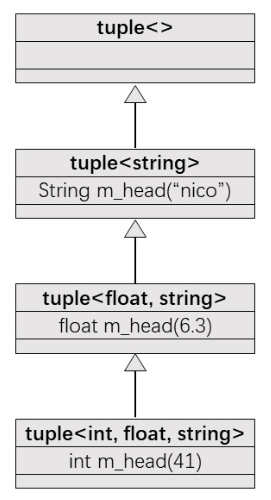
tuple是C++11提出来的, 内部实现使用的是variadic template, 所以需要特别处理. 下面给出tuple一种基于递归继承的简洁实现:
template <typename ... Values> class mytuple1; //前向申明

template <> class mytuple1<> {}; //递归终止类

template <typename Head, typename ... Tail>

class mytuple<Head, Tail...> : private mytuple1<Tail ...> //递归继承

{

    using inherited = mytuple1<Tail...>;

public:

    mytuple1() {}

    mytuple1(Head v, Tail... vtail) : m_head(v), inherited(vtail...) {}

    Head head() {return m_head;}

    inherited& tail() {return *this;}

protected:

    Head m_head;

};
mytuple1<int, float, string> t(41, 6.3, "nico");

print1(t1.head(), t1.tail().head(), t1.tail().tail().head());
上述继承关系可以表示为如下结构:
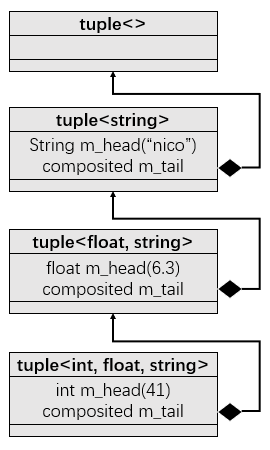
tuple还有一种递归组合的实现方式, 也列出来, 有兴趣的朋友也可以看看:
template <typename ... Values> class mytuple2;

template <> class mytuple2<> {};

template <typename Head, typename ... Tail>

class mytuple2<Head, Tail...>

{

    using composited = mytuple2<Tail...>;

public:

    mytuple2() {}

    mytuple2(Head v, Tail... vtail) : m_head(v), m_tail(vtail...) {}

    Head head() {return m_head;}

    composited& tail() {return m_tail;}

protected:

    Head m_head;

    composited m_tail;

};
结构图就不是继承了,而是组合了,与上面类似:
现在来重载tuple容器的操作符, 代码如下:
template <int IDX, int MAX, typename... Args>

struct PRINT_TUPLE {

    static void print (ostream& os, const tuple<Args...>& t){

        os << get<IDX>(t) << (IDX + 1 == MAX ? "": ",");

        PRINT_TUPLE<IDX+1, MAX, Args...>::print(os, t);

    }

};

template <int MAX, typename... Args>

struct PRINT_TUPLE<MAX, MAX, Args...> {

    static void print (ostream& os, const tuple<Args...>& t){

    }

};

template <typename ... Args>

ostream& operator << (ostream& os, const tuple<Args...>& t) {

    os << "[";

    PRINT_TUPLE<0, sizeof...(Args), Args...>::print(os, t);

    return os << "]";

}
一个技巧是通过sizeof...求出参数包的长度, 然后从建立一个索引, 依次调用get函数打印元素, 直到索引等于包的长度调用递归结束函数, 其中PRINT_TUPLE类中的是否打印逗号也是一样的道理.
结语
最后附上所有代码, 以供试玩, 建议在C++17环境运行, if constexpr是C++17引入的新功能.
#include <iostream>

#include <bitset>

#include <string>

#include <vector>

#include <tuple>

using namespace std;

// version1

void print1() {};

template <typename T, typename... Types>

void print1(const T& firstArg, const Types&... args)

{

    cout << firstArg << endl;

    print1(args...);

}

// version2

template < typename T , typename ... Types>

void print2 (const T& firstArg , const Types&... args)

{

    cout << firstArg << endl;

    if constexpr ( sizeof ...(args) > 0) print2 (args...) ;

}

// version3

template < typename T , typename ... Types>

void print3 (const T& firstArg , const Types&... args)

{

    cout << firstArg << endl ;

    initializer_list <T> {

        ( [&args] {cout << args << endl;}(), firstArg)...};

}

// version4

template <typename ... Types>

void print4 (const Types&... args)

{

    initializer_list <int> { ([&args] {cout << args << endl;}(), 0)...};

}

template < typename T , typename ... Types>

void print3_test1 (const T& firstArg , const Types&... args)

{

    cout << firstArg << endl ;

    auto i_l = initializer_list <T> {

            ( [&args] {cout << args << endl;}(), firstArg)...};

    for (auto i : i_l)

        cout << i << endl;

}

template < typename T , typename ... Types>

void print3_test2 (const T& firstArg , const Types&... args)

{

    cout << firstArg << endl ;

    auto i_l = initializer_list <T> {

            ( [&args] {cout << args << endl;}(), [&args] {cout << args << endl;}(), firstArg)...};

    for (auto i : i_l)

        cout << i << endl;

}

template <typename T>

ostream& operator << (ostream& os, const vector<T>& vec){

    os << "{ ";

    for (auto& v : vec)

        os << v << ' ';

    os << "}";

    return os;

}

template <typename ... Values> class mytuple1;

template <> class mytuple1<> {};

template <typename Head, typename ... Tail>

class mytuple1<Head, Tail...> : private mytuple1<Tail ...>

{

    using inherited = mytuple1<Tail...>;

public:

    mytuple1() {}

    mytuple1(Head v, Tail... vtail) : m_head(v), inherited(vtail...) {}

    Head head() {return m_head;}

    inherited& tail() {return *this;}

protected:

    Head m_head;

};

template <typename ... Values> class mytuple2;

template <> class mytuple2<> {};

template <typename Head, typename ... Tail>

class mytuple2<Head, Tail...>

{

    using composited = mytuple2<Tail...>;

public:

    mytuple2() {}

    mytuple2(Head v, Tail... vtail) : m_head(v), m_tail(vtail...) {}

    Head head() {return m_head;}

    composited& tail() {return m_tail;}

protected:

    Head m_head;

    composited m_tail;

};

template <int IDX, int MAX, typename... Args>

struct PRINT_TUPLE {

    static void print (ostream& os, const tuple<Args...>& t){

        os << get<IDX>(t) << (IDX + 1 == MAX ? "": ",");

        PRINT_TUPLE<IDX+1, MAX, Args...>::print(os, t);

    }

};

template <int MAX, typename... Args>

struct PRINT_TUPLE<MAX, MAX, Args...> {

    static void print (ostream& os, const tuple<Args...>& t){

    }

};

template <typename ... Args>

ostream& operator << (ostream& os, const tuple<Args...>& t) {

    os << "[";

    PRINT_TUPLE<0, sizeof...(Args), Args...>::print(os, t);

    return os << "]";

}

int main()

{

    print1(7.5, "hello", bitset<16>(377), 42);

    print2(7.5, "hello", bitset<16>(377), 42);

    print3(7.5, "hello", bitset<16>(377), 42);

    print4(7.5, "hello", bitset<16>(377), 42);

    print1(vector<int> {1, 2, 3, 4});

    print2(vector<int> {1, 2, 3, 4});

    print3(vector<int> {1, 2, 3, 4});

    print4(vector<int> {1, 2, 3, 4});

    mytuple1<int, float, string> t1(41, 6.3, "nico");

    print1(t1.head(), t1.tail().head(), t1.tail().tail().head());

    mytuple2<int, float, string> t2(41, 6.3, "nico");

    print1(t2.head(), t2.tail().head(), t2.tail().tail().head());

    cout << make_tuple(41, 6.3, "nico");

    return 0;

}
Print("到此结束!")
现代C++实现多种print的更多相关文章
- python 列表 总结
在python里创建列表和字典非常简单,这里总结一下它们的常用方法 1.创建列表 myArry = ["one", "two", "three&quo ...
- Python 简单模块学习
1. openpyxl / xlrd / xlwt => 操作Excel 文件(xlsx格式) => xlrd + xlwt : 只能操作xls文件,分别负责读写, 暂时不讨论 => ...
- python多种格式数据加载、处理与存储
多种格式数据加载.处理与存储 实际的场景中,我们会在不同的地方遇到各种不同的数据格式(比如大家熟悉的csv与txt,比如网页HTML格式,比如XML格式),我们来一起看看python如何和这些格式的数 ...
- print、sp_helptext的限制与扩展
在SQL中,使用动态SQL是很常见的.有些复杂的计算,或是存储过程,代码很长,中间可能有多次执行SQL语句.而调试拼串的SQL语句却是件痛苦的事,很难看出来运行的语句是什么.所以我会经常使用print ...
- grep(Global Regular Expression Print)
.grep -iwr --color 'hellp' /home/weblogic/demo 或者 grep -iw --color 'hellp' /home/weblogic/demo/* (-i ...
- sql语句分页多种方式ROW_NUMBER()OVER
sql语句分页多种方式ROW_NUMBER()OVER 摘自: http://www.cnblogs.com/CodingArt/articles/1692468.html 方式一 select to ...
- PHP获取时间日期的多种方法
分享下PHP获取时间日期的多种方法. <?php echo "今天:".date("Y-m-d")."<br>"; ...
- PrintWriter的print和write方法(转)
public void print(String s) {if (s == null) {s = "null";}write(s); } print只是先对s==null转换为 ...
- print流
PrintWriter和PrintStream都属于输出流,分别针对字符和字节. PrintWriter和PrintStream提供了重载的print,println方法用于多种类型的输出 Print ...
随机推荐
- Python学习笔记六(免费获取代理IP)
为获取网上免费代理IP,闲的无聊,整合了一下,免费从三个代理网站获取免费代理IP,目的是在某一代理网站被限制时,仍可从可以访问的其他网站上获取代理IP.亲测可用哦!^_^ 仅供大家参考,以下脚本可添 ...
- 【使用篇二】Quartz自动化配置集成(17)
出处:https://www.jianshu.com/p/49133c107143 定时任务在企业项目比较常用到,几乎所有的项目都会牵扯该功能模块,定时任务一般会处理指定时间点执行某一些业务逻辑.间隔 ...
- 从壹开始 [ 学调试 ]║ 轻松实现 PC端+移动端的本地同步联调
缘起 哈喽!(瞬间就想到了开场白:亲爱的朋友们,我又回来了
- thinkphp5.0学习笔记
2019-11-11学习笔记 安装TP5.0 a)源代码包下载 在thinkphp官网下载(www.thinkphp.cn)下载 完整版本的TP5.0 b) composer 安装 切换到网站的根目录 ...
- Swoole Redis 连接池的实现
概述 这是关于 Swoole 入门学习的第九篇文章:Swoole Redis 连接池的实现. 第八篇:Swoole MySQL 连接池的实现 第七篇:Swoole RPC 的实现 第六篇:Swoole ...
- slave_master_info和slave_relay_log_info中的Master_log_pos不一致
最近在研究mysql的主从,发现一个问题,我在主库做任何修改时,在从库中只有slave_relay_log_info中的Master_log_pos在变化,而slave_master_info中的Ma ...
- C# detect latest .net framework installed on PC
static void GetNetVersionDemo() { using (RegistryKey ndpKey = RegistryKey.OpenBaseKey(RegistryHive.L ...
- windows下的go get 显示进度
我的Go版本是:go1.12.7 1.在你的Go安装目录下找到 D:\Go\src\github.com\tools\godep\vendor\golang.org\x\tools\go\vcs\vs ...
- GO语言介绍以及开发环境配置
一.介绍 GO语言是静态强类型语言 静态也就是编译型语言 二.安装 1.下载地址 下载地址 https://golang.google.cn/dl/ 2.安装 Linux安装 1.下载二进制包:go1 ...
- linux下unzip解压报错“symlink error: File name too long”怎么办?提供解决方案。
点击上方↑↑↑蓝字[协议分析与还原]关注我们 " 分享unzip工具的一个bug." 最近在研究菠菜站,中间用到了Spidermonkey,碰到一些小波折,在这里分享出来,以便大家 ...