
Django rest framework(3)----节流
目录
添加节流
自定义节流的方法
- 限制60s内只能访问3次
(1)API文件夹下面新建throttle.py,代码如下:
# utils/throttle.py

from rest_framework.throttling import BaseThrottle

import time

VISIT_RECORD = {}   #保存访问记录

class VisitThrottle(BaseThrottle):

    '''60s内只能访问3次'''

    def __init__(self):

        self.history = None   #初始化访问记录

    def allow_request(self,request,view):

        #获取用户ip (get_ident)

        remote_addr = self.get_ident(request)

        ctime = time.time()

        #如果当前IP不在访问记录里面,就添加到记录

        if remote_addr not in VISIT_RECORD:

            VISIT_RECORD[remote_addr] = [ctime,]     #键值对的形式保存

            return True    #True表示可以访问

        #获取当前ip的历史访问记录

        history = VISIT_RECORD.get(remote_addr)

        #初始化访问记录

        self.history = history

        #如果有历史访问记录,并且最早一次的访问记录离当前时间超过60s,就删除最早的那个访问记录,

        #只要为True,就一直循环删除最早的一次访问记录

        while history and history[-1] < ctime - 60:

            history.pop()

        #如果访问记录不超过三次,就把当前的访问记录插到第一个位置(pop删除最后一个)

        if len(history) < 3:

            history.insert(0,ctime)

            return True

    def wait(self):

        '''还需要等多久才能访问'''

        ctime = time.time()

        return 60 - (ctime - self.history[-1])
(2)settings中全局配置节流
#全局

REST_FRAMEWORK = {

    #节流

    "DEFAULT_THROTTLE_CLASSES":['API.utils.throttle.VisitThrottle'],

}
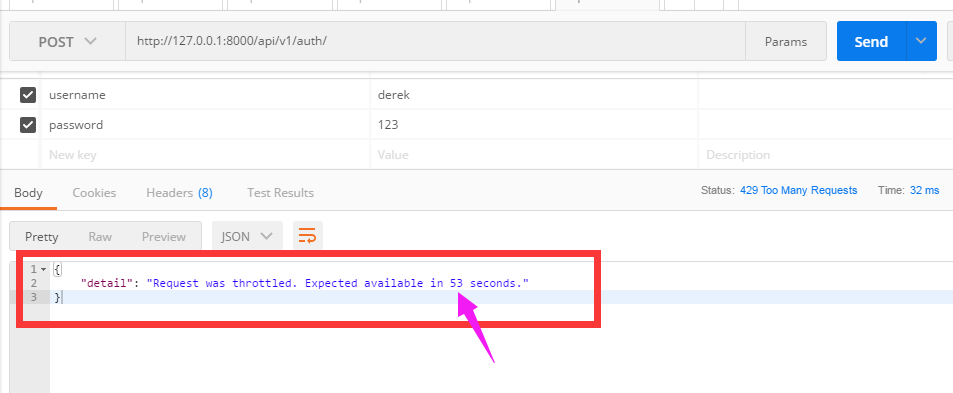
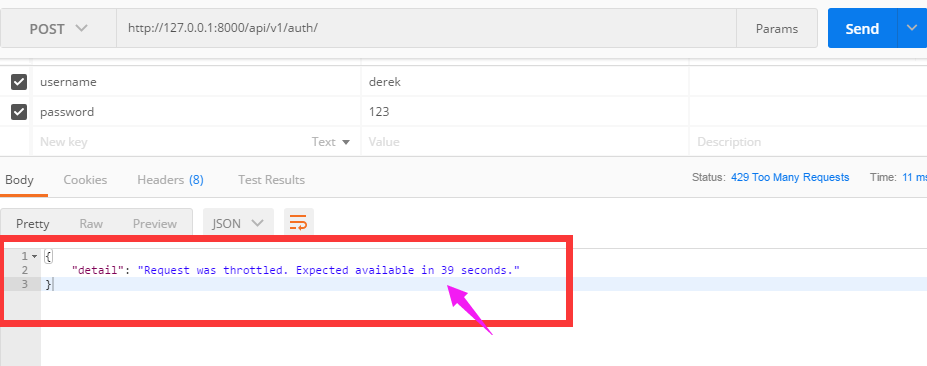
(3)现在访问auth看看结果:
- 60s内访问次数超过三次,会限制访问
- 提示剩余多少时间可以访问
接着访问
节流源码分析
(1)dispatch
 def dispatch(self, request, *args, **kwargs):

        """

        `.dispatch()` is pretty much the same as Django's regular dispatch,

        but with extra hooks for startup, finalize, and exception handling.

        """

        self.args = args

        self.kwargs = kwargs

        #对原始request进行加工,丰富了一些功能

        #Request(

        #     request,

        #     parsers=self.get_parsers(),

        #     authenticators=self.get_authenticators(),

        #     negotiator=self.get_content_negotiator(),

        #     parser_context=parser_context

        # )

        #request(原始request,[BasicAuthentications对象,])

        #获取原生request,request._request

        #获取认证类的对象,request.authticators

        #1.封装request

        request = self.initialize_request(request, *args, **kwargs)

        self.request = request

        self.headers = self.default_response_headers  # deprecate?

        try:

            #2.认证

            self.initial(request, *args, **kwargs)

            # Get the appropriate handler method

            if request.method.lower() in self.http_method_names:

                handler = getattr(self, request.method.lower(),

                                  self.http_method_not_allowed)

            else:

                handler = self.http_method_not_allowed

            response = handler(request, *args, **kwargs)

        except Exception as exc:

            response = self.handle_exception(exc)

        self.response = self.finalize_response(request, response, *args, **kwargs)

        return self.response
(2)initial
 def initial(self, request, *args, **kwargs):

        """

        Runs anything that needs to occur prior to calling the method handler.

        """

        self.format_kwarg = self.get_format_suffix(**kwargs)

        # Perform content negotiation and store the accepted info on the request

        neg = self.perform_content_negotiation(request)

        request.accepted_renderer, request.accepted_media_type = neg

        # Determine the API version, if versioning is in use.

        version, scheme = self.determine_version(request, *args, **kwargs)

        request.version, request.versioning_scheme = version, scheme

        # Ensure that the incoming request is permitted

        #4.实现认证

        self.perform_authentication(request)

        #5.权限判断

        self.check_permissions(request)

        #6.控制访问频率

        self.check_throttles(request)
(3)check_throttles
里面有个allow_request
    def check_throttles(self, request):

        """

        Check if request should be throttled.

        Raises an appropriate exception if the request is throttled.

        """

        for throttle in self.get_throttles():

            if not throttle.allow_request(request, self):

                self.throttled(request, throttle.wait())
(4)get_throttles
    def get_throttles(self):

        """

        Instantiates and returns the list of throttles that this view uses.

        """

        return [throttle() for throttle in self.throttle_classes]
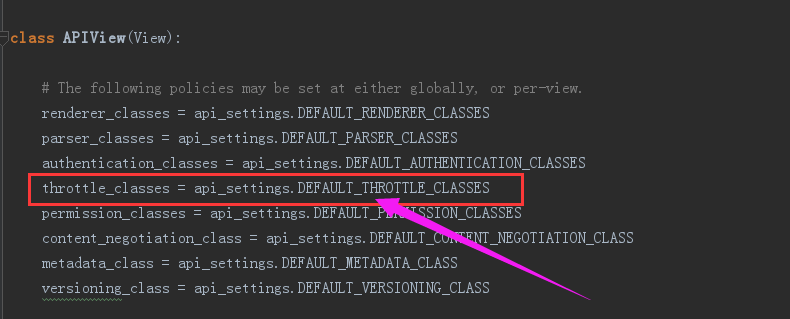
(5)thtottle_classes
内置节流类
上面是写的自定义节流,drf内置了很多节流的类,用起来比较方便。
(1)BaseThrottle
- 自己要写allow_request和wait方法
- get_ident就是获取ip
class BaseThrottle(object):

    """

    Rate throttling of requests.

    """

    def allow_request(self, request, view):

        """

        Return `True` if the request should be allowed, `False` otherwise.

        """

        raise NotImplementedError('.allow_request() must be overridden')

    def get_ident(self, request):

        """

        Identify the machine making the request by parsing HTTP_X_FORWARDED_FOR

        if present and number of proxies is > 0. If not use all of

        HTTP_X_FORWARDED_FOR if it is available, if not use REMOTE_ADDR.

        """

        xff = request.META.get('HTTP_X_FORWARDED_FOR')

        remote_addr = request.META.get('REMOTE_ADDR')

        num_proxies = api_settings.NUM_PROXIES

        if num_proxies is not None:

            if num_proxies == 0 or xff is None:

                return remote_addr

            addrs = xff.split(',')

            client_addr = addrs[-min(num_proxies, len(addrs))]

            return client_addr.strip()

        return ''.join(xff.split()) if xff else remote_addr

    def wait(self):

        """

        Optionally, return a recommended number of seconds to wait before

        the next request.

        """

        return None
(2)SimpleRateThrottle
class SimpleRateThrottle(BaseThrottle):

    """

    A simple cache implementation, that only requires `.get_cache_key()`

    to be overridden.

    The rate (requests / seconds) is set by a `rate` attribute on the View

    class.  The attribute is a string of the form 'number_of_requests/period'.

    Period should be one of: ('s', 'sec', 'm', 'min', 'h', 'hour', 'd', 'day')

    Previous request information used for throttling is stored in the cache.

    """

    cache = default_cache

    timer = time.time

    cache_format = 'throttle_%(scope)s_%(ident)s'

    scope = None   #这个值自定义,写什么都可以

    THROTTLE_RATES = api_settings.DEFAULT_THROTTLE_RATES

    def __init__(self):

        if not getattr(self, 'rate', None):

            self.rate = self.get_rate()

        self.num_requests, self.duration = self.parse_rate(self.rate)

    def get_cache_key(self, request, view):

        """

        Should return a unique cache-key which can be used for throttling.

        Must be overridden.

        May return `None` if the request should not be throttled.

        """

        raise NotImplementedError('.get_cache_key() must be overridden')

    def get_rate(self):

        """

        Determine the string representation of the allowed request rate.

        """

        if not getattr(self, 'scope', None):

            msg = ("You must set either `.scope` or `.rate` for '%s' throttle" %

                   self.__class__.__name__)

            raise ImproperlyConfigured(msg)

        try:

            return self.THROTTLE_RATES[self.scope]

        except KeyError:

            msg = "No default throttle rate set for '%s' scope" % self.scope

            raise ImproperlyConfigured(msg)

    def parse_rate(self, rate):

        """

        Given the request rate string, return a two tuple of:

        <allowed number of requests>, <period of time in seconds>

        """

        if rate is None:

            return (None, None)

        num, period = rate.split('/')

        num_requests = int(num)

        duration = {'s': 1, 'm': 60, 'h': 3600, 'd': 86400}[period[0]]

        return (num_requests, duration)

    def allow_request(self, request, view):

        """

        Implement the check to see if the request should be throttled.

        On success calls `throttle_success`.

        On failure calls `throttle_failure`.

        """

        if self.rate is None:

            return True

        self.key = self.get_cache_key(request, view)

        if self.key is None:

            return True

        self.history = self.cache.get(self.key, [])

        self.now = self.timer()

        # Drop any requests from the history which have now passed the

        # throttle duration

        while self.history and self.history[-1] <= self.now - self.duration:

            self.history.pop()

        if len(self.history) >= self.num_requests:

            return self.throttle_failure()

        return self.throttle_success()

    def throttle_success(self):

        """

        Inserts the current request's timestamp along with the key

        into the cache.

        """

        self.history.insert(0, self.now)

        self.cache.set(self.key, self.history, self.duration)

        return True

    def throttle_failure(self):

        """

        Called when a request to the API has failed due to throttling.

        """

        return False

    def wait(self):

        """

        Returns the recommended next request time in seconds.

        """

        if self.history:

            remaining_duration = self.duration - (self.now - self.history[-1])

        else:

            remaining_duration = self.duration

        available_requests = self.num_requests - len(self.history) + 1

        if available_requests <= 0:

            return None

        return remaining_duration / float(available_requests)
我们可以通过继承SimpleRateThrottle类,来实现节流,会更加的简单,因为SimpleRateThrottle里面都帮我们写好了
(1)throttle.py
from rest_framework.throttling import SimpleRateThrottle

class VisitThrottle(SimpleRateThrottle):

    '''匿名用户60s只能访问三次(根据ip)'''

    scope = 'NBA'   #这里面的值,自己随便定义,settings里面根据这个值配置Rate

    def get_cache_key(self, request, view):

        #通过ip限制节流

        return self.get_ident(request)

class UserThrottle(SimpleRateThrottle):

    '''登录用户60s可以访问10次'''

    scope = 'NBAUser'    #这里面的值,自己随便定义,settings里面根据这个值配置Rate

    def get_cache_key(self, request, view):

        return request.user.username
(2)settings.py
#全局

REST_FRAMEWORK = {

    #节流

    "DEFAULT_THROTTLE_CLASSES":['API.utils.throttle.UserThrottle'],   #全局配置,登录用户节流限制(10/m)

    "DEFAULT_THROTTLE_RATES":{

        'NBA':'3/m',         #没登录用户3/m,NBA就是scope定义的值

        'NBAUser':'10/m',    #登录用户10/m,NBAUser就是scope定义的值

    }

}
(3)views.py
局部配置方法
class AuthView(APIView):

    .

    .

    .

    # 默认的节流是登录用户(10/m),AuthView不需要登录,这里用匿名用户的节流(3/m)

    throttle_classes = [VisitThrottle,]
   .
    .
from django.shortcuts import render,HttpResponse

from django.http import JsonResponse

from rest_framework.views import APIView

from API import models

from rest_framework.request import Request

from rest_framework import exceptions

from rest_framework.authentication import BaseAuthentication

from API.utils.permission import SVIPPremission,MyPremission

from API.utils.throttle import  VisitThrottle

ORDER_DICT = {

    1:{

        'name':'apple',

        'price':15

    },

    2:{

        'name':'dog',

        'price':100

    }

}

def md5(user):

    import hashlib

    import time

    #当前时间,相当于生成一个随机的字符串

    ctime = str(time.time())

    m = hashlib.md5(bytes(user,encoding='utf-8'))

    m.update(bytes(ctime,encoding='utf-8'))

    return m.hexdigest()

class AuthView(APIView):

    '''用于用户登录验证'''

    authentication_classes = []      #里面为空,代表不需要认证

    permission_classes = []          #不里面为空,代表不需要权限

    # 默认的节流是登录用户(10/m),AuthView不需要登录,这里用匿名用户的节流(3/m)

    throttle_classes = [VisitThrottle,]

    def post(self,request,*args,**kwargs):

        ret = {'code':1000,'msg':None}

        try:

            user = request._request.POST.get('username')

            pwd = request._request.POST.get('password')

            obj = models.UserInfo.objects.filter(username=user,password=pwd).first()

            if not obj:

                ret['code'] = 1001

                ret['msg'] = '用户名或密码错误'

            #为用户创建token

            token = md5(user)

            #存在就更新,不存在就创建

            models.UserToken.objects.update_or_create(user=obj,defaults={'token':token})

            ret['token'] = token

        except Exception as e:

            ret['code'] = 1002

            ret['msg'] = '请求异常'

        return JsonResponse(ret)

class OrderView(APIView):

    '''

    订单相关业务(只有SVIP用户才能看)

    '''

    def get(self,request,*args,**kwargs):

        self.dispatch

        #request.user

        #request.auth

        ret = {'code':1000,'msg':None,'data':None}

        try:

            ret['data'] = ORDER_DICT

        except Exception as e:

            pass

        return JsonResponse(ret)

class UserInfoView(APIView):

    '''

       订单相关业务(普通用户和VIP用户可以看)

       '''

    permission_classes = [MyPremission,]    #不用全局的权限配置的话,这里就要写自己的局部权限

    def get(self,request,*args,**kwargs):

        print(request.user)

        return HttpResponse('用户信息')
views.py
说明:
- API.utils.throttle.UserThrottle 这个是全局配置(根据ip限制,10/m)
- DEFAULT_THROTTLE_RATES --->>>设置访问频率的
- throttle_classes = [VisitThrottle,] --->>>局部配置(不适用settings里面默认的全局配置)
总结
基本使用
- 创建类,继承BaseThrottle, 实现:allow_request ,wait
- 创建类,继承SimpleRateThrottle, 实现: get_cache_key, scope='NBA' (配置文件中的key)
全局
   #节流

    "DEFAULT_THROTTLE_CLASSES":['API.utils.throttle.UserThrottle'],   #全局配置,登录用户节流限制(10/m)

    "DEFAULT_THROTTLE_RATES":{

        'NBA':'3/m',         #没登录用户3/m,NBA就是scope定义的值

        'NBAUser':'10/m',    #登录用户10/m,NBAUser就是scope定义的值

    }

}
局部
throttle_classes = [VisitThrottle,]
所有代码
认证、权限和节流
# MyProject/urls.py

from django.contrib import admin

from django.urls import path

from API.views import AuthView,OrderView,UserInfoView

urlpatterns = [

    path('admin/', admin.site.urls),

    path('api/v1/auth/',AuthView.as_view()),

    path('api/v1/order/',OrderView.as_view()),

    path('api/v1/info/',UserInfoView.as_view()),

]
MyProject/urls.py
#全局

REST_FRAMEWORK = {

    #认证

    "DEFAULT_AUTHENTICATION_CLASSES":['API.utils.auth.Authentication',],

    #权限

    "DEFAULT_PERMISSION_CLASSES":['API.utils.permission.SVIPPermission'],

    #节流

    "DEFAULT_THROTTLE_CLASSES":['API.utils.throttle.UserThrottle'],   #全局配置,登录用户节流限制(10/m)

    "DEFAULT_THROTTLE_RATES":{

        'NBA':'3/m',         #没登录用户3/m,NBA就是scope定义的值

        'NBAUser':'10/m',    #登录用户10/m,NBAUser就是scope定义的值

    }

}
settings.py
# API/models.py

from django.db import models

class UserInfo(models.Model):

    USER_TYPE = (

        (1,'普通用户'),

        (2,'VIP'),

        (3,'SVIP')

    )

    user_type = models.IntegerField(choices=USER_TYPE)

    username = models.CharField(max_length=32)

    password = models.CharField(max_length=64)

class UserToken(models.Model):

    user = models.OneToOneField(UserInfo,on_delete=models.CASCADE)

    token = models.CharField(max_length=64)
API/models.py
# API/views.py

from django.shortcuts import render,HttpResponse

from django.http import JsonResponse

from rest_framework.views import APIView

from API import models

from rest_framework.request import Request

from rest_framework import exceptions

from rest_framework.authentication import BaseAuthentication

from API.utils.permission import SVIPPermission,MyPermission

from API.utils.throttle import  VisitThrottle

ORDER_DICT = {

    1:{

        'name':'apple',

        'price':15

    },

    2:{

        'name':'dog',

        'price':100

    }

}

def md5(user):

    import hashlib

    import time

    #当前时间,相当于生成一个随机的字符串

    ctime = str(time.time())

    m = hashlib.md5(bytes(user,encoding='utf-8'))

    m.update(bytes(ctime,encoding='utf-8'))

    return m.hexdigest()

class AuthView(APIView):

    '''用于用户登录验证'''

    authentication_classes = []      #里面为空,代表不需要认证

    permission_classes = []          #不里面为空,代表不需要权限

    # 默认的节流是登录用户(10/m),AuthView不需要登录,这里用匿名用户的节流(3/m)

    throttle_classes = [VisitThrottle,]

    def post(self,request,*args,**kwargs):

        ret = {'code':1000,'msg':None}

        try:

            user = request._request.POST.get('username')

            pwd = request._request.POST.get('password')

            obj = models.UserInfo.objects.filter(username=user,password=pwd).first()

            if not obj:

                ret['code'] = 1001

                ret['msg'] = '用户名或密码错误'

            #为用户创建token

            token = md5(user)

            #存在就更新,不存在就创建

            models.UserToken.objects.update_or_create(user=obj,defaults={'token':token})

            ret['token'] = token

        except Exception as e:

            ret['code'] = 1002

            ret['msg'] = '请求异常'

        return JsonResponse(ret)

class OrderView(APIView):

    '''

    订单相关业务(只有SVIP用户才能看)

    '''

    def get(self,request,*args,**kwargs):

        self.dispatch

        #request.user

        #request.auth

        ret = {'code':1000,'msg':None,'data':None}

        try:

            ret['data'] = ORDER_DICT

        except Exception as e:

            pass

        return JsonResponse(ret)

class UserInfoView(APIView):

    '''

       订单相关业务(普通用户和VIP用户可以看)

       '''

    permission_classes = [MyPermission,]    #不用全局的权限配置的话,这里就要写自己的局部权限

    def get(self,request,*args,**kwargs):

        print(request.user)

        return HttpResponse('用户信息')
API/views.py
# API/utils/auth/py

from rest_framework import exceptions

from API import models

from rest_framework.authentication import BaseAuthentication

class Authentication(BaseAuthentication):

    '''用于用户登录验证'''

    def authenticate(self,request):

        token = request._request.GET.get('token')

        token_obj = models.UserToken.objects.filter(token=token).first()

        if not token_obj:

            raise exceptions.AuthenticationFailed('用户认证失败')

        #在rest framework内部会将这两个字段赋值给request,以供后续操作使用

        return (token_obj.user,token_obj)

    def authenticate_header(self, request):

        pass
API/utils/auth/py
# utils/permission.py

from rest_framework.permissions import BasePermission

class SVIPPermission(BasePermission):

    message = "必须是SVIP才能访问"

    def has_permission(self,request,view):

        if request.user.user_type != 3:

            return False

        return True

class MyPermission(BasePermission):

    def has_permission(self,request,view):

        if request.user.user_type == 3:

            return False

        return True
utils/permission.py
# utils/throttle.py

#

# from rest_framework.throttling import BaseThrottle

# import time

# VISIT_RECORD = {}   #保存访问记录

#

# class VisitThrottle(BaseThrottle):

#     '''60s内只能访问3次'''

#     def __init__(self):

#         self.history = None   #初始化访问记录

#

#     def allow_request(self,request,view):

#         #获取用户ip (get_ident)

#         remote_addr = self.get_ident(request)

#         ctime = time.time()

#         #如果当前IP不在访问记录里面,就添加到记录

#         if remote_addr not in VISIT_RECORD:

#             VISIT_RECORD[remote_addr] = [ctime,]     #键值对的形式保存

#             return True    #True表示可以访问

#         #获取当前ip的历史访问记录

#         history = VISIT_RECORD.get(remote_addr)

#         #初始化访问记录

#         self.history = history

#

#         #如果有历史访问记录,并且最早一次的访问记录离当前时间超过60s,就删除最早的那个访问记录,

#         #只要为True,就一直循环删除最早的一次访问记录

#         while history and history[-1] < ctime - 60:

#             history.pop()

#         #如果访问记录不超过三次,就把当前的访问记录插到第一个位置(pop删除最后一个)

#         if len(history) < 3:

#             history.insert(0,ctime)

#             return True

#

#     def wait(self):

#         '''还需要等多久才能访问'''

#         ctime = time.time()

#         return 60 - (ctime - self.history[-1])

from rest_framework.throttling import SimpleRateThrottle

class VisitThrottle(SimpleRateThrottle):

    '''匿名用户60s只能访问三次(根据ip)'''

    scope = 'NBA'   #这里面的值,自己随便定义,settings里面根据这个值配置Rate

    def get_cache_key(self, request, view):

        #通过ip限制节流

        return self.get_ident(request)

class UserThrottle(SimpleRateThrottle):

    '''登录用户60s可以访问10次'''

    scope = 'NBAUser'    #这里面的值,自己随便定义,settings里面根据这个值配置Rate

    def get_cache_key(self, request, view):

        return request.user.username
utils/throttle.py
Django rest framework(3)----节流的更多相关文章
- Django Rest framework 之 节流
RESTful 规范 django rest framework 之 认证(一) django rest framework 之 权限(二) django rest framework 之 节流(三) ...
- Django Rest framework 之 序列化
RESTful 规范 django rest framework 之 认证(一) django rest framework 之 权限(二) django rest framework 之 节流(三) ...
- Django Rest framework 之 解析器
RESTful 规范 django rest framework 之 认证(一) django rest framework 之 权限(二) django rest framework 之 节流(三) ...
- Django Rest framework 之 版本
RESTful 规范 django rest framework 之 认证(一) django rest framework 之 权限(二) django rest framework 之 节流(三) ...
- Django Rest framework 之 权限
django rest framework 之 认证(一) django rest framework 之 权限(二) django rest framework 之 节流(三) django res ...
- Django Rest framework 之 认证
django rest framework 官网 django rest framework 之 认证(一) django rest framework 之 权限(二) django rest fra ...
- Django Rest framework 之 视图
RESTful 规范 django rest framework 之 认证(一) django rest framework 之 权限(二) django rest framework 之 节流(三) ...
- Django Rest framework 之 分页
RESTful 规范 django rest framework 之 认证(一) django rest framework 之 权限(二) django rest framework 之 节流(三) ...
- Django rest framework源码分析(3)----节流
目录 Django rest framework(1)----认证 Django rest framework(2)----权限 Django rest framework(3)----节流 Djan ...
随机推荐
- wpf的webbrowser与javascript交互
JS调用C#代码 HTML代码: <button onclick="window.external.Test('called from script code')"> ...
- WPF——TargetNullValue(如何在绑定空值显示默认字符)
原文:WPF--TargetNullValue(如何在绑定空值显示默认字符) 说明:在数据绑定时,如果有些字段为空值,那么在数据绑定时可以用默认值来显示为空的字段. </Grid> { L ...
- qmake.exe是在Qt安装编译时生成的,里面内嵌了Qt相关的一些路径(最简单的方法是保持一样的安装路径,最方便的办法是设置qt.conf文件)
在网上直接下载别人编译好的Qt库,为自己使用省了不少事.但往往也会遇到些问题,其中Qt version is not properly installed,please run make instal ...
- DBLINK学习
1.连接本地scott用户查看拥有的表 [oracle@ORADG ~]$ sqlplus scott/tiger SQL> select * from tab; TNAME ...
- ORACLE 11.2.0.4 安装在 rhel6 上
. 修改host文件,添加本机的host记录 [root@RACDG ~]# vi /etc/hosts 127.0.0.1 localhost localhost.localdomain local ...
- 我怎么忽略了身份框架魔法,只是使用OWIN验证的中间件,以获得要求我寻求什么呢?
该OWIN中间件的东西第三方登录集成到您的ASP.NET应用程序是非常酷的,但我似乎无法弄清楚如何就剜出来的新的ID,它取代了蹩脚的成员身份 API.我没有兴趣在坚持所产生的债权,并在英法为基础的数据 ...
- Webpack Waringing Critical dependencies
报错信息如下: 出错原因先上图: 未注释部分使用了require的同时使用了es6的语法. 官方解释如下: 解决方法就是放开代码中的注释部分,不要使用es6语法
- 不仅仅是百万级TCP长连接框架 t-io
t-io: 不仅仅是百万级TCP长连接框架 t-io是基于jdk aio实现的易学易用.稳定.性能强悍.将多线程运用到极致.内置功能丰富的即时通讯框架(广义上的即时通讯,并非指im),字母 t 寓意t ...
- 配置 ClientIDMode 控件ID生成规则
废话不说先例子: <asp:GridView ID="grd" runat="server"AutoGenerateColumns="False ...
- ThreadLocal使用原理、注意问题、使用场景
想必很多朋友对ThreadLocal并不陌生,今天我们就来一起探讨下ThreadLocal的使用方法和实现原理.首先,本文先谈一下对ThreadLocal的理解,然后根据ThreadLocal类的源码 ...