
【译】ModSecurity事务生命周期
本篇简要介绍ModSecurity Transaction Lifecycle,也即ModSecurity的事务生命周期。
Transaction Lifecycle
In ModSecurity, every transaction goes through five steps, or phases. In each of the phases, ModSecurity will perform some work at the beginning (e.g., parse data that has become avail- able), invoke the rules specified to work in that phase, and perhaps perform a task or two after the phase rules have finished. At first glance, it may seem that five phases are too many, but there’s a reason that each phase exists. There is always one task, sometimes several, that can only be performed at a particular moment in the transaction lifecycle.
在ModSecurity中,每个事务都经过五个步骤或阶段。在每个阶段中,ModSecurity都将在开始时执行一些工作(例如,解析可用的数据),调用指定在该阶段中工作的规则,并可能在阶段规则完成后执行一两个任务。乍一看,似乎阶段太多了,但是每个阶段都存在一个原因。总是有一个任务,有时是几个,只能在事务生命周期的特定时刻执行。
Request headers (1)
The request headers phase is the first entry point for ModSecurity. The principal pur- pose of this phase is to allow rule writers to assess a request before the costly request body processing is undertaken. Similarly, there is often a need to influence how Mod- Security will process a request body, and in this phase is the time to do it. For example, ModSecurity will not parse an XML or JSON request body by default, but you can in- struct it do so by placing the appropriate rules into phase 1.
请求头阶段是ModSecurity的第一个入口点。此阶段的主要目的是允许规则编写器在执行代价高昂的请求正文处理之前评估请求。类似地,经常需要影响Mod-Security如何处理请求主体,在这个阶段是时候这样做了。例如,默认情况下,ModSecurity不会解析XML或JSON请求体,但您可以通过在阶段1中放置适当的规则来指示其进行相应的操作。
Request body (2)
The request body phase is the main request analysis phase and takes place immediately after a complete request body has been received and processed. The rules in this phase have all the available request data at their disposal. Afterward, the web server will either generate the response itself (in embedded mode) or forward the transaction to a back- end web server (in reverse proxy mode).
请求正文阶段是主要的请求分析阶段,在接收和处理完完整的请求正文之后立即进行。这个阶段的规则拥有所有可用的请求数据。之后,web服务器将生成响应本身(在嵌入式模式下)或将事务转发到后端web服务器(在反向代理模式下)。
Response headers (3)
The response headers phase takes place after response headers become available but before a response body is read. The rules that need to decide whether to inspect a re- sponse body should run in this phase.
响应头阶段发生在响应头可用之后,但在读取响应体之前。需要决定是否检查响应主体的规则应该在这个阶段运行。
Response body (4)
The response body phase is the main response analysis phase. By the time this phase begins, the response body will have been read and all its data made available for the rules to make their decisions.
响应体阶段是主要的响应分析阶段。到这个阶段开始时,响应体已经被读取,并且所有的数据都可以供规则做出决定。
Logging (5)
The logging phase is special. It’s the only phase from which you cannot block. By the time this phase runs, the transaction will have finished, so there’s little you can do but record the fact that it happened. Rules in this phase are run to control how logging is performed or to save information in persistent storage.
日志记录阶段是特殊的。这是你唯一无法阻止的阶段。到这个阶段运行时,事务将完成,所以除了记录它发生的事实之外,您几乎无能为力。此阶段中的规则用于控制如何执行日志记录或将信息保存在持久性存储中。
图示
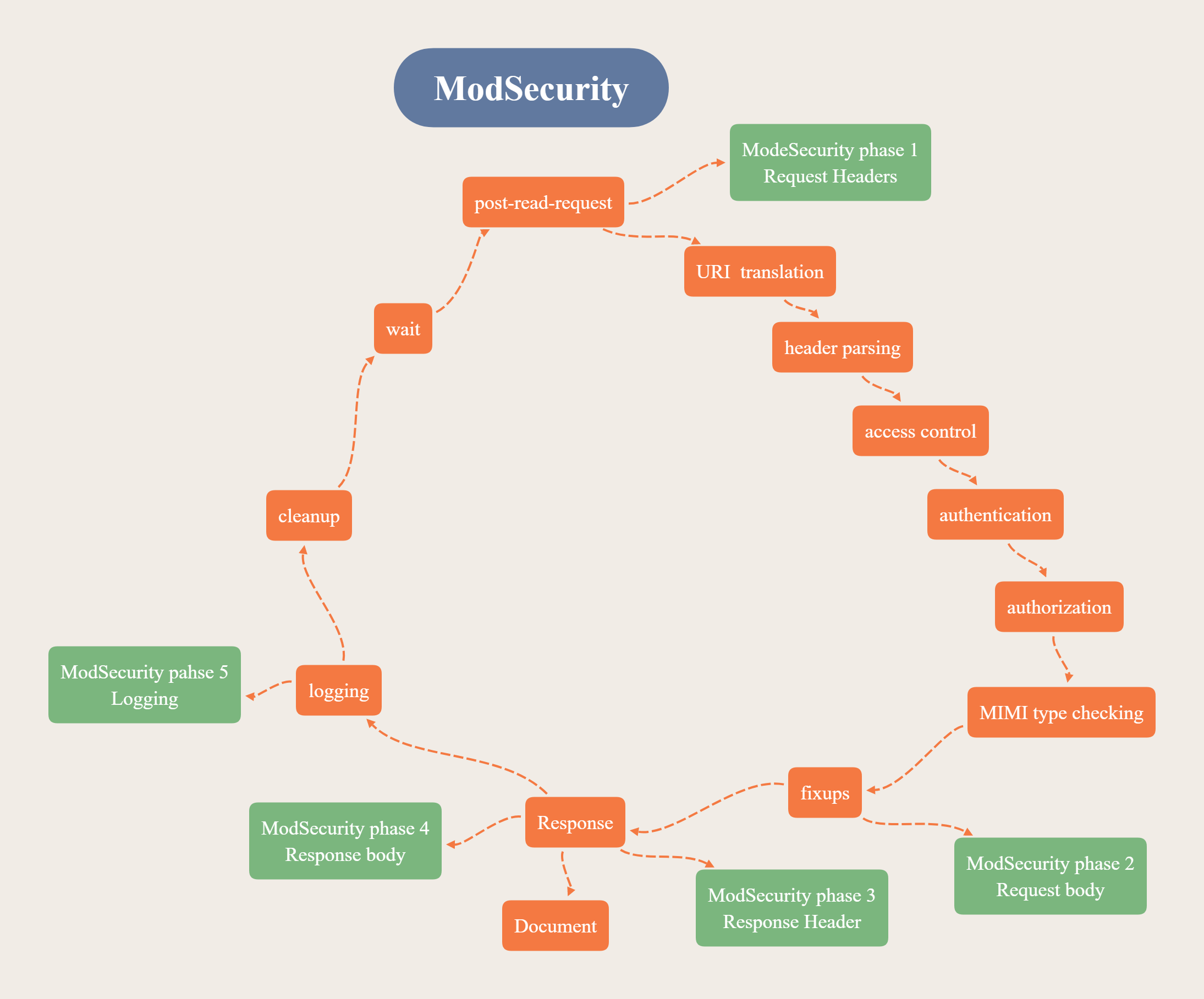
ModSecurity 事务生命周期的5个阶段图示如下。
The End.
【译】ModSecurity事务生命周期的更多相关文章
- [译] ASP.NET 生命周期 – ASP.NET 上下文对象(六)
使用 HttpApplication 对象 ASP.NET 框架中的许多类都提供了许多很方便的属性可以直接映射到 HttpContext 类中定义的属性.这种交叠有一个很好的例子就是 HttpAppl ...
- [译] ASP.NET 生命周期 – ASP.NET 上下文对象(五)
ASP.NET 上下文对象 ASP.NET 提供了一系列对象用来给当前请求,将要返回到客户端的响应,以及 Web 应用本身提供上下文信息.间接的,这些上下文对象也可以用来回去核心 ASP.NET 框架 ...
- [译] ASP.NET 生命周期 – ASP.NET 请求生命周期(四)
不使用特殊方法来处理请求生命周期事件 HttpApplication 类是全局应用类的基类,定义了可以直接使用的一般 C# 事件.那么使用标准 C# 事件还是特殊方法那就是个人偏好的问题了,如果喜欢, ...
- [译] ASP.NET 生命周期 – ASP.NET 请求生命周期(三)
使用特殊方法处理请求生命周期事件 为了在全局应用类中处理这些事件,我们会创建一个名称以 Application_ 开头,以事件名称结尾的方法,比如 Application_BeginRequest.举 ...
- [译] ASP.NET 生命周期 – ASP.NET 请求生命周期(二)
ASP.NET 请求生命周期 全局应用类也可以用来跟踪每个独立请求的生命周期,包括请求从 ASP.NET 平台传递到 MVC 框架.ASP.NET 框架会创建一个定义在 Global.asax 文件中 ...
- [译] ASP.NET 生命周期 – ASP.NET 应用生命周期(一)
概述 ASP.NET 平台定义了两个非常重要的生命周期.第一个是 应用生命周期 (application life cycle),用来追踪应用从启动的那一刻到终止的那一刻.另一个就是 请求生命周期 ...
- [译] ASP.NET 生命周期 – ASP.NET 上下文对象(八)
使用 HttpResponse 对象 HttpResponse 对象是与 HttpRequest 对象相对应的,用来表示构建中的响应.它当中提供了方法和属性可供我们自定义响应,有一些在使用 MVC 视 ...
- [译] ASP.NET 生命周期 – ASP.NET 上下文对象(七)
使用 HttpRequest 对象 HttpRequest 对象描述的是一个正在被处理的 HTTP 请求.下表列举了 HttpRequest 中的属性,它们提供了当前请求的相关信息(HttpReque ...
- JavaEE(9) - Session EJB的生命周期、事务及拦截器
1. SessionBean的生命周期 无状态Session Bean: 不存在状态-->待命状态-->被销毁状态 不存在状态-->待命状态: 1)通过构造器创建EJB实例 2)执行 ...
随机推荐
- 【漏洞复现】Apache Solr远程代码执行(CVE-2019-0193)
0x01 概述 Solr简介 Apache Solr 是一个开源的企业级搜索服务器.Solr 使用 Java 语言开发,主要基于 HTTP 和 Apache Lucene 实现.Apache Solr ...
- 安装Linux基本工具
yum install wget httpd-tools vim lrzsz Linux安装wget:yum -y install wget Linux安装vim编辑器:yum -y install ...
- Linux查看系统基本信息、版本信息等
Linux下如何查看版本信息, 包括位数.版本信息以及CPU内核信息.CPU具体型号 1.uname -a (Linux查看版本当前操作系统内核信息) 2.cat /proc/version (L ...
- 【Android - IPC】之Binder机制简介
参考资料: 1.<Android开发艺术探索>第二章2.3.3 Binder 2.[Android Binder设计与实现-设计篇] 3.[Android Binder机制介绍] 1. 什 ...
- centos 7 MysSQL 5.7.23 二进制安装
MySQL 5.7.23 二进制安装 CentOS 7 将默认数据库MySQL替换成了Mariadb. 这里会从系统的环境准备开始一步一步安装. 环境准备 系统版本 内核版本 IP地址 Centos ...
- Server MyEclipse Tomcat v7.0 was unable to start within 45 seconds. If the server requires more time
启动Tomcat服务器时经常遇到这个错误, Server MyEclipse Tomcat v7.0 was unable to start within 45 seconds. If the ser ...
- centos7.6安装python3.7
1.安装python3.7后,需要: yum install libffi-devel -y 然后再到python源码目录再make install 重新编译一下. 否则pip安装一些包时会安装不上, ...
- Spring Cloud系列-Zuul网关集成JWT身份验证
前言 这两三年项目中一直在使用比较流行的spring cloud框架,也算有一定积累,打算有时间就整理一些干货与大家分享. 本次分享zuul网关集成jwt身份验证 业务背景 项目开发少不了身份认证,j ...
- 请问1^x+2^x+3^x+\cdots +n^x的算式是什么呢?
目录 总结 请问\(1^x+2^x+3^x+\cdots +n^x\)的算式是什么呢? 一.求和式\(\sum\limits_{i=1}^n{i}\)的算式 如何证明求和简式\(\sum_{i=1}^ ...
- 成为高手前必懂的TCP干货【华为云技术分享】
版权声明:本文为博主原创文章,遵循CC 4.0 BY-SA版权协议,转载请附上原文出处链接和本声明. 本文链接:https://blog.csdn.net/devcloud/article/detai ...