
04 Django REST Framework 认证、权限和限制
目前,我们的API对谁可以编辑或删除代码段没有任何限制。我们希望有更高级的行为,以确保:
- 代码片段始终与创建者相关联。
- 只有通过身份验证的用户可以创建片段。
- 只有代码片段的创建者可以更新或删除它。
- 未经身份验证的请求应具有完全只读访问权限。
01-认证
REST framework 提供了一些开箱即用的身份验证方案,并且还允许你实现自定义方案。
1.1-自定义Token认证
定义一个用户表和一个保存用户Token的表:
class UserInfo(models.Model):

    username = models.CharField(max_length=16)

    password = models.CharField(max_length=32)

    type = models.SmallIntegerField(

        choices=((1, '普通用户'), (2, 'VIP用户')),

        default=1

    )

class Token(models.Model):

    user = models.OneToOneField(to='UserInfo')

    token_code = models.CharField(max_length=128)
1.2-定义一个登录视图
def get_random_token(username):

    """

    根据用户名和时间戳生成随机token

    :param username:

    :return:

    """

    import hashlib, time

    timestamp = str(time.time())

    m = hashlib.md5(bytes(username, encoding="utf8"))

    m.update(bytes(timestamp, encoding="utf8"))

    return m.hexdigest()

class LoginView(APIView):

    """

    校验用户名密码是否正确从而生成token的视图

    """

    def post(self, request):

        res = {"code": 0}

        print(request.data)

        username = request.data.get("username")

        password = request.data.get("password")

        user = models.UserInfo.objects.filter(username=username, password=password).first()

        if user:

            # 如果用户名密码正确

            token = get_random_token(username)

            models.Token.objects.update_or_create(defaults={"token_code": token}, user=user)

            res["token"] = token

        else:

            res["code"] = 1

            res["error"] = "用户名或密码错误"

        return Response(res)
1.3-定义一个认证类
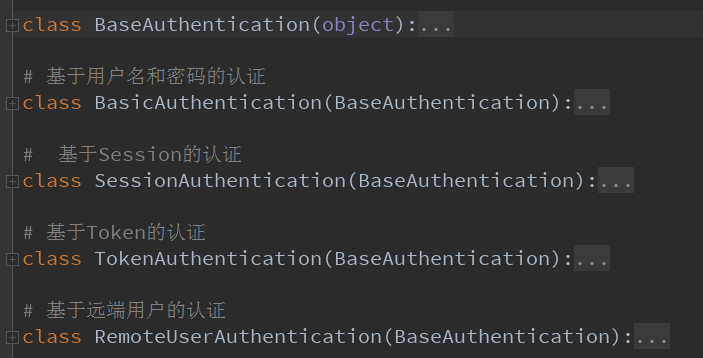
我们自己写的认证类都要继承内置认证类 "BaseAuthentication"
class BaseAuthentication(object):

    """

    All authentication classes should extend BaseAuthentication.

    """

    def authenticate(self, request):

        """

        Authenticate the request and return a two-tuple of (user, token).

        """

        #内置的认证类,authenticate方法,如果不自己写,默认则抛出异常

        raise NotImplementedError(".authenticate() must be overridden.")

    def authenticate_header(self, request):

        """

        Return a string to be used as the value of the `WWW-Authenticate`

        header in a `401 Unauthenticated` response, or `None` if the

        authentication scheme should return `403 Permission Denied` responses.

        """

        #authenticate_header方法,作用是当认证失败的时候,返回的响应头

        pass
BaseAuthentication源码
from rest_framework.authentication import BaseAuthentication

from rest_framework.exceptions import AuthenticationFailed

class MyAuth(BaseAuthentication):

    def authenticate(self, request):

        if request.method in ["POST", "PUT", "DELETE"]:

            request_token = request.data.get("token", None)

            if not request_token:

                raise AuthenticationFailed('缺少token')

            token_obj = models.Token.objects.filter(token_code=request_token).first()

            if not token_obj:

                raise AuthenticationFailed('无效的token')

            return token_obj.user.username, None

        else:

            return None, None

    def authenticate_header(self, request):

        pass
1.4-视图级别认证
class CommentViewSet(ModelViewSet):

    queryset = models.Comment.objects.all()

    serializer_class = app01_serializers.CommentSerializer

    authentication_classes = [MyAuth, ]
1.5-全局级别认证
# 在settings.py中配置

REST_FRAMEWORK = {

    "DEFAULT_AUTHENTICATION_CLASSES": ["app01.utils.MyAuth", ]

}
1.6 在settings里面设置的全局认证,所有业务都需要经过认证,如果想让某个不需要认证,只需要在其中添加下面的代码:
authentication_classes = [] #里面为空,代表不需要认证
02-权限
只有VIP用户才能看的内容。premission.py
2.1-内置权限验证类
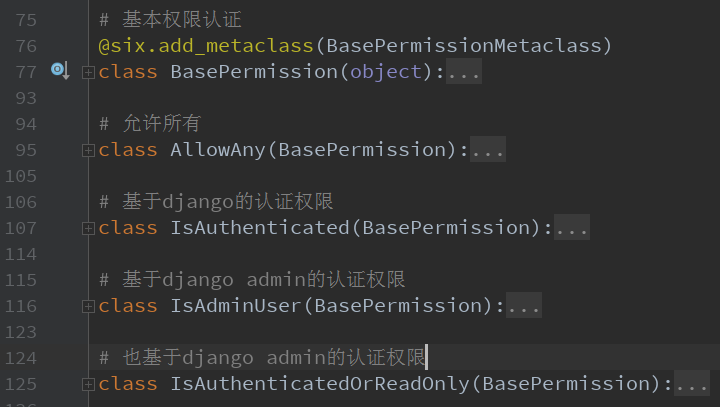
django rest framework 提供了内置的权限验证类,其本质都是定义has_permission()方法对权限进行验证:
2.2-自定义一个权限类
# 自定义权限

class MyPermission(BasePermission):

    message = 'VIP用户才能访问'

    def has_permission(self, request, view):

        """

        自定义权限只有VIP用户才能访问

        """

        # 因为在进行权限判断之前已经做了认证判断,所以这里可以直接拿到request.user

        if request.user and request.user.type == 2:  # 如果是VIP用户

            return True

        else:

            return False
2.3-视图级别配置
class CommentViewSet(ModelViewSet):

    queryset = models.Comment.objects.all()

    serializer_class = app01_serializers.CommentSerializer

    authentication_classes = [MyAuth, ]

    permission_classes = [MyPermission, ]
2.4-全局级别配置
# 在settings.py中设置rest framework相关配置项

REST_FRAMEWORK = {

    "DEFAULT_AUTHENTICATION_CLASSES": ["app01.utils.MyAuth", ],

    "DEFAULT_PERMISSION_CLASSES": ["app01.utils.MyPermission", ]

}
在全局配置权限后,因部分视图不想使用全局的权限限制,所以 需要在部分视图里配置:
permission_classes = [OrdinaryPremission,] #不用全局的权限配置的话,这里就要写自己的局部权限
03-限制
DRF内置了基本的限制类,首先我们自己动手写一个限制类,熟悉下限制组件的执行过程。
3.1-自定义限制类
VISIT_RECORD = {}

# 自定义限制

class MyThrottle(object):

    def __init__(self):

        self.history = None

    def allow_request(self, request, view):

        """

        自定义频率限制60秒内只能访问三次

        """

        # 获取用户IP

        ip = request.META.get("REMOTE_ADDR")

        timestamp = time.time()

        if ip not in VISIT_RECORD:

            VISIT_RECORD[ip] = [timestamp, ]

            return True

        history = VISIT_RECORD[ip]

        self.history = history

        history.insert(0, timestamp)

        while history and history[-1] < timestamp - 60:

            history.pop()

        if len(history) > 3:

            return False

        else:

            return True

    def wait(self):

        """

        限制时间还剩多少

        """

        timestamp = time.time()

        return 60 - (timestamp - self.history[-1])
3.2-视图级别配置
class CommentViewSet(ModelViewSet):

    queryset = models.Comment.objects.all()

    serializer_class = app01_serializers.CommentSerializer

    throttle_classes = [MyThrottle, ]
3.3-全局级别配置
# 在settings.py中设置rest framework相关配置项

REST_FRAMEWORK = {

    "DEFAULT_AUTHENTICATION_CLASSES": ["app01.utils.MyAuth", ],

    "DEFAULT_PERMISSION_CLASSES": ["app01.utils.MyPermission", ]

    "DEFAULT_THROTTLE_CLASSES": ["app01.utils.MyThrottle", ]

}
04-使用内置限制类
我们可以通过继承SimpleRateThrottle类,来实现节流,会更加的简单,因为SimpleRateThrottle里面都帮我们写好了。
class SimpleRateThrottle(BaseThrottle):

    """

    A simple cache implementation, that only requires `.get_cache_key()`

    to be overridden.

    The rate (requests / seconds) is set by a `rate` attribute on the View

    class.  The attribute is a string of the form 'number_of_requests/period'.

    Period should be one of: ('s', 'sec', 'm', 'min', 'h', 'hour', 'd', 'day')

    Previous request information used for throttling is stored in the cache.

    """

    cache = default_cache

    timer = time.time

    cache_format = 'throttle_%(scope)s_%(ident)s'

    scope = None   #这个值自定义,写什么都可以

    THROTTLE_RATES = api_settings.DEFAULT_THROTTLE_RATES

    def __init__(self):

        if not getattr(self, 'rate', None):

            self.rate = self.get_rate()

        self.num_requests, self.duration = self.parse_rate(self.rate)

    def get_cache_key(self, request, view):

        """

        Should return a unique cache-key which can be used for throttling.

        Must be overridden.

        May return `None` if the request should not be throttled.

        """

        raise NotImplementedError('.get_cache_key() must be overridden')

    def get_rate(self):

        """

        Determine the string representation of the allowed request rate.

        """

        if not getattr(self, 'scope', None):

            msg = ("You must set either `.scope` or `.rate` for '%s' throttle" %

                   self.__class__.__name__)

            raise ImproperlyConfigured(msg)

        try:

            return self.THROTTLE_RATES[self.scope]

        except KeyError:

            msg = "No default throttle rate set for '%s' scope" % self.scope

            raise ImproperlyConfigured(msg)

    def parse_rate(self, rate):

        """

        Given the request rate string, return a two tuple of:

        <allowed number of requests>, <period of time in seconds>

        """

        if rate is None:

            return (None, None)

        num, period = rate.split('/')

        num_requests = int(num)

        duration = {'s': 1, 'm': 60, 'h': 3600, 'd': 86400}[period[0]]

        return (num_requests, duration)

    def allow_request(self, request, view):

        """

        Implement the check to see if the request should be throttled.

        On success calls `throttle_success`.

        On failure calls `throttle_failure`.

        """

        if self.rate is None:

            return True

        self.key = self.get_cache_key(request, view)

        if self.key is None:

            return True

        self.history = self.cache.get(self.key, [])

        self.now = self.timer()

        # Drop any requests from the history which have now passed the

        # throttle duration

        while self.history and self.history[-1] <= self.now - self.duration:

            self.history.pop()

        if len(self.history) >= self.num_requests:

            return self.throttle_failure()

        return self.throttle_success()

    def throttle_success(self):

        """

        Inserts the current request's timestamp along with the key

        into the cache.

        """

        self.history.insert(0, self.now)

        self.cache.set(self.key, self.history, self.duration)

        return True

    def throttle_failure(self):

        """

        Called when a request to the API has failed due to throttling.

        """

        return False

    def wait(self):

        """

        Returns the recommended next request time in seconds.

        """

        if self.history:

            remaining_duration = self.duration - (self.now - self.history[-1])

        else:

            remaining_duration = self.duration

        available_requests = self.num_requests - len(self.history) + 1

        if available_requests <= 0:

            return None

        return remaining_duration / float(available_requests)
SimpleRateThrottle 源码
from rest_framework.throttling import SimpleRateThrottle

class VisitThrottle(SimpleRateThrottle):

    '''匿名用户60s只能访问三次(根据ip)'''

    scope = 'NBA'   #这里面的值,自己随便定义,settings里面根据这个值配置Rate

    def get_cache_key(self, request, view):

        #通过ip限制节流

        return self.get_ident(request)

class UserThrottle(SimpleRateThrottle):

    '''登录用户60s可以访问10次'''

    scope = 'NBAUser'    #这里面的值,自己随便定义,settings里面根据这个值配置Rate

    def get_cache_key(self, request, view):

        return request.user.username
4.1-全局配置
# 在settings.py中设置rest framework相关配置项

REST_FRAMEWORK = {

    "DEFAULT_AUTHENTICATION_CLASSES": ["app01.utils.MyAuth", ],

    # "DEFAULT_PERMISSION_CLASSES": ["app01.utils.MyPermission", ]

    "DEFAULT_THROTTLE_CLASSES": ["app01.utils.VisitThrottle", ],

    # 设置访问频率

    "DEFAULT_THROTTLE_RATES": {

        'NBA':'3/m',         #没登录用户3/m,NBA就是scope定义的值

        'NBAUser':'10/m',    #登录用户10/m,NBAUser就是scope定义的值

    }

}
4.2-局部配置
class AuthView(APIView):

    .

    .

    .

    # 默认的节流是登录用户(10/m),AuthView不需要登录,这里用匿名用户的节流(3/m)

    throttle_classes = [VisitThrottle,]

   .

    .
4.3-BaseThrottle
1. 自己要写allow_request和wait方法

2. get_ident就是获取ip
源码如下:
class BaseThrottle(object):

    """

    Rate throttling of requests.

    """

    def allow_request(self, request, view):

        """

        Return `True` if the request should be allowed, `False` otherwise.

        """

        raise NotImplementedError('.allow_request() must be overridden')

    def get_ident(self, request):

        """

        Identify the machine making the request by parsing HTTP_X_FORWARDED_FOR

        if present and number of proxies is > 0. If not use all of

        HTTP_X_FORWARDED_FOR if it is available, if not use REMOTE_ADDR.

        """

        xff = request.META.get('HTTP_X_FORWARDED_FOR')

        remote_addr = request.META.get('REMOTE_ADDR')

        num_proxies = api_settings.NUM_PROXIES

        if num_proxies is not None:

            if num_proxies == 0 or xff is None:

                return remote_addr

            addrs = xff.split(',')

            client_addr = addrs[-min(num_proxies, len(addrs))]

            return client_addr.strip()

        return ''.join(xff.split()) if xff else remote_addr

    def wait(self):

        """

        Optionally, return a recommended number of seconds to wait before

        the next request.

        """

        return None
04 Django REST Framework 认证、权限和限制的更多相关文章
- Django REST framework认证权限和限制和频率
认证.权限和限制 身份验证是将传入请求与一组标识凭据(例如请求来自的用户或其签名的令牌)相关联的机制.然后 权限 和 限制 组件决定是否拒绝这个请求. 简单来说就是: 认证确定了你是谁 权限确定你能不 ...
- Django REST Framework 认证 - 权限 - 限制
一. 认证 (你是谁?) REST framework 提供了一些开箱即用的身份验证方案,并且还允许你实现自定义方案. 自定义Token认证 第一步 : 建表>>>> 定义一个 ...
- Django REST framework认证权限和限制 源码分析
1.首先 我们进入这个initial()里面看下他内部是怎么实现的. 2.我们进入里面看到他实现了3个方法,一个认证,权限频率 3.我们首先看下认证组件发生了什么 权限: 啥都没返回,self.per ...
- Django Rest Framework(认证、权限、限制访问频率)
阅读原文Django Rest Framework(认证.权限.限制访问频率) django_rest_framework doc django_redis cache doc
- Django Rest framework 之 权限
django rest framework 之 认证(一) django rest framework 之 权限(二) django rest framework 之 节流(三) django res ...
- django 之(三) --- 认证|权限
用户模块 登陆注册1:Django2.0 [ 1:N ] user/url.py from django.urls import path from user.views0 import UserT ...
- rest framework 认证 权限 频率
认证组件 发生位置 APIview 类种的 dispatch 方法执行到 initial 方法 进行 认证组件认证 源码位置 rest_framework.authentication 源码内部需要 ...
- Django Rest Framework之权限
基本代码结构 url.py: from django.conf.urls import url, include from app import views urlpatterns = [ url(r ...
- Django REST framework - 认证
目录 认证 DRF 5种验证方式 如何确定身份验证? 设置身份验证方案 案例: 基于自定义Token认证 第一步: 定义一个用户表和一个保存用户Token的表 第二步: 定义一个登陆视图 第三步定义一 ...
随机推荐
- Java提高班(四)面试必备—你不知道的数据集合
导读:Map竟然不属于Java集合框架的子集?队列也和List一样属于集合的三大子集之一?更有队列的正确使用姿势,一起来看吧! Java中的集合通常指的是Collection下的三个集合框架List. ...
- 永不重复的id生成器
目录 (1)需要导入的包 (2)IdGenerator类 (3)使用举例 (1)需要导入的包 主要用在格式化日FastDateFormat.getInstance("yyyyMMddHHmm ...
- js获取文件后缀
//获取文件后缀 function getType(file){ var filename=file; var index1=filename.lastIndexOf("."); ...
- openlayers3 实现点选的几种方式
WebGIS开发中,点击查询是最常用的一种查询方式,在ArcGIS api 中,这种查询叫IdentifyTask,主要作用是前台提交参数,交ArcServer查询分析返回.本文从开源框架的角度,从前 ...
- linux下sophos,clamav+clamtk杀毒软件
以deepin为例 avast for linux sophos for linux comodo for linux 目前能够在官网找到. 先说clamav clamav 听说很活跃,clamav是 ...
- KeePass全网最详使用指南
从入门到熟练:KeePass全网最详使用指南 https://post.smzdm.com/p/713042/
- JButton 按钮,JRadioJButton单选按钮,JChectBox复选框
一. [按钮JButton] //导入Java类 import javax.swing.*;import java.awt.*;import java.awt.event.ActionEvent;im ...
- 010 Editor v8.0.1(32 - bit) 算法逆向分析、注册机编写
010 Editor 的逆向分析整体算下来还是比较简单的,将程序拖入OD,通过字符串搜索定位到核心代码,经过分析,主要是如下图所示的两个关键函数,返回正确的值,才算是注册成功. 00409C9B 这个 ...
- SQLServer之修改UNIQUE约束
使用SSMS数据库管理工具修改UNIQUE约束 1.连接数据库,选择数据表->右键点击->选择设计(或者展开键,选择要修改的键,右键点击,选择修改,后面步骤相同). 2.选择要修改的数据列 ...
- 【Linux基础】查看硬件信息-系统
1.查看计算机名 hostname 2.查看内核/操作系统/CPU信息 uname -a 4.查看操作系统版本(Linux) head -n 2 /etc/issue Red Hat Enterp ...