
day06 面向对象编程
面向对象:


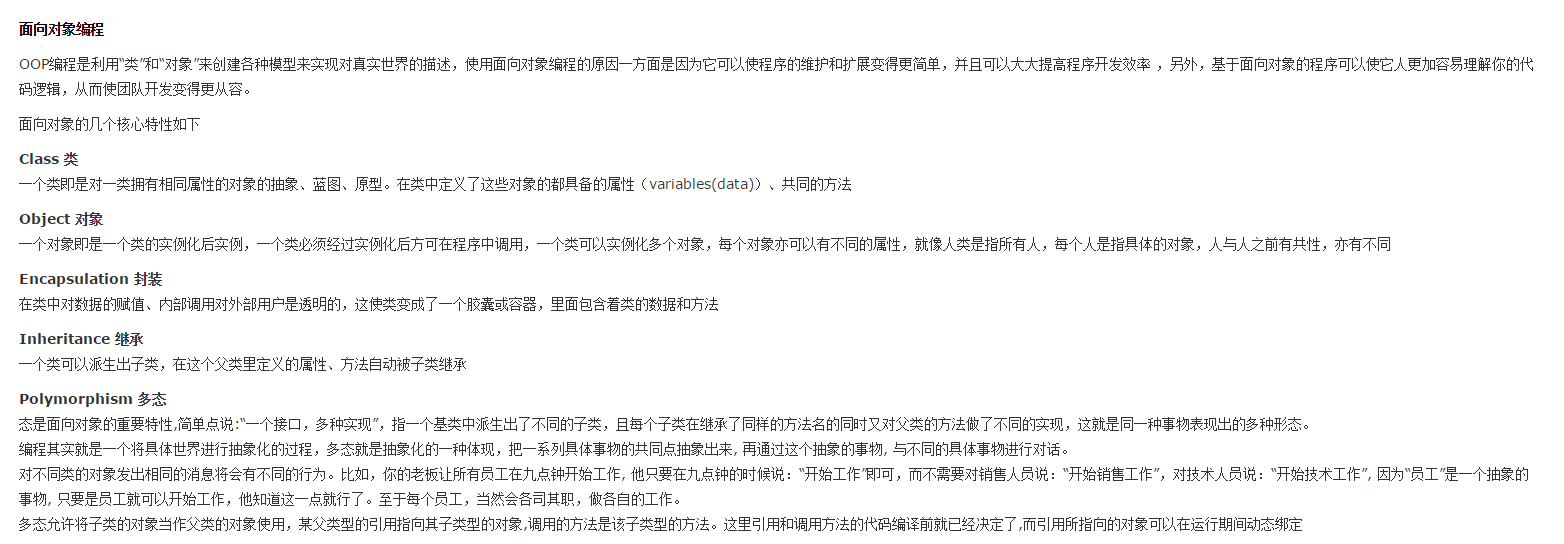

多态:


就是把 r1 这个变量名传进去类里了

self 就是你创建的对象的变量名

实践:
 class Role:

     def __init__(self,name,role,weapon,life_value=100,money=15000):

         self.name = name

         self.role = role

         self.weapon = weapon

         self.life_value = life_value

         self.money = money

     def shot(self):

         print("shotting ...")

     def got_shot(self):

         print("ah .... ,i got shot ...")

     def buy_gun(self,gun_name):

         print("{_name} buy the {_gun_name} gun".format(_name=self.name,_gun_name=gun_name))

 r1 = Role("Alex","F","ak-47")

 r2 = Role("小明","T","m4-a1")

 r1.buy_gun("m4")

 r2.got_shot()
运行结果:


类变量:

新加变量:

默认去找实例变量,找不到实例变量才去找类变量
r1添加变量,r2 实例化不变,因为是r1 添加变量

改变类变量,如果实例里没有那个变量,那么就会跟着改变

对于list 会导致所有的改变

 class Role:

     n = 123

     n_lsit = []

     def __init__(self,name,role,weapon,life_value=100,money=15000):

         self.name = name

         self.role = role

         self.weapon = weapon

         self.life_value = life_value

         self.money = money

     def shot(self):

         print("shotting ...")

     def got_shot(self):

         print("ah .... ,i got shot ...")

     def buy_gun(self,gun_name):

         print("{_name} buy the {_gun_name} gun".format(_name=self.name,_gun_name=gun_name))

 r1 = Role("Alex","F","ak-47")

 r2 = Role("小明","T","m4-a1")

 # r1.buy_gun("m4")

 #

 # r2.got_shot()

 print("r1",r1.n,r1.n_lsit)

 print("r2",r2.n,r2.n_lsit)

 r1.n = "heh1"

 r2.n = "hah2"

 print("Class:",Role.n,Role.n_lsit)

 r1.n_lsit.append("r11")

 print("r1",r1.n,r1.n_lsit)

 r2.n_lsit.append("r22")

 print("r2",r2.n,r2.n_lsit)

 print("Class:",Role.n,Role.n_lsit)

 print("r1",r1.n,r1.n_lsit)
运行结果:


写一个:


如果在这之前就del 那么就会提前执行,也就是这个会在一个实例销毁时执行的


外面想要查看,那么就定义一个函数然后在外面来调用这个函数即可

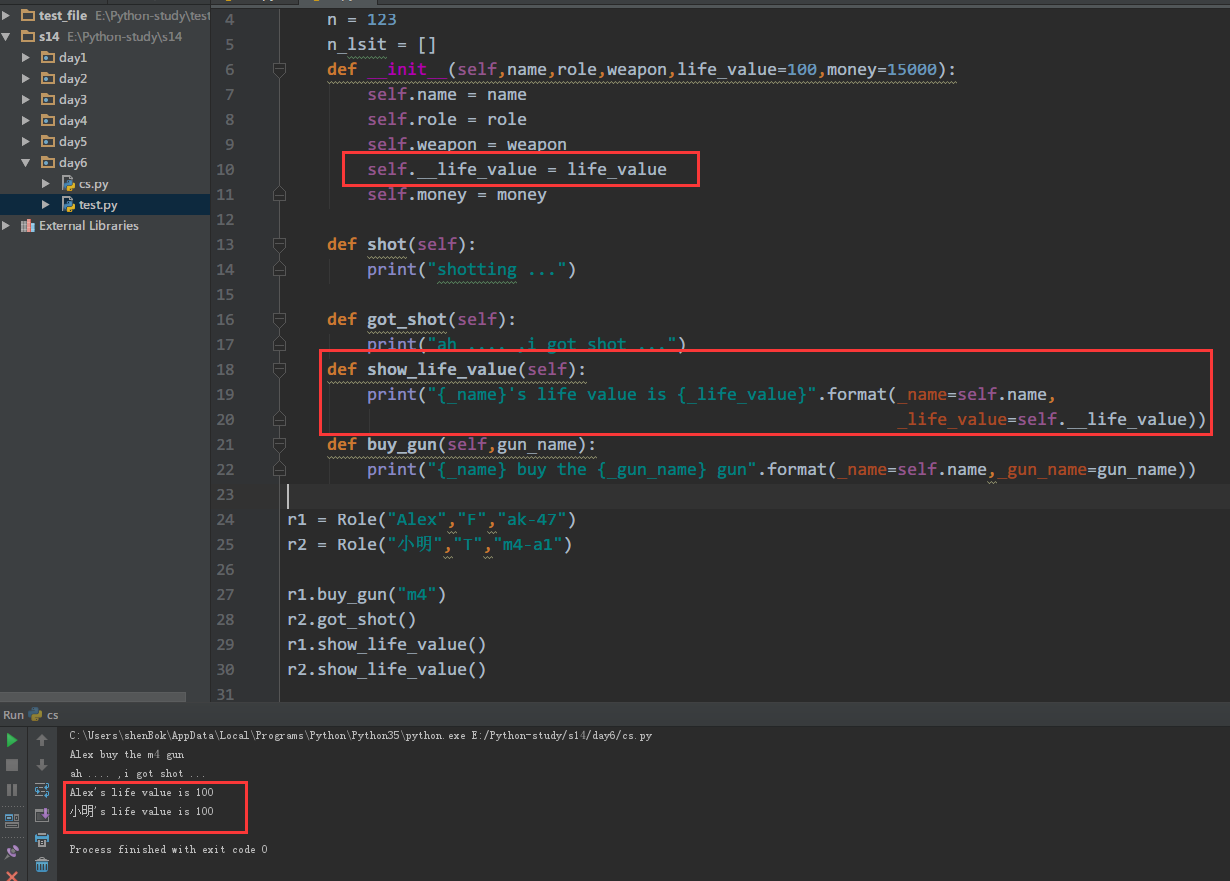
当然外面的不能访问,必然不能修改,所以想修改就要在里面定义好修改的方式,如下:


实践 私有属性:
 class Role:

     n = 123

     n_lsit = []

     def __init__(self,name,role,weapon,life_value=100,money=15000):

         self.name = name

         self.role = role

         self.weapon = weapon

         self.__life_value = life_value

         self.money = money

     def shot(self):

         print("shotting ...")

     def got_shot(self):

         print("ah .... ,i got shot ...")

     def show_life_value(self):

         print("{_name}'s life value is {_life_value}".format(_name=self.name,

                                                              _life_value=self.__life_value))

     def buy_gun(self,gun_name):

         print("{_name} buy the {_gun_name} gun".format(_name=self.name,_gun_name=gun_name))

 r1 = Role("Alex","F","ak-47")

 r2 = Role("小明","T","m4-a1")

 r1.buy_gun("m4")

 r2.got_shot()

 r1.show_life_value()

 r2.show_life_value()
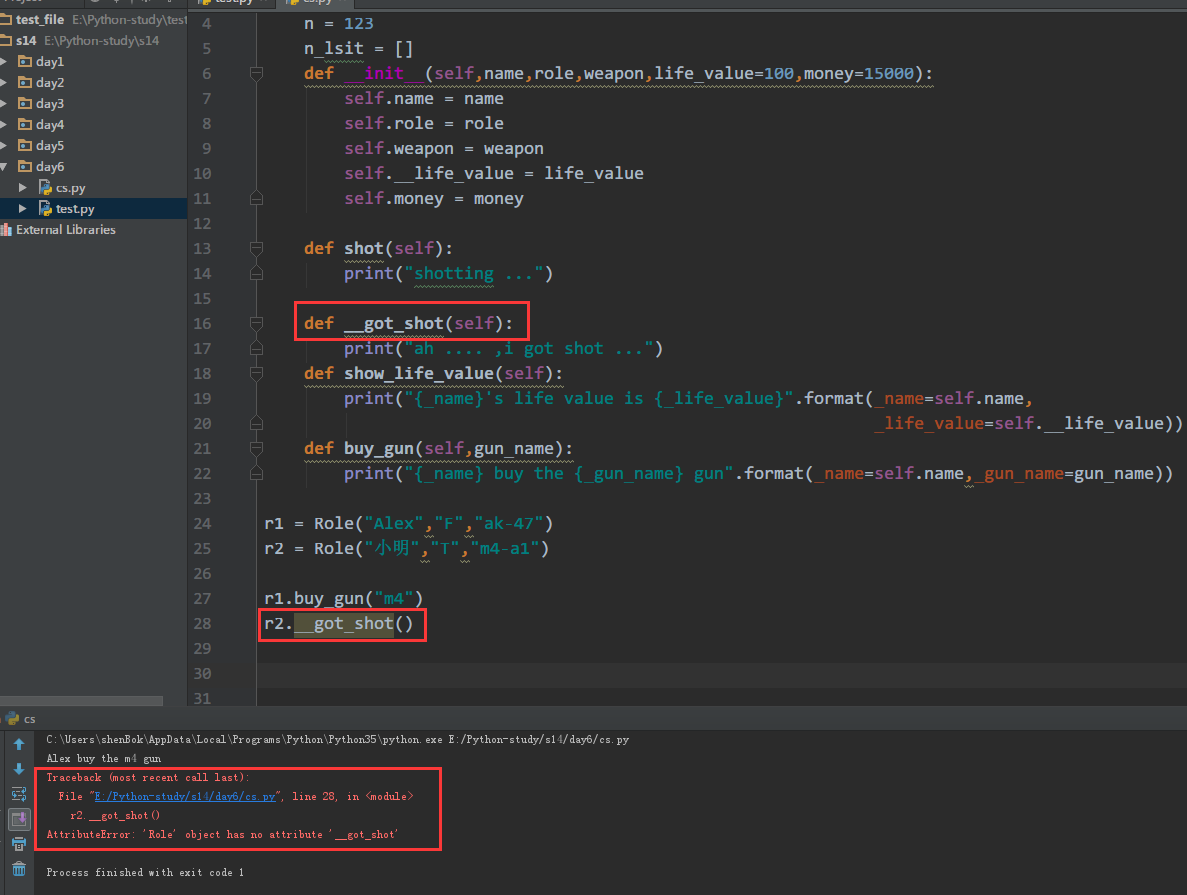
正确方式就是在类里定义另一个方法来调用这个方法:

 class Role:

     n = 123

     n_lsit = []

     def __init__(self,name,role,weapon,life_value=100,money=15000):

         self.name = name

         self.role = role

         self.weapon = weapon

         self.__life_value = life_value

         self.money = money

     def shot(self):

         print("shotting ...")

     def __got_shot(self):

         print("ah .... ,i got shot ...")

         self.__life_value -= 50

     def show_life_value(self):

         print("{_name}'s life value is {_life_value}".format(_name=self.name,

                                                              _life_value=self.__life_value))

     def buy_gun(self,gun_name):

         print("{_name} buy the {_gun_name} gun".format(_name=self.name,_gun_name=gun_name))

     def out_shot(self):

         print("调用里面的私有方法被射中...")

         self.__got_shot()

 r2 = Role("小明","T","m4-a1")

 r2.out_shot()

 r2.show_life_value()


增加新功能,并先调用父类方法:


这就等于重构了父类的方法
创建一个woman:

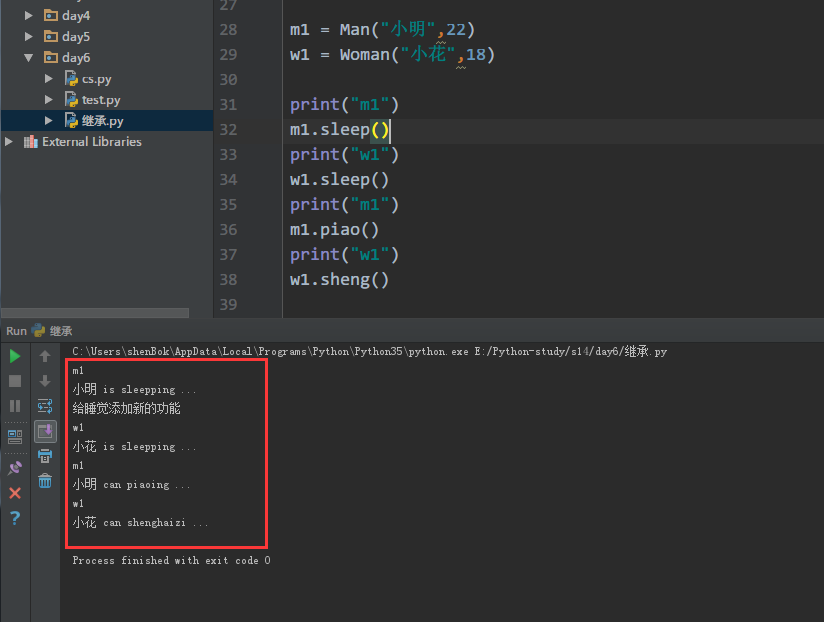
实践:
 class People:

     def __init__(self,name,age):

         self.name = name

         self.age = age

     def eat(self):

         print("{_name} is eatting ...".format(_name=self.name))

     def sleep(self):

         print("{_name} is sleepping ...".format(_name=self.name))

 class Man(People):

     def piao(self):  #添加新的方法,这个方法只能是这个类来用

         print("{_name} can piaoing ...".format(_name=self.name))

     def sleep(self):    #修改父类里的方法,添加功能,实现个性化

         People.sleep(self)

         print("给睡觉添加新的功能")

 class Woman(People):

     def sheng(self):   #添加新的方法,这个方法只能是这个类来用

         print("{_name} can shenghaizi ...".format(_name=self.name))

 m1 = Man("小明",22)

 w1 = Woman("小花",18)

 print("m1")

 m1.sleep()

 print("w1")

 w1.sleep()

 print("m1")

 m1.piao()

 print("w1")

 w1.sheng()

父类的所有参数都要写一遍,写完后面加自己的初始化变量


 class People:

     def __init__(self,name,age):

         self.name = name

         self.age = age

     def eat(self):

         print("{_name} is eatting ...".format(_name=self.name))

     def sleep(self):

         print("{_name} is sleepping ...".format(_name=self.name))

 class Action(object):

     def make_friends(self,object):

         print("{_name} is making from {_obj_name}".format(_name=self.name,

                                                       _obj_name=object.name))

 class Man(People,Action):

     def piao(self):  #添加新的方法,这个方法只能是这个类来用

         print("{_name} can piaoing ...".format(_name=self.name))

     def sleep(self):    #修改父类里的方法,添加功能,实现个性化

         People.sleep(self)

         print("给睡觉添加新的功能")

 class Woman(People):

     def sheng(self):   #添加新的方法,这个方法只能是这个类来用

         print("{_name} can shenghaizi ...".format(_name=self.name))

 m1 = Man("小明",22)

 w1 = Woman("小花",18)

 m1.make_friends(w1)


扩展版:
 #!/usr/bin/env python3

 # Author: Shen Yang

 class People:

     def __init__(self,name,age):

         self.name = name

         self.age = age

     def eat(self):

         print("{_name} is eatting ...".format(_name=self.name))

     def sleep(self):

         print("{_name} is sleepping ...".format(_name=self.name))

 class Action(object):

     def make_friends(self,object):

         print("{_name} is making from {_obj_name}".format(_name=self.name,

                                                       _obj_name=object.name))

         self.firends.append(object)

     def pay_money(self,object):

         print("{_name} giveing {_obj_name} {_money} money".format(_name=self.name,

                                                                   _obj_name=object.name,

                                                                   _money=self.money))

 class Man(People,Action):

     firends = []

     def __init__(self,name,age,money):

         super(Man,self).__init__(name,age)

         self.money = money

     def piao(self):  #添加新的方法,这个方法只能是这个类来用

         print("{_name} can piaoing ...".format(_name=self.name))

     def sleep(self):    #修改父类里的方法,添加功能,实现个性化

         People.sleep(self)

         print("给睡觉添加新的功能")

 class Woman(People):

     def sheng(self):   #添加新的方法,这个方法只能是这个类来用

         print("{_name} can shenghaizi ...".format(_name=self.name))

 m1 = Man("小明",22,6800)

 w1 = Woman("小花",18)

 m1.make_friends(w1)

 m1.pay_money(w1)

 w1.name ="小花花"

 print(m1.firends[0].name)


 #!/usr/bin/env python3

 # Author: Shen Yang

 #object 是所有类的类:

 class School(object):

     def __init__(self,name,addr):

         self.name = name

         self.addr = addr

         self.students = []

         self.staffs = []

     def enroll(self,stu_obj):

         print("为{_stu_obj} 办理了入学手续。。。".format(_stu_obj=stu_obj.name))

         self.students.append(stu_obj)

     def hire(self,staff_obj):

         print("雇佣了新员工 {_staff_obj}".format(_staff_obj=staff_obj.name))

         self.staffs.append(staff_obj)

 class SchoolMember(object):

     def __init__(self,name,age,sex):

         self.name = name

         self.age = age

         self.sex = sex

     def tell(self):

         pass

 class Student(SchoolMember):

     def __init__(self,name,age,sex,stu_id,grade):

         super(Student,self).__init__(name,age,sex)

         self.stu_id = stu_id

         self.grade = grade

     def tell(self):

         print('''

         ----- info of Student: {_name} -----

         Name:{_name}

         Age:{_age}

         Sex:{_sex}

         Stu_id:{_stu_id}

         Grade:{_grade}

         '''.format(_name=self.name,_age=self.age,_sex=self.sex,_stu_id=self.stu_id,_grade=self.grade))

     def pay_tuition(self,amount):

         print("{_name} has paid tuition {_amount}".format(_name=self.name,_amount=amount))

 class Teacher(SchoolMember):

     def __init__(self,name,age,sex,salary,coure):

         super(Teacher,self).__init__(name,age,sex)

         self.salary = salary

         self.coure = coure

     def tell(self):

         print('''

         ----- info of Teacher: {_name} -----

         Name:{_name}

         Age:{_age}

         Sex:{_sex}

         Salary:{_salary}

         Coure:{_coure}

         '''.format(_name=self.name,_age=self.age,_sex=self.sex,_salary=self.salary,_coure=self.coure))

     def teach(self):

         print("{_name} has teach {_coure}".format(_name=self.name,_coure=self.coure))

 #初始化一个学校

 school = School("老男孩","沙河")

 #初始化两个教师

 t1 = Teacher("Oldboy",35,"M",20000,"Linux")

 t2 = Teacher("Alex",22,"M",3000,"Python")

 #初始化一个学生

 s1 = Student("Yang",26,"M",1001,"Python")

 #让第一个老师打印信息然后开始教课

 t1.tell()

 t1.teach()

 #让第二个老师打印信息

 t2.tell()

 #让学生打印信息然后缴费

 s1.tell()

 s1.pay_tuition(6888)

 #学校给学生办理入学手续

 school.enroll(s1)

 #打印学校学生

 print(school.students[0].name)

 school.hire(t1)

 school.hire(t2)

 for i in school.staffs:

     print(i.name)


day06 面向对象编程的更多相关文章
- Java面向对象编程基础
一.Java面向对象编程基础 1.什么是对象?Object 什么都是对象! 只要是客观存在的具体事物,都是对象(汽车.小强.事件.任务.按钮.字体) 2.为什么需要面向对象? 面向对象能够像分析现实生 ...
- angular2系列教程(六)两种pipe:函数式编程与面向对象编程
今天,我们要讲的是angualr2的pipe这个知识点. 例子
- 带你一分钟理解闭包--js面向对象编程
上一篇<简单粗暴地理解js原型链--js面向对象编程>没想到能攒到这么多赞,实属意外.分享是个好事情,尤其是分享自己的学习感悟.所以网上关于原型链.闭包.作用域等文章多如牛毛,很多文章写得 ...
- PHP 面向对象编程和设计模式 (1/5) - 抽象类、对象接口、instanceof 和契约式编程
PHP高级程序设计 学习笔记 2014.06.09 什么是面向对象编程 面向对象编程(Object Oriented Programming,OOP)是一种计算机编程架构.OOP 的一条基本原则是计算 ...
- Delphi_09_Delphi_Object_Pascal_面向对象编程
今天这里讨论一下Delphi中的面向对象编程,这里不做过多过细的讨论,主要做提纲挈领的描述,帮助自己抓做重点. 本随笔分为两部分: 一.面向对象编程 二.面向对象编程详细描述 ------------ ...
- python基础-面向对象编程
一.三大编程范式 编程范式即编程的方法论,标识一种编程风格 三大编程范式: 1.面向过程编程 2.函数式编程 3.面向对象编程 二.编程进化论 1.编程最开始就是无组织无结构,从简单控制流中按步写指令 ...
- 面向对象编程(OOP)
什么是面向对象编程,对于面向对象编程与面向过程编程的解释随处可见,个人认为对面向对象编程解释最好的一个定义是:依赖倒转原则是面向对象编程的标志,面向对象编程是一种思想,无论使用哪一种编程语言,如果在编 ...
- python 学习笔记7 面向对象编程
一.概述 面向过程:根据业务逻辑从上到下写垒代码 函数式:将某功能代码封装到函数中,日后便无需重复编写,仅调用函数即可 面向对象:对函数进行分类和封装,让开发"更快更好更强..." ...
- 进击的Python【第七章】:Python的高级应用(四)面向对象编程进阶
Python的高级应用(三)面向对象编程进阶 本章学习要点: 面向对象高级语法部分 静态方法.类方法.属性方法 类的特殊方法 反射 异常处理 Socket开发基础 一.面向对象高级语法部分 静态方法 ...
随机推荐
- SpringMVC的基础配置及视图定位
概要 记录一下搭建SpringMVC框架的步骤 视图定位也就是改变jsp在项目中的路径 一.新建javaweb项目springmvc1,在lib中导入jar包 此项目上传了GitHub,方便去下载ja ...
- 《移动Web前端高效开发实战》笔记4--打造单页应用SPA
路由是一个单页应用的核心,大部分前端框架都实现了一个复杂的路由库,包括动态路由,路由钩子,组件生命周期甚至服务器端渲染等复杂的功能.但是对于前端开发者而言,路由组件的核心是URL路径到函数的映射,了解 ...
- css3创建多边形clip属性,可用来绘制不规则图形了
.path1 { clip-path: polygon(5px 10px, 16px 3px, 16px 17px); } .path2 { clip-path: polygon(3px 5px, 1 ...
- <Android 应用 之路> 天气预报(三)
昨天介绍了基本的载入界面,今天介绍下天气信息显示界面的代码 基本ListView显示 搜索框,查询城市 上一篇文章中,载入界面通过showWeatherInfo()方法跳转到天气信息显示界面 priv ...
- iOS - NSString 封装
在实际项目开发过程中,发现字符串使用频率还是非常高的,NSString提供了很多相关的API,但是在开发过程中发现很多业务功能都是相同的.因此根据在开发过程中遇到的字符串使用场景,进行了简单封装.具体 ...
- windows下安装pm2
安装pm2 npm install pm2 -g 添加系统环境变量 PM2_HOME=C:\Users\PCONE\.pm2 打开新的cmd命令行窗口,执行以下命令来安装服务 pm2-service- ...
- JSON 序列化格式
一.C#处理简单json数据json数据: 复制代码代码如下: {"result":"0","res_info":"ok" ...
- C# XML序列化/反序列化类XmlSerializer使用示例
using System; using System.IO; using System.Text; using System.Xml; using System.Xml.Serialization; ...
- Page_Load与sender -- PostBack是由哪个 ASP.NET控件引起 ?
Page_Load与sender -- PostBack是由哪个 ASP.NET控件引起 ? 之前有讨论过ASP.NET Web Form "事件"里面的 "sender ...
- method 'redisConnectionFactory' threw exception; nested exception is java.lang.NoClassDefFoundError
spring boot 整合redis是报了如下错误 org.springframework.beans.factory.UnsatisfiedDependencyException: Error c ...