
Spring 中的接口知识整理
本想每个小知识一篇随笔,但是那样,看起来有些单薄,所以,就放在一片文章里了。而且,以后还会慢慢在最后不断的追加。
目录:
FactoryBean
BeanPostProcessor
1.FactoryBean
FactoryBean接口,它在Spring框架源码内部,被大量使用,如使用AOP创建bean的代理时,使用了ProxyFactoryBean;从JNDI中查找对象时,使用了JndiObjectFactoryBean。
它在框架外,很少使用。但是为了学习,也得研究研究,您说是不?
它怎么使用?首先看看构造。
 public interface FactoryBean<T> {

 // 返回的是这个工厂管理的对象的实例

 T getObject() throws Exception;


 // 返回的是工厂创建的对象的类型

 Class<?> getObjectType();

 boolean isSingleton();

 }
上个例子,看具体东西。
 public class Tool {

     private int id;

     public Tool(int id) {

         this.id = id;

     }

     public int getId() {

         return id;

     }

     public void setId(int id) {

         this.id = id;

     }

 }
 public class ToolFactory implements FactoryBean<Tool> {

     private int factoryId;

     private int toolId;


    // 创建的是Tool的对象

     @Override

     public Tool getObject() throws Exception {

 8         return new Tool(toolId);

 9     }

     @Override

     public Class<?> getObjectType() {

13         return Tool.class;

14     }

     @Override

     public boolean isSingleton() {

         return false;

     }

     public int getFactoryId() {

         return factoryId;

     }

     public int getToolId() {

         return toolId;

     }

     public void setFactoryId(int factoryId) {

         this.factoryId = factoryId;

     }

     public void setToolId(int toolId) {

         this.toolId = toolId;

     }

 }
 public class Test {

     public static void main(String[] args) {

         @SuppressWarnings("resource")

         ApplicationContext context = new ClassPathXmlApplicationContext("beaFactoryTest.xml");

         Tool tool = (Tool) context.getBean("tool");
       // 在名字前面加 & 表示要得到工厂类的bean

         ToolFactory tool2 = (ToolFactory) context.getBean("&tool");

         System.out.println("Tool Id is " + tool.getId());

         System.out.println("ToolFactory Id is " + tool2.getFactoryId());

     }

 }
     <bean id="tool" class="com.lee.demo.beanfactory.ToolFactory">

         <property name="factoryId" value="9090"/>

         <property name="toolId" value="108"/>

     </bean>
最后执行结果:
Tool Id is 108
ToolFactory Id is 9090
2.BeanPostProcessor
它叫bean后处理器,也就是处理bean,它针对所有的bean,在初始化前后,对bean进行操作。主要内容我会在例子中描述。
例子:
 public class HelloWorld {

     private String message;

     public void setMessage(String message) {

         this.message = message;

     }

     public void getMessage() {

         System.out.println("Your Message : " + message);

     }


       // 加上init方法和destory方法,是为了在后面验证他们和postProcessBeforeInitialization  postProcessAfterInitialization 执行的先后顺序

     public void init() {

         System.out.println("Bean is going through init.");

     }

     public void destroy() {

         System.out.println("Bean will destroy now.");

     }

 }
 public class InitHelloWorld implements BeanPostProcessor {


    // BeanPostProcessor 接口中主要是下面两个方法 初始化前的后处理 初始化后的后处理

     @Override

     public Object postProcessBeforeInitialization(Object bean, String beanName) throws BeansException {

         System.out.println("BeforeInitialization : " + beanName);

         return bean; // you can return any other object as well

     }

     @Override

     public Object postProcessAfterInitialization(Object bean, String beanName) throws BeansException {

         System.out.println("AfterInitialization : " + beanName);

         return bean; // you can return any other object as well

     }

 }
Test.java
 public class Test {

     public static void main(String[] args) {

         @SuppressWarnings("resource")

         AbstractApplicationContext  context = new ClassPathXmlApplicationContext("beaFactoryTest.xml");

         HelloWorld obj = (HelloWorld) context.getBean("helloWorld");

         obj.getMessage();
       // 注册钩子方法

         context.registerShutdownHook();

     }

 }
查看源码:
 @Override
    // 在JVM运行期间,注册一个钩子关闭方法,关闭掉这个context。实际的关闭程序的操作,被代理给doClose方法。

     public void registerShutdownHook() {

         if (this.shutdownHook == null) {

             // No shutdown hook registered yet.

             this.shutdownHook = new Thread() {

                 @Override

                 public void run() {

                     doClose();

                 }

             };

             Runtime.getRuntime().addShutdownHook(this.shutdownHook);

         }

     }
xml文件
     <bean id = "helloWorld" class = "com.lee.demo.beanfactory.HelloWorld"

       init-method = "init" destroy-method = "destroy">

       <property name = "message" value = "Hello World!"/>

    </bean>

    <bean class = "com.lee.demo.beanfactory.InitHelloWorld" />
执行结果:
 BeforeInitialization : helloWorld

 Bean is going through init.

 AfterInitialization : helloWorld

 Your Message : Hello World!

 [org.springframework.context.support.ClassPathXmlApplicationContext] - Closing org.springframework.context.support.ClassPathXmlApplicationContext@6ae40994: startup date [Thu May 17 23:31:53 JST 2018]; root of context hierarchy

 Bean will destroy now.
在这里大致说一下Spring的实例化过程:
实例化Bean对象→设置对象属性→检查Aware相关接口并设置相关依赖→BeanPostProcessor前置处理→检查是否是InitializingBean以决定是否调用afterPropertiesSet方法→
检查是否配置有自定义的init-method方法→BeanPostProcessor后置处理→是否实现DisposableBean接口→是否配置有自定义的destroy方法
3.Aware接口
它是干什么用的呢?作用就是通过上下文(Context)可以获得当前环境。看看它的接口:
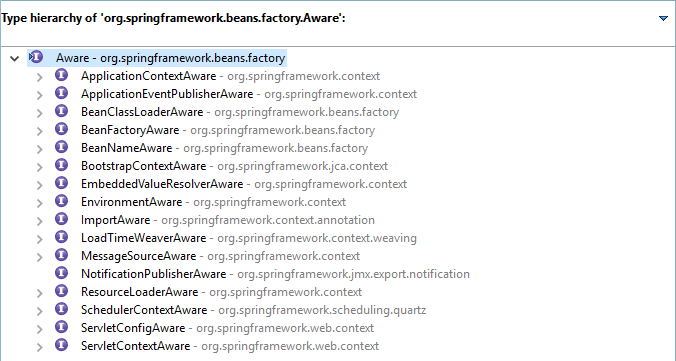
我们拿BeanNameAware来举个例子。
 public class User implements GetNameAware {

     private String id;

     private String name;

     private String address;

 6     @Override

 7     public void setBeanName(String name) {

 8         this.id = name;

 9     }

     public String getId() {

         return id;

     }

     public String getName() {

         return name;

     }

     public String getAddress() {

         return address;

     }

     public void setId(String id) {

         this.id = id;

     }

     public void setName(String name) {

         this.name = name;

     }

     public void setAddress(String address) {

         this.address = address;

     }

 }
 public class User2 {

     private String id;

     private String name;

     private String address;

     public String getId() {

         return id;

     }

     public String getName() {

         return name;

     }

     public String getAddress() {

         return address;

     }

     public void setId(String id) {

         this.id = id;

     }

     public void setName(String name) {

         this.name = name;

     }

     public void setAddress(String address) {

         this.address = address;

     }

 }
 public interface GetNameAware extends BeanNameAware {

 }
 public class Test {

     public static void main(String[] args) {

         ApplicationContext ctx = new ClassPathXmlApplicationContext("beaFactoryTest.xml");

         User user = (User) ctx.getBean("user1");

         User2 user2 = (User2) ctx.getBean("user2");

         System.out.println("user id " + user.getId() + " user name " + user.getName() + " user address " + user.getAddress());

         System.out.println("========================================");

         System.out.println("user2 id " + user2.getId() + " user2 name " + user2.getName() + " user2 address " + user2.getAddress());

     }

 }
     <bean id="user1" class="com.lee.demo.aware.User">

         <property name="name" value="lee"/>

         <property name="address" value="China"/>

     </bean>

     <bean id="user2" class="com.lee.demo.aware.User2">

         <property name="name" value="lin"/>

         <property name="address" value="Tokyo"/>

     </bean>
执行结果(user id 因为继承了GetNameAware接口,对BeanName进行了设置):
 user id user1 user name lee user address China

 ========================================

 user2 id null user2 name lin user2 address Tokyo
Spring 中的接口知识整理的更多相关文章
- Spring中Ordered接口简介
目录 前言 Ordered接口介绍 Ordered接口在Spring中的使用 总结 前言 Spring中提供了一个Ordered接口.Ordered接口,顾名思义,就是用来排序的. Spring是一个 ...
- 转:spring中InitailizingBean接口的简单理解
转自:https://www.cnblogs.com/wxgblogs/p/6849782.html spring中InitializingBean接口使用理解 InitializingBean接 ...
- spring中InitializingBean接口使用理解
InitializingBean接口为bean提供了初始化方法的方式,它只包括afterPropertiesSet方法,凡是继承该接口的类,在初始化bean的时候会执行该方法. 测试程序如下: imp ...
- spring中ApplicationContextAware接口描述
项目中使用了大量的工厂类,采用了简单工厂模式: 通过该工厂类可以获取指定的处理器bean,这些处理器bean我们是从spring容器中获取的,如何获取,是通过实现ApplicationContextA ...
- spring中InitializingBean接口使用理解(转)
InitializingBean接口为bean提供了初始化方法的方式,它只包括afterPropertiesSet方法,凡是继承该接口的类,在初始化bean的时候会执行该方法. 测试程序如下: imp ...
- spring(五):spring中Aware接口的使用
spring中自定义组件需要使用spring的底层组件时,可以通过自定义组件实现相关XxxAware接口,重写其中的方法进而实现 例如:自定义一个组件,该组件中需要使用ApplicationConte ...
- Spring中ApplicationContextAware接口的用法
1.为什么使用AppplicationContextAware? ApplicationContext的BeanFactory 的子类, 拥有更强大的功能,ApplicationContext可以在服 ...
- Spring中的接口BeanFactory和FactoryBean的学习
BeanFactory: 相当于对象工厂,可以获取对象的实例以及相应的属性.BeanFactory定义了IOC容器的最基本形式,并提供了IOC容器应遵守的的最基本的接口,也就是Spring IOC所遵 ...
- spring中ApplicationContextAware接口使用理解
一.这个接口有什么用?当一个类实现了这个接口(ApplicationContextAware)之后,这个类就可以方便获得ApplicationContext中的所有bean.换句话说,就是这个类可以直 ...
随机推荐
- laravel 连表查询数据库
$this->model ->select($field) ->leftJoin('b', 'b.cid', '=', 'a.id') ->orderBy("a.ad ...
- 卷积与反卷积以及步长stride
1. 卷积与反卷积 如上图演示了卷积核反卷积的过程,定义输入矩阵为 I(4×4),卷积核为 K(3×3),输出矩阵为 O(2×2): 卷积的过程为:Conv(I,W)=O 反卷积的过称为:Deconv ...
- 经典面试题sql基础篇-50常用的sql语句(有部分错误)
Student(S#,Sname,Sage,Ssex) 学生表 Course(C#,Cname,T#) 课程表 SC(S#,C#,score) 成绩表 Teacher(T#,Tname) 教师表 问题 ...
- Cracking The Coding Interview5.2
//Given a (decimal - e.g. 3.72) number that is passed in as a string, print the binary representatio ...
- [PyImageSearch] Ubuntu16.04 使用深度学习和OpenCV实现物体检测
上一篇博文中讲到如何用OpenCV实现物体分类,但是接下来这篇博文将会告诉你图片中物体的位置具体在哪里. 我们将会知道如何使用OpenCV‘s的dnn模块去加载一个预训练的物体检测网络,它能使得我们将 ...
- Map的isEmpty()与==null的区别
isEmpty()方法判断Map是否有内容(即new分配空间后是否put键值对),若没有内容则true,否则false == null是判断map是否为null(即是否new分配空间,和其中的键值对没 ...
- ClickOnce 和管理员权限
有些程序需要管理员权限需要运行,同时又想用ClickOnce进行发布,这时候就麻烦了,两者是互斥的. 解决方案是,去掉管理员权限的要求,可以进行发布. 程序启动的时候,加载程序员权限的请求. 代码如下 ...
- NuGet 程序源包
https://api.nuget.org/v3/index.json (2018-4-24 10:20:07-最新测试,可以用) https://nuget.cnblogs.com/v3/inde ...
- <Spark><Running on a Cluster>
Introduction 之前学习的时候都是通过使用spark-shell或者是在local模式运行spark 这边我们首先介绍Spark分布式应用的架构,然后讨论在分布式clusters中运行Spa ...
- ios scrollView代理的用法
// // ZQRViewController.m // 03-图片缩放 // // Created by apple on 17-08-25. // #import "ZQRViewCon ...