
POJ 1523 SPF(寻找关节点)
| Time Limit: 1000MS | Memory Limit: 10000K | |
| Total Submissions: 8155 | Accepted: 3730 |
Description
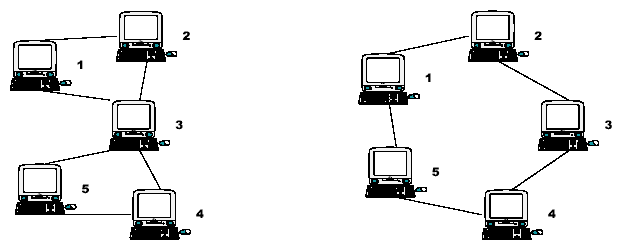
Node 3 is therefore a Single Point of Failure (SPF) for this
network. Strictly, an SPF will be defined as any node that, if
unavailable, would prevent at least one pair of available nodes from
being able to communicate on what was previously a fully connected
network. Note that the network on the right has no such node; there is
no SPF in the network. At least two machines must fail before there are
any pairs of available nodes which cannot communicate.
Input
input will contain the description of several networks. A network
description will consist of pairs of integers, one pair per line, that
identify connected nodes. Ordering of the pairs is irrelevant; 1 2 and 2
1 specify the same connection. All node numbers will range from 1 to
1000. A line containing a single zero ends the list of connected nodes.
An empty network description flags the end of the input. Blank lines in
the input file should be ignored.
Output
The first network in the file should be identified as "Network #1",
the second as "Network #2", etc. For each SPF node, output a line,
formatted as shown in the examples below, that identifies the node and
the number of fully connected subnets that remain when that node fails.
If the network has no SPF nodes, simply output the text "No SPF nodes"
instead of a list of SPF nodes.
Sample Input
1 2

5 4

3 1

3 2

3 4

3 5

0

1 2

2 3

3 4

4 5

5 1

0

1 2

2 3

3 4

4 6

6 3

2 5

5 1

0

0
Sample Output
Network #1

  SPF node 3 leaves 2 subnets

Network #2

  No SPF nodes

Network #3

  SPF node 2 leaves 2 subnets

  SPF node 3 leaves 2 subnets
#include <iostream>

#include <cstring>

#include <cstdio>

#include <algorithm>

#include <cmath>

#include <string>

#include <map>

#include <queue>

#include <vector>

#define inf 0x7fffffff

#define met(a,b) memset(a,b,sizeof a)

typedef long long ll;

using namespace std;

const int N = ;

const int M = ;

int edg[N][N],vis[N];

int nodes,tmpdfn,son;

int dfn[N],low[N],subnets[N];

void init()

{

    low[]=dfn[]=;

    tmpdfn=;son=;

    met(vis,);met(subnets,);

    vis[]=;

}

void Tarjan(int u)

{

    for(int v=;v<=nodes;v++){

        if(edg[u][v]){

            if(!vis[v]){

                vis[v]=;

                dfn[v]=low[v]=++tmpdfn;

                Tarjan(v);

                low[u]=min(low[u],low[v]);

                if(low[v]>=dfn[u]){

                    if(u!=)subnets[u]++;

                    else son++;

                }

            }

            else low[u]=min(low[u],dfn[v]);

        }

    }

}

int main()

{

    int u,v,num=;

    while(~scanf("%d",&u)&&u){

        met(edg,);nodes=;

        scanf("%d",&v);

        nodes=max(max(u,v),nodes);

        edg[u][v]=edg[v][u]=;

        while(){

            scanf("%d",&u);

            if(!u)break;

            scanf("%d",&v);

            nodes=max(max(u,v),nodes);

            edg[u][v]=edg[v][u]=;

        }

        if(num>)printf("\n");

        printf("Network #%d\n",num);num++;

        init();

        Tarjan();

        if(son>)subnets[]=son-;

        bool find=false;

        for(int i=;i<=nodes;i++){

            if(subnets[i]){

                find=true;printf("  SPF node %d leaves %d subnets\n",i,subnets[i]+);

            }

        }

        if(!find)printf("  No SPF nodes\n");

    }

    return ;

}
POJ 1523 SPF(寻找关节点)的更多相关文章
- poj 1523 SPF(双连通分量割点模板)
题目链接:http://poj.org/problem?id=1523 题意:给出无向图的若干条边,求割点以及各个删掉其中一个割点后将图分为几块. 题目分析:割点用tarjan算法求出来,对于每个割点 ...
- zoj 1119 / poj 1523 SPF (典型例题 求割点 Tarjan 算法)
poj : http://poj.org/problem?id=1523 如果无向图中一个点 u 为割点 则u 或者是具有两个及以上子女的深度优先生成树的根,或者虽然不是一个根,但是它有一个子女 w, ...
- POJ 1523 SPF 割点与桥的推断算法-Tarjan
题目链接: POJ1523 题意: 问一个连通的网络中有多少个关节点,这些关节点分别能把网络分成几部分 题解: Tarjan 算法模板题 顺序遍历整个图,能够得到一棵生成树: 树边:可理解为在DFS过 ...
- POJ 1523 SPF tarjan求割点
SPF Time Limit: 1000MS Memory Limit ...
- POJ 1523 SPF(求割点)
题目链接 题意 : 找出图中所有的割点,然后输出删掉他们之后还剩多少个连通分量. 思路 : v与u邻接,要么v是u的孩子,要么u是v的祖先,(u,v)构成一条回边. //poj1523 #includ ...
- POJ 1523 SPF (割点,连通分量)
题意:给出一个网络(不一定连通),求所有的割点,以及割点可以切分出多少个连通分量. 思路:很多种情况. (1)如果给的图已经不是连通图,直接“ No SPF nodes”. (2)求所有割点应该不难 ...
- zoj 1119 /poj 1523 SPF
题目描述:考虑图8.9中的两个网络,假定网络中的数据只在有线路直接连接的2个结点之间以点对点的方式传输.一个结点出现故障,比如图(a)所示的网络中结点3出现故障,将会阻止其他某些结点之间的通信.结点1 ...
- POJ - 1523 SPF
题目要求割顶集,并且还要求出去掉割顶之后剩下的图连通数目. tarjan算法求出割顶后直接枚举就可以了吧. 一开始想到利用iscut[u]的次数也就是点u被判定为割顶的次数求连通分量数,还有利用与结点 ...
- poj 1523 SPF【点双连通求去掉割点后bcc个数】
SPF Time Limit: 1000MS Memory Limit: 10000K Total Submissions: 7246 Accepted: 3302 Description C ...
随机推荐
- <转载>DB2常用命令
1.数据库的启动.停止 db2start --启动 db2stop [force] --停止 2.与数据库的连接.断开 db2 CONNECT TO DBName [user UserI ...
- Android TextView多行垂直滚动
在Android应用中,有时候需要TextView可以垂直滚动,今天我就介绍一下怎么实现的.在布局里: <TextView android:id="@+id/tvCWJ" a ...
- [网络技术]VPN设置
1.解决VPN服务器默认路由困扰 现在移动办公已经变得家常便饭,每次外出出差办公需要访问单位的内网服务器时,该怎么办呢?相信很多人都想到了VPN连接!的确,使用VPN连接, 我们可以利用现成的Inte ...
- MicroPython开发板TPYBoard关于USB-HID的应用
USB-HID是Human Interface Device的缩写,属于人机交互操作的设备,如USB鼠标,USB键盘,USB游戏操纵杆,USB触摸板,USB轨迹球.电话拨号设备.VCR遥控等等设备. ...
- 在VS2010中打开VS2012的项目
修改工程文件来把VS2012的工程文件移植到VS2010中 首先是修改解决方案文件(.sln文件). 使用记事本打开,把里面的 Microsoft Visual Studio Solution Fil ...
- 《day16_多线程细节_Eclipse使用》
多线程的一些细节: 1,面试题:sleep方法和wait方法异同点是什么? 相同点:可以让线程处于冻结状态. 不同点: 1, sleep必须指定时间. wait可以指定时间,也可以不指定时间. 2, ...
- iOS App上架流程(2016详细版
http://www.jianshu.com/p/b1b77d804254 iOS App上传项目遇到的问题 http://www.jianshu.com/p/9195cd991fc7
- hdu 2028
PS:以前对long long型的数据就一直不怎么明白...弄了好久... long long a; scanf("%lld",&a); printf("%lld ...
- 玩转无线电 -- 温哥华天车 RFID 票务系统
0x00 前言 如今物联网 RFID系统已经完全融入了我们的生活当中. 从楼宇门禁到 Apple Pay. 可以说其身影是无处不在.很多网友也分享了自己对RFID系统的安全测试心得.不过大多还是基于门 ...
- 了解magento数据库
网址是:http://www.magereverse.com/,不同版本都有