
POJ 1523 SPF(寻找关节点)
| Time Limit: 1000MS | Memory Limit: 10000K | |
| Total Submissions: 8155 | Accepted: 3730 |
Description
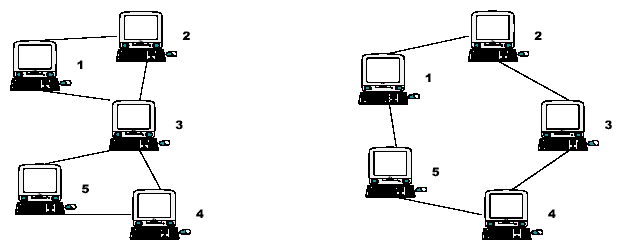
Node 3 is therefore a Single Point of Failure (SPF) for this
network. Strictly, an SPF will be defined as any node that, if
unavailable, would prevent at least one pair of available nodes from
being able to communicate on what was previously a fully connected
network. Note that the network on the right has no such node; there is
no SPF in the network. At least two machines must fail before there are
any pairs of available nodes which cannot communicate.
Input
input will contain the description of several networks. A network
description will consist of pairs of integers, one pair per line, that
identify connected nodes. Ordering of the pairs is irrelevant; 1 2 and 2
1 specify the same connection. All node numbers will range from 1 to
1000. A line containing a single zero ends the list of connected nodes.
An empty network description flags the end of the input. Blank lines in
the input file should be ignored.
Output
The first network in the file should be identified as "Network #1",
the second as "Network #2", etc. For each SPF node, output a line,
formatted as shown in the examples below, that identifies the node and
the number of fully connected subnets that remain when that node fails.
If the network has no SPF nodes, simply output the text "No SPF nodes"
instead of a list of SPF nodes.
Sample Input
1 2

5 4

3 1

3 2

3 4

3 5

0

1 2

2 3

3 4

4 5

5 1

0

1 2

2 3

3 4

4 6

6 3

2 5

5 1

0

0
Sample Output
Network #1

  SPF node 3 leaves 2 subnets

Network #2

  No SPF nodes

Network #3

  SPF node 2 leaves 2 subnets

  SPF node 3 leaves 2 subnets
#include <iostream>

#include <cstring>

#include <cstdio>

#include <algorithm>

#include <cmath>

#include <string>

#include <map>

#include <queue>

#include <vector>

#define inf 0x7fffffff

#define met(a,b) memset(a,b,sizeof a)

typedef long long ll;

using namespace std;

const int N = ;

const int M = ;

int edg[N][N],vis[N];

int nodes,tmpdfn,son;

int dfn[N],low[N],subnets[N];

void init()

{

    low[]=dfn[]=;

    tmpdfn=;son=;

    met(vis,);met(subnets,);

    vis[]=;

}

void Tarjan(int u)

{

    for(int v=;v<=nodes;v++){

        if(edg[u][v]){

            if(!vis[v]){

                vis[v]=;

                dfn[v]=low[v]=++tmpdfn;

                Tarjan(v);

                low[u]=min(low[u],low[v]);

                if(low[v]>=dfn[u]){

                    if(u!=)subnets[u]++;

                    else son++;

                }

            }

            else low[u]=min(low[u],dfn[v]);

        }

    }

}

int main()

{

    int u,v,num=;

    while(~scanf("%d",&u)&&u){

        met(edg,);nodes=;

        scanf("%d",&v);

        nodes=max(max(u,v),nodes);

        edg[u][v]=edg[v][u]=;

        while(){

            scanf("%d",&u);

            if(!u)break;

            scanf("%d",&v);

            nodes=max(max(u,v),nodes);

            edg[u][v]=edg[v][u]=;

        }

        if(num>)printf("\n");

        printf("Network #%d\n",num);num++;

        init();

        Tarjan();

        if(son>)subnets[]=son-;

        bool find=false;

        for(int i=;i<=nodes;i++){

            if(subnets[i]){

                find=true;printf("  SPF node %d leaves %d subnets\n",i,subnets[i]+);

            }

        }

        if(!find)printf("  No SPF nodes\n");

    }

    return ;

}
POJ 1523 SPF(寻找关节点)的更多相关文章
- poj 1523 SPF(双连通分量割点模板)
题目链接:http://poj.org/problem?id=1523 题意:给出无向图的若干条边,求割点以及各个删掉其中一个割点后将图分为几块. 题目分析:割点用tarjan算法求出来,对于每个割点 ...
- zoj 1119 / poj 1523 SPF (典型例题 求割点 Tarjan 算法)
poj : http://poj.org/problem?id=1523 如果无向图中一个点 u 为割点 则u 或者是具有两个及以上子女的深度优先生成树的根,或者虽然不是一个根,但是它有一个子女 w, ...
- POJ 1523 SPF 割点与桥的推断算法-Tarjan
题目链接: POJ1523 题意: 问一个连通的网络中有多少个关节点,这些关节点分别能把网络分成几部分 题解: Tarjan 算法模板题 顺序遍历整个图,能够得到一棵生成树: 树边:可理解为在DFS过 ...
- POJ 1523 SPF tarjan求割点
SPF Time Limit: 1000MS Memory Limit ...
- POJ 1523 SPF(求割点)
题目链接 题意 : 找出图中所有的割点,然后输出删掉他们之后还剩多少个连通分量. 思路 : v与u邻接,要么v是u的孩子,要么u是v的祖先,(u,v)构成一条回边. //poj1523 #includ ...
- POJ 1523 SPF (割点,连通分量)
题意:给出一个网络(不一定连通),求所有的割点,以及割点可以切分出多少个连通分量. 思路:很多种情况. (1)如果给的图已经不是连通图,直接“ No SPF nodes”. (2)求所有割点应该不难 ...
- zoj 1119 /poj 1523 SPF
题目描述:考虑图8.9中的两个网络,假定网络中的数据只在有线路直接连接的2个结点之间以点对点的方式传输.一个结点出现故障,比如图(a)所示的网络中结点3出现故障,将会阻止其他某些结点之间的通信.结点1 ...
- POJ - 1523 SPF
题目要求割顶集,并且还要求出去掉割顶之后剩下的图连通数目. tarjan算法求出割顶后直接枚举就可以了吧. 一开始想到利用iscut[u]的次数也就是点u被判定为割顶的次数求连通分量数,还有利用与结点 ...
- poj 1523 SPF【点双连通求去掉割点后bcc个数】
SPF Time Limit: 1000MS Memory Limit: 10000K Total Submissions: 7246 Accepted: 3302 Description C ...
随机推荐
- HDU 3341 状态压缩DP+AC自动机
题目大意: 调整基因的顺序,希望使得最后得到的基因包含有最多的匹配串基因,使得所能达到的智商最高 这里很明显要用状态压缩当前AC自动机上点使用了基因的情况所能达到的最优状态 我最开始对于状态的保存是, ...
- 基于K2 BPM平台,中原地产实现了从2个人到5万多人的跨越
演讲人:吴付文 中原地产CIO 点击这里查看中原地产怎么使用BPM实现业绩的飞跃式发展.
- Android 之 数据存储
在Android操作系统中,提供了5种数据存储方式:SharedPreferences存储,文件存储,SQLite数据库存储,ContentProvider存储和网络存储. 一.SharedPrefe ...
- ScrollView中嵌入ListView,GridView冲突的解决(让ListView全显示出来)
ScrollView中嵌入原生ListView或GridView,会出现ListView,GridView显示不全的问题. 解决方法:重新构造一个ListView或GridView,重写OnMeasu ...
- 表(list)
表 表(list)是常见的数据结构.从数学上来说,表是一个有序的元素集合.在C语言的内存中,表储存为分散的节点(node).每个节点包含有一个元素,以及一个指向下一个(或者上一个)元素的指针.如下图所 ...
- MongoDB的C#驱动程序教程(译) 转
1.概述 本教程是10gen支持C#驱动程序MongoDB的介绍.假定您熟悉使用MongoDB,因此主要集中在如何使用C#访问MongoDB的. 它分为两个部分:C# 驱动程序 ,BSON图书馆.C# ...
- scanf
scanf函数: (1)与printf函数一样,都被定义在头文件stdio.h里,因此在使用scanf函数时要加上#include <stdio.h>.它是格式输入函数,即按用户指定的格式 ...
- UIViewController添加子控制器(addChildViewController)
// // TaskHallViewController.m // yybjproject // // Created by bingjun on 15/10/27. // Copyright ...
- Java中接口作为方法的返回
在<算法>中的散列表一节,在用拉链法实现散列表的API时要求实现以下一个方法: public Iterable<Key> keys() 我们知道Iterable是一个接口,那么 ...
- 自动打补丁Bat指令
自动打补丁 补丁放于hotfix文件夹下 for %%i in (hotfix\*.exe) do start /wait %%i /z /u