
Flow类注释解读
参考:
(1)https://docs.oracle.com/javase/specs/jls/se7/html/jls-16.html
(2)https://docs.oracle.com/javase/specs/jls/se7/html/jls-14.html#jls-14.1 后面的Unreachable Statements部分
This pass implements dataflow analysis for Java programs.
Liveness analysis checks that every statement is reachable.
Exception analysis ensures that every checked exception that is thrown is declared or caught.
Definite(一定的、确定的) assignment analysis ensures that each variable is assigned when used.
如上指出了要做的三项工作,分别是Liveness analysis、Exception analysis与DA/DU
eg:
任何局部变量在使用前要进行初始化,包括基本类型,如下将报错:
int i;
if(i==2){ // 报错,局部变量i未初始化

}
Definite unassignment analysis ensures that no final variable is assigned more than once(不止一次).
eg:
final int i;
i = 1;
i = 22; // The final local variable i may already have been assigned
The JLS has a number of problems in the specification of these flow analysis problems.This implementation attempts to address those issues.
First, there is no accommodation for a finally clause that cannot complete normally.
For liveness analysis, an intervening finally clause can cause a break, continue, or return not to reach its target.
For exception analysis, an intervening finally clause can cause any exception to be "caught".
eg:
什么是intervening finally,就比如finally中有return 、continue等有控制流程转移的语句。
for(int i=0;i<2;i++){
			try{
				System.out.println("a");
				break;
			}catch(Exception ex){

			}finally{ // finally block does not complete normally
				System.out.println("b");
				continue;
			}
}
输出为:a b a b
@SuppressWarnings("finally")
private boolean isReturnWithinFinally() {
		try {
			if (true)
				throw new RuntimeException();
		} finally {
			return true; // This hides the exception
		}
}
所以这是一个Finally block may not complete normally 的问题。
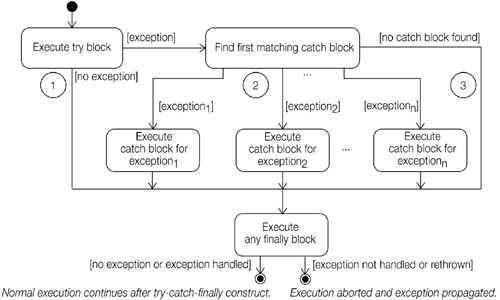
A 'finally' block that runs because an exception has been thrown, and that does not complete normally, causes the exception to disappear silently.
A finally block that does not complete normally suppresses any exceptions that may have been thrown in the corresponding try block. This can happen if the finally block contains any return or throw statements, or if it contains any break or continue statements whose jump target lies outside of the finally block.
To avoid suppressing exceptions that are thrown in a try block, design the code so that the corresponding finally block always completes normally. Remove any of the following statements that may cause it to terminate abnormally:
returnthrowbreakcontinue
用如下图总结一下:
参考:
(1)https://help.semmle.com/wiki/display/JAVA/Finally+block+may+not+complete+normally
(2)http://etutorials.org/cert/java+certification/Chapter+5.+Control+Flow+Exception+Handling+and+Assertions/5.7+Exception+Handling+try+catch+and+finally/
For DA/DU analysis, the finally clause can prevent a transfer of control(控制权的转移) from propagating(传播) DA/DU state to the target. In addition(另外), code in the finally clause can affect the DA/DU status of variables.
For try statements, we introduce the idea of a variable being definitely unassigned "everywhere" in a block.
A variable V is "unassigned everywhere" in a block iff(if and only if) it is unassigned at the beginning of the block and there is no reachable assignment to V in the block.
An assignment V=e is reachable iff V is not DA after e. Then we can say that V is DU at the beginning of the catch block iff V is DU everywhere in the try block. 如上的变量e说的可能是catch块的Exception中的变量e
Similarly,V is DU at the beginning of the finally block iff V is DU everywhere in the try block and in every catch block.
Specifically, the following bullet is added to 16.2.2
V is unassigned everywhere in a block if it is unassigned before the block and there is no reachable assignment to V within the block.
In 16.2.15, the third bullet (and all of its sub-bullets) for all try blocks is changed to
V is definitely unassigned before a catch block iff V is definitely unassigned everywhere in the try block.
The last bullet (and all of its sub-bullets) for try blocks that have a finally block is changed to
V is definitely unassigned before the finally block iff V is definitely unassigned everywhere in the try block and everywhere in each catch block of the try statement.
In addition,
V is definitely assigned at the end of a constructor iff V is definitely assigned after the block that is the body of the constructor and V is definitely assigned at every return that can return from the constructor.
In addition, each continue statement with the loop as its target is treated as a jump to the end of the loop body,and "intervening" finally clauses are treated as follows:
V is DA "due to(归因于) the continue" iff V is DA before the continue statement or V is DA at the end of any intervening finally block.
V is DU "due to the continue" iff any intervening finally cannot complete normally or V is DU at the end of every intervening finally block. This "due to the continue" concept is then used in the spec for the loops.
Similarly, break statements must consider intervening finally blocks.
For liveness analysis, a break statement for which any intervening finally cannot complete normally is not considered to cause the target statement to be
able to complete normally. Then we say V is DA "due to the break" iff V is DA before the break or V is DA
at the end of any intervening finally block. V is DU "due to the break" iff any intervening finally cannot complete normally
or V is DU at the break and at the end of every intervening finally block. (I suspect this latter condition can be simplified.)
This "due to the break" is then used in the spec for all statements that can be "broken".
The return statement is treated similarly. V is DA "due to a return statement" iff V is DA before the return statement
or V is DA at the end of any intervening finally block. Note that we don't have to worry about the return expression because this concept is only used for construcrors.
There is no spec in JLS2 for when a variable is definitely assigned at the end of a constructor, which is needed for
final fields (8.3.1.2). We implement the rule that V is DA at the end of the constructor iff it is DA and the end of
the body of the constructor and V is DA "due to" every return of the constructor.
Intervening finally blocks similarly affect exception analysis. An intervening finally that cannot complete normally allows us to ignore an otherwise uncaught exception.
To implement the semantics of intervening finally clauses, all nonlocal transfers (break, continue, return, throw,
method call that can throw a checked exception, and a constructor invocation that can thrown a checked exception)
are recorded in a queue, and removed from the queue when we complete processing the target of the nonlocal transfer.
This allows us to modify the queue in accordance with the above rules when we encounter a finally clause.
The only exception to this [no pun intended 没有双关] is that checked exceptions that are known to be caught or declared
to be caught in the enclosing method are not recorded in the queue, but instead are recorded in a global variable
"Set thrown" that records the type of all exceptions that can be thrown.
Other minor issues the treatment of members of other classes (always considered DA except that within an anonymous class constructor, where DA status from the enclosing scope is preserved),
treatment of the case expression (V is DA before the case expression iff V is DA after the switch expression), treatment of variables declared in a
switch block (the implied DA/DU status after the switch expression is DU and not DA for variables defined in a switch block),
the treatment of boolean ?: expressions (The JLS rules only handle b and c non-boolean; the new rule is that
if b and c are boolean valued, then V is (un)assigned after a?b:c when true/false iff V is (un)assigned after b
when true/false and V is (un)assigned after c when true/false).
There is the remaining question of what syntactic forms constitute(组成) a reference to a variable. It is conventional to
allow this.x on the left-hand-side to initialize a final instance field named x, yet this.x isn't considered a "use" when appearing on a right-hand-side in most implementations.
Should parentheses affect what is considered a variable reference?(括号会影响被视为变量引用的内容)The simplest rule would be to allow unqualified forms only, parentheses optional, and phase out support for assigning to a final field via this.x.
参考:
(1)https://docs.oracle.com/javase/specs/jls/se7/html/jls-16.html
Flow类注释解读的更多相关文章
- VAssistX的VA Snippet Editor的类注释和函数注释
title:类注释shortcut:=== /******************************************************** [DateTime]:$YEAR$.$M ...
- IDEA(添加类注释以及方法注释)
添加类注释: File---Setting----Editor----Code Style-----File and Code Templates--------Class #if (${PA ...
- PhpStorm 头部注释、类注释和函数注释的设置
*设置位置:"Settings"->"file templates"; 如下图,设置头部注释.类注释以及函数注释,时间.用户名.文件名称等随机改变的属性, ...
- 超详细设置Idea类注释模板和方法注释模板
网上找了一下,没有很详细且正确介绍Idea配置注释模板的,于是结合多篇文章自己琢磨整理出如下. 设置类注释模板 1.选择File–>Settings–>Editor–>File an ...
- idea生成类注释和方法注释的正确方法
系统:Mac OS idea版本:2017.3.1 ---------------- 生成类注释 打开Preferences Editor -> File and Code Templates ...
- Idea设置类注释模板
1.选择File–>Settings–>Editor–>File and Code Templates–>Includes–>File Header. 在Descript ...
- IntelliJ Idea注释模板--类注释、方法注释
刚从Eclipse切换到IntelliJ Idea,之前使用eclipse时用到了注释模板,包括类注释和方法注释,现在分别讲一下在Intellij Idea中如何进行配置,作为备忘 一. 类注释模板配 ...
- Hibernate---数据操作示例BY实体类注释
通过实体的映射文件创建表的示例,除了基本jar包外,还需要jar包如下 ejb3-persistence.jar.hibernate-annotations.jar这两个包均在hibernate-an ...
- IntelliJ IDEA 添加类注释模板
效果展示 /** * Created with IntelliJ IDEA * USER:jacun * CLASSNAME: HalloWorldController * DATE: 2019/1/ ...
随机推荐
- spring 课程
官网 参考文档 // 1. Spring_HelloWorld 20:22 // 2. Spring_IOC&DI概述 08:07 // 3. Spring_配置 Bean 21:58 // ...
- 为UITextView添加通知..来检测UITextView内容的改变
self.mTextView =[[UITextView alloc]initWithFrame:CGRectMake(0, 0, SCREEN_WIDTH - 100, 28)]; se ...
- Linux C 创建目录函数mkdir相关【转】
转自:http://blog.csdn.net/fallenink/article/details/8480483 原文地址:http://sharp2wing.iteye.com/blog/1280 ...
- 修改jenkins启动的默认用户
# 背景 通过yum命令安装的jenkins,通过service jenkins去启动jenkins的话,默认的用户是jenkins,但jenkins这个用户是无法通过su切换过去的 ,在某些环节可能 ...
- SQL 取两日期的记录
SELECT TOP 1000 [ID] ,[SourcePageID] ,[PlatformType] ,[CreateTime] FROM [home_sendor ...
- 如何使用socket进行java网络编程(三)
本篇文章继续记录java网络通讯编程的学习.在本系列笔记的第一篇中曾经记录过一个项目中的程序,当时还处于项目早期,还未进入与第三方公司的联调阶段,笔者只是用java写了一个client程序模拟了一下第 ...
- Handler主线程和子线程相通信
//创建主线程的handlerprivate Handler handler = new Handler(){ @Override public void handleMessage(Message ...
- Cordova - 实现热更新 !
Cordova版本:8.0.0 更新APP平台:Android 操作系统:Windows Cordova的热更新,作用是把www内的变动部分更新到APP中,实现主程序不动,完成更新!!这个热更新功能, ...
- 用layui遇到过的问题
1.报错“layui.form is not a function”问题 把代码中这一串修改一下:form = layui.form(); 括号去掉就行: form = layui.form; 如果你 ...
- “全栈2019”Java多线程第二十五章:生产者与消费者线程详解
难度 初级 学习时间 10分钟 适合人群 零基础 开发语言 Java 开发环境 JDK v11 IntelliJ IDEA v2018.3 文章原文链接 "全栈2019"Java多 ...