
Android Hook框架adbi的分析(1)---注入工具hijack
本文博客地址:http://blog.csdn.net/qq1084283172/article/details/74055505
一、Android Hook框架adbi的基本介绍
adbi是Android平台的inline Hook框架,和前面博客中提到的libinject和poison注入工具原理差不多,要说具体的相似性的话,poison注入工具可以替换此处adbi的hijack注入工具实现so的注入和函数的Hook。adbi Hook框架和前面poison注入工具实现函数Hook的原理是一样的,先通过进程注入工具将so库文件注入到指定的目标pid进程中,函数Hook的执行在so库文件注入到目标pid中即so库文件被目标pid进程加载的时候执行的,具体的原理可以参考前面的博客 《Android so注入(inject)和Hook(挂钩)的实现思路讨论》,在so库文件加载的时候,会首先执行.init段的构造函数,该构造函数的定义方法为:
void __attribute__((constructor)) x_init(void)
当我们向目标pid进程注入so库文件时,会最先执行该x_init函数,因此可以实现Hook目标pid进程函数的目的,该x_init函数唯一的不足就是不能传递函数参数。
Android Hook框架adbi的源码地址:https://github.com/crmulliner/adbi 。
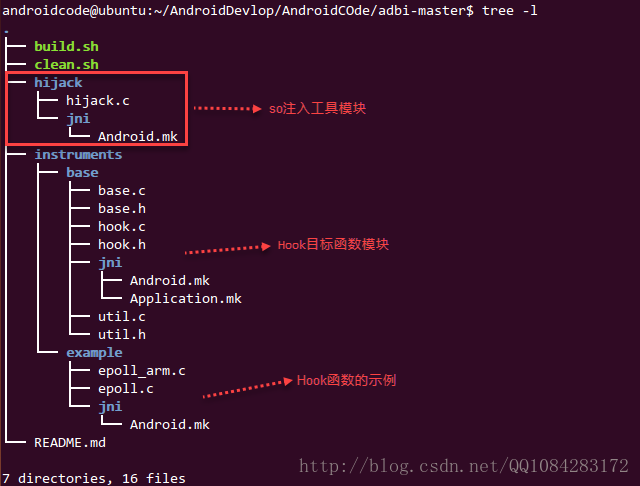
Android Hook框架adbi的源码结构和功能示意图如下:
二、hijack注入工具的工作步骤
默认的约定
.目标pid进程:远程被注入so库文件的目标pid进程
.本地进程:当前so注入工具hijack所在的进程
.Android系统跨进程so库文件注入能够实现的前提:在获取到root权限的条件下
- 获取目标pid进程的libc库中
mprotect函数的远程调用地址; - 获取被注入的目标pid进程中
dlopen函数的远程调用地址; ptrace附加到被注入的目标pid进程中,等待附加目标pid进程成功完成;- 获取目标pid进程
被ptrace时寄存器的状态值并保存,用于后面目标pid进程环境的恢复还原; - 通过修改目标pid进程被ptrace时的栈指针寄存器SP,实现在目标pid进程中申请内存空间;
- 将需要注入的so库文件的路径和实现在目标pid进程中调用dlopen函数加载so库文件的shellcode写入到
步骤5中申请的栈内存空间中; - 修改获取到目标pid进程被ptrace时,
R0、R1、R2寄存器的值为mprotect函数被调用时的参数值,设置程序指令计数寄存器PC的值为步骤1中,获取到的目标pid进程的mprotect函数的远程调用地址; - 修改获取到目标pid进程被ptrace时的
LR寄存器的值为步骤6中提到的实现在目标pid进程中调用dlopen函数加载so库文件的shellcode地址; - 设置目标pid进程被ptrace时寄存器的环境状态值即上面步骤7、步骤8提到的操作;
- 再次调用
ptrace函数释放对目标pid进程的附加,目标pid进程得以继续执行(但是寄存器环境已经改变),因此基于上面的操作实现了在目标pid进程中调用mprotect函数修改存放shellcode的堆栈为可读可写可执行,并在mprotect函数返回时实现了执行调用目标pid进程的dlopen函数加载so库文件的shellcode代码,从而实现了跨进程so库文件的注入.
三、注入工具hijack代码的详细分析
(1).获取目标pid进程libc库中mprotect函数的远程调用地址
1.获取指定目标pid进程内存布局的内存地址信息和名称,相同名称的内存布局空间进行合并。
static int load_memmap(pid_t pid, struct mm *mm, int *nmmp)

{

    char raw[80000]; // increase this if needed for larger "maps"

    char name[MAX_NAME_LEN];

    char *p;

    unsigned long start, end;

    struct mm *m;

    int nmm = 0;

    int fd, rv;

    int i;

    // 格式字符串"/proc/pid/maps"

    sprintf(raw, "/proc/%d/maps", pid);

    // 获取目标pid进程的内存布局信息

    fd = open(raw, O_RDONLY);

    if (0 > fd) {

        //printf("Can't open %s for reading\n", raw);

        return -1;

    }

    // 数组清零

    memset(raw, 0, sizeof(raw));

    // 格式:400c2000-400da000 r-xp 00000000 b3:19 949        /system/lib/libm.so

    p = raw;

    while (1) {

        // 分行读取目标pid进程的内存布局信息

        rv = read(fd, p, sizeof(raw)-(p-raw));

        if (0 > rv) {

            //perror("read");

            return -1;

        }

        // 判断内存布局信息是否读取完了

        if (0 == rv)

            break;

        // 修改指向内存缓冲区raw中的指针偏移p

        p += rv;

        // 判断是否超过内存缓冲区范围

        if (p-raw >= sizeof(raw)) {

            //printf("Too many memory mapping\n");

            return -1;

        }

    }

    // 关闭文件

    close(fd);

    // 分割字符串

    p = strtok(raw, "\n");

    m = mm;

    while (p) {

        // 根据格式解析每一行内存布局信息

        // rv = sscanf函数都将返回成功转换并分配的字段数

        rv = sscanf(p, "%08lx-%08lx %*s %*s %*s %*s %s\n", &start, &end, name);

        // 继续分割字符串

        p = strtok(NULL, "\n");

        // sscanf函数前两个字段start、end匹配成功的情况即没有名称的情况

        if (rv == 2) {

            m = &mm[nmm++];

            // 内存布局起始地址

            m->start = start;

            // 内存布局结束地址

            m->end = end;

            // 设置默认内存布局名称为"[memory]"

            strcpy(m->name, MEMORY_ONLY);

            continue;

        }

        /* search backward for other mapping with same name */

        // 在前面保存的内存布局行信息中查找相同名称的内存布局

        // 例如:

        // 7739a000-7739c000 r-xp 00000000 b3:19 795        /system/lib/libOpenSLES.so

        // 7739c000-7739d000 r--p 00001000 b3:19 795        /system/lib/libOpenSLES.so

        // 7739d000-7739e000 rw-p 00002000 b3:19 795        /system/lib/libOpenSLES.so

        for (i = nmm-1; i >= 0; i--) {

            m = &mm[i];

            if (!strcmp(m->name, name))

                break;

        }

        // 进行相同名称的内存布局起始地址和结束地址的合并

        if (i >= 0) {

            if (start < m->start)

                m->start = start;

            if (end > m->end)

                m->end = end;

        } else {

            // 内存起始地址、内存结束地址、内存布局名称

            m = &mm[nmm++];

            // 内存起始地址

            m->start = start;

            // 内存结束地址

            m->end = end;

            // 内存布局名称

            strcpy(m->name, name);

        }

    }

    // 保存合并后内存布局的个数

    *nmmp = nmm;

    return 0;

}
2.通过在上面获取到的目标pid进程的内存布局信息中,匹配查找到目标lib库libn,获取目标lib库libn的内存基地址libcaddr并获取保存libn的全路径字符串(此处要查找的是目标pid进程的libc.so库文件的内存基地址和路径字符串)。
/* Find libc in MM, storing no more than LEN-1 chars of

   its name in NAME and set START to its starting

   address.  If libc cannot be found return -1 and

   leave NAME and START untouched.  Otherwise return 0

   and null-terminated NAME. */

// libn为要查找的lib库文件的名称字符串,如:"libc."

static int find_libname(char *libn, char *name, int len, unsigned long *start, struct mm *mm, int nmm)

{

    int i;

    struct mm *m;

    char *p;

    // 遍历获取到的目标pid进程的内存布局的信息

    for (i = 0, m = mm; i < nmm; i++, m++) {

        // 直接跳过内存布局名称为"[memory]"的情况

        if (!strcmp(m->name, MEMORY_ONLY))

            continue;

        // 从右开始搜索'/'符号,获取内存布局的名称

        // 例如/system/lib/libdl.so,获取名称libdl.so

        p = strrchr(m->name, '/');

        // 跳过不符合要求的情况

        if (!p)

            continue;

        // 判断获取到的lib库名称是否是要查找的目标lib库名称libn

        p++;

        if (strncmp(libn, p, strlen(libn)))

            continue;

        // 获取查找的例如:"libc."的长度

        p += strlen(libn);

        /* here comes our crude test -> 'libc.so' or 'libc-[0-9]' */

        // 作者并没有使用

        if (!strncmp("so", p, 2) || 1) // || (p[0] == '-' && isdigit(p[1])))

            break;

    }

    // 判断是否查找到目标lib库libn

    if (i >= nmm)

        /* not found */

        return -1;

    // 获取指定lib库文件的内存的起始地址

    *start = m->start;

    // 保存查找到的目标lib库文件的路径字符串m->name

    strncpy(name, m->name, len);

    // 判断lib库文件的路径字符串是否超过内存数组的长度

    if (strlen(m->name) >= len)

        // 进行字符串的截取

        name[len-1] = '\0';

    // 修改指定内存区域内存属性为可读可写可执行

    mprotect((void*)m->start, m->end - m->start, PROT_READ|PROT_WRITE|PROT_EXEC);

    return 0;

}
3.打开查找到的lib目标库文件(路径字符串libc),解析该Elf文件,获取该lib目标库文件的静态库和动态库的符号表信息即”.symtab”和”.dynsym”系统符号表的信息(此处要解析和查找的为目标pid进程的libc.so库文件的系统符号表的结构体信息),有关elf文件的解析过程可以仔细的去分析 do_load函数 。
static symtab_t load_symtab(char *filename)

{

    int fd;

    symtab_t symtab;

    symtab = (symtab_t) xmalloc(sizeof(*symtab));

    memset(symtab, 0, sizeof(*symtab));

    // 打开elf文件

    fd = open(filename, O_RDONLY);

    if (0 > fd) {

        //perror("open");

        return NULL;

    }

    // 解析elf文件,获取elf的".symtab"和".dynsym"的信息结构体

    if (0 > do_load(fd, symtab)) {

        printf("Error ELF parsing %s\n", filename);

        free(symtab);

        symtab = NULL;

    }

    close(fd);

    return symtab;

}
4.在目标lib库libn的静态库和动态库的符号表查找被Hook的目标函数的RVA即相对地址偏移(此处为在目标pid进程的libc.so库文件的静态库和动态库的符号表中查找mprotect函数的相对地址偏移)。
//struct symtab {

//  struct symlist *st;    /* "static" symbols */

//  struct symlist *dyn;   /* dynamic symbols */

//};

static int lookup_sym(symtab_t s, unsigned char type,

       char *name, unsigned long *val)

{

    // 在动态系统符号表中查找获取目标函数的RVA

    if (s->dyn && !lookup2(s->dyn, type, name, val))

        return 0;

    // 在静态系统符号表中查找获取目标函数的RVA

    if (s->st && !lookup2(s->st, type, name, val))

        return 0;

    return -1;

}
5.将获取到的目标pid进程的mprotect函数的RVA和目标pid进程的libc.so库文件的基地址进行相加就得到了目标pid进程中mprotect函数的远程调用地址mprotectaddr。
static int find_name(pid_t pid, char *name, unsigned long *addr)

{

    struct mm mm[1000];

    unsigned long libcaddr;

    int nmm;

    char libc[256];

    symtab_t s;

    // 获取被注入pid进程的so库文件的名称和内存布局起始、结束地址的信息

    if (0 > load_memmap(pid, mm, &nmm)) {

        printf("cannot read memory map\n");

        return -1;

    }

    // 获取被注入pid进程的libc.so库文件的加载基地址以及libc库文件的路径

    if (0 > find_libc(libc, sizeof(libc), &libcaddr, mm, nmm)) {

        printf("cannot find libc\n");

        return -1;

    }

    // 打开查找到的lib目标库文件(路径字符串libc)解析该Elf文件

    // 获取该lib库文件的静态库和动态库的符号表信息".symtab"或者".dynsym".

    s = load_symtab(libc);

    if (!s) {

        printf("cannot read symbol table\n");

        return -1;

    }

    // 在当前进程加载的libc库文件中查找导出的 name名称函数的相对偏移RVA

    // 这个地方,有更好获取mprotect函数调用地址的方法,作者后面也用到了,不知道为什么要用这么复杂的方法?

    if (0 > lookup_func_sym(s, name, addr)) {

        printf("cannot find %s\n", name);

        return -1;

    }

    // 获取得到目标pid中 name 名称的指定函数的远程调用地址

    *addr += libcaddr;

    return 0;

}
(2).根据so动态库的加载原理,获取到目标pid进程中dlopen函数的远程调用地址(本地进程dlopen函数的调用地址 -本地进程加载的libdl.so库的基地址 = 远程目标pid进程dlopen函数的调用地址 - 远程目标pid进程加载的libdl.so库的基地址)。
    // 加载动态库文件"/system/lib/libdl.so"

    // 甚至获取当前进程中dlopen函数的调用地址,这一步不是必须这么去做的

    void *ldl = dlopen("libdl.so", RTLD_LAZY);

    if (ldl) {

        // 获取当前进程中,dlopen函数的调用地址

        dlopenaddr = (unsigned long)dlsym(ldl, "dlopen");

        dlclose(ldl);

    }

    unsigned long int lkaddr;

    unsigned long int lkaddr2;

    // 获取当前进程中的"/system/bin/linker"的基地址

    find_linker(getpid(), &lkaddr);

    //printf("own linker: 0x%x\n", lkaddr);

    //printf("offset %x\n", dlopenaddr - lkaddr);

    // 获取被注入的pid进程中"/system/bin/linker"的基地址

    find_linker(pid, &lkaddr2);

    //printf("tgt linker: %x\n", lkaddr2);

    // 获取被注入的目标pid进程中函数dlopen的远程调用地址

    dlopenaddr = lkaddr2 + (dlopenaddr - lkaddr);

    //printf("tgt dlopen : %x\n", lkaddr2 + (dlopenaddr - lkaddr));

    if (debug)

        printf("dlopen: 0x%lx\n", dlopenaddr);
(3).ptrace附加到被注入的目标pid进程上,获取此时目标pid进程寄存器环境的状态值。
// ptrace附加到被注入的目标pid进程中
if (0 > ptrace(PTRACE_ATTACH, pid, 0, 0)) {
printf("cannot attach to %d, error!\n", pid);
exit(1);
}
// 等待附加到目标pid进程完成
waitpid(pid, NULL, 0);
......
// 格式化得到字符串"/proc/pid/mem"
sprintf(buf, "/proc/%d/mem", pid);
// 获取被注入的目标pid进程内存中的内容
fd = open(buf, O_WRONLY);
if (0 > fd) {
printf("cannot open %s, error!\n", buf);
exit(1);
}
// 获取目标pid进程中此时所有寄存器的状态值
ptrace(PTRACE_GETREGS, pid, 0, ®s);(4).通过抬高栈顶,减小获取到的目标pid进程的SP寄存器的值,实现在目标pid进程中申请内存空间。将需要加载的so库文件的路径字符串写入到申请的内存空间中,还将在目标pid进程中实现远程调用dlopen函数加载so库文件的shellcode代码写入到申请的内存空间中。
// dlopen函数的调用方式:void * dlopen( const char * pathname, int mode);

// pc寄存器值指向的是当前指令位置加8个字节

// codeaddr即写入的shellcode执行代码开始的位置

// 作者在目标pid进程中写入shellcode进行执行的方法不错,比较巧妙

unsigned int sc[] = {

0xe59f0040, //        ldr     r0, [pc, #64]   ; 48 <.text+0x48>-->将需要加载的so库文件的文件路径字符串的地址给r0

0xe3a01000, //        mov     r1, #0  ; 0x0                    -->即dlopen函数的mode=0

0xe1a0e00f, //        mov     lr, pc                           -->设置dlopen函数的返回地址,返回时跳到ldr sp, [pc, #44]去执行

0xe59ff038, //        ldr     pc, [pc, #56]   ; 4c <.text+0x4c>-->调用dlopen函数实现在目标pid进程中加载so库文件

0xe59fd02c, //        ldr     sp, [pc, #44]   ; 44 <.text+0x44>-->开始恢复目标pid进程被ptrace时的进程环境即恢复此时一些寄存器的值

0xe59f0010, //        ldr     r0, [pc, #16]   ; 30 <.text+0x30>-->感觉目标pid进程环境的恢复不是很完美~~~~

0xe59f1010, //        ldr     r1, [pc, #16]   ; 34 <.text+0x34>

0xe59f2010, //        ldr     r2, [pc, #16]   ; 38 <.text+0x38>

0xe59f3010, //        ldr     r3, [pc, #16]   ; 3c <.text+0x3c>

0xe59fe010, //        ldr     lr, [pc, #16]   ; 40 <.text+0x40>

0xe59ff010, //        ldr     pc, [pc, #16]   ; 44 <.text+0x44>

0xe1a00000, //        nop                     r0

0xe1a00000, //        nop                     r1

0xe1a00000, //        nop                     r2

0xe1a00000, //        nop                     r3

0xe1a00000, //        nop                     lr

0xe1a00000, //        nop                     pc

0xe1a00000, //        nop                     sp

0xe1a00000, //        nop                     addr of libname

0xe1a00000, //        nop                     dlopenaddr

};
// setup variables of the loading and fixup code
/*
sc[9] = regs.ARM_r0;
sc[10] = regs.ARM_r1;
sc[11] = regs.ARM_lr;
sc[12] = regs.ARM_pc;
sc[13] = regs.ARM_sp;
sc[15] = dlopenaddr;
*/
// 保存目标pid进程此时所有寄存器的值(保存当前执行环境,用于还原)
sc[11] = regs.ARM_r0;
sc[12] = regs.ARM_r1;
sc[13] = regs.ARM_r2;
sc[14] = regs.ARM_r3;
sc[15] = regs.ARM_lr;
sc[16] = regs.ARM_pc;
sc[17] = regs.ARM_sp;
sc[19] = dlopenaddr;
// 打印日志消息
if (debug) {
printf("pc=%lx lr=%lx sp=%lx fp=%lx\n", regs.ARM_pc, regs.ARM_lr, regs.ARM_sp, regs.ARM_fp);
printf("r0=%lx r1=%lx\n", regs.ARM_r0, regs.ARM_r1);
printf("r2=%lx r3=%lx\n", regs.ARM_r2, regs.ARM_r3);
}
// 在目标pid进程中,抬高栈顶分配内存空间用于存放需要加载的动态库文件
libaddr = regs.ARM_sp - n*4 - sizeof(sc);
// 保存加载到目标pid进程中的so库文件的路径字符串的指针
sc[18] = libaddr;
//sc[14] = libaddr;
//printf("libaddr: %x\n", libaddr);
if (stack_start == 0) {
stack_start = (unsigned long int) strtol(argv[3], NULL, 16);
stack_start = stack_start << 12;
stack_end = stack_start + strtol(argv[4], NULL, 0);
}
if (debug)
printf("stack: 0x%x-0x%x leng = %d\n", stack_start, stack_end, stack_end-stack_start);
// 将需要加载的so库文件的路径字符串写入到目标pid进程的内存地址libaddr处
if (0 > write_mem(pid, (unsigned long*)arg, n, libaddr)) {
printf("cannot write library name (%s) to stack, error!\n", arg);
exit(1);
}
// 在目标pid进程中,再次抬高栈顶用于存放执行的shellcode
codeaddr = regs.ARM_sp - sizeof(sc);
// 将shellcode代码src写入到目标pid进程的内存地址codeaddr处
if (0 > write_mem(pid, (unsigned long*)&sc, sizeof(sc)/sizeof(long), codeaddr)) {
printf("cannot write code, error!\n");
exit(1);
}
if (debug)
printf("executing injection code at 0x%lx\n", codeaddr);
// 修改目标pid进程中的栈指针regs.ARM_sp的值
regs.ARM_sp = regs.ARM_sp - n*4 - sizeof(sc);(5).在目标pid进程中实现远程调用dlopen函数加载so库文件的shellcode代码不是很好理解,博主Roland_Sun特此画了一张图,感觉还不错,拿来学习一下,顺便将作者的分析思路也一并摘过来,感谢作者Roland_Sun。

对于ARM处理器来说,pc寄存器的值指向的不是当前正在执行指令的地址,而是往下第二条指令的地址。
开始分析shellcode代码的含义,指令将从codeaddr指示的位置从低到高依次执行。
1. 第一条指令将pc寄存器的值加上64,读出那个地方的内容(4个字节),然后放到寄存器r0中。刚才说过了,pc寄存器值指向的是当前指令位置加8个字节,也就是说这条指令实际读出的是当前指令位置向下72个字节。由于sc数组是int型的,就是数组当前元素位置向下18个元素处。数一数,刚好是libaddr的位置。所以这条指令是为了让r0寄存器指向.so共享库路径名字符串。
2. 第二条指令很简单,是将0赋值给寄存器r1。
3. 第三条指令用来将pc寄存器值保存到lr寄存器中,这样做的目的是为了调用dlopen()函数返回后,跳转到指令“ldr sp, [pc, #44]”处执行。
4. 第四条指令是将pc加上56处的数值加载到pc中,pc+56处是哪?当前指令位置往下64字节,16个元素,刚好是dlopen()函数的调用地址。所以,这条指令其实就是调用dlopen()函数,传入的参数一个是r0寄存器指向的共享库路径名,另一个是r1寄存器中的0。
(6).修改获取到目标pid进程的R0、R1、R2寄存器的值为mprotect函数被调用时的参数值,修改获取到目标pid进程的PC寄存器值为前面获取到的目标pid进程mprotect函数的远程调用地址mprotectaddr,修改获取到目标pid进程的LR寄存器值为shellcode的地址codeaddr。/font>
// 设置mprotect函数的第1个参数为目标pid进程中栈的起始地址
regs.ARM_r0 = stack_start; // want to make stack executable
//printf("r0 %x\n", regs.ARM_r0);
// 设置mprotect函数的第2个参数为目标pid进程中整个栈大小
regs.ARM_r1 = stack_end - stack_start; // stack size
//printf("mprotect(%x, %d, ALL)\n", regs.ARM_r0, regs.ARM_r1);
// 设置mprotect函数的第3个参数为目标pid进程中栈被修改为可读可写可执行
regs.ARM_r2 = PROT_READ|PROT_WRITE|PROT_EXEC; // protections
// normal mode, first call mprotect
if (nomprotect == 0) {
if (debug)
printf("calling mprotect\n");
// 在目标pid进程中调用完mprotect函数之后,函数返回调用写入的关键shellcode代码
regs.ARM_lr = codeaddr; // points to loading and fixing code
// 在目标pid进程中调用mprotect函数将目标pid进程整个栈修改为可读可写可执行
regs.ARM_pc = mprotectaddr; // execute mprotect()
} else {
// no need to execute mprotect on old Android versions
// 直接调用shellcode,不需要修改内存属性(可以删除)
regs.ARM_pc = codeaddr;
}(7).重新设置目标pid进程的寄存器环境的状态值(已经被我们修改了),释放附加的目标pid进程让其继续执行;由于目标pid进程的寄存器状态被我们改变了,因此目标pid进程继续执行会先调用mprotect函数将shellcode所在栈内存的属性改为可读可写可执行,然后在mprotect函数返回时,在目标pid进程中调用dlopen函数加载so库文件的shellcode代码也得以执行,从而实现Android跨进程的so注入。
// 设置目标pid进程的所有寄存器的值(即设置好目标pid进程中mprotect函数的参数及调用)
ptrace(PTRACE_SETREGS, pid, 0, ®s);
// 让目标pid进程继续执行即让目标pid进程先执行mprotect函数然后执行shellcode代码实现so动态库文件的注入
ptrace(PTRACE_DETACH, pid, 0, (void *)SIGCONT);
// 打印日志消息
if (debug)
printf("library injection completed!\n");(8).注入工具hijack实现思路的总结
- 作者在获取目标pid进程mprotect函数的远程调用地址的思路为我们跨进程获取远程目标pid进程的目标函数的调用地址提供了另外一种思路:先通过/proc/pid/maps获取到目标pid进程的目标函数所在的so库文件的基地址和so库文件的路径,然后解析目标pid进程的目标函数所在的so库文件,获取到该so库文件的系统静态符号表和系统动态符号表,查找到目标函数的调用地址的RVA,该目标函数的RVA和该so库文件的内存基地址相加即为目标pid进程的目标函数的远程调用地址VA。
- ptrace附加目标pid进程,减小目标pid进程的SP寄存器的值,实现在目标pid进程中申请内存空间,写入shellcode的思路也不错。
- 修改ptrace附加目标pid进程时寄存器R0、R1、R2的状态值为mprotect函数的参数值,PC寄存器的值为mprotect函数的调用地址,然后mprotect函数返回调用shellcode实现dlopen加载so库文件的思路也是很赞的。
- 借助ptrace释放进程时目标pid进程寄存器环境的恢复来先执行mprotect函数修改栈内存为可读可写可执行,为shellcode的顺利执行做准备,然后函数mprotect返回执行shellcode代码,比较巧妙。唯独不足就是,目标pid进程被附加后寄存器环境的恢复稍有不足,不过应该影响不大。
四、注入工具hijack代码
源码文件 hijack.c
/*
* hijack.c - force a process to load a library
*
* ARM / Android version by:
* Collin Mulliner <collin[at]mulliner.org>
* http://www.mulliner.org/android/
* (c) 2012,2013
*
*
* original x86 version by:
* Copyright (C) 2002 Victor Zandy <zandy[at]cs.wisc.edu>
*
* License: LGPL 2.1
*
*/
#define _XOPEN_SOURCE 500 /* include pread,pwrite */
#define _GNU_SOURCE
#include <stdio.h>
#include <stdlib.h>
#include <string.h>
#include <ctype.h>
#include <fcntl.h>
#include <sys/ptrace.h>
#include <sys/types.h>
#include <sys/wait.h>
#include <sys/stat.h>
#include <dlfcn.h>
#include <elf.h>
#include <unistd.h>
#include <errno.h>
#include <sys/mman.h>
int debug = 0;
int zygote = 0;
int nomprotect = 0;
unsigned int stack_start;
unsigned int stack_end;
/* memory map for libraries */
#define MAX_NAME_LEN 256
// 默认的内存布局的模块的名称
#define MEMORY_ONLY "[memory]"
struct mm {
// so库文件的名称
char name[MAX_NAME_LEN];
// so库文件的起始内存地址和结束内存地址
unsigned long start, end;
};
// elf文件的系统符号表数据结构
typedef struct symtab *symtab_t;
struct symlist {
Elf32_Sym *sym; /* symbols */
char *str; /* symbol strings */
unsigned num; /* number of symbols */
};
struct symtab {
struct symlist *st; /* "static" symbols */
struct symlist *dyn; /* dynamic symbols */
};
// 用于内存空间的申请
static void *
xmalloc(size_t size)
{
void *p;
p = malloc(size);
if (!p) {
printf("Out of memory\n");
exit(1);
}
return p;
}
static struct symlist *
get_syms(int fd, Elf32_Shdr *symh, Elf32_Shdr *strh)
{
struct symlist *sl, *ret;
int rv;
ret = NULL;
sl = (struct symlist *) xmalloc(sizeof(struct symlist));
sl->str = NULL;
sl->sym = NULL;
/* sanity */
if (symh->sh_size % sizeof(Elf32_Sym)) {
printf("elf_error\n");
goto out;
}
/* symbol table */
sl->num = symh->sh_size / sizeof(Elf32_Sym);
sl->sym = (Elf32_Sym *) xmalloc(symh->sh_size);
rv = pread(fd, sl->sym, symh->sh_size, symh->sh_offset);
if (0 > rv) {
//perror("read");
goto out;
}
if (rv != symh->sh_size) {
printf("elf error\n");
goto out;
}
/* string table */
sl->str = (char *) xmalloc(strh->sh_size);
rv = pread(fd, sl->str, strh->sh_size, strh->sh_offset);
if (0 > rv) {
//perror("read");
goto out;
}
if (rv != strh->sh_size) {
printf("elf error");
goto out;
}
ret = sl;
out:
return ret;
}
// 解析打开的ELF文件
static int do_load(int fd, symtab_t symtab)
{
int rv;
size_t size;
Elf32_Ehdr ehdr;
Elf32_Shdr *shdr = NULL, *p;
Elf32_Shdr *dynsymh, *dynstrh;
Elf32_Shdr *symh, *strh;
char *shstrtab = NULL;
int i;
int ret = -1;
/* elf header */
rv = read(fd, &ehdr, sizeof(ehdr));
if (0 > rv) {
//perror("read");
goto out;
}
if (rv != sizeof(ehdr)) {
printf("elf error\n");
goto out;
}
if (strncmp(ELFMAG, ehdr.e_ident, SELFMAG)) { /* sanity */
printf("not an elf\n");
goto out;
}
if (sizeof(Elf32_Shdr) != ehdr.e_shentsize) { /* sanity */
printf("elf error\n");
goto out;
}
/* section header table */
size = ehdr.e_shentsize * ehdr.e_shnum;
shdr = (Elf32_Shdr *) xmalloc(size);
rv = pread(fd, shdr, size, ehdr.e_shoff);
if (0 > rv) {
//perror("read");
goto out;
}
if (rv != size) {
printf("elf error");
goto out;
}
/* section header string table */
size = shdr[ehdr.e_shstrndx].sh_size;
shstrtab = (char *) xmalloc(size);
rv = pread(fd, shstrtab, size, shdr[ehdr.e_shstrndx].sh_offset);
if (0 > rv) {
//perror("read");
goto out;
}
if (rv != size) {
printf("elf error\n");
goto out;
}
/* symbol table headers */
symh = dynsymh = NULL;
strh = dynstrh = NULL;
for (i = 0, p = shdr; i < ehdr.e_shnum; i++, p++)
if (SHT_SYMTAB == p->sh_type) {
if (symh) {
printf("too many symbol tables\n");
goto out;
}
symh = p;
} else if (SHT_DYNSYM == p->sh_type) {
if (dynsymh) {
printf("too many symbol tables\n");
goto out;
}
dynsymh = p;
} else if (SHT_STRTAB == p->sh_type
&& !strncmp(shstrtab+p->sh_name, ".strtab", 7)) {
if (strh) {
printf("too many string tables\n");
goto out;
}
strh = p;
} else if (SHT_STRTAB == p->sh_type
&& !strncmp(shstrtab+p->sh_name, ".dynstr", 7)) {
if (dynstrh) {
printf("too many string tables\n");
goto out;
}
dynstrh = p;
}
/* sanity checks */
if ((!dynsymh && dynstrh) || (dynsymh && !dynstrh)) {
printf("bad dynamic symbol table");
goto out;
}
if ((!symh && strh) || (symh && !strh)) {
printf("bad symbol table");
goto out;
}
if (!dynsymh && !symh) {
printf("no symbol table");
goto out;
}
/* symbol tables */
if (dynsymh)
symtab->dyn = get_syms(fd, dynsymh, dynstrh);
if (symh)
symtab->st = get_syms(fd, symh, strh);
ret = 0;
out:
free(shstrtab);
free(shdr);
return ret;
}
static symtab_t load_symtab(char *filename)
{
int fd;
symtab_t symtab;
symtab = (symtab_t) xmalloc(sizeof(*symtab));
memset(symtab, 0, sizeof(*symtab));
// 打开elf文件
fd = open(filename, O_RDONLY);
if (0 > fd) {
//perror("open");
return NULL;
}
// 解析elf文件,获取elf的".symtab"和".dynsym"的信息结构体
if (0 > do_load(fd, symtab)) {
printf("Error ELF parsing %s\n", filename);
free(symtab);
symtab = NULL;
}
close(fd);
return symtab;
}
// 获取指定进程内存布局的内存地址信息和名称,相同名称的内存布局空间进行合并
static int
load_memmap(pid_t pid, struct mm *mm, int *nmmp)
{
char raw[80000]; // this depends on the number of libraries an executable uses
char name[MAX_NAME_LEN];
char *p;
unsigned long start, end;
struct mm *m;
int nmm = 0;
int fd, rv;
int i;
sprintf(raw, "/proc/%d/maps", pid);
fd = open(raw, O_RDONLY);
if (0 > fd) {
printf("Can't open %s for reading\n", raw);
return -1;
}
/* Zero to ensure data is null terminated */
memset(raw, 0, sizeof(raw));
p = raw;
while (1) {
rv = read(fd, p, sizeof(raw)-(p-raw));
if (0 > rv) {
//perror("read");
return -1;
}
if (0 == rv)
break;
p += rv;
if (p-raw >= sizeof(raw)) {
printf("Too many memory mapping\n");
return -1;
}
}
close(fd);
p = strtok(raw, "\n");
m = mm;
while (p) {
/* parse current map line */
rv = sscanf(p, "%08lx-%08lx %*s %*s %*s %*s %s\n",
&start, &end, name);
p = strtok(NULL, "\n");
if (rv == 2) {
m = &mm[nmm++];
m->start = start;
m->end = end;
strcpy(m->name, MEMORY_ONLY);
continue;
}
if (strstr(name, "stack") != 0) {
stack_start = start;
stack_end = end;
}
/* search backward for other mapping with same name */
for (i = nmm-1; i >= 0; i--) {
m = &mm[i];
if (!strcmp(m->name, name))
break;
}
if (i >= 0) {
if (start < m->start)
m->start = start;
if (end > m->end)
m->end = end;
} else {
/* new entry */
m = &mm[nmm++];
m->start = start;
m->end = end;
strcpy(m->name, name);
}
}
*nmmp = nmm;
return 0;
}
/* Find libc in MM, storing no more than LEN-1 chars of
its name in NAME and set START to its starting
address. If libc cannot be found return -1 and
leave NAME and START untouched. Otherwise return 0
and null-terminated NAME. */
static int
find_libc(char *name, int len, unsigned long *start,
struct mm *mm, int nmm)
{
int i;
struct mm *m;
char *p;
for (i = 0, m = mm; i < nmm; i++, m++) {
if (!strcmp(m->name, MEMORY_ONLY))
continue;
p = strrchr(m->name, '/');
if (!p)
continue;
p++;
if (strncmp("libc", p, 4))
continue;
p += 4;
/* here comes our crude test -> 'libc.so' or 'libc-[0-9]' */
if (!strncmp(".so", p, 3) || (p[0] == '-' && isdigit(p[1])))
break;
}
if (i >= nmm)
/* not found */
return -1;
*start = m->start;
strncpy(name, m->name, len);
if (strlen(m->name) >= len)
name[len-1] = '\0';
return 0;
}
static int
find_linker_mem(char *name, int len, unsigned long *start,
struct mm *mm, int nmm)
{
int i;
struct mm *m;
char *p;
for (i = 0, m = mm; i < nmm; i++, m++) {
//printf("name = %s\n", m->name);
//printf("start = %x\n", m->start);
if (!strcmp(m->name, MEMORY_ONLY))
continue;
p = strrchr(m->name, '/');
if (!p)
continue;
p++;
if (strncmp("linker", p, 6))
continue;
break; // <--- hack
p += 4;
/* here comes our crude test -> 'libc.so' or 'libc-[0-9]' */
if (!strncmp(".so", p, 3) || (p[0] == '-' && isdigit(p[1])))
break;
}
if (i >= nmm)
/* not found */
return -1;
*start = m->start;
strncpy(name, m->name, len);
if (strlen(m->name) >= len)
name[len-1] = '\0';
return 0;
}
static int
lookup2(struct symlist *sl, unsigned char type,
char *name, unsigned long *val)
{
Elf32_Sym *p;
int len;
int i;
len = strlen(name);
for (i = 0, p = sl->sym; i < sl->num; i++, p++) {
//printf("name: %s %x\n", sl->str+p->st_name, p->st_value);
if (!strncmp(sl->str+p->st_name, name, len)
&& ELF32_ST_TYPE(p->st_info) == type) {
//if (p->st_value != 0) {
*val = p->st_value;
return 0;
//}
}
}
return -1;
}
static int lookup_sym(symtab_t s, unsigned char type,
char *name, unsigned long *val)
{
if (s->dyn && !lookup2(s->dyn, type, name, val))
return 0;
if (s->st && !lookup2(s->st, type, name, val))
return 0;
return -1;
}
static int lookup_func_sym(symtab_t s, char *name, unsigned long *val)
{
return lookup_sym(s, STT_FUNC, name, val);
}
static int find_name(pid_t pid, char *name, unsigned long *addr)
{
struct mm mm[1000];
unsigned long libcaddr;
int nmm;
char libc[256];
symtab_t s;
// 获取被注入pid进程的so库文件的名称和内存布局起始、结束地址的信息
if (0 > load_memmap(pid, mm, &nmm)) {
printf("cannot read memory map\n");
return -1;
}
// 获取被注入pid进程的libc.so库文件的加载基地址以及libc库文件的路径
if (0 > find_libc(libc, sizeof(libc), &libcaddr, mm, nmm)) {
printf("cannot find libc\n");
return -1;
}
// 打开查找到的lib目标库文件(路径字符串libc)解析该Elf文件
// 获取该lib库文件的静态库和动态库的符号表信息".symtab"或者".dynsym".
s = load_symtab(libc);
if (!s) {
printf("cannot read symbol table\n");
return -1;
}
// 在当前进程加载的libc库文件中查找导出的 name名称函数的相对偏移RVA
// 这个地方,有更好获取mprotect函数调用地址的方法,作者后面也用到了,不知道为什么要用这么复杂的方法?
if (0 > lookup_func_sym(s, name, addr)) {
printf("cannot find %s\n", name);
return -1;
}
// 获取得到目标pid中 name 名称的指定函数的远程调用地址
*addr += libcaddr;
return 0;
}
// 获取指定进程中"/system/bin/linker"的基地址
static int find_linker(pid_t pid, unsigned long *addr)
{
struct mm mm[1000];
unsigned long libcaddr;
int nmm;
char libc[256];
symtab_t s;
// 获取指定进程的内存映射的信息
if (0 > load_memmap(pid, mm, &nmm)) {
printf("cannot read memory map\n");
return -1;
}
// 获取指定进程中"/system/bin/linker"的基地址
if (0 > find_linker_mem(libc, sizeof(libc), &libcaddr, mm, nmm)) {
printf("cannot find libc\n");
return -1;
}
*addr = libcaddr;
return 1;
}
/* Write NLONG 4 byte words from BUF into PID starting
at address POS. Calling process must be attached to PID. */
static int
write_mem(pid_t pid, unsigned long *buf, int nlong, unsigned long pos)
{
unsigned long *p;
int i;
for (p = buf, i = 0; i < nlong; p++, i++)
if (0 > ptrace(PTRACE_POKETEXT, pid, (void *)(pos+(i*4)), (void *)*p))
return -1;
return 0;
}
static int
read_mem(pid_t pid, unsigned long *buf, int nlong, unsigned long pos)
{
unsigned long *p;
int i;
for (p = buf, i = 0; i < nlong; p++, i++)
if ((*p = ptrace(PTRACE_PEEKTEXT, pid, (void *)(pos+(i*4)), (void *)*p)) < 0)
return -1;
return 0;
}
// 没有用到
unsigned int sc_old[] = {
// libname
0xe59f0030, // ldr r0, [pc, #48] | addr of "libname" in r0
0xe3a01000, // mov r1, #0 | r1 = 0 (flags=0)
0xe1a0e00f, // mov lr, pc | populate lr
0xe59ff028, // ldr pc, [pc, #40] | call dlopen()
0xe59fd01c, // ldr sp, [pc, #28] | fix sp
0xe59f0008, // ldr r0, [pc, #12] | fix r0
0xe59f1008, // ldr r1, [pc, #12] | fix r1
0xe59fe008, // ldr lr, [pc, #12] | fix lr
0xe59ff008, // ldr pc, [pc, #12] | fix pc (continue process)
0xe1a00000, // nop (mov r0,r0) | r0
0xe1a00000, // nop (mov r0,r0) | r1
0xe1a00000, // nop (mov r0,r0) | lr
0xe1a00000, // nop (mov r0,r0) | pc
0xe1a00000, // nop (mov r0,r0) | sp
0xe1a00000, // nop (mov r0,r0) | addr of libname
0xe1a00000 // nop (mov r0,r0) | dlopen address
};
// dlopen函数的调用方式:void * dlopen( const char * pathname, int mode);
// pc寄存器值指向的是当前指令位置加8个字节
// codeaddr即写入的shellcode执行代码开始的位置
// 作者在目标pid进程中写入shellcode进行执行的方法不错,比较巧妙
unsigned int sc[] = {
0xe59f0040, // ldr r0, [pc, #64] ; 48 <.text+0x48>-->将需要加载的so库文件的文件路径字符串的地址给r0
0xe3a01000, // mov r1, #0 ; 0x0 -->即dlopen函数的mode=0
0xe1a0e00f, // mov lr, pc -->设置dlopen函数的返回地址,用以后面恢复目标pid进程的寄存器sp、r0、r1、r2、r3、lr、pc的值。
0xe59ff038, // ldr pc, [pc, #56] ; 4c <.text+0x4c>-->调用dlopen函数实现在目标pid进程中加载so库文件
0xe59fd02c, // ldr sp, [pc, #44] ; 44 <.text+0x44>-->开始恢复目标pid进程被ptrace时的进程环境即恢复此时一些寄存器的值
0xe59f0010, // ldr r0, [pc, #16] ; 30 <.text+0x30>-->感觉目标pid进程环境的恢复不是很完美~~~~
0xe59f1010, // ldr r1, [pc, #16] ; 34 <.text+0x34>
0xe59f2010, // ldr r2, [pc, #16] ; 38 <.text+0x38>
0xe59f3010, // ldr r3, [pc, #16] ; 3c <.text+0x3c>
0xe59fe010, // ldr lr, [pc, #16] ; 40 <.text+0x40>
0xe59ff010, // ldr pc, [pc, #16] ; 44 <.text+0x44>
0xe1a00000, // nop r0
0xe1a00000, // nop r1
0xe1a00000, // nop r2
0xe1a00000, // nop r3
0xe1a00000, // nop lr
0xe1a00000, // nop pc
0xe1a00000, // nop sp
0xe1a00000, // nop addr of libname
0xe1a00000, // nop dlopenaddr
};
struct pt_regs2 {
long uregs[18];
};
#define ARM_cpsr uregs[16]
#define ARM_pc uregs[15]
#define ARM_lr uregs[14]
#define ARM_sp uregs[13]
#define ARM_ip uregs[12]
#define ARM_fp uregs[11]
#define ARM_r10 uregs[10]
#define ARM_r9 uregs[9]
#define ARM_r8 uregs[8]
#define ARM_r7 uregs[7]
#define ARM_r6 uregs[6]
#define ARM_r5 uregs[5]
#define ARM_r4 uregs[4]
#define ARM_r3 uregs[3]
#define ARM_r2 uregs[2]
#define ARM_r1 uregs[1]
#define ARM_r0 uregs[0]
#define ARM_ORIG_r0 uregs[17]
// Android系统进行so的注入需要root权限才能顺利进行
#define HELPSTR "error usage: %s -p PID -l LIBNAME [-d (debug on)] [-z (zygote)] [-m (no mprotect)] [-s (appname)] [-Z (trace count)] [-D (debug level)]\n"
// main函数的地方
int main(int argc, char *argv[])
{
pid_t pid = 0;
struct pt_regs2 regs;
unsigned long dlopenaddr, mprotectaddr, codeaddr, libaddr;
unsigned long *p;
int fd = 0;
int n = 0;
char buf[32];
char *arg;
int opt;
char *appname = 0;
// 解析传入的参数
while ((opt = getopt(argc, argv, "p:l:dzms:Z:D:")) != -1) {
switch (opt) {
case 'p':
// 获取被注入的进程pid
pid = strtol(optarg, NULL, 0);
break;
case 'Z':
// trace count
zygote = strtol(optarg, NULL, 0);
break;
case 'D':
debug = strtol(optarg, NULL, 0);
break;
case 'l':
n = strlen(optarg)+1;
n = n/4 + (n%4 ? 1 : 0);
arg = malloc(n*sizeof(unsigned long));
// 获取将被注入的so库的文件路径
memcpy(arg, optarg, n*4);
break;
case 'm':
nomprotect = 1;
break;
case 'd':
debug = 1;
break;
case 'z':
zygote = 1;
break;
case 's':
zygote = 1;
// 获取目标pid的子进程的名称
appname = strdup(optarg);
break;
default:
fprintf(stderr, HELPSTR, argv[0]);
exit(0);
break;
}
}
// 判断进程pid和将被注入的so库文件的路径是否符合要求
if (pid == 0 || n == 0) {
fprintf(stderr, HELPSTR, argv[0]);
exit(0);
}
// 获取目标进程的libc库中 mprotect 函数远程调用地址
if (!nomprotect) {
if (0 > find_name(pid, "mprotect", &mprotectaddr)) {
printf("can't find address of mprotect(), error!\n");
exit(1);
}
if (debug)
printf("mprotect: 0x%lx\n", mprotectaddr);
}
// 加载动态库文件"/system/lib/libdl.so"
// 甚至获取当前进程中dlopen函数的调用地址,这一步不是必须这么去做的
void *ldl = dlopen("libdl.so", RTLD_LAZY);
if (ldl) {
// 获取当前进程中,dlopen函数的调用地址
dlopenaddr = (unsigned long)dlsym(ldl, "dlopen");
dlclose(ldl);
}
unsigned long int lkaddr;
unsigned long int lkaddr2;
// 获取当前进程中的"/system/bin/linker"的基地址
find_linker(getpid(), &lkaddr);
//printf("own linker: 0x%x\n", lkaddr);
//printf("offset %x\n", dlopenaddr - lkaddr);
// 获取被注入的pid进程中"/system/bin/linker"的基地址
find_linker(pid, &lkaddr2);
//printf("tgt linker: %x\n", lkaddr2);
// 获取被注入的目标pid进程中函数dlopen的远程调用地址
dlopenaddr = lkaddr2 + (dlopenaddr - lkaddr);
//printf("tgt dlopen : %x\n", lkaddr2 + (dlopenaddr - lkaddr));
if (debug)
printf("dlopen: 0x%lx\n", dlopenaddr);
// ptrace附加到被注入的目标pid进程中
if (0 > ptrace(PTRACE_ATTACH, pid, 0, 0)) {
printf("cannot attach to %d, error!\n", pid);
exit(1);
}
// 等待附加到目标pid进程完成
waitpid(pid, NULL, 0);
// 被注入的目标pid进程有子进程的情况处理(不是很理解,有待学习)
if (appname) {
// 对被附加的目标pid进程设置被跟踪的调试选项PTRACE_O_TRACEFORK
// PTRACE_O_TRACEFORK:被跟踪进程在下次调用fork()时停止执行,并自动跟踪新产生的进程,新产生的进程刚开始收到SIGSTOP信号。
// 其新产生的进程的pid可以 通过PTRACE_GETEVENTMSG得到。
if (ptrace(PTRACE_SETOPTIONS, pid, (void*)1, (void*)(PTRACE_O_TRACEFORK))) {
printf("FATAL ERROR: ptrace(PTRACE_SETOPTIONS, ...)");
return -1;
}
// 让目标pid进程继续执行并处理信号signal
ptrace(PTRACE_CONT, pid, (void*)1, 0);
int t;
int stat;
int child_pid = 0;
for (;;) {
// pid=-1 等待任何子进程,相当于 wait()。
// __WALL等待所有的子进程
// WUNTRACED 若子进程进入暂停状态,则马上返回,但子进程的结束状态不予以理会
t = waitpid(-1, &stat, __WALL|WUNTRACED);
//
if (t != 0 && t == child_pid) {
if (debug > 1)
printf(".");
char fname[256];
sprintf(fname, "/proc/%d/cmdline", child_pid);
int fp = open(fname, O_RDONLY);
if (fp < 0) {
// 附加跟踪系统调用
ptrace(PTRACE_SYSCALL, child_pid, 0, 0);
continue;
}
read(fp, fname, sizeof(fname));
close(fp);
if (strcmp(fname, appname) == 0) {
if (debug)
printf("zygote -> %s\n", fname);
// detach from zygote
ptrace(PTRACE_DETACH, pid, 0, (void *)SIGCONT);
// now perform on new process
pid = child_pid;
break;
}
else {
ptrace(PTRACE_SYSCALL, child_pid, 0, 0);
continue;
}
}
if (WIFSTOPPED(stat) && (WSTOPSIG(stat) == SIGTRAP)) {
if ((stat >> 16) & PTRACE_EVENT_FORK) {
if (debug > 1)
printf("fork\n");
int b = t; // save parent pid
ptrace(PTRACE_GETEVENTMSG, t, 0, &child_pid);
if (debug)
printf("PID=%d child=%d\n", t, child_pid);
t = child_pid;
if (debug > 1)
printf("continue parent (zygote) PID=%d\n", b);
ptrace(PTRACE_CONT, b, (void*)1, 0);
ptrace(PTRACE_SYSCALL, child_pid, 0, 0);
}
}
}
}
// 当被注入的目标pid进程为zygote进程情况的处理(不是很理解,有待学习)
if (zygote) {
int i = 0;
for (i = 0; i < zygote; i++) {
// -- zygote fix ---
// we have to wait until the syscall is completed, IMPORTANT!
// PTRACE_SYSCALL与PTRACE_CONT不同的是进行系统调用跟踪。在被跟踪进程继续运行直到调用系统调用开始或结束时,被跟踪进程被中止,并通知父进程。
ptrace(PTRACE_SYSCALL, pid, 0, 0);
if (debug > 1)
printf("/");
// 等待进程操作步骤完成
waitpid(pid, NULL, 0);
// 获取被注入的目标pid进程的所有寄存器的值
ptrace(PTRACE_GETREGS, pid, 0, ®s);
// 判断目标pid进程的指令指针寄存器regs.ARM_ip是否为0
// 进而判断目标pid进程是否在系统调用跟踪的entry点处
if (regs.ARM_ip != 0) {
if (debug > 1)
printf("not a syscall entry, wait for entry\n");
// 进行系统调用的跟踪
ptrace(PTRACE_SYSCALL, pid, 0, 0);
// 等待进程前面的操作步骤完成
waitpid(pid, NULL, 0);
}
//if (debug)
// printf("process mode: currently waiting in SYSCALL\n");
ptrace(PTRACE_SYSCALL, pid, 0, 0);
if (debug > 1)
printf("\\");
// 等待进程操作步骤完成
waitpid(pid, NULL, 0);
//if (debug)
// printf("process mode: SYSCALL completed now inject\n");
// ---- need to work with zygote --- end ---
}
}
if (debug > 1)
printf("\n");
// 格式化得到字符串"/proc/pid/mem"
sprintf(buf, "/proc/%d/mem", pid);
// 获取被注入的目标pid进程内存中的内容
fd = open(buf, O_WRONLY);
if (0 > fd) {
printf("cannot open %s, error!\n", buf);
exit(1);
}
// 获取目标pid进程中此时所有寄存器的状态值
ptrace(PTRACE_GETREGS, pid, 0, ®s);
    // setup variables of the loading and fixup code

    /*

    sc[9] = regs.ARM_r0;

    sc[10] = regs.ARM_r1;

    sc[11] = regs.ARM_lr;

    sc[12] = regs.ARM_pc;

    sc[13] = regs.ARM_sp;

    sc[15] = dlopenaddr;

    */

    // 保存目标pid进程此时所有寄存器的值(保存当前执行环境,用于还原)

    sc[11] = regs.ARM_r0;

    sc[12] = regs.ARM_r1;

    sc[13] = regs.ARM_r2;

    sc[14] = regs.ARM_r3;

    sc[15] = regs.ARM_lr;

    sc[16] = regs.ARM_pc;

    sc[17] = regs.ARM_sp;

    sc[19] = dlopenaddr;

    // 打印日志消息

    if (debug) {

        printf("pc=%lx lr=%lx sp=%lx fp=%lx\n", regs.ARM_pc, regs.ARM_lr, regs.ARM_sp, regs.ARM_fp);

        printf("r0=%lx r1=%lx\n", regs.ARM_r0, regs.ARM_r1);

        printf("r2=%lx r3=%lx\n", regs.ARM_r2, regs.ARM_r3);

    }

    // 在目标pid进程中,抬高栈顶分配内存空间用于存放需要加载的动态库文件

    libaddr = regs.ARM_sp - n*4 - sizeof(sc);

    // 保存加载到目标pid进程中的so库文件的路径字符串的指针

    sc[18] = libaddr;

    //sc[14] = libaddr;

    //printf("libaddr: %x\n", libaddr);

    if (stack_start == 0) {

        stack_start = (unsigned long int) strtol(argv[3], NULL, 16);

        stack_start = stack_start << 12;

        stack_end = stack_start + strtol(argv[4], NULL, 0);

    }

    if (debug)

        printf("stack: 0x%x-0x%x leng = %d\n", stack_start, stack_end, stack_end-stack_start);

    // 将需要加载的so库文件的路径字符串写入到目标pid进程的内存地址libaddr处

    if (0 > write_mem(pid, (unsigned long*)arg, n, libaddr)) {

        printf("cannot write library name (%s) to stack, error!\n", arg);

        exit(1);

    }

    // 在目标pid进程中,再次抬高栈顶用于存放执行的shellcode

    codeaddr = regs.ARM_sp - sizeof(sc);

    // 将shellcode代码src写入到目标pid进程的内存地址codeaddr处

    if (0 > write_mem(pid, (unsigned long*)&sc, sizeof(sc)/sizeof(long), codeaddr)) {

        printf("cannot write code, error!\n");

        exit(1);

    }

    if (debug)

        printf("executing injection code at 0x%lx\n", codeaddr);

    // 修改目标pid进程中的栈指针regs.ARM_sp的值

    regs.ARM_sp = regs.ARM_sp - n*4 - sizeof(sc);
    // 设置mprotect函数的第1个参数为目标pid进程中栈的起始地址

    regs.ARM_r0 = stack_start; // want to make stack executable

    //printf("r0 %x\n", regs.ARM_r0);

    // 设置mprotect函数的第2个参数为目标pid进程中整个栈大小

    regs.ARM_r1 = stack_end - stack_start; // stack size

    //printf("mprotect(%x, %d, ALL)\n", regs.ARM_r0, regs.ARM_r1);

    // 设置mprotect函数的第3个参数为目标pid进程中栈被修改为可读可写可执行

    regs.ARM_r2 = PROT_READ|PROT_WRITE|PROT_EXEC; // protections

    // normal mode, first call mprotect

    if (nomprotect == 0) {

        if (debug)

            printf("calling mprotect\n");

        // 在目标pid进程中调用完mprotect函数之后,函数返回调用写入的关键shellcode代码

        regs.ARM_lr = codeaddr; // points to loading and fixing code

        // 在目标pid进程中调用mprotect函数将目标pid进程整个栈修改为可读可写可执行

        regs.ARM_pc = mprotectaddr; // execute mprotect()

    } else {

        // no need to execute mprotect on old Android versions

        // 直接调用shellcode,不需要修改内存属性(可以删除)

        regs.ARM_pc = codeaddr;

    }
// 设置目标pid进程的所有寄存器的值(即设置好目标pid进程中mprotect函数的参数及调用)
ptrace(PTRACE_SETREGS, pid, 0, ®s);
// 让目标pid进程继续执行即让目标pid进程先执行mprotect函数然后执行shellcode代码实现so动态库文件的注入
ptrace(PTRACE_DETACH, pid, 0, (void *)SIGCONT);
// 打印日志消息
if (debug)
printf("library injection completed!\n");
return 0;
}编译需要的配置文件 Android.mk
# Copyright (C) 2009 The Android Open Source Project

#

# Licensed under the Apache License, Version 2.0 (the "License");

# you may not use this file except in compliance with the License.

# You may obtain a copy of the License at

#

#      http://www.apache.org/licenses/LICENSE-2.0

#

# Unless required by applicable law or agreed to in writing, software

# distributed under the License is distributed on an "AS IS" BASIS,

# WITHOUT WARRANTIES OR CONDITIONS OF ANY KIND, either express or implied.

# See the License for the specific language governing permissions and

# limitations under the License.

#

LOCAL_PATH := $(call my-dir)

include $(CLEAR_VARS)

LOCAL_MODULE    := hijack

LOCAL_SRC_FILES := ../hijack.c

# 编译成arm指令模式

LOCAL_ARM_MODE := arm

# 设置编译选项 -g

LOCAL_CFLAGS := -g

# 编译生成可执行文件

include $(BUILD_EXECUTABLE)
hijack注入工具源码的编译和使用方法
cd hijack

cd jni

ndk-build

cd ..

adb push libs/armeabi/hijack /data/local/tmp/

adb shell chmod 0777 /data/local/tmp/hijack
adb shell
su
cd /data/local/tmp
>/data/local/tmp/adbi_example.log
# GET PID from com.android.phone
./hijack -d -p PID -l /data/local/tmp/libexample.so
cat adbi_example.loghijack注入工具使用帮助的简要说明
// Android系统进行so的注入需要root权限才能顺利进行

#define HELPSTR "error usage: %s -p PID -l LIBNAME [-d (debug on)] [-z (zygote)] [-m (no mprotect)] [-s (appname)] [-Z (trace count)] [-D (debug level)]\n"
参考连接:
Android平台下hook框架adbi的研究(上)
android hook 框架 libinject2 简介、编译、运行
Android利用ptrace实现Hook API
Android Hook框架adbi的分析(1)---注入工具hijack的更多相关文章
- Android Hook框架adbi的分析(2)--- inline Hook的实现
本文博客地址:http://blog.csdn.net/qq1084283172/article/details/74452308 一. Android Hook框架adbi源码中inline Hoo ...
- Android Hook框架adbi的分析(3)---编译和inline Hook实践
本文博客地址:http://blog.csdn.net/qq1084283172/article/details/75200800 一.序言 在前面的博客中,已经分析过了Android Hook框架a ...
- android hook 框架 ADBI 如何实现so注入
Android so注入-libinject2 简介.编译.运行 Android so注入-libinject2 如何实现so注入 Android so注入-Libinject 如何实现so注入 A ...
- android hook 框架 ADBI 如何实现dalvik函数挂钩
Android so注入-libinject2 简介.编译.运行 Android so注入-libinject2 如何实现so注入 Android so注入-Libinject 如何实现so注入 A ...
- android hook 框架 libinject 如何实现so注入
前面两篇 android hook 框架 libinject2 简介.编译.运行 android hook 框架 libinject2 如何实现so注入 实际运行并分析了 Android中的so注入( ...
- android hook 框架 libinject2 如何实现so注入
Android so注入-libinject2 简介.编译.运行 Android so注入-libinject2 如何实现so注入 Android so注入-Libinject 如何实现so注入 A ...
- Android Hook框架adbi源码浅析(一)
adbi(The Android Dynamic Binary Instrumentation Toolkit)是一个Android平台通用hook框架,基于动态库注入与inline hook技术实现 ...
- Android Hook框架adbi源码浅析(二)
二.libbase 其实上面加载完SO库后,hook的功能我们完全可以自己在动态库中实现.而adbi作者为了方便我们使用,编写了一个通用的hook框架工具即libbase库.libbase依然在解决两 ...
- android hook 框架 ADBI 如何实现so函数挂钩
上一篇 android 5 HOOK 技术研究之 ADBI 项目 02 分析了hijack.c, 这个文件编译为一个可执行程序 hijack, 该程序实现了向目标进程注入一个动态库的功能.这一篇继续研 ...
随机推荐
- 剑指 Offer 50. 第一个只出现一次的字符 + 哈希表 + 有序哈希表
剑指 Offer 50. 第一个只出现一次的字符 Offer_50 题目详情 方法一:使用无序哈希表 package com.walegarrett.offer; /** * @Author Wale ...
- 12. Vue搭建本地服务
一. 搭建本地服务器 本地服务可以提高开发效率. webpack不需要每次都打包, 就可以看到修改后的效果. 本地服务器基于node.js搭建, 内部使用二十express框架. 可以实现让浏览器自动 ...
- Java 语言基础 01
语言基础·一级 什么是计算机? 计算机(Computer)全称:电子计算机,俗称电脑.是一种能够按照程序运行,自动.高速处理海量数据的现代化智能电子设备.由硬件和软件所组成,没有安装任何软件的计算机称 ...
- 翻译:《实用的Python编程》05_02_Classes_encapsulation
目录 | 上一节 (5.1 再谈字典) | 下一节 (6 生成器) 5.2 类和封装 创建类时,通常会尝试将类的内部细节进行封装.本节介绍 Python 编程中有关封装的习惯用法(包括私有变量和私有属 ...
- c# DataGirdView动态刷新
using MySql.Data.MySqlClient;using System; using System.Data; using System.Threading; using System.W ...
- P1177【模板】快速排序(JAVA语言)
import java.util.Scanner; import java.util.ArrayList; import java.util.Collections; import java.util ...
- 攻防世界 reverse re4-unvm-me
re4-unvm-me alexctf-2017 pyc文件,祭出大杀器EasyPythonDecompiler.exe 得到源代码: 1 # Embedded file name: unvm_me. ...
- 你要偷偷学会排查线上CPU飙高的问题,然后惊艳所有人!
GitHub 20k Star 的Java工程师成神之路,不来了解一下吗! GitHub 20k Star 的Java工程师成神之路,真的不来了解一下吗! GitHub 20k Star 的Java工 ...
- PAT (Advanced Level) Practice 1011 World Cup Betting (20 分) 凌宸1642
PAT (Advanced Level) Practice 1011 World Cup Betting (20 分) 凌宸1642 题目描述: With the 2010 FIFA World Cu ...
- 文件连接--ln
ln -n file1 file2 将文件2设置为文件1的软连接:file1和file2 任何一个改动都会反馈到另一方,删除源文件, 软连接文件不可用 ln -s file1 file2 将文件2 ...