
Majority Element in an Array
Problem Statement
Given a large array of non-negative integer numbers, write a function which determines whether or not there is a number that appears in the array more times than all other numbers combined. If such element exists, function should return its value; otherwise, it should return a negative value to indicate that there is no majority element in the array.
Example: Suppose that array consists of values 2, 6, 1, 2, 2, 4, 7, 2, 2, 2, 1, 2. Majority element in this array is number 2, which appears seven times while all other values combined occupy five places in the array.
Keywords: Array, searching, majority, vote.
Problem Analysis
This problem can be viewed as the task of counting votes, where number of candidates is not determined in advance. Goal is to see if any of the candidates has collected more than half of all votes.
We could approach the problem in several ways. For example, we could sort the array and then simply count how many times each candidate appears. Since all occurrences of one value in sorted sequence are consecutive, determining the winner would be very simple. Here is the pseudo-code:
function FindMajoritySort(a, n)

a - unsorted integer array

n - number of elements in the array

begin

    SortArray(a, n) -- use external function for sorting

    winner = -

    winCount =

    curCount =

    for i = , n -

        begin

            if a[i] = cur then

                curCount = curCount +

            else if curCount > winCount then

                winner = a[i - ]

                winCount = curCount

                curCount =

            else

            curCount =

        end

    if curCount > winCount

        begin

            winner = a[n - ]

            winCount = curCount

        end

    if winCount <= n - winCount then

        winner = -

    return winner

end
This function is very efficient once the array is sorted. However, sorting the array takes time - O(NlogN) in general - and that will be the overall time complexity of this solution.
We might tackle the time complexity problem by somehow indexing the values while traversing the array. As long as data structure used to keep the counters runs in less than O(logN) time per read or write operation, we will be fine. And really, there is such a structure: hash table takes O(1) time to store a value or to find it. Here is the pseudo-code of the solution which relies on hash table to count how many times each element occurs in the array:
function FindMajorityHash(a, n)

a - unsorted integer array

n - number of elements in the array

begin

    hashtable -- used to index counts for each value

    winner = -

    for i = , n -

        begin

            count =

            if hashtable.Contains(a[i]) then

                count = hashtable(a[i]) +

            hashtable(a[i]) = count

            if winner <  or count > hashtable(winner) then

                winner = a[i]

        end

    if  * hashtable(winner) <= n then

        winner = -

    return winner

end
This function runs in O(N) time, but suffers a problem of a different sort. It requires additional space for the hash table, which is proportional to N. For a very large array, this may be a serious obstacle.
By this point we have devised one solution which runs in O(NlogN) time and O(1) space; another solution runs in O(N) time and O(N)space. Neither of the two is really good. It would be beneficial if we could devise a solution that takes good parts of both, i.e. a solution that runs in constant space and completes in time that is proportional to length of the array. We will try to construct a solution that runs in O(N) time and O(1) space.
We could run through the array and let that number outperform all other numbers. For instance, whenever we encounter value M in the array, we would increment some counter. On any other value, we would decrement the counter. Current value stored in the counter is the information which survives during the array traversal. It would go up and down, or might even be negative sometimes. But when end of the array is reached, value in the counter will definitely be positive because there was more increment than decrement operations. Figure below shows an example in which we are proving that number 1 is the majority value in an array.
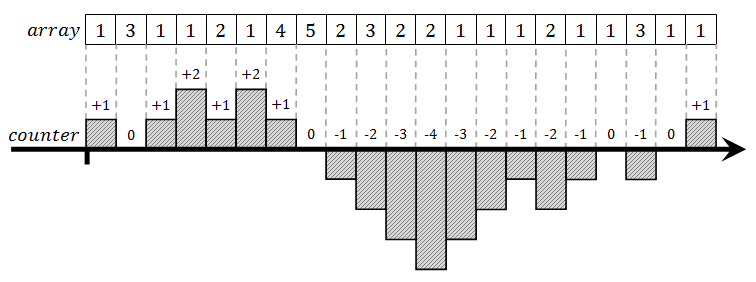
When this modified solution is applied to the whole array, we end up with a number which is the last majority candidate. We are still not sure whether this number is overall majority element of the array or not. But the selection process adds some qualities to that candidate. Let's observe the previous array when processed by this new algorithm.

This time counter never goes into negative. It always bounces off the zero value and turns back into positive range, at the same time switching to the new majority candidate. The whole process now divides the array into segments. In each segment one number occurs as many times as all other numbers combined. In the worst case, those "all other numbers" will actually be a single number which occurs as many times as the candidate for that segment - we don't know whether that is the case or not, because we are counting only the candidate’s occurrences.
Anyway, when all segments align, the last segment alone decides the battle, and here is why. All segments except the last one look the same. First number in the segment is the special element and it occurs as many times as all other numbers in the segment combined. We know this fact because every segment ends with counter equal to zero (this is what candidate selection process guarantees). So all segments but the last one together are guaranteed not to contain a majority element. At best, there will be one number that occurs as many times as all the others combined, but not more than that. The only number that really could be the majority element of the array is the winner of the last segment, i.e. final majority candidate that remains when end of array is reached.
This complete solution requires a couple of variables to store current candidate and the counter. It passes the array once or twice. In the first pass, majority candidate is established. In the second pass we simply check whether the candidate is a solution or there is no majority element. This means that algorithm described runs in O(N) time and O(1) space.
Implementation will consist of two functions. First one will count occurrences of a number, subtracting other elements from the count. Majority element will be the value for which this function returns positive result. Another function will establish the majority candidate and then call the first function to decide whether it is the majority element or there is no majority element in the array. Here is the pseudo-code:
function GetCountForValue(a, n, x)

a - array of non-negative integers

n - number of elements in the array

x - number for which count is required

begin

    count =

    for i = , n-

        begin

            if a[i] = x then

                count = count +

            else

                count = count -

        end

    return count

end

function FindMajorityElement(a, n)

a - array of non-negative integers

n - number of elements in the array

begin

    count =

    candidate = a[]

    for i = , n-

        begin

            if a[i] = candidate then

                count = count +

            else if count =  then

                candidate = a[i]

                count =

            else

                count = count –

        end

    if count >  then

        count = GetCountForValue(a, n, candidate)

    if count >  then

        return candidate

    return - -- there is no majority element

end
Implementation
Below are functions GetCountForValue and FindMajorityElement, coded in C#. The code is relatively simple, once all the analysis has been provided.
static int GetCountForValue(int[] a, int x)

{

    int count = ;

    for (int i = ; i < a.Length; i++)

        if (a[i] == x)

            count++;

        else

            count--;

    return count;

}

static int FindMajorityElement(int[] a)

{

    int count = ;

    int candidate = a[];

    for (int i = ; i < a.Length; i++)

    {

        if (a[i] == candidate)

        {

            count++;

        }

        else if (count == )

        {

            candidate = a[i];

            count = ;

        }

        else

        {

            count--;

        }

    }

    if (count > )

        count = GetCountForValue(a, candidate);

    if (count > )

        return candidate;

    return -;

}
Quote From:
Exercise #9: Finding a Majority Element in an Array
Majority Element in an Array的更多相关文章
- 169. Majority Element(C++)
169. Majority Element Given an array of size n, find the majority element. The majority element is t ...
- Majority Element,Majority Element II
一:Majority Element Given an array of size n, find the majority element. The majority element is the ...
- 23. leetcode 169. Majority Element
169. Majority Element Given an array of size n, find the majority element. The majority element is t ...
- 【LEETCODE】35、169题, Majority Element
package y2019.Algorithm.array; import java.util.HashMap; import java.util.Map; /** * @ProjectName: c ...
- Week1 - 169.Majority Element
这周刚开始讲了一点Divide-and-Conquer的算法,于是这周的作业就选择在LeetCode上找分治法相关的题目来做. 169.Majority Element Given an array ...
- Algo: Majority Element
Approach #1 Brute Force Intuition We can exhaust the search space in quadratic time by checking w ...
- LeetCode169 Majority Element, LintCode47 Majority Number II, LeetCode229 Majority Element II, LintCode48 Majority Number III
LeetCode169. Majority Element Given an array of size n, find the majority element. The majority elem ...
- (Array)169. Majority Element
Given an array of size n, find the majority element. The majority element is the element that appear ...
- 169. Majority Element (Array)
Given an array of size n, find the majority element. The majority element is the element that appear ...
随机推荐
- 使用CLR Profiler分析.NET程序
使用CLR Profiler分析.NET程序 就像剥去.NET语法糖衣的工具(Reflector等)很多一样,我们可以用来分析.NET程序性能的工具有很多,如前面一片博文DebugLZQ给大家介绍的v ...
- 构建一个真实的应用电子商务SportsStore9
使用MVC4,Ninject,EF,Moq,构建一个真实的应用电子商务SportsStore(九) 实在不好意思,好久没有更新了,我不想找些客观原因来解释,只想请大家见谅!现在我们继续我们的项目,客户 ...
- 在 Cordova/Phonegap for Android 中包含中文文件名的页面
在 Cordova/Phonegap for Android 中包含中文文件名的页面 本贴首发于: http://xuekaiyuan.com/forum.php?mod=viewthread& ...
- 个人知识管理利器wiz
Personal Knowledge Management PKM(Personal Knowledge Management),中文译为个人知识管理. 个人知识管理是一种新的知识管理的理念和方法,能 ...
- 【Zookeeper】源码分析之持久化--FileSnap
一.前言 前篇博文已经分析了FileTxnLog的源码,现在接着分析持久化中的FileSnap,其主要提供了快照相应的接口. 二.SnapShot源码分析 SnapShot是FileTxnLog的父类 ...
- Dubbo源码学习--服务是如何发布的
相关文章: Dubbo源码学习--服务是如何发布的 Dubbo源码学习--服务是如何引用的 ServiceBean ServiceBean 实现ApplicationListener接口监听Conte ...
- vmare虚拟化解决方案
最近刚入职一家公司!主要是做vmare虚拟化的,虽然跟openstack不太沾边,但现在很多openstack都会兼容vmare程序,最终会如何我拭目以待,今天写这个也是做一个总结. 虚拟化.云计算. ...
- iOS -不同模拟器字体适配
1.先建立一个UILabel的分类 导入#import <objc/runtime.h>头文件 2.在.m文件中写入如下代码 //不同设备的屏幕比例(当然倍数可以自己控制) #define ...
- JavaEE XML DOM解析之DOM4J
DOM解析之DOM4J @author ixenos DOM4J常用API 读取xml文档: Document doc = new SAXReader().read("xml文件" ...
- 在server2012安装tfs遇到的问题:KB2919355
参考资料:http://blog.csdn.net/wo_984633714/article/details/52869851 安装tfs2015的时候,提示需要安装KB2919355的更新.然后我就 ...