
Linux内核分析第三周学习笔记
linux内核分析第三周学习笔记
标签(空格分隔): 20135328陈都
陈都 原创作品转载请注明出处 《Linux内核分析》MOOC课程http://mooc.study.163.com/course/USTC-1000029000
构造一个简单的Linux系统MenuOS
上周回顾:
计算机三大法宝
存储程序计算机
函数调用堆栈
中断
操作系统两把宝剑
中断上下文的切换
进程上下文的切换
Linux内核源码简介
我们关注的部分
- arch/x86目录下的代码
- init/main.c中start_kernel函数就相当于普通C程序的main函数
- kernel目录:存放linux内核最核心的代码,用于实现系统的核心模块,包括进程管理、进程调度器、中断处理、系统时钟管理、同步机制等
README
提供内核的各种编译方法、生成文件的查看方法。
- installing 如何安装内核源代码
- make mrproper 清理安装时生成的中间代码
启动Linux内核的三个参数:
- kernel
- initrd
- root所在分区、目录
需要知道的一行代码:qemu -kernel (文件名) -initrd (rootfs.img)
qemu -kernel linux-3.18.6/arch/x86/boot/bzImage -initrd rootfs.img -s -S

使用gdb跟踪调试内核
qemu -kernel linux-3.18.6/arch/x86/boot/bzImage -initrd rootfs.img -s
-S # 关于-s和-S选项的说明:
-S freeze CPU at startup (use ’c’ to start execution)
-s shorthand for -gdb tcp::1234 若不想使用1234端口,则可以使用-gdb
tcp:xxxx来取代-s选项
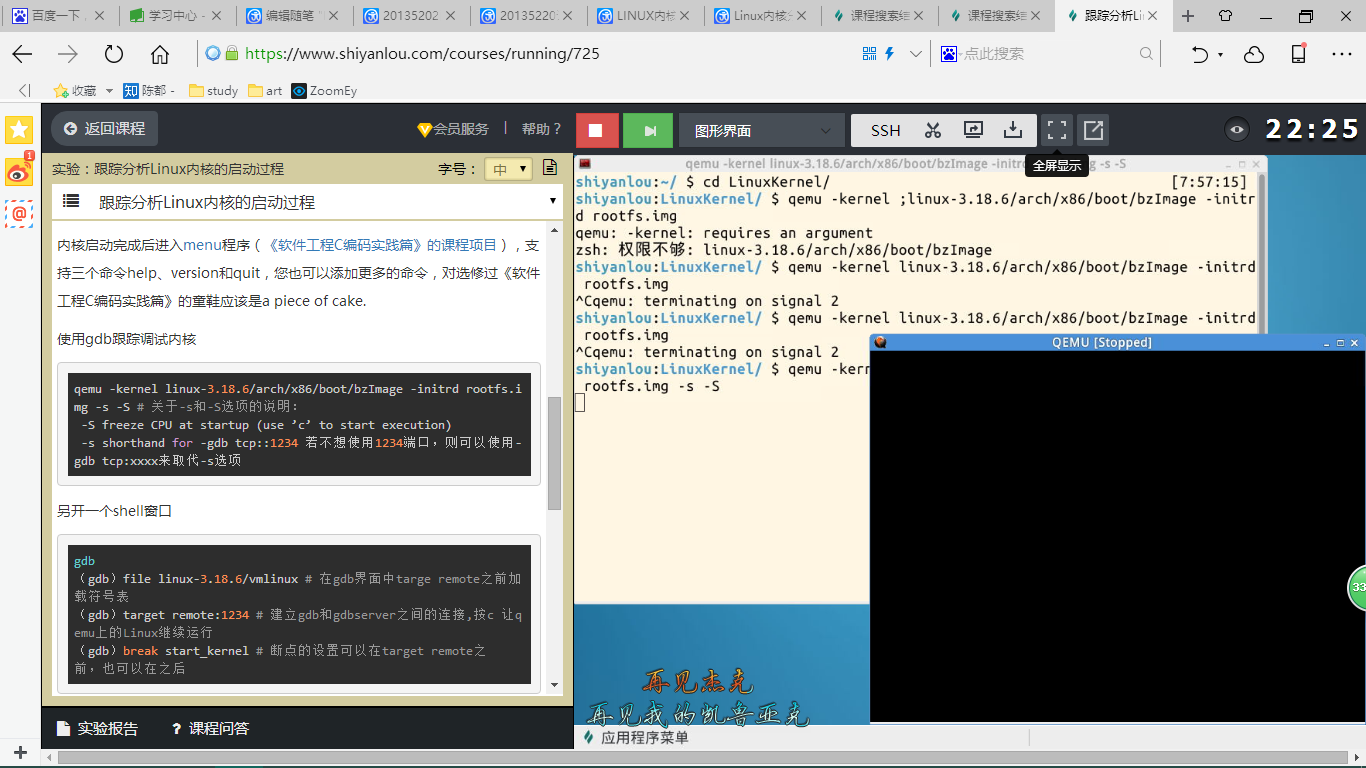
另开一个shell窗口
gdb (gdb)file linux-3.18.6/vmlinux # 在gdb界面中targe remote之前加载符号表
(gdb)target remote:1234 # 建立gdb和gdbserver之间的连接,按c 让qemu上的Linux继续运行
(gdb)break start_kernel # 断点的设置可以在target remote之前,也可以在之后
总结分析start_kernel
start_kernel:包括很多模块的初始化。
分析内核都会涉及到start_kernel,都会在init初始化。
详细分析从start_kernel到init进程启动的过程
start_kernel函数的执行代码在init目录下的main.c[1]
500asmlinkage __visible void __init start_kernel(void)

501{

   char *command_line;

   char *after_dashes;

505    /*

    * Need to run as early as possible, to initialize the

    * lockdep hash:

    */

   lockdep_init();

   set_task_stack_end_magic(&init_task);     init_task即手工创建的PCB,0号进程即最终的idle进程。

   smp_setup_processor_id();

   debug_objects_early_init();

514    /*

    * Set up the the initial canary ASAP:

    */

   boot_init_stack_canary();

519    cgroup_init_early();

521    local_irq_disable();

   early_boot_irqs_disabled = true;

524/*

* Interrupts are still disabled. Do necessary setups, then

* enable them

*/

   boot_cpu_init();

   page_address_init();

   pr_notice("%s", linux_banner);

   setup_arch(&command_line);

   mm_init_cpumask(&init_mm);

   setup_command_line(command_line);

   setup_nr_cpu_ids();

   setup_per_cpu_areas();

   smp_prepare_boot_cpu();    /* arch-specific boot-cpu hooks */

538    build_all_zonelists(NULL, NULL);

   page_alloc_init();

541    pr_notice("Kernel command line: %s\n", boot_command_line);

   parse_early_param();

   after_dashes = parse_args("Booting kernel",

                 static_command_line, __start___param,

                 __stop___param - __start___param,

                 -1, -1, &unknown_bootoption);

   if (!IS_ERR_OR_NULL(after_dashes))

       parse_args("Setting init args", after_dashes, NULL, 0, -1, -1,

              set_init_arg);

551    jump_label_init();

553    /*

    * These use large bootmem allocations and must precede

    * kmem_cache_init()

    */

   setup_log_buf(0);

   pidhash_init();

   vfs_caches_init_early();

   sort_main_extable();

   trap_init();   涉及到中断的初始化

   mm_init();

564    /*

    * Set up the scheduler prior starting any interrupts (such as the

    * timer interrupt). Full topology setup happens at smp_init()

    * time - but meanwhile we still have a functioning scheduler.

    */

   sched_init();

   /*

    * Disable preemption - early bootup scheduling is extremely

    * fragile until we cpu_idle() for the first time.

    */

   preempt_disable();

   if (WARN(!irqs_disabled(),

        "Interrupts were enabled *very* early, fixing it\n"))

       local_irq_disable();

   idr_init_cache();

   rcu_init();

   context_tracking_init();

   radix_tree_init();

   /* init some links before init_ISA_irqs() */

   early_irq_init();

   init_IRQ();

   tick_init();

   rcu_init_nohz();

   init_timers();

   hrtimers_init();

   softirq_init();

   timekeeping_init();

   time_init();

   sched_clock_postinit();

   perf_event_init();

   profile_init();

   call_function_init();

   WARN(!irqs_disabled(), "Interrupts were enabled early\n");

   early_boot_irqs_disabled = false;

   local_irq_enable();

600    kmem_cache_init_late();

602    /*

    * HACK ALERT! This is early. We're enabling the console before

    * we've done PCI setups etc, and console_init() must be aware of

    * this. But we do want output early, in case something goes wrong.

    */

   console_init();

   if (panic_later)

       panic("Too many boot %s vars at `%s'", panic_later,

             panic_param);

612    lockdep_info();

614    /*

    * Need to run this when irqs are enabled, because it wants

    * to self-test [hard/soft]-irqs on/off lock inversion bugs

    * too:

    */

   locking_selftest();

621#ifdef CONFIG_BLK_DEV_INITRD

   if (initrd_start && !initrd_below_start_ok &&

       page_to_pfn(virt_to_page((void *)initrd_start)) < min_low_pfn) {

       pr_crit("initrd overwritten (0x%08lx < 0x%08lx) - disabling it.\n",

           page_to_pfn(virt_to_page((void *)initrd_start)),

           min_low_pfn);

       initrd_start = 0;

   }

629#endif

   page_cgroup_init();

   debug_objects_mem_init();

   kmemleak_init();

   setup_per_cpu_pageset();

   numa_policy_init();

   if (late_time_init)

       late_time_init();

   sched_clock_init();

   calibrate_delay();

   pidmap_init();

   anon_vma_init();

   acpi_early_init();

642#ifdef CONFIG_X86

   if (efi_enabled(EFI_RUNTIME_SERVICES))

       efi_enter_virtual_mode();

645#endif

646#ifdef CONFIG_X86_ESPFIX64

   /* Should be run before the first non-init thread is created */

   init_espfix_bsp();

649#endif

   thread_info_cache_init();

   cred_init();

   fork_init(totalram_pages);

   proc_caches_init();

   buffer_init();

   key_init();

   security_init();

   dbg_late_init();

   vfs_caches_init(totalram_pages);

   signals_init();

   /* rootfs populating might need page-writeback */

   page_writeback_init();

   proc_root_init();

   cgroup_init();

   cpuset_init();

   taskstats_init_early();

   delayacct_init();

668    check_bugs();

670    sfi_init_late();

672    if (efi_enabled(EFI_RUNTIME_SERVICES)) {

       efi_late_init();

       efi_free_boot_services();

   }

677    ftrace_init();

679    /* Do the rest non-__init'ed, we're now alive */

   rest_init();

681}
Linux内核分析第三周学习笔记的更多相关文章
- 20135320赵瀚青LINUX内核分析第三周学习笔记
赵瀚青原创作品转载请注明出处<Linux内核分析>MOOC课程http://mooc.study.163.com/course/USTC-1000029000 概述 本周是学习的主要是构造 ...
- Linux内核分析——第三周学习笔记
20135313吴子怡.北京电子科技学院 chapter1 知识点梳理 一.Linux内核源代码简介 (视频中对目录下的文件进行了简介,记录如下) arch目录 占有相当庞大的空间 arch/x86目 ...
- Linux内核分析——第三周学习笔记20135308
第三周 构造一个简单的Linux系统MenuOS 计算机三个法宝: 1.存储程序计算机 2.函数调用堆栈 3.中断 操作系统两把宝剑: 1.中断上下文的切换:保存现场和恢复现场 2.进程上下文的切换 ...
- 《Linux内核分析》第二周学习笔记
<Linux内核分析>第二周学习笔记 操作系统是如何工作的 郭垚 原创作品转载请注明出处 <Linux内核分析>MOOC课程http://mooc.study.163.com/ ...
- linux内核分析第五周学习笔记
linux内核分析第五周学习笔记 标签(空格分隔): 20135328陈都 陈都 原创作品转载请注明出处 <Linux内核分析>MOOC课程http://mooc.study.163.co ...
- Linux内核分析第六周学习笔记——分析Linux内核创建一个新进程的过程
Linux内核分析第六周学习笔记--分析Linux内核创建一个新进程的过程 zl + <Linux内核分析>MOOC课程http://mooc.study.163.com/course/U ...
- 《Linux内核分析》第一周学习笔记
<Linux内核分析>第一周学习笔记 计算机是如何工作的 郭垚 原创作品转载请注明出处 <Linux内核分析>MOOC课程http://mooc.study.163.com/c ...
- LINUX内核分析第三周学习总结——构造一个简单的Linux系统MenuOS
LINUX内核分析第三周学习总结——构造一个简单的Linux系统MenuOS 张忻(原创作品转载请注明出处) <Linux内核分析>MOOC课程http://mooc.study.163. ...
- Linux内核分析第三周学习博客——跟踪分析Linux内核的启动过程
Linux内核分析第三周学习博客--跟踪分析Linux内核的启动过程 实验过程截图: 过程分析: 在Linux内核的启动过程中,一共经历了start_kernel,rest_init,kernel_t ...
随机推荐
- [python] 修改Tkinter 的默认图标
先上一个不修改的样式,如下: import easygui as g g.msgbox("hello","hi") 注意左上角的图标为红色的Tk字样 修改后: ...
- chrome主页被篡改为360导航之解决方式
昨天,安装某款游戏之后,发现chrome的主页被篡改为360导航. 进入chrome设置改动主页,又一次启动chrome还是360导航,后来发如今chrome快捷方式的属性中目标后面加了一串360导航 ...
- Android与js交互拍照上传资料
应用场景:h5通知android端拍照,选相册,然后将图片路径上传成功之后,获取到网络路径,将此路径返还给h5界面,并展示出来. android与js快速交互 效果图如下: 1.在Activity ...
- php的匿名函数和闭包函数
php的匿名函数和闭包函数 tags: 匿名函数 闭包函数 php闭包函数 php匿名函数 function use 引言:匿名函数和闭包函数都不是特别高深的知识,但是很多刚入门的朋友却总是很困惑,因 ...
- 利用 share code 插件同步代码片段
利用 Settings Sync可以同步 VS code 配置,但它只能同步插件,利用 Settings Sync 再配合 share code 插件可以同步自定义代码片段,可以把 VS code ...
- ethereum/EIPs-725
https://github.com/ethereum/EIPs/blob/master/EIPS/eip-725.md eip title author discussions-to status ...
- Stay true to yourself
https://zhuanlan.zhihu.com/p/22928614 艾伦·德詹尼斯,1958年1月26日出生于美国路易斯安纳州梅泰里,美国主持人.演员.凭借出众的诙谐幽默的口才和喜剧天赋,活跃 ...
- JavaScript模块化思想之入门篇
在写正文之前先写一点废话,从我大三下学期正式接触前端到现在,已经六个月了.自己从HTML,CSS,简单的JS验证开始,一点点开始走入前端的世界.越发的感觉前端这一领域散发着无穷的魅力,也许这和我真心喜 ...
- Unable to start a VM due to insufficient capacity
今天cloudstack中的一个普通用户创建虚拟机时,总是报错:Unable to start a VM due to insufficient capacity ,看management and a ...
- 【小程序】<image>图片实现宽度100%时,高度自适应
*.wxss样式设置 .img{ width:100% } *.wxml给<image>标签添加属性 mode="widthFix" <image class= ...