
Round 1A 2020 - Code Jam 2020
Problem A. Pattern Matching
把每个字符串分成第一个之前,最后一个之后,中间的部分 三个部分
每个字符串的中间的部分可以直接拼接
前后两个部分需要判断下是否合法
#include <algorithm>

#include <bitset>

#include <cassert>

#include <cmath>

#include <complex>

#include <cstring>

#include <ctime>

#include <deque>

#include <fstream>

#include <functional>

#include <iomanip>

#include <iostream>

#include <map>

#include <numeric>

#include <queue>

#include <random>

#include <set>

#include <stack>

#include <unordered_map>

#include <unordered_set>

#include <vector>

#define MP make_pair

#define ll long long

#define ld long double

#define null NULL

#define all(a) a.begin(), a.last()

#define forn(i, n) for (int i = 0; i < n; ++i)

#define sz(a) (int)a.size()

#define lson l , m , rt << 1

#define rson m + 1 , r , rt << 1 | 1

#define bitCount(a)  __builtin_popcount(a)

template<class T> int gmax(T &a, T b) { if (b > a) { a = b; return 1; } return 0; }

template<class T> int gmin(T &a, T b) { if (b < a) { a = b; return 1; } return 0; }

using namespace std;

const int INF = 0x3f3f3f3f;

string to_string(string s) { return '"' + s + '"'; }

string to_string(const char* s) { return to_string((string) s); }

string to_string(bool b) { return (b ? "true" : "false"); }

template <typename A, typename B>

string to_string(pair<A, B> p) { return "(" + to_string(p.first) + ", " + to_string(p.second) + ")"; }

template <typename A>

string to_string(A v) { bool first = true; string res = "{"; for (const auto &x : v) { if (!first) { res += ", "; } first = false; res += to_string(x); } res += "}"; return res; }

void debug_out() { cerr << endl; }

template <typename Head, typename... Tail>

void debug_out(Head H, Tail... T) { cerr << " " << to_string(H); debug_out(T...); }

#ifdef LOCAL

#define debug(...) cerr << "[" << #__VA_ARGS__ << "]:", debug_out(__VA_ARGS__)

#else

#define debug(...) 42

#endif

char seq[55][105];

int main() {

    int T;

    scanf("%d", &T);

    for(int cas = 1; cas <= T; ++cas) {

        int n;

        scanf("%d", &n);

        for(int i = 0; i < n; ++i) {

            scanf("%s", seq[i]);

        }

        vector<string> front, last;

        string mid_result;

        for(int i = 0; i < n; ++i) {

            int len = strlen(seq[i]);

            vector<string> split;

            string tmp;

            if(seq[i][0] == '*') split.push_back("");

            for(int j = 0; j < len; ++j) {

                // cout << seq[i][j] << endl;

                if(seq[i][j] == '*') {

                    if((int)tmp.size() != 0) split.push_back(tmp);

                    tmp.clear();

                } else tmp += seq[i][j];

            }

            if((int)tmp.size() != 0) split.push_back(tmp);

            // debug(split);

            if(seq[i][len - 1] == '*') split.push_back("");

            front.push_back(split[0]); last.push_back(split.back());

            if(split.size() > 2) {

                for(int j = 1, split_len = split.size(); j < split_len - 1; ++j) {

                    mid_result += split[j];

                }

            }

        }

        auto cmp = [](string &A, string &B) { return A.size() < B.size(); };

        sort(front.begin(), front.end(), cmp);

        sort(last.begin(), last.end(), cmp);

        // debug(front, last, mid_result);

        bool suc = true;

        for(int i = 0, len = front.size(); i < len - 1 && suc; ++i) {

            string &now = front[i]; string &tem = front.back();

            for(int j = 0, len_now = now.size(); j < len_now && suc; ++j) {

                if(now[j] != tem[j]) { suc = false; }

            }

        }

        // debug(suc);

        for(int i = 0, len = last.size(); i < len - 1 && suc; ++i) {

            string &now = last[i]; string &tem = last.back(); int len_tem = tem.size();

            for(int j = 0, len_now = now.size(); j < len_now && suc; ++j) {

                if(now[j] != tem[len_tem + j - len_now]) {

                    // debug(now, tem, j);

                    suc = false;

                }

            }

        }

        string result = front.back() + mid_result + last.back();

        printf("Case #%d: ", cas);

        if(suc == false) printf("*\n");

        else printf("%s\n", result.c_str());

    }

    return 0;

}

/*

2

5

*CONUTS

*COCONUTS

*OCONUTS

*CONUTS

*S

2

*XZ

*XYZ

*/
problem B. Pascal Walk
这是一个 非常巧妙的构造题
首先想到一个杨辉三角的每一个层的和是 2^i ,如果我们可以跳跃就好了,直接按照N的二进制表示,使用对应层的和
问题在于我们无法跳跃,怎么办
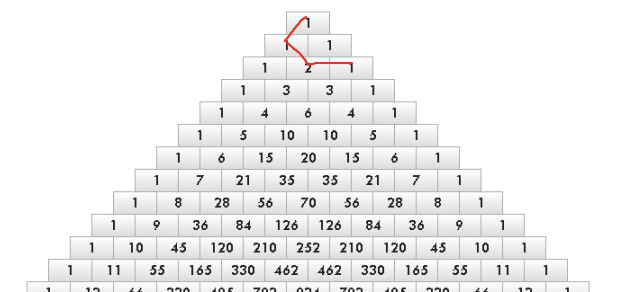
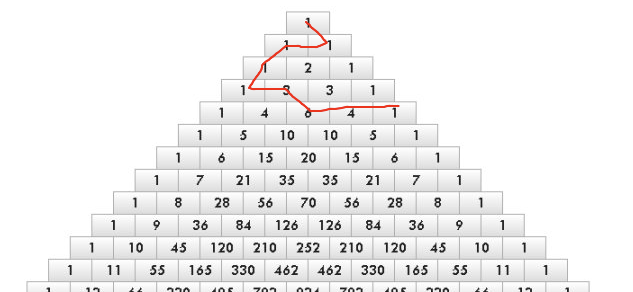
通过构造可以发现我们可以将两个很远的两层连在一起,下面举例5,19的情况,具体的逻辑可以去代码里面体会
#include <algorithm>

#include <bitset>

#include <cassert>

#include <cmath>

#include <complex>

#include <cstring>

#include <ctime>

#include <deque>

#include <fstream>

#include <functional>

#include <iomanip>

#include <iostream>

#include <map>

#include <numeric>

#include <queue>

#include <random>

#include <set>

#include <stack>

#include <unordered_map>

#include <unordered_set>

#include <vector>

#define MP make_pair

#define ll long long

#define ld long double

#define null NULL

#define all(a) a.begin(), a.last()

#define forn(i, n) for (int i = 0; i < n; ++i)

#define sz(a) (int)a.size()

#define lson l , m , rt << 1

#define rson m + 1 , r , rt << 1 | 1

#define bitCount(a)  __builtin_popcount(a)

template<class T> int gmax(T &a, T b) { if (b > a) { a = b; return 1; } return 0; }

template<class T> int gmin(T &a, T b) { if (b < a) { a = b; return 1; } return 0; }

using namespace std;

const int INF = 0x3f3f3f3f;

string to_string(string s) { return '"' + s + '"'; }

string to_string(const char* s) { return to_string((string) s); }

string to_string(bool b) { return (b ? "true" : "false"); }

template <typename A, typename B>

string to_string(pair<A, B> p) { return "(" + to_string(p.first) + ", " + to_string(p.second) + ")"; }

template <typename A>

string to_string(A v) { bool first = true; string res = "{"; for (const auto &x : v) { if (!first) { res += ", "; } first = false; res += to_string(x); } res += "}"; return res; }

void debug_out() { cerr << endl; }

template <typename Head, typename... Tail>

void debug_out(Head H, Tail... T) { cerr << " " << to_string(H); debug_out(T...); }

#ifdef LOCAL

#define debug(...) cerr << "[" << #__VA_ARGS__ << "]:", debug_out(__VA_ARGS__)

#else

#define debug(...) 42

#endif

void add(vector<pair<int, int> >& vc, int pre, int target, int times) {

    // debug(pre, target, vc);

    int dir = 0;

    if( times % 2 == 0) dir = 0; else dir = 1;

    int preX = -1, preY = 0;

    if(vc.size() != 0) {

        preX = vc.back().first; preY = vc.back().second;

    }

    int needFloor = target - pre - 1;

    if(needFloor == 0) {

        vc.push_back(dir ? MP(preX + 1, preY + 1) : MP(preX + 1, preY));

        for(int i = 0; i < target; ++i) {

            vc.push_back(dir ? MP(vc.back().first, vc.back().second - 1) : MP(vc.back().first, vc.back().second + 1));

        }

    } else {

        vc.push_back(dir ? MP(preX + 1, preY + 1) : MP(preX + 1, preY));

        int count = 2;

        for(int i = 0; i < needFloor - 1; ++i) {

            int tmp_count = count - 1; int now_dir = (i & 1) ^ (needFloor & 1) ^ dir;

            vc.push_back(now_dir ? MP(vc.back().first + 1, vc.back().second + 1) : MP(vc.back().first + 1, vc.back().second));

            while(tmp_count --) {

                vc.push_back(now_dir ? MP(vc.back().first, vc.back().second - 1) : MP(vc.back().first, vc.back().second + 1));

            }

            count ++;

        }

        vc.push_back(dir ? MP(vc.back().first + 1, vc.back().second) : MP(vc.back().first + 1, vc.back().second + 1));

        for(int i = 0; i < target - count + 1; ++i) {

            vc.push_back(dir ? MP(vc.back().first, vc.back().second - 1) : MP(vc.back().first, vc.back().second + 1));

        }

    }

}

int main() {

    int T;

    scanf("%d", &T);

    for(int cas = 1; cas <= T; ++cas) {

        int n;

        scanf("%d", &n);

        vector<pair<int, int> > vc;

        int floor = -1; int cnt = 0; int times = 0;

        while(n) {

            if(n & 1) {

                add(vc, floor, cnt, times);

                times ++;

                floor = cnt;

            }

            cnt ++;

            n /= 2;

        }

        assert((int)vc.size() < 500);

        printf("Case #%d: \n", cas);

        for(int i = 0, len = vc.size(); i < len; ++i) {

            printf("%d %d\n", vc[i].first + 1, vc[i].second + 1);

        }

    }

    return 0;

}
Problem C: Square Dance
这题看起来就是暴力,能过小数据
有个显而易见的优化,就是每次删除一个点之后,下一轮潜在的可能删除点一定是上轮被删点的邻居
复杂度不太会算,题解说这样优化后能到O(R * C)
找邻居这种数据结构 我用十字链表维护的
#include <algorithm>

#include <bitset>

#include <cassert>

#include <cmath>

#include <complex>

#include <cstring>

#include <ctime>

#include <deque>

#include <fstream>

#include <functional>

#include <iomanip>

#include <iostream>

#include <map>

#include <numeric>

#include <queue>

#include <random>

#include <set>

#include <stack>

#include <unordered_map>

#include <unordered_set>

#include <vector>

#define MP make_pair

#define ll long long

#define ld long double

#define null NULL

#define all(a) a.begin(), a.last()

#define forn(i, n) for (int i = 0; i < n; ++i)

#define sz(a) (int)a.size()

#define lson l , m , rt << 1

#define rson m + 1 , r , rt << 1 | 1

#define bitCount(a)  __builtin_popcount(a)

template<class T> int gmax(T &a, T b) { if (b > a) { a = b; return 1; } return 0; }

template<class T> int gmin(T &a, T b) { if (b < a) { a = b; return 1; } return 0; }

using namespace std;

const int INF = 0x3f3f3f3f;

string to_string(string s) { return '"' + s + '"'; }

string to_string(const char* s) { return to_string((string) s); }

string to_string(bool b) { return (b ? "true" : "false"); }

template <typename A, typename B>

string to_string(pair<A, B> p) { return "(" + to_string(p.first) + ", " + to_string(p.second) + ")"; }

template <typename A>

string to_string(A v) { bool first = true; string res = "{"; for (const auto &x : v) { if (!first) { res += ", "; } first = false; res += to_string(x); } res += "}"; return res; }

void debug_out() { cerr << endl; }

template <typename Head, typename... Tail>

void debug_out(Head H, Tail... T) { cerr << " " << to_string(H); debug_out(T...); }

#ifdef LOCAL

#define debug(...) cerr << "[" << #__VA_ARGS__ << "]:", debug_out(__VA_ARGS__)

#else

#define debug(...) 42

#endif

struct Node{

    int u, d, l, r;

    int val;

    Node() {

        u = d = l = r = -1; val = 0;

    }

};

vector<Node> mp;

int R, C;

int getId(int x, int y) { return x * (C + 2) + y; }

void erase(int x) {

   mp[mp[x].l].r = mp[x].r;

   mp[mp[x].r].l = mp[x].l;

   mp[mp[x].u].d = mp[x].d;

   mp[mp[x].d].u = mp[x].u;

   mp[x].val = 0;

}

vector<int> update(vector<int> &choosList, ll &ans, ll &origin) {

    // debug(origin);

    vector<int> needErase;

    vector<int> newList, _newList;

    ans += origin;

    for(int i = 0, len = choosList.size(); i < len; ++i) {

        int x = choosList[i];

        int neiNum = 0; int neiVal = 0;

        if(mp[mp[x].r].val != 0) { neiNum ++; neiVal += mp[mp[x].r].val; }

        if(mp[mp[x].l].val != 0) { neiNum ++; neiVal += mp[mp[x].l].val; }

        if(mp[mp[x].u].val != 0) { neiNum ++; neiVal += mp[mp[x].u].val; }

        if(mp[mp[x].d].val != 0) { neiNum ++; neiVal += mp[mp[x].d].val; }

        // debug(x / (C + 2), x % (C + 2), neiVal, neiNum, mp[x].val);

        if(neiVal > mp[x].val * neiNum) {

            // debug("erase", x / (C + 2), x % (C + 2));

            origin -= mp[x].val;

            needErase.push_back(x);

        }

    }

    for(auto x : needErase) {

        assert(mp[x].r != -1); assert(mp[x].l != -1); assert(mp[x].u != -1); assert(mp[x].d != -1);

        if(mp[mp[x].r].val != 0) { _newList.push_back(mp[x].r); }

        if(mp[mp[x].l].val != 0) { _newList.push_back(mp[x].l); }

        if(mp[mp[x].u].val != 0) { _newList.push_back(mp[x].u); }

        if(mp[mp[x].d].val != 0) { _newList.push_back(mp[x].d); }

        erase(x);

    }

    for(auto it : _newList) {

        if(mp[it].val != 0) newList.push_back(it);

    }

    sort(newList.begin(), newList.end());

    newList.erase(unique(newList.begin(), newList.end()), newList.end());

    // for(int i = 0, len = newList.size(); i < len; ++i) printf("%d %d: ", newList[i] / (C + 2), newList[i] % (C + 2)); printf("\n");

    return newList;

}

int main() {

    int T;

    scanf("%d", &T);

    for(int cas = 1; cas <= T; ++cas) {

        mp.clear();

        scanf("%d %d", &R, &C);

        mp.resize( (R + 5) * (C + 5), Node());

        ll origin = 0;

        for(int i = 1; i <= R; ++i) {

            for(int j = 1; j <= C; ++j) {

                scanf("%d", &mp[getId(i , j)].val);

                origin += mp[getId(i , j)].val;

            }

        }

        for(int i = 1; i <= R; ++i) {

            mp[getId(i , 1)].l = getId(i, 0);

            for(int j = 1; j <= C; ++j) {

                mp[getId(i , j - 1)].r = getId(i, j);

                mp[getId(i , j + 1)].l = getId(i, j);

            }

            mp[getId(i , C)].r = getId(i, C + 1);

        }

        for(int i = 1; i <= C; ++i) {

            mp[getId(1 , i)].u = getId(0, i);

            for(int j = 1; j <= R; ++j) {

                mp[getId(j - 1, i)].d = getId(j, i);

                mp[getId(j + 1, i)].u = getId(j, i);

            }

            mp[getId(R, i)].d = getId(R + 1, i);

        }

        vector<int> choosList;

        for(int i = 1; i <= R; ++i) {

            for(int j = 1; j <= C; ++j) {

                choosList.push_back(getId(i, j));

            }

        }

        ll ans = 0;

        while(1) {

            choosList = update(choosList, ans, origin);

            if(choosList.size() == 0) break;

        }

        printf("Case #%d: %lld\n", cas, ans);

    }

    return 0;

}

/*

4

1 1

15

3 3

1 1 1

1 2 1

1 1 1

1 3

3 1 2

1 3

1 2 3

3 3

1 100 1

1 2 2

1000 1 1

1 3

1 1

*/
Round 1A 2020 - Code Jam 2020的更多相关文章
- Google Code Jam 2020 Round1B Expogo
题意 你初始位于\((0,0)\),然后你想要到\((x,y)\)去,第\(i\)步的步长是\(2^{i-1}\),要求用最少的步数走到\((x,y)\). 解题思路 首先可以推出,走\(i\)步可以 ...
- Google Code Jam 2020 Round1B Join the Ranks
题意 给你一个形如\(1,2,\cdots,R,1,2,\cdots,R,1\cdots\)的序列,共重复\(C\)次.你每次可以选择一个区间\([L,R]\)将其平移到序列首部,最终使得序列具有\( ...
- Google Code Jam 2020 Round1B Blindfolded Bullseye
总结 这一题是道交互题,平时写的不多,没啥调试经验,GYM上遇到了少说交个十几发.一开始很快的想出了恰烂分的方法,但是没有着急写,果然很快就又把Test Set3的方法想到了,但是想到归想到,调了快一 ...
- [C++]Store Credit——Google Code Jam Qualification Round Africa 2010
Google Code Jam Qualification Round Africa 2010 的第一题,很简单. Problem You receive a credit C at a local ...
- Google Code Jam Africa 2010 Qualification Round Problem B. Reverse Words
Google Code Jam Africa 2010 Qualification Round Problem B. Reverse Words https://code.google.com/cod ...
- Google Code Jam Africa 2010 Qualification Round Problem A. Store Credit
Google Code Jam Qualification Round Africa 2010 Problem A. Store Credit https://code.google.com/code ...
- Google Code Jam 2010 Round 1C Problem A. Rope Intranet
Google Code Jam 2010 Round 1C Problem A. Rope Intranet https://code.google.com/codejam/contest/61910 ...
- ural 2020 Traffic Jam in Flower Town(模拟)
2020. Traffic Jam in Flower Town Time limit: 1.0 secondMemory limit: 64 MB Having returned from Sun ...
- Google Code Jam 2010 Round 1C Problem B. Load Testing
https://code.google.com/codejam/contest/619102/dashboard#s=p1&a=1 Problem Now that you have won ...
随机推荐
- unzip详解,Linux系统如何解压缩zip文件?
通常在使用linux时会自带了unzip,但是在最小化安装之后,可能系统里就无法使用此命令了. yum list unzip 查看是否安装 如果没安装过就继续 yum install unzip 安装 ...
- 安卓 打飞机 app 开发 第一篇
先上效果图 其实,当时刚买 htc G8 的时候(那时北京的房价还是6千一平),安卓2.1 ,2.3 的时候就已经有安卓方面的开发的兴趣,但后来就没有弄过... today 突然想起来,手机上连个游戏 ...
- Java中的IO与NIO
前文开了高并发学习的头,文末说了将会选择NIO.RPC相关资料做进一步学习,所以本文开始学习NIO知识. IO知识回顾 在学习NIO前,有必要先回顾一下IO的一些知识. IO中的流 Java程序通过流 ...
- Button相关设置
2020-03-11 每日一例第4天 1.添加按钮1-6,并修改相应的text值: 2.窗体Load事件加载代码: private void Form1_Load(object sender, Ev ...
- MassDNS:跨域DNS枚举工具
MassDNS:跨域DNS枚举工具 simeon 原文地址:http://offsecbyautomation.com/Use-MassDNS/ 工具地址:https://github.com/ble ...
- shellcode
msf > use windows/exec msf > set CMD calc.exe msf > set EXITFUNC thread msf > generate - ...
- 第九周Java实验作业
实验九 异常.断言与日志 实验时间 2018-10-25 1.实验目的与要求 (1) 掌握java异常处理技术: Java的异常处理机制可以控制程序从错误产生的位置转移到能够进行错误处理的位置. Ja ...
- shell脚本的函数介绍和使用案例
#前言:今天我们来聊聊shell脚本中的函数知识,看一下函数的优势,执行过程和相关的使用案例,我们也来看一下shell和python的函数书写方式有什么不同 #简介 .函数也具有别名类似的功能 .函数 ...
- 使用PyTorch建立图像分类模型
概述 在PyTorch中构建自己的卷积神经网络(CNN)的实践教程 我们将研究一个图像分类问题--CNN的一个经典和广泛使用的应用 我们将以实用的格式介绍深度学习概念 介绍 我被神经网络的力量和能力所 ...
- CNN更新换代!性能提升算力减半,还即插即用
传统的卷积运算,要成为过去时了. Facebook和新加坡国立大学联手提出了新一代替代品:OctConv(Octave Convolution),效果惊艳,用起来还非常方便. OctConv就如同卷积 ...