
HashMap 学习笔记
先摆上JDK1.8中HashMap的类注释;我翻译了一下
/**

 * Hash table based implementation of the <tt>Map</tt> interface.  This

 * implementation provides all of the optional map operations, and permits

 * <tt>null</tt> values and the <tt>null</tt> key.  (The <tt>HashMap</tt>

 * class is roughly equivalent to <tt>Hashtable</tt>, except that it is

 * unsynchronized and permits nulls.)  This class makes no guarantees as to

 * the order of the map; in particular, it does not guarantee that the order

 * will remain constant over time.

 * 哈希表实现了Map接口.哈希表允许空的键和值.HashMap相当于Hashtable,只是它是线程不同步的且允许空值.

 * 这个实现类不保证映射的顺序,尤其是随着时间变化不保证映射的顺序不发生变化.

 *

 * <p>This implementation provides constant-time performance for the basic

 * operations (<tt>get</tt> and <tt>put</tt>), assuming the hash function

 * disperses the elements properly among the buckets.  Iteration over

 * collection views requires time proportional to the "capacity" of the

 * <tt>HashMap</tt> instance (the number of buckets) plus its size (the number

 * of key-value mappings).  Thus, it's very important not to set the initial

 * capacity too high (or the load factor too low) if iteration performance is

 * important.

 * 当哈希表中的元素都是正常分布的,get,put操作时间复杂度都是O(1).迭代一个哈希表所需要的时间与哈希表的容量成正比,

 * 因此如果迭代性能不是很重要,不要将初始容量设置太高(或负载因子太低).

 *

 * <p>An instance of <tt>HashMap</tt> has two parameters that affect its

 * performance: <i>initial capacity</i> and <i>load factor</i>.  The

 * <i>capacity</i> is the number of buckets in the hash table, and the initial

 * capacity is simply the capacity at the time the hash table is created.  The

 * <i>load factor</i> is a measure of how full the hash table is allowed to

 * get before its capacity is automatically increased.  When the number of

 * entries in the hash table exceeds the product of the load factor and the

 * current capacity, the hash table is <i>rehashed</i> (that is, internal data

 * structures are rebuilt) so that the hash table has approximately twice the

 * number of buckets.

 * 一个HashMap两个参数会影响它的性能,初始容量和负载因子.容量是哈希表中的数据量,初始容量只是创建哈希表时的指定的哈希表容量.

 * 负载因子loadFactor= HashMap中的数据量/HashMap中的总容量(initial capacity),map中的数据量达到 总容量*负载因子时,

 * HashMap的总容量就会自动扩张一倍.

 * 注:HashMap的三个构造函数能帮助理解,见本人博客 "HashMap构造函数"

 *

 *

 * <p>As a general rule, the default load factor (.75) offers a good

 * tradeoff between time and space costs.  Higher values decrease the

 * space overhead but increase the lookup cost (reflected in most of

 * the operations of the <tt>HashMap</tt> class, including

 * <tt>get</tt> and <tt>put</tt>).  The expected number of entries in

 * the map and its load factor should be taken into account when

 * setting its initial capacity, so as to minimize the number of

 * rehash operations.  If the initial capacity is greater than the

 * maximum number of entries divided by the load factor, no rehash

 * operations will ever occur.

 * 作为一般规则,默认负载因子是0.75,这在时间成本和空间成本之间提供了一个比较好的平衡.

 * 较高的值会降低空间开销,但增加查找成本(大部分体现在对HashMap的操作上,比如get,put).

 * 在设置初始容量时,应当考虑map中的数据量和负载因子,以便最小化重新对map结构进行扩容的操作.

 * 注:这和ArrayList的ensureCapaciry(int size)有点类似.

 *

 *

 * <p>If many mappings are to be stored in a <tt>HashMap</tt>

 * instance, creating it with a sufficiently large capacity will allow

 * the mappings to be stored more efficiently than letting it perform

 * automatic rehashing as needed to grow the table.  Note that using

 * many keys with the same {@code hashCode()} is a sure way to slow

 * down performance of any hash table. To ameliorate impact, when keys

 * are {@link Comparable}, this class may use comparison order among

 * keys to help break ties.

 * 如果许多映射要存储在HashMap实例中,那么将实例的初始容量设置比较大要比按需要自动扩容效率要高.

 * 请注意,使用相同的键(hashCode)是降低任何哈希表的一个可靠方法,为了改善这种性能问题,使用

 * 连续的键.

 * 注:hashMap允许相同的key,只是值会被覆盖.

 *

 * <p><strong>Note that this implementation is not synchronized.</strong>

 * If multiple threads access a hash map concurrently, and at least one of

 * the threads modifies the map structurally, it <i>must</i> be

 * synchronized externally.  (A structural modification is any operation

 * that adds or deletes one or more mappings; merely changing the value

 * associated with a key that an instance already contains is not a

 * structural modification.)  This is typically accomplished by

 * synchronizing on some object that naturally encapsulates the map.

 * 注意,此实现线程不同步.如果多个线程同时访问hashMap,其中有一个线程修改了hashMap的结构.那么必须在

 * 外部进行线程同步处理.这通常是对hashMap的操作上进行同步处理封装

 *

 * If no such object exists, the map should be "wrapped" using the

 * {@link Collections#synchronizedMap Collections.synchronizedMap}

 * method.  This is best done at creation time, to prevent accidental

 * unsynchronized access to the map:<pre>

 *   Map m = Collections.synchronizedMap(new HashMap(...));</pre>

 * 因为线程同步问题,可以调用Collections.synchronizedMap来(Map<K,V> m)来返回一个线程安全的hashMap.

 *

 * <p>The iterators returned by all of this class's "collection view methods"

 * are <i>fail-fast</i>: if the map is structurally modified at any time after

 * the iterator is created, in any way except through the iterator's own

 * <tt>remove</tt> method, the iterator will throw a

 * {@link ConcurrentModificationException}.  Thus, in the face of concurrent

 * modification, the iterator fails quickly and cleanly, rather than risking

 * arbitrary, non-deterministic behavior at an undetermined time in the

 * future.

 * hashMap同样是快速失败机制.参考我的博客 "Iterator fail-fast"

 *

 * <p>Note that the fail-fast behavior of an iterator cannot be guaranteed

 * as it is, generally speaking, impossible to make any hard guarantees in the

 * presence of unsynchronized concurrent modification.  Fail-fast iterators

 * throw <tt>ConcurrentModificationException</tt> on a best-effort basis.

 * Therefore, it would be wrong to write a program that depended on this

 * exception for its correctness: <i>the fail-fast behavior of iterators

 * should be used only to detect bugs.</i>

 * 快速失败机制,是一种错误检测机制.它只能被用来检测错误,JDK并不保证fail-fast一定会发生.

 *

 * <p>This class is a member of the

 * <a href="{@docRoot}/../technotes/guides/collections/index.html">

 * Java Collections Framework</a>.

 *

 * @param <K> the type of keys maintained by this map

 * @param <V> the type of mapped values

 *

 * @author  Doug Lea

 * @author  Josh Bloch

 * @author  Arthur van Hoff

 * @author  Neal Gafter

 * @see     Object#hashCode()

 * @see     Collection

 * @see     Map

 * @see     TreeMap

 * @see     Hashtable

 * @since   1.2

 */

public class HashMap<K,V> extends AbstractMap<K,V>

implements Map<K,V>, Cloneable, Serializable
总结
1.数据结构
初始化一个HashMap<String,String>,存储了一些测试数据,
     Map map = new HashMap();

         map.put("What", "chenyz");

         map.put("You", "chenyz");

         map.put("Don't", "chenyz");

         map.put("Know", "chenyz");

         map.put("About", "chenyz");

         map.put("Geo", "chenyz");

         map.put("APIs", "chenyz");

         map.put("Can't", "chenyz");

         map.put("Hurt", "chenyz");

         map.put("you", "chenyz");

         map.put("google", "chenyz");

         map.put("map", "chenyz");

         map.put("hello", "chenyz");

 //        每个<k,v>的hash(key)如下:

 //        What-->hash值:8

 //        You-->hash值:3

 //        Don't-->hash值:7

 //        Know-->hash值:13

 //        About-->hash值:11

 //        Geo-->hash值:12

 //        APIs-->hash值:1

 //        Can't-->hash值:7

 //        Hurt-->hash值:1

 //        you-->hash值:10

 //        google-->hash值:3

 //        map-->hash值:8

 //        hello-->hash值:0
此时HashMap的内部如 图1:
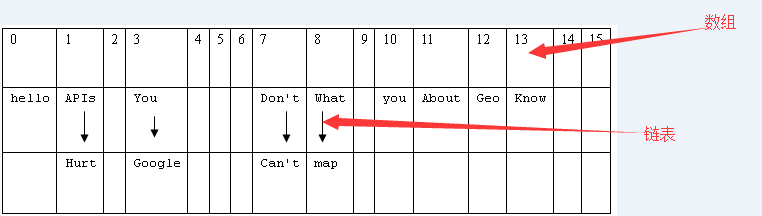
在Java中,最基础的数据类型是数组和链表,HashMap是两者结合体。所以在数据结构中被称作“链表散列”。每创建一个HashMap,就初始化一个数组。
关于这个数组源码是这样定义的:
 /**

  * The table, initialized on first use, and resized as

  * necessary. When allocated, length is always a power of two.

  * (We also tolerate length zero in some operations to allow

  * bootstrapping mechanics that are currently not needed.)

  * 该表首先使用初始化,并根据需要调整大小.分配时长度总是2的幂.

  * (这个数组的长度有些时候也允许为0)

  */

 transient Node<K,V>[] table;

 static class Node<K,V> implements Map.Entry<K,V> {

     final int hash;

     final K key;

     V value;

     Node<K,V> next;

     Node(int hash, K key, V value, Node<K,V> next) {

         this.hash = hash;

         this.key = key;

         this.value = value;

         this.next = next;

     }

 }
所以,数组中存储的是一个Map.Entry<K,V>,它由hash,key,value,next组成。next是指向下一个元素的引用,这就形成了链表。
2.存储元素
源码如下 :
     /**

      * Associates the specified value with the specified key in this map.

      * If the map previously contained a mapping for the key, the old

      * value is replaced.

      *

      * @param key key with which the specified value is to be associated

      * @param value value to be associated with the specified key

      * @return the previous value associated with <tt>key</tt>, or

      *         <tt>null</tt> if there was no mapping for <tt>key</tt>.

      *         (A <tt>null</tt> return can also indicate that the map

      *         previously associated <tt>null</tt> with <tt>key</tt>.)

      */

     public V put(K key, V value) {

         return putVal(hash(key), key, value, false, true);

     }

     /**

      * Implements Map.put and related methods

      *

      * @param hash hash for key

      * @param key the key

      * @param value the value to put

      * @param onlyIfAbsent if true, don't change existing value

      * @param evict if false, the table is in creation mode.

      * @return previous value, or null if none

      */

     final V putVal(int hash, K key, V value, boolean onlyIfAbsent,

                    boolean evict) {

         Node<K,V>[] tab; Node<K,V> p; int n, i;

         if ((tab = table) == null || (n = tab.length) == 0)

             n = (tab = resize()).length;

         if ((p = tab[i = (n - 1) & hash]) == null)

             tab[i] = newNode(hash, key, value, null);

         else {

             Node<K,V> e; K k;

             if (p.hash == hash &&

                 ((k = p.key) == key || (key != null && key.equals(k))))

                 e = p;

             else if (p instanceof TreeNode)

                 e = ((TreeNode<K,V>)p).putTreeVal(this, tab, hash, key, value);

             else {

                 for (int binCount = 0; ; ++binCount) {

                     if ((e = p.next) == null) {

                         p.next = newNode(hash, key, value, null);

                         if (binCount >= TREEIFY_THRESHOLD - 1) // -1 for 1st

                             treeifyBin(tab, hash);

                         break;

                     }

                     if (e.hash == hash &&

                         ((k = e.key) == key || (key != null && key.equals(k))))

                         break;

                     p = e;

                 }

             }

             if (e != null) { // existing mapping for key

                 V oldValue = e.value;

                 if (!onlyIfAbsent || oldValue == null)

                     e.value = value;

                 afterNodeAccess(e);

                 return oldValue;

             }

         }

         ++modCount;

         if (++size > threshold)

             resize();

         afterNodeInsertion(evict);

         return null;

     }
不难理解,首先hash(key)得到key的哈希值,这些值就是“数据结构”中数组的元素。根据hash值确定当前元素的存储格子,如果当前格子已经存储了元素,那么就以链表形式
存到这个格子中,新加入的放在链表的头部,所以最早加入的就被排在了链尾部。如图1中hash值为1的位置,就以链表的形式存储了两个值。
每一次添加元素都会修改modCount全局变量,这是是用来检测HashMap在迭代的过程中是否发生了结构变化
同时这里还会设计到扩容resize().详见“HashMap负载因子”
3.索引元素
源码如下:
 public V get(Object key) {

         Node<K,V> e;

         return (e = getNode(hash(key), key)) == null ? null : e.value;

     }

     /**

      * Implements Map.get and related methods

      *

      * @param hash hash for key

      * @param key the key

      * @return the node, or null if none

      */

     final Node<K,V> getNode(int hash, Object key) {

         Node<K,V>[] tab; Node<K,V> first, e; int n; K k;

         if ((tab = table) != null && (n = tab.length) > 0 &&

             (first = tab[(n - 1) & hash]) != null) {

             if (first.hash == hash && // always check first node

                 ((k = first.key) == key || (key != null && key.equals(k))))

                 return first;

             if ((e = first.next) != null) {

                 if (first instanceof TreeNode)

                     return ((TreeNode<K,V>)first).getTreeNode(hash, key);

                 do {

                     if (e.hash == hash &&

                         ((k = e.key) == key || (key != null && key.equals(k))))

                         return e;

                 } while ((e = e.next) != null);

             }

         }

         return null;

     }
首先计算出key的hash值,找到数组中对应的下标,然后通过key的equals方法匹配出对应位置的链表中的元素,这就完成了元素get的操作。这也是为什么要成对复写hashCode
和equals方法的原因。由此可知HashMap的get操作,效率会有瓶颈,如果一个位置存放了大量的元素,由于是链表存储的,就需要挨个比对,才能找到匹配的值。
所以让HashMap中的元素均匀的分布,每个位置上的链表只存储一个元素那么HashMap的效率就会很高。
4.性能因素
创建一个HashMap时,有initialCapacity和loadFactor这两个初始化参数,初始容量和负载因子。
这两个参数的设置会决定一个HashMap结构是否合理。详见“HashMap 负载因子”
5.hash算法
这是整个HashMap最核心的方法了,因为get(),put()操作都会用到这个方法,用于定位。确定新元素的存放位置。这关系着元素分布是否合理。
 /**

      * Computes key.hashCode() and spreads (XORs) higher bits of hash

      * to lower.  Because the table uses power-of-two masking, sets of

      * hashes that vary only in bits above the current mask will

      * always collide. (Among known examples are sets of Float keys

      * holding consecutive whole numbers in small tables.)  So we

      * apply a transform that spreads the impact of higher bits

      * downward. There is a tradeoff between speed, utility, and

      * quality of bit-spreading. Because many common sets of hashes

      * are already reasonably distributed (so don't benefit from

      * spreading), and because we use trees to handle large sets of

      * collisions in bins, we just XOR some shifted bits in the

      * cheapest possible way to reduce systematic lossage, as well as

      * to incorporate impact of the highest bits that would otherwise

      * never be used in index calculations because of table bounds.

      */

     static final int hash(Object key) {

         int h;

         return (key == null) ? 0 : (h = key.hashCode()) ^ (h >>> 16);

     }
这与以往jdk中有些区别,至于为什么这样计算,目前还在学习中。
6.安全问题
HashMap线程不同步,采用fail-fast机制。多线程下,在迭代器中,如果有线程修改了HashMap结构,会抛出 Java.util.ConcurrentModificationException异常
学海无涯,学习是苦涩的.坚持,看了两天了,还有很多不明白的地方,不放弃,持续更新。
谢谢一下同仁的分享
参考资料:
深入浅出 Java Concurrency (17): 并发容器 part 2 ConcurrentMap (2)
HashMap 学习笔记的更多相关文章
- HashMap学习笔记
概述 HashMap是Map接口的一个哈希表的实现,内部是一个数组表示的.数组中的元素叫做一个Node,一个Node可以一个是一个简单的表示键值对的二元组,也可以是一个复杂的TreeNod ...
- Java HashMap学习笔记
1.HashMap数据结构 在java编程语言中,最基本的结构就是两种,一个是数组,另外一个是模拟指针(引用),所有的数据结构都可以用这两个基本结构来构造的,HashMap也不例外.HashMap实际 ...
- 基于jdk1.8的HashMap源码学习笔记
作为一种最为常用的容器,同时也是效率比较高的容器,HashMap当之无愧.所以自己这次jdk源码学习,就从HashMap开始吧,当然水平有限,有不正确的地方,欢迎指正,促进共同学习进步,就是喜欢程序员 ...
- java集合类学习笔记之HashMap
1.简述 HashMap是java语言中非常典型的数据结构,也是我们平常用的最多的的集合类之一.它的底层是通过一个单向链表(Node<k,v>)数组(也称之为桶bucket,数组的长度也叫 ...
- HashMap源码剖析及实现原理分析(学习笔记)
一.需求 最近开发中,总是需要使用HashMap,而为了更好的开发以及理解HashMap:因此特定重新去看HashMap的源码并写下学习笔记,以便以后查阅. 二.HashMap的学习理解 1.我们首先 ...
- Redis学习笔记4-Redis配置详解
在Redis中直接启动redis-server服务时, 采用的是默认的配置文件.采用redis-server xxx.conf 这样的方式可以按照指定的配置文件来运行Redis服务.按照本Redi ...
- 《Java学习笔记(第8版)》学习指导
<Java学习笔记(第8版)>学习指导 目录 图书简况 学习指导 第一章 Java平台概论 第二章 从JDK到IDE 第三章 基础语法 第四章 认识对象 第五章 对象封装 第六章 继承与多 ...
- [原创]java WEB学习笔记109:Spring学习---spring对JDBC的支持:使用 JdbcTemplate 查询数据库,简化 JDBC 模板查询,在 JDBC 模板中使用具名参数两种实现
本博客的目的:①总结自己的学习过程,相当于学习笔记 ②将自己的经验分享给大家,相互学习,互相交流,不可商用 内容难免出现问题,欢迎指正,交流,探讨,可以留言,也可以通过以下方式联系. 本人互联网技术爱 ...
- spark学习笔记总结-spark入门资料精化
Spark学习笔记 Spark简介 spark 可以很容易和yarn结合,直接调用HDFS.Hbase上面的数据,和hadoop结合.配置很容易. spark发展迅猛,框架比hadoop更加灵活实用. ...
随机推荐
- 本机安装mysql服务,步骤教程(另附SQLyog和Navicat工具)
因为这段时间不是装系统就是换硬盘,导致装了还几次MySql,每次都记不住都要上网找教程,着实麻烦,所以这次干脆直接写到博客上好了,便于自己也便于他人: 百度云:http://pan.baidu.com ...
- swift -- 代理delegate
1.声明协议 protocol SecondDelagate { func sendValue(text : String!) -> Void } 2.声明代理属性 var delegate : ...
- conky 1.10以后的新配置格式
包装 config conky.config = { ... } 包装 TEXT conky.text = [[ ... ]] 每个 config 选项的变量和取值之间插入 "=" ...
- 自己做得一个用于直观观察css3 transform属性中的rotate 3D效果
这段代码还是非常简单,是看了一个老师的视频受的启发,也是调用了很多个函数,所以比较杂乱吧! <!DOCTYPE html><html lang="en">& ...
- mac 下安装securecrt
下载文件链接中附带的文件. 1.先找到secureCRT的包内容,进入MACOS文件夹.替换crack中的secureCRT文件. 2.断网.进入软件,显示你的验证码过期.点continue.选择手动 ...
- java中 "==" 和 ".equels"的区别
起初接触java的时候这个问题还是比较迷茫的,最近上班之余刷博客的时候看了一些大神写的文章,自己也来总结一下,直接贴代码: package string; public class demo1 { p ...
- 树链剖分-SPOJ375(QTREE)
QTREE - Query on a tree You are given a tree (an acyclic undirected connected graph) with N nodes, a ...
- 初识 Javascript.02 -- Date日期、Math对象、数据类型转换、字符串、布尔Boolean、逻辑运算符、if else 、三元表达式、代码调试方法、
Date()对象: Date对象用于处理日期和时间. 1.1 Math对象 ◆Math.ceil() 天花板函数 向上取整 只取整数,不足则进1 ◆Math.floor() 地板函数 ...
- ZooKeeper集群-搭建指南
第一步: 上传安装程序到Linux 这一步很简单就不在这过多说明了! 第二步: 在Linux上使用命令行安装 第三步: 修改配置文件 1.修改zoo.cfg文件 2.修改集群中各台主机的名称 1).如 ...
- 在React中使用CSS Modules设置样式
最近,一直在看React...那真的是一个一直在学的过程啊,从配置环境webpack,到基础知识jsx,babel,es6,没有一个不是之前没有接触的.其实,我内心是兴奋的啊,毕竟,活着就是要接触一些 ...