
mina写入数据的过程
mina架构图
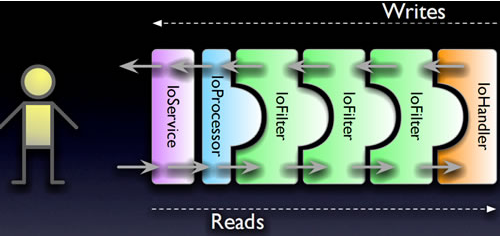
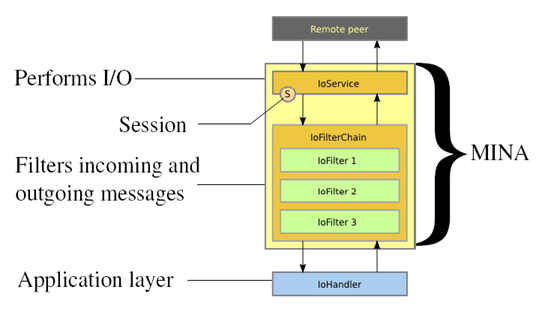
写数据、读数据触发点:
写数据:
1、写操作很简单,是调用session的write方法,进行写数据的,写数据的最终结果保存在一个缓存队列里面,等待发送,并把当前session放入flushSession队列里面。
2、发数据其实和读数据是差不多的,都在Processor中的触发的,在process()完新消息后,会调用flush()方法,把flushSession队列里面的session取出来,并把缓存的消息发送到客户端。
读数据:
读操作是在Processor中的触发的,Processor是AbstractPollingIoProcessor的内部私有类。
Processor中有一个死循环,循环调用Selector的select方法,若有新消息,则进行process()。
写数据过程
MINA数据类型
ByteBuffer、IoBuffer、Object。ByteBuffer是Java的NIO接口从channel读取数据的数据类型;IoBuffer是MINA自定义的数据类型,它封装了ByteBuffer;Object是用户自定义类型,通过用户自定义的codec与IoBuffer进行互相转换。
MINA数据类型转换流程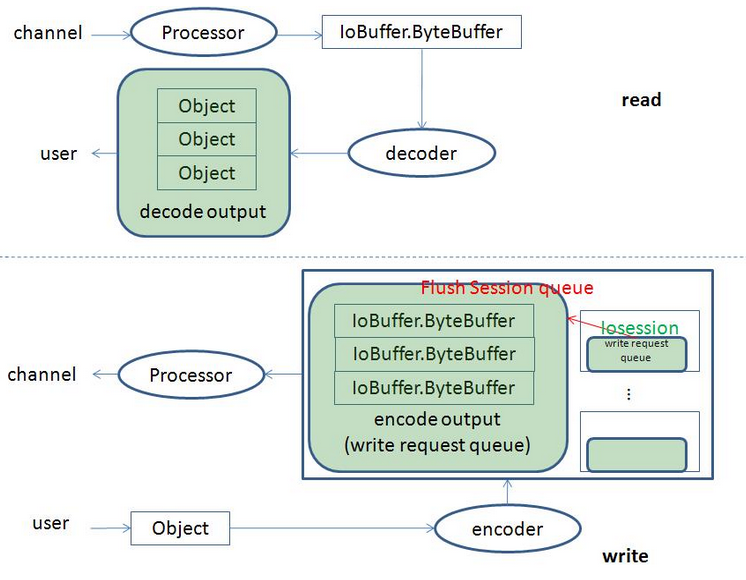
读数据过程
Processor从channel读取ByteBuffer数据,经MINA封装成IoBuffer提交给用户设置的decoder,decoder把解码结果放到一个解码输出队列(decode output queue)中,最后把队列元素按顺序提交给用户。如果设置了线程池来处理IO事件,那么Processor解码ByteBuffer数据以后的操作都由线程池执行,不然所有的操作都由Processor所在的线程执行。使用解码输出队列的原因是processor可能会收到的数据量超过decode成一个Object的所需要数据量,同时该队列是一个线程安全的,目的是防止在使用线程池运行IO事件时带来的数据竞争。
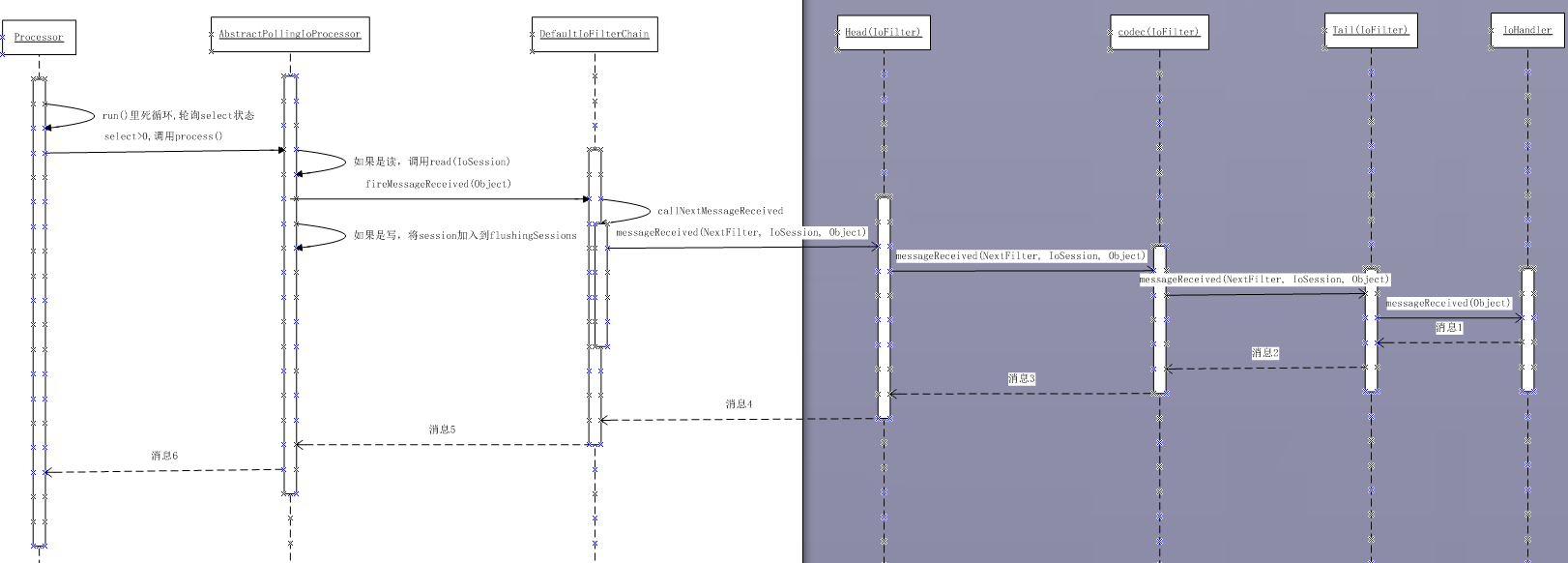
写数据过程
用户往IoSession中写入数据,通过encoder把用户类型的数据编码成IoBuffer并把它放入编码输出队列(写请求队列WriteRequestQueue),并把当前的IoSession放入Processor的刷新队列,最后Processor把每个IoSession中的写请求队列(WriteRequestQueue)中的数据写入channel。可以设置了运行IO事件的线程池执行在Processor处理之前的操作,不然这些操作都在用户写入IoSession的当前线程中执行。因为Processor所在线程跟用户往IoSession写数据的线程并不是同一个线程,所以需要一个线程安全的写请求队列(WriteRequestQueue)。
写数据:
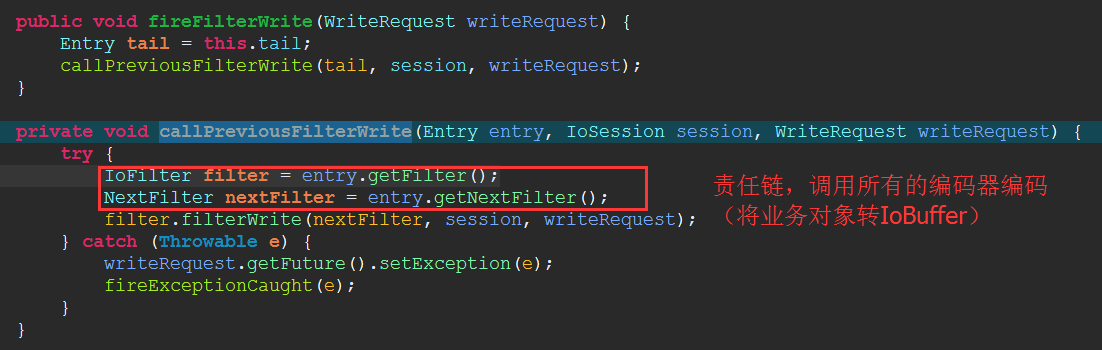
通过eclipse的单步调试:session.write()-->AbsructIoSession.write()-->DefaultIoFilterChain.fireFilterWrite()-->DefaultIoFilterChain.callPreviousFilterWrite()-->HeadFilter.filterWrite()-->SimpleIoProcessorPool-->IoProcessor(线程).write()
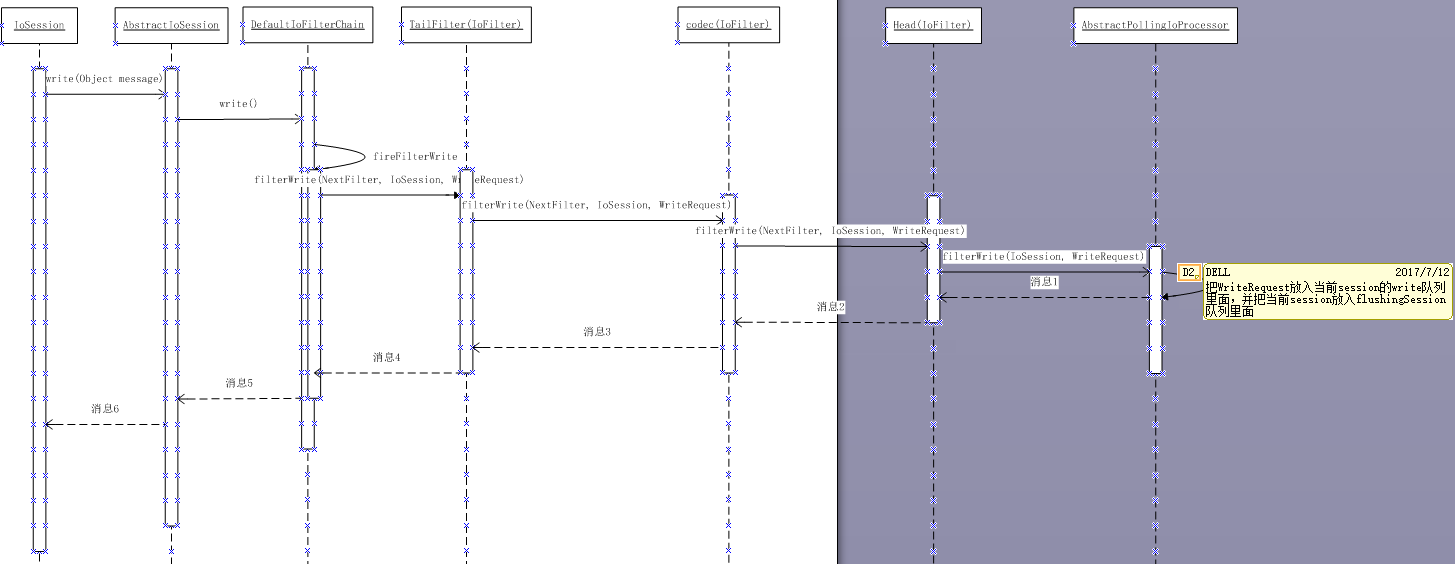
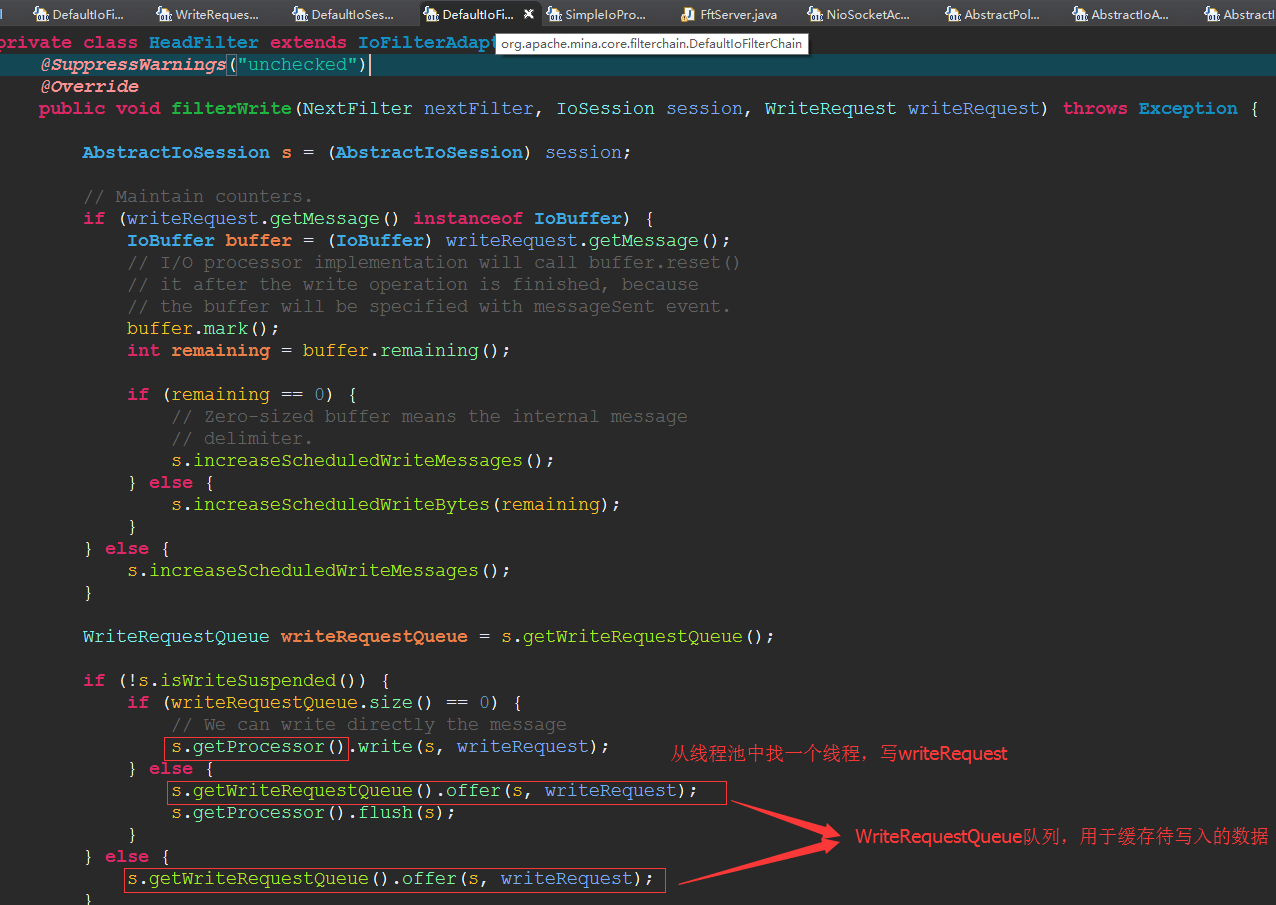
在最后一个Filter也就是HeadFilter中,会获取IoSession与之相关的 WriteRequestQueue 队列,作为应用层写出数据缓冲区。 把写出的WriteRequest放到写出缓冲区队列中。
因为apache mina 是按照SEDA架构设计,同时把要写出数据的IoSession放在 WriteRequestQueue队列中等待写出数据。
再看HeadFilter:
再来看 WriteRequestQueue中的数据是怎么处理的。
然后在Processor线程的run()方法中,来轮询flushIoSession队列。
AbstractPollingIoProcessor$Processor.run()-->AbstractPollingIoProcessor.flush(currentTime)-->AbstractPollingIoProcessor.flushNow(session, currentTime)-->
在NioProcessor(AbstractPollingIoProcessor<S>).flushNow(S, long) 方法中,依次把同一个IoSession中的writeRequest 请求写入到系统缓冲区。
private boolean flushNow(S session, long currentTime) {

        if (!session.isConnected()) {

            scheduleRemove(session);

            return false;

        }

        final boolean hasFragmentation = session.getTransportMetadata().hasFragmentation();

        final WriteRequestQueue writeRequestQueue = session.getWriteRequestQueue();

        // Set limitation for the number of written bytes for read-write

        // fairness. I used maxReadBufferSize * 3 / 2, which yields best

        // performance in my experience while not breaking fairness much.

        final int maxWrittenBytes = session.getConfig().getMaxReadBufferSize()

                + (session.getConfig().getMaxReadBufferSize() >>> 1);

        int writtenBytes = 0;

        WriteRequest req = null;

        try {

            // Clear OP_WRITE

            setInterestedInWrite(session, false);

            do {

                // Check for pending writes.

                req = session.getCurrentWriteRequest();

                if (req == null) {

                    req = writeRequestQueue.poll(session);

                    if (req == null) {

                        break;

                    }

                    session.setCurrentWriteRequest(req);

                }

                int localWrittenBytes = 0;

                Object message = req.getMessage();

                if (message instanceof IoBuffer) {

                    localWrittenBytes = writeBuffer(session, req, hasFragmentation, maxWrittenBytes - writtenBytes,

                            currentTime);

                    if ((localWrittenBytes > 0) && ((IoBuffer) message).hasRemaining()) {

                        // the buffer isn't empty, we re-interest it in writing

                        writtenBytes += localWrittenBytes;

                        setInterestedInWrite(session, true);

                        return false;

                    }

                } else if (message instanceof FileRegion) {

                    localWrittenBytes = writeFile(session, req, hasFragmentation, maxWrittenBytes - writtenBytes,

                            currentTime);

                    // Fix for Java bug on Linux

                    // http://bugs.sun.com/bugdatabase/view_bug.do?bug_id=5103988

                    // If there's still data to be written in the FileRegion,

                    // return 0 indicating that we need

                    // to pause until writing may resume.

                    if ((localWrittenBytes > 0) && (((FileRegion) message).getRemainingBytes() > 0)) {

                        writtenBytes += localWrittenBytes;

                        setInterestedInWrite(session, true);

                        return false;

                    }

                } else {

                    throw new IllegalStateException("Don't know how to handle message of type '"

                            + message.getClass().getName() + "'.  Are you missing a protocol encoder?");

                }

                if (localWrittenBytes == 0) {

                    // Kernel buffer is full.

                    setInterestedInWrite(session, true);

                    return false;

                }

                writtenBytes += localWrittenBytes;

                if (writtenBytes >= maxWrittenBytes) {

                    // Wrote too much

                    scheduleFlush(session);

                    return false;

                }

            } while (writtenBytes < maxWrittenBytes);

        } catch (Exception e) {

            if (req != null) {

                req.getFuture().setException(e);

            }

            IoFilterChain filterChain = session.getFilterChain();

            filterChain.fireExceptionCaught(e);

            return false;

        }

        return true;

    }
如何在应用层缓冲区的写出数据全部写入到系统缓冲区后才关闭socket
关闭socket,从IoSession开始:IoSession(boolean immediately)-->AstractIoSession.close(boolean rightNow)
如果参数是true:-->AstractIoSession.close()
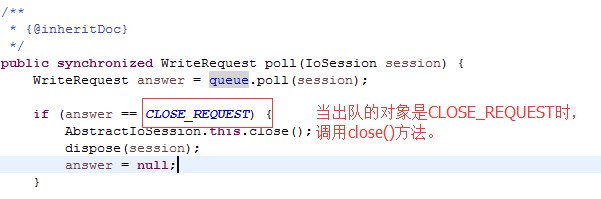
如果参数是false:-->AstractIoSession.closeOnFlush():创建了一个CLOSE_Request请求,当轮询flushIosession时,调用了close()方法。因为IoSession.close(flase) 也是一个写请求队列,所以在处理CLOSE_REQUEST请求时,之前的应用层缓冲区数据已经写入到系统缓冲区中。
CloseFuture close(boolean immediately);
IoSession的默认实现类AstractIoSession:
public final CloseFuture close(boolean rightNow) {

        if (!isClosing()) {

            if (rightNow) {

                return close();

            }

            return closeOnFlush();

        } else {

            return closeFuture;

        }

    }
    private final CloseFuture closeOnFlush() {

        getWriteRequestQueue().offer(this, CLOSE_REQUEST);

        getProcessor().flush(this);

        return closeFuture;

    }
CLOSE_REQUEST:(AbstractIoSession)
/**

     * An internal write request object that triggers session close.

     *

     * @see #writeRequestQueue

     */

    private static final WriteRequest CLOSE_REQUEST = new DefaultWriteRequest(new Object());
AbstractIoSession里的writeRequestQueue是CloseAwareWriteQueue
/**

     * Create a new close aware write queue, based on the given write queue.

     *

     * @param writeRequestQueue

     *            The write request queue

     */

    public final void setWriteRequestQueue(WriteRequestQueue writeRequestQueue) {

        this.writeRequestQueue = new CloseAwareWriteQueue(writeRequestQueue);

    }

NioProcessor(AbstractPollingIoProcessor<S>)
AbstractPollingIoProcessor
    /** A queue used to store the sessions to be removed */

    private final Queue<S> removingSessions = new ConcurrentLinkedQueue<S>();
AbstractPollingIoProcessor$Processor.run()-->NioProcessor(AbstractPollingIoProcessor<S>).removeSessions()
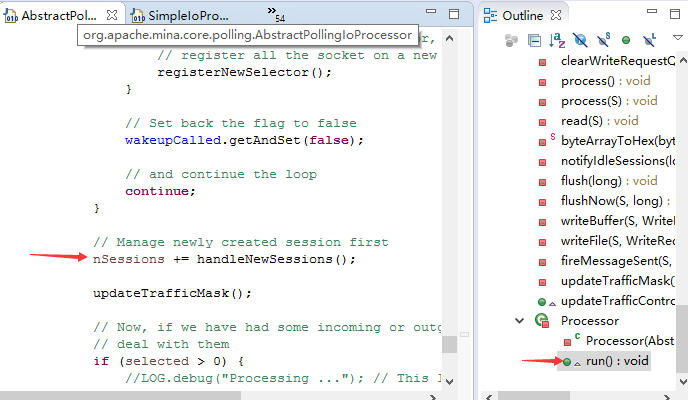
    private class Processor implements Runnable {

        public void run() {

            assert (processorRef.get() == this);

            int nSessions = 0;

            lastIdleCheckTime = System.currentTimeMillis();

            for (;;) {

                try {

                    // This select has a timeout so that we can manage

                    // idle session when we get out of the select every

                    // second. (note : this is a hack to avoid creating

                    // a dedicated thread).

                    long t0 = System.currentTimeMillis();

                    int selected = select(SELECT_TIMEOUT);

                    long t1 = System.currentTimeMillis();

                    long delta = (t1 - t0);

                    if ((selected == 0) && !wakeupCalled.get() && (delta < 100)) {

                        // Last chance : the select() may have been

                        // interrupted because we have had an closed channel.

                        if (isBrokenConnection()) {

                            LOG.warn("Broken connection");

                            // we can reselect immediately

                            // set back the flag to false

                            wakeupCalled.getAndSet(false);

                            continue;

                        } else {

                            LOG.warn("Create a new selector. Selected is 0, delta = " + (t1 - t0));

                            // Ok, we are hit by the nasty epoll

                            // spinning.

                            // Basically, there is a race condition

                            // which causes a closing file descriptor not to be

                            // considered as available as a selected channel, but

                            // it stopped the select. The next time we will

                            // call select(), it will exit immediately for the same

                            // reason, and do so forever, consuming 100%

                            // CPU.

                            // We have to destroy the selector, and

                            // register all the socket on a new one.

                            registerNewSelector();

                        }

                        // Set back the flag to false

                        wakeupCalled.getAndSet(false);

                        // and continue the loop

                        continue;

                    }

                    // Manage newly created session first

                    nSessions += handleNewSessions();

                    updateTrafficMask();

                    // Now, if we have had some incoming or outgoing events,

                    // deal with them

                    if (selected > 0) {

                        //LOG.debug("Processing ..."); // This log hurts one of the MDCFilter test...

                        process();

                    }

                    // Write the pending requests

                    long currentTime = System.currentTimeMillis();

                    flush(currentTime);

                    // And manage removed sessions

                    nSessions -= removeSessions();

                    // Last, not least, send Idle events to the idle sessions

                    notifyIdleSessions(currentTime);

                    // Get a chance to exit the infinite loop if there are no

                    // more sessions on this Processor

                    if (nSessions == 0) {

                        processorRef.set(null);

                        if (newSessions.isEmpty() && isSelectorEmpty()) {

                            // newSessions.add() precedes startupProcessor

                            assert (processorRef.get() != this);

                            break;

                        }

                        assert (processorRef.get() != this);

                        if (!processorRef.compareAndSet(null, this)) {

                            // startupProcessor won race, so must exit processor

                            assert (processorRef.get() != this);

                            break;

                        }

                        assert (processorRef.get() == this);

                    }

                    // Disconnect all sessions immediately if disposal has been

                    // requested so that we exit this loop eventually.

                    if (isDisposing()) {

                        for (Iterator<S> i = allSessions(); i.hasNext();) {

                            scheduleRemove(i.next());

                        }

                        wakeup();

                    }

                } catch (ClosedSelectorException cse) {

                    // If the selector has been closed, we can exit the loop

                    break;

                } catch (Throwable t) {

                    ExceptionMonitor.getInstance().exceptionCaught(t);

                    try {

                        Thread.sleep(1000);

                    } catch (InterruptedException e1) {

                        ExceptionMonitor.getInstance().exceptionCaught(e1);

                    }

                }

            }

            try {

                synchronized (disposalLock) {

                    if (disposing) {

                        doDispose();

                    }

                }

            } catch (Throwable t) {

                ExceptionMonitor.getInstance().exceptionCaught(t);

            } finally {

                disposalFuture.setValue(true);

            }

        }

    }
可以看到这个类实现了Runnable接口, run方法中的for循环一直在处理IOSession的数据读取和写入。
int selected = select(SELECT_TIMEOUT); SELECT_TIMEOUT 的默认值为1000L 所以超时时间设置为1S 如果有数据可写或者数据可读 则返回值大于0
if ((selected == 0) && !wakeupCalled.get() && (delta < 100)) 这个地方主要是处理判断是已经断开的连接还是新建立的连接 对于delta 为什么小于100
这个暂时还不知道 哦,这个是个nio的bug 链接可以看下 http://maoyidao.iteye.com/blog/1739282
selected大于0 则开始处理IOSession的读写。
如果可读
IoFilterChain filterChain = session.getFilterChain();
filterChain.fireMessageReceived(buf);
DefaultIoFilterChain实现fireMessageReceived的方法来处理
再由实现IoFilter接口的实现类来处理消息 基本上就结束了。
IoFilter有编解码,日志,线程池 这个有很多大家可以看下API。
    private int removeSessions() {

        int removedSessions = 0;

        for (S session = removingSessions.poll(); session != null; session = removingSessions.poll()) {

            SessionState state = getState(session);

            // Now deal with the removal accordingly to the session's state

            switch (state) {

            case OPENED:

                // Try to remove this session

                if (removeNow(session)) {

                    removedSessions++;

                }

                break;

            case CLOSING:

                // Skip if channel is already closed

                break;

            case OPENING:

                // Remove session from the newSessions queue and

                // remove it

                newSessions.remove(session);

                if (removeNow(session)) {

                    removedSessions++;

                }

                break;

            default:

                throw new IllegalStateException(String.valueOf(state));

            }

        }

        return removedSessions;

    }
如果在IoSession真正关闭时,有数据尚未写入到系统缓冲区,将会有异常抛出。
AbstractPollingIoProcessor<S extends AbstractIoSession>.removeNow(S session)-->AbstractPollingIoProcessor<S extends AbstractIoSession>.clearWriteRequestQueue()
    private void clearWriteRequestQueue(S session) {

        WriteRequestQueue writeRequestQueue = session.getWriteRequestQueue();

        WriteRequest req;

        List<WriteRequest> failedRequests = new ArrayList<WriteRequest>();

        if ((req = writeRequestQueue.poll(session)) != null) {

            Object message = req.getMessage();

            if (message instanceof IoBuffer) {

                IoBuffer buf = (IoBuffer) message;

                // The first unwritten empty buffer must be

                // forwarded to the filter chain.

                if (buf.hasRemaining()) {

                    buf.reset();

                    failedRequests.add(req);

                } else {

                    IoFilterChain filterChain = session.getFilterChain();

                    filterChain.fireMessageSent(req);

                }

            } else {

                failedRequests.add(req);

            }

            // Discard others.

            while ((req = writeRequestQueue.poll(session)) != null) {

                failedRequests.add(req);

            }

        }

        // Create an exception and notify.

        if (!failedRequests.isEmpty()) {

            WriteToClosedSessionException cause = new WriteToClosedSessionException(failedRequests);

            for (WriteRequest r : failedRequests) {

                session.decreaseScheduledBytesAndMessages(r);

                r.getFuture().setException(cause);

            }

            IoFilterChain filterChain = session.getFilterChain();

            filterChain.fireExceptionCaught(cause);

        }

    }
参考:
http://blog.csdn.net/smart_k/article/details/6617334
http://blog.csdn.net/wzm112358/article/details/46409181
mina写入数据的过程的更多相关文章
- Elasticsearch写入数据的过程是什么样的?以及是如何快速更新索引数据的?
前言 最近面试过程中遇到问Elasticsearch的问题不少,这次总结一下,然后顺便也了解一下Elasticsearch内部是一个什么样的结构,毕竟总不能就只了解个倒排索引吧.本文标题就是我遇到过的 ...
- ES 18 - (底层原理) Elasticsearch写入索引数据的过程 以及优化写入过程
目录 1 Lucene操作document的流程 1.1 添加document的流程 1.2 删除document的流程 2 优化写入流程 - 实现近实时搜索 2.1 流程的改进思路 2.2 设置re ...
- Python中,添加写入数据到已经存在的Excel的xls文件,即打开excel文件,写入新数据
背景 Python中,想要打开已经存在的excel的xls文件,然后在最后新的一行的数据. 折腾过程 1.找到了参考资料: writing to existing workbook using xlw ...
- 转载-python学习笔记之输入输出功能读取和写入数据
读取.写入和 Python 在 “探索 Python” 系列以前的文章中,学习了基本的 Python 数据类型和一些容器数据类型,例如tuple.string 和 list.其他文章讨论了 Pytho ...
- 通过I2C总线向EEPROM中写入数据,记录开机次数
没买板子之前,用protues画过电路图,实现了通过i2c总线向EEPROM中写入和读出数据. 今天,在自己买的板子上面写关于i2c总线的程序,有个地方忘了延时,调程序的时候很蛋疼.下面说说我对I2c ...
- HBase BulkLoad批量写入数据实战
1.概述 在进行数据传输中,批量加载数据到HBase集群有多种方式,比如通过HBase API进行批量写入数据.使用Sqoop工具批量导数到HBase集群.使用MapReduce批量导入等.这些方式, ...
- ElasticSearch写入数据的工作原理是什么?
面试题 es 写入数据的工作原理是什么啊?es 查询数据的工作原理是什么啊?底层的 lucene 介绍一下呗?倒排索引了解吗? 面试官心理分析 问这个,其实面试官就是要看看你了解不了解 es 的一些基 ...
- Kafka权威指南 读书笔记之(三)Kafka 生产者一一向 Kafka 写入数据
不管是把 Kafka 作为消息队列.消息总线还是数据存储平台来使用 ,总是需要有一个可以往 Kafka 写入数据的生产者和一个从 Kafka 读取数据的消费者,或者一个兼具两种角色的应用程序. 开发者 ...
- Mysql数据库写入数据速度优化
Mysql数据库写入数据速度优化 1)innodb_flush_log_at_trx_commit 默认值为1:设置为0,可以提高写入速度. 值为0:提升写入速度,但是安全方面较差,mysql服务器 ...
随机推荐
- springboot+mybatis+springSecurity+thymeleaf
配置步骤: .pom <dependencies> <dependency> <groupId>org.springframework.security</g ...
- socket io 记得flush
public class Client { public static void main(String args[]) throws Exception { //为了简单起见,所有的异常都直接往外抛 ...
- 关于如何处理JSONObject.fromObject(Object obj)无法转换特殊日期(java.sql.Date,java.sql.Timestamp)格式的问题。
转:关于如何处理JSONObject.fromObject(Object obj)无法转换特殊日期(java.sql.Date,java.sql.Timestamp)格式的问题. 关于JSONObje ...
- JSON 在JavaScript 中的应用及自己的理解
[对象和json]JSON:JavaScript 对象表示法(JavaScript Object Notation).JSON 是存储和交换文本信息的语法.类似 XML.JSON是一种数据格式,不是一 ...
- mysql性能优化之索引优化
作为免费又高效的数据库,mysql基本是首选.良好的安全连接,自带查询解析.sql语句优化,使用读写锁(细化到行).事物隔离和多版本并发控制提高并发,完备的事务日志记录,强大的存储引擎提供高效查询(表 ...
- [非原创] 常用加密算法整理 AES/SSL(一)
前言: 在伟大的计算机科学家研究下,发明了许多的加密算法,以下做个简答的描述: 一.分类 加密算法分为两种:单向加密.双向加密. 单向加密,不可逆的加密算法,只能加密不能解密: 双向加密,由对称性加密 ...
- 按返回键退出程序但不销毁代码,像QQ一样,后台运行
@Override public boolean onKeyDown(int keyCode, KeyEvent event) { if (keyCode == KeyEvent.KEYCODE_BA ...
- PHP JSON文件解析并获取key、value,判断key是否存在
/****************************************************************************** * PHP JSON文件解析并获取key ...
- LeetCode Employee Importance
原题链接在这里:https://leetcode.com/problems/employee-importance/description/ 题目: You are given a data stru ...
- LeetCode Continuous Subarray Sum
原题链接在这里:https://leetcode.com/problems/continuous-subarray-sum/description/ 题目: Given a list of non-n ...