
mina写入数据的过程
mina架构图
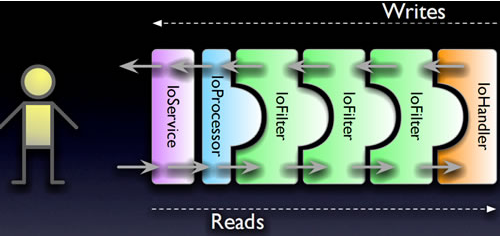
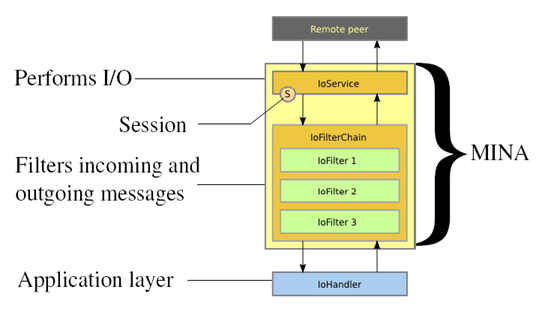
写数据、读数据触发点:
写数据:
1、写操作很简单,是调用session的write方法,进行写数据的,写数据的最终结果保存在一个缓存队列里面,等待发送,并把当前session放入flushSession队列里面。
2、发数据其实和读数据是差不多的,都在Processor中的触发的,在process()完新消息后,会调用flush()方法,把flushSession队列里面的session取出来,并把缓存的消息发送到客户端。
读数据:
读操作是在Processor中的触发的,Processor是AbstractPollingIoProcessor的内部私有类。
Processor中有一个死循环,循环调用Selector的select方法,若有新消息,则进行process()。
写数据过程
MINA数据类型
ByteBuffer、IoBuffer、Object。ByteBuffer是Java的NIO接口从channel读取数据的数据类型;IoBuffer是MINA自定义的数据类型,它封装了ByteBuffer;Object是用户自定义类型,通过用户自定义的codec与IoBuffer进行互相转换。
MINA数据类型转换流程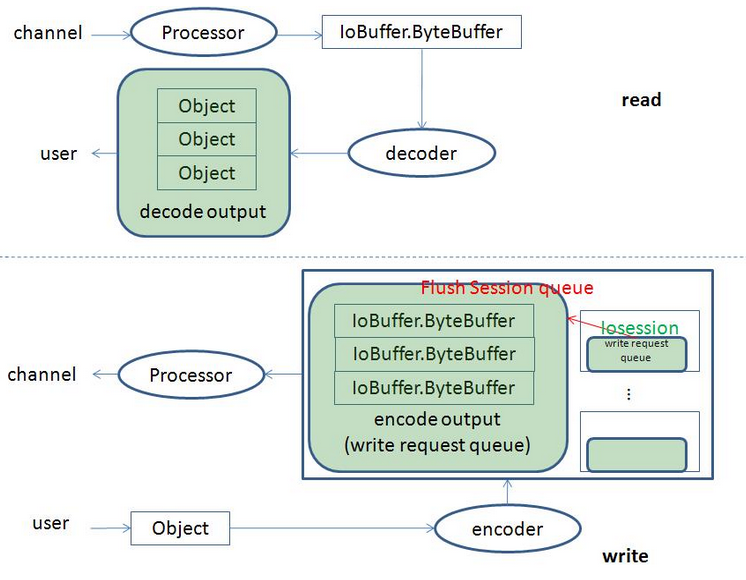
读数据过程
Processor从channel读取ByteBuffer数据,经MINA封装成IoBuffer提交给用户设置的decoder,decoder把解码结果放到一个解码输出队列(decode output queue)中,最后把队列元素按顺序提交给用户。如果设置了线程池来处理IO事件,那么Processor解码ByteBuffer数据以后的操作都由线程池执行,不然所有的操作都由Processor所在的线程执行。使用解码输出队列的原因是processor可能会收到的数据量超过decode成一个Object的所需要数据量,同时该队列是一个线程安全的,目的是防止在使用线程池运行IO事件时带来的数据竞争。
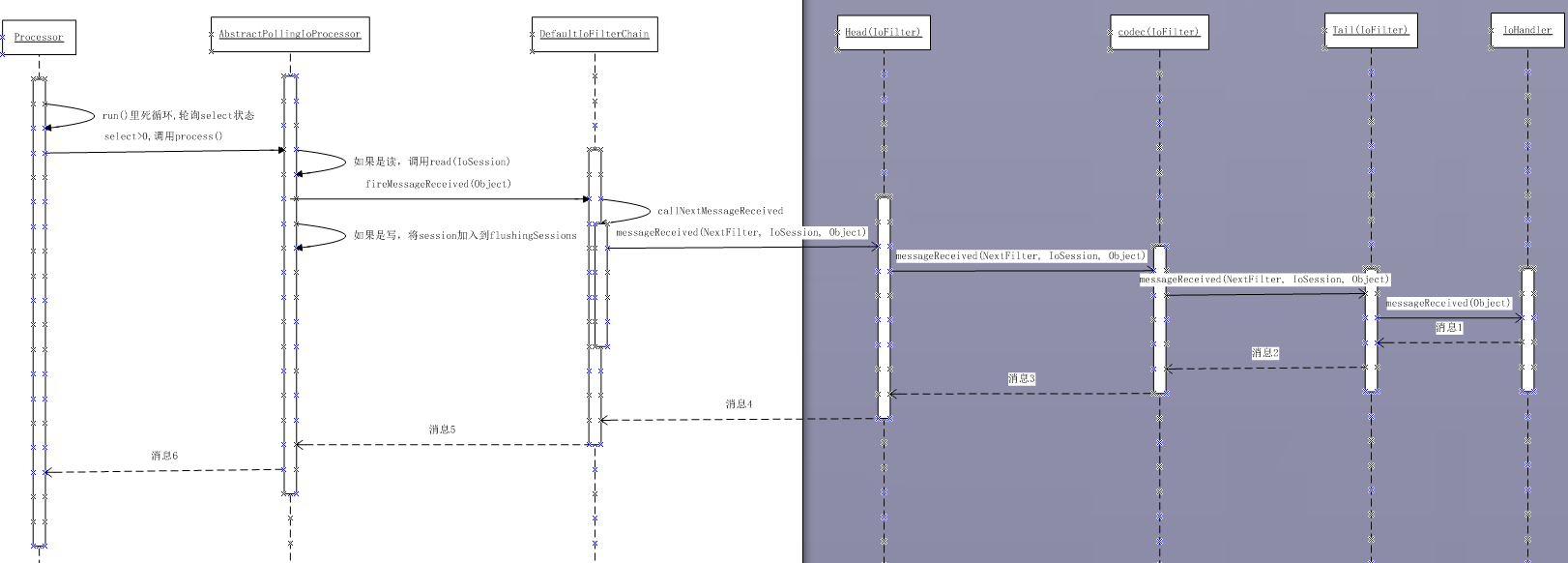
写数据过程
用户往IoSession中写入数据,通过encoder把用户类型的数据编码成IoBuffer并把它放入编码输出队列(写请求队列WriteRequestQueue),并把当前的IoSession放入Processor的刷新队列,最后Processor把每个IoSession中的写请求队列(WriteRequestQueue)中的数据写入channel。可以设置了运行IO事件的线程池执行在Processor处理之前的操作,不然这些操作都在用户写入IoSession的当前线程中执行。因为Processor所在线程跟用户往IoSession写数据的线程并不是同一个线程,所以需要一个线程安全的写请求队列(WriteRequestQueue)。
写数据:
通过eclipse的单步调试:session.write()-->AbsructIoSession.write()-->DefaultIoFilterChain.fireFilterWrite()-->DefaultIoFilterChain.callPreviousFilterWrite()-->HeadFilter.filterWrite()-->SimpleIoProcessorPool-->IoProcessor(线程).write()
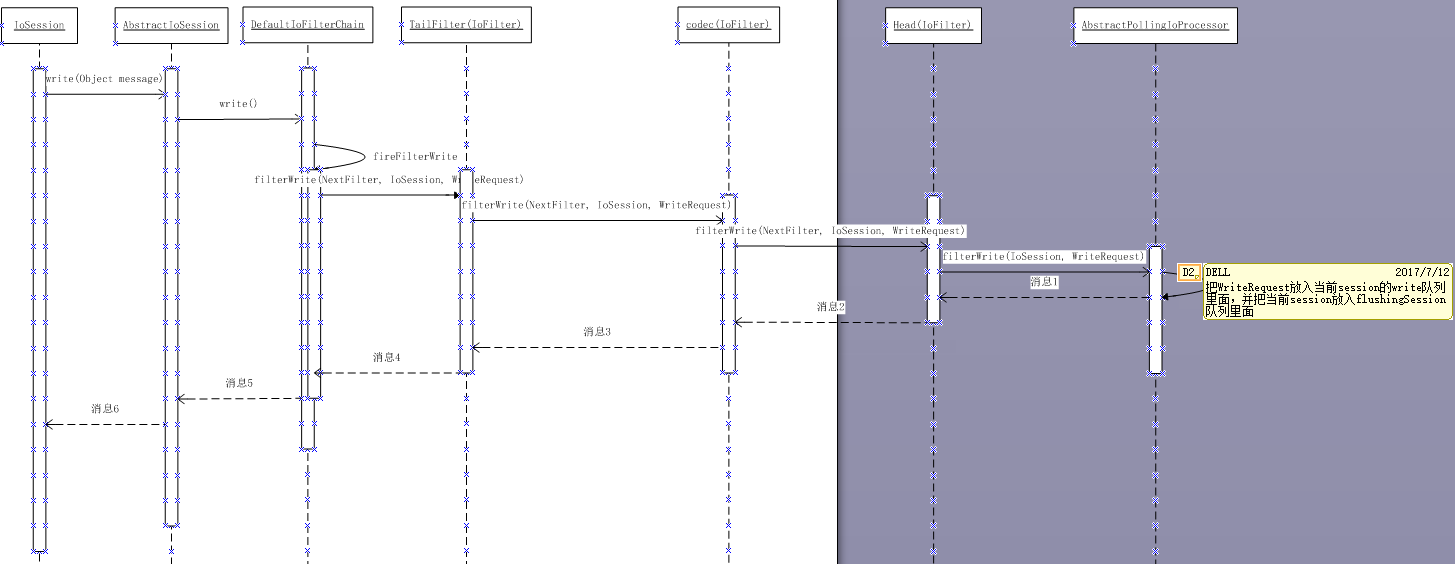
在最后一个Filter也就是HeadFilter中,会获取IoSession与之相关的 WriteRequestQueue 队列,作为应用层写出数据缓冲区。 把写出的WriteRequest放到写出缓冲区队列中。
因为apache mina 是按照SEDA架构设计,同时把要写出数据的IoSession放在 WriteRequestQueue队列中等待写出数据。
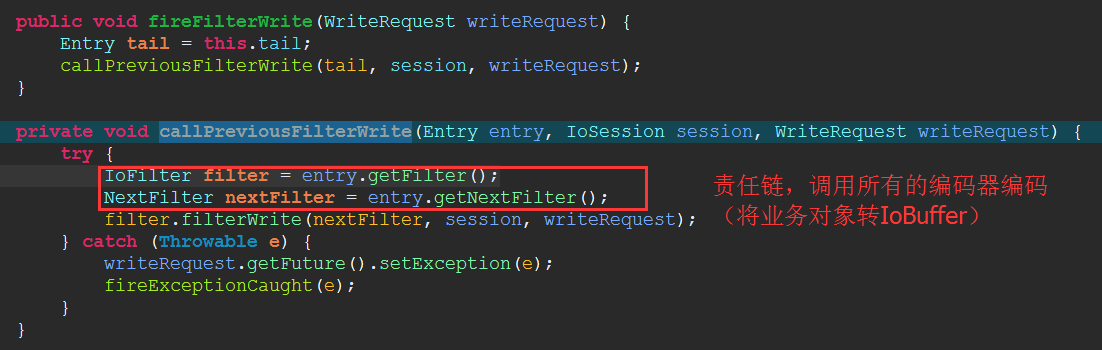
再看HeadFilter:
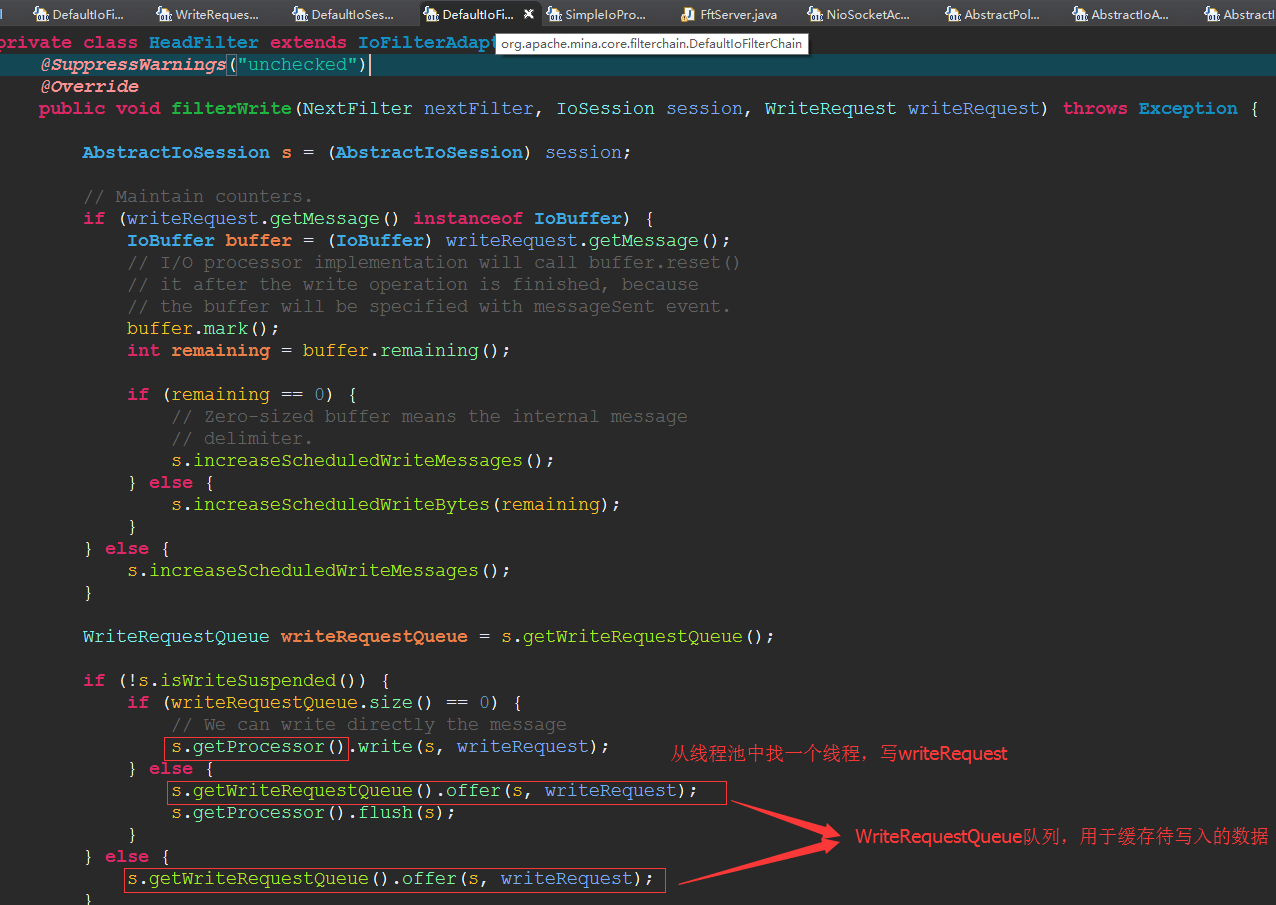
再来看 WriteRequestQueue中的数据是怎么处理的。
然后在Processor线程的run()方法中,来轮询flushIoSession队列。
AbstractPollingIoProcessor$Processor.run()-->AbstractPollingIoProcessor.flush(currentTime)-->AbstractPollingIoProcessor.flushNow(session, currentTime)-->
在NioProcessor(AbstractPollingIoProcessor<S>).flushNow(S, long) 方法中,依次把同一个IoSession中的writeRequest 请求写入到系统缓冲区。
private boolean flushNow(S session, long currentTime) {

        if (!session.isConnected()) {

            scheduleRemove(session);

            return false;

        }

        final boolean hasFragmentation = session.getTransportMetadata().hasFragmentation();

        final WriteRequestQueue writeRequestQueue = session.getWriteRequestQueue();

        // Set limitation for the number of written bytes for read-write

        // fairness. I used maxReadBufferSize * 3 / 2, which yields best

        // performance in my experience while not breaking fairness much.

        final int maxWrittenBytes = session.getConfig().getMaxReadBufferSize()

                + (session.getConfig().getMaxReadBufferSize() >>> 1);

        int writtenBytes = 0;

        WriteRequest req = null;

        try {

            // Clear OP_WRITE

            setInterestedInWrite(session, false);

            do {

                // Check for pending writes.

                req = session.getCurrentWriteRequest();

                if (req == null) {

                    req = writeRequestQueue.poll(session);

                    if (req == null) {

                        break;

                    }

                    session.setCurrentWriteRequest(req);

                }

                int localWrittenBytes = 0;

                Object message = req.getMessage();

                if (message instanceof IoBuffer) {

                    localWrittenBytes = writeBuffer(session, req, hasFragmentation, maxWrittenBytes - writtenBytes,

                            currentTime);

                    if ((localWrittenBytes > 0) && ((IoBuffer) message).hasRemaining()) {

                        // the buffer isn't empty, we re-interest it in writing

                        writtenBytes += localWrittenBytes;

                        setInterestedInWrite(session, true);

                        return false;

                    }

                } else if (message instanceof FileRegion) {

                    localWrittenBytes = writeFile(session, req, hasFragmentation, maxWrittenBytes - writtenBytes,

                            currentTime);

                    // Fix for Java bug on Linux

                    // http://bugs.sun.com/bugdatabase/view_bug.do?bug_id=5103988

                    // If there's still data to be written in the FileRegion,

                    // return 0 indicating that we need

                    // to pause until writing may resume.

                    if ((localWrittenBytes > 0) && (((FileRegion) message).getRemainingBytes() > 0)) {

                        writtenBytes += localWrittenBytes;

                        setInterestedInWrite(session, true);

                        return false;

                    }

                } else {

                    throw new IllegalStateException("Don't know how to handle message of type '"

                            + message.getClass().getName() + "'.  Are you missing a protocol encoder?");

                }

                if (localWrittenBytes == 0) {

                    // Kernel buffer is full.

                    setInterestedInWrite(session, true);

                    return false;

                }

                writtenBytes += localWrittenBytes;

                if (writtenBytes >= maxWrittenBytes) {

                    // Wrote too much

                    scheduleFlush(session);

                    return false;

                }

            } while (writtenBytes < maxWrittenBytes);

        } catch (Exception e) {

            if (req != null) {

                req.getFuture().setException(e);

            }

            IoFilterChain filterChain = session.getFilterChain();

            filterChain.fireExceptionCaught(e);

            return false;

        }

        return true;

    }
如何在应用层缓冲区的写出数据全部写入到系统缓冲区后才关闭socket
关闭socket,从IoSession开始:IoSession(boolean immediately)-->AstractIoSession.close(boolean rightNow)
如果参数是true:-->AstractIoSession.close()
如果参数是false:-->AstractIoSession.closeOnFlush():创建了一个CLOSE_Request请求,当轮询flushIosession时,调用了close()方法。因为IoSession.close(flase) 也是一个写请求队列,所以在处理CLOSE_REQUEST请求时,之前的应用层缓冲区数据已经写入到系统缓冲区中。
CloseFuture close(boolean immediately);
IoSession的默认实现类AstractIoSession:
public final CloseFuture close(boolean rightNow) {

        if (!isClosing()) {

            if (rightNow) {

                return close();

            }

            return closeOnFlush();

        } else {

            return closeFuture;

        }

    }
    private final CloseFuture closeOnFlush() {

        getWriteRequestQueue().offer(this, CLOSE_REQUEST);

        getProcessor().flush(this);

        return closeFuture;

    }
CLOSE_REQUEST:(AbstractIoSession)
/**

     * An internal write request object that triggers session close.

     *

     * @see #writeRequestQueue

     */

    private static final WriteRequest CLOSE_REQUEST = new DefaultWriteRequest(new Object());
AbstractIoSession里的writeRequestQueue是CloseAwareWriteQueue
/**

     * Create a new close aware write queue, based on the given write queue.

     *

     * @param writeRequestQueue

     *            The write request queue

     */

    public final void setWriteRequestQueue(WriteRequestQueue writeRequestQueue) {

        this.writeRequestQueue = new CloseAwareWriteQueue(writeRequestQueue);

    }

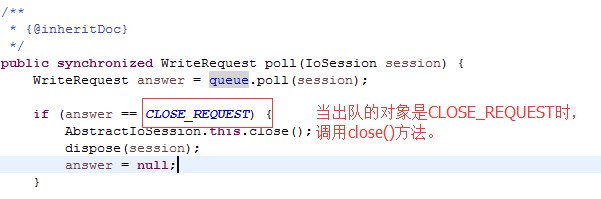
NioProcessor(AbstractPollingIoProcessor<S>)
AbstractPollingIoProcessor
    /** A queue used to store the sessions to be removed */

    private final Queue<S> removingSessions = new ConcurrentLinkedQueue<S>();
AbstractPollingIoProcessor$Processor.run()-->NioProcessor(AbstractPollingIoProcessor<S>).removeSessions()
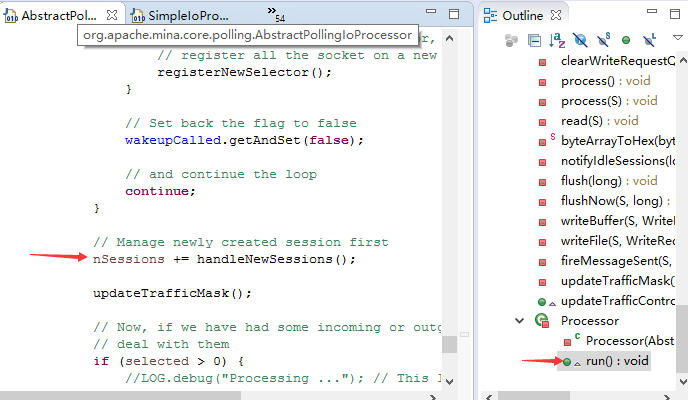
    private class Processor implements Runnable {

        public void run() {

            assert (processorRef.get() == this);

            int nSessions = 0;

            lastIdleCheckTime = System.currentTimeMillis();

            for (;;) {

                try {

                    // This select has a timeout so that we can manage

                    // idle session when we get out of the select every

                    // second. (note : this is a hack to avoid creating

                    // a dedicated thread).

                    long t0 = System.currentTimeMillis();

                    int selected = select(SELECT_TIMEOUT);

                    long t1 = System.currentTimeMillis();

                    long delta = (t1 - t0);

                    if ((selected == 0) && !wakeupCalled.get() && (delta < 100)) {

                        // Last chance : the select() may have been

                        // interrupted because we have had an closed channel.

                        if (isBrokenConnection()) {

                            LOG.warn("Broken connection");

                            // we can reselect immediately

                            // set back the flag to false

                            wakeupCalled.getAndSet(false);

                            continue;

                        } else {

                            LOG.warn("Create a new selector. Selected is 0, delta = " + (t1 - t0));

                            // Ok, we are hit by the nasty epoll

                            // spinning.

                            // Basically, there is a race condition

                            // which causes a closing file descriptor not to be

                            // considered as available as a selected channel, but

                            // it stopped the select. The next time we will

                            // call select(), it will exit immediately for the same

                            // reason, and do so forever, consuming 100%

                            // CPU.

                            // We have to destroy the selector, and

                            // register all the socket on a new one.

                            registerNewSelector();

                        }

                        // Set back the flag to false

                        wakeupCalled.getAndSet(false);

                        // and continue the loop

                        continue;

                    }

                    // Manage newly created session first

                    nSessions += handleNewSessions();

                    updateTrafficMask();

                    // Now, if we have had some incoming or outgoing events,

                    // deal with them

                    if (selected > 0) {

                        //LOG.debug("Processing ..."); // This log hurts one of the MDCFilter test...

                        process();

                    }

                    // Write the pending requests

                    long currentTime = System.currentTimeMillis();

                    flush(currentTime);

                    // And manage removed sessions

                    nSessions -= removeSessions();

                    // Last, not least, send Idle events to the idle sessions

                    notifyIdleSessions(currentTime);

                    // Get a chance to exit the infinite loop if there are no

                    // more sessions on this Processor

                    if (nSessions == 0) {

                        processorRef.set(null);

                        if (newSessions.isEmpty() && isSelectorEmpty()) {

                            // newSessions.add() precedes startupProcessor

                            assert (processorRef.get() != this);

                            break;

                        }

                        assert (processorRef.get() != this);

                        if (!processorRef.compareAndSet(null, this)) {

                            // startupProcessor won race, so must exit processor

                            assert (processorRef.get() != this);

                            break;

                        }

                        assert (processorRef.get() == this);

                    }

                    // Disconnect all sessions immediately if disposal has been

                    // requested so that we exit this loop eventually.

                    if (isDisposing()) {

                        for (Iterator<S> i = allSessions(); i.hasNext();) {

                            scheduleRemove(i.next());

                        }

                        wakeup();

                    }

                } catch (ClosedSelectorException cse) {

                    // If the selector has been closed, we can exit the loop

                    break;

                } catch (Throwable t) {

                    ExceptionMonitor.getInstance().exceptionCaught(t);

                    try {

                        Thread.sleep(1000);

                    } catch (InterruptedException e1) {

                        ExceptionMonitor.getInstance().exceptionCaught(e1);

                    }

                }

            }

            try {

                synchronized (disposalLock) {

                    if (disposing) {

                        doDispose();

                    }

                }

            } catch (Throwable t) {

                ExceptionMonitor.getInstance().exceptionCaught(t);

            } finally {

                disposalFuture.setValue(true);

            }

        }

    }
可以看到这个类实现了Runnable接口, run方法中的for循环一直在处理IOSession的数据读取和写入。
int selected = select(SELECT_TIMEOUT); SELECT_TIMEOUT 的默认值为1000L 所以超时时间设置为1S 如果有数据可写或者数据可读 则返回值大于0
if ((selected == 0) && !wakeupCalled.get() && (delta < 100)) 这个地方主要是处理判断是已经断开的连接还是新建立的连接 对于delta 为什么小于100
这个暂时还不知道 哦,这个是个nio的bug 链接可以看下 http://maoyidao.iteye.com/blog/1739282
selected大于0 则开始处理IOSession的读写。
如果可读
IoFilterChain filterChain = session.getFilterChain();
filterChain.fireMessageReceived(buf);
DefaultIoFilterChain实现fireMessageReceived的方法来处理
再由实现IoFilter接口的实现类来处理消息 基本上就结束了。
IoFilter有编解码,日志,线程池 这个有很多大家可以看下API。
    private int removeSessions() {

        int removedSessions = 0;

        for (S session = removingSessions.poll(); session != null; session = removingSessions.poll()) {

            SessionState state = getState(session);

            // Now deal with the removal accordingly to the session's state

            switch (state) {

            case OPENED:

                // Try to remove this session

                if (removeNow(session)) {

                    removedSessions++;

                }

                break;

            case CLOSING:

                // Skip if channel is already closed

                break;

            case OPENING:

                // Remove session from the newSessions queue and

                // remove it

                newSessions.remove(session);

                if (removeNow(session)) {

                    removedSessions++;

                }

                break;

            default:

                throw new IllegalStateException(String.valueOf(state));

            }

        }

        return removedSessions;

    }
如果在IoSession真正关闭时,有数据尚未写入到系统缓冲区,将会有异常抛出。
AbstractPollingIoProcessor<S extends AbstractIoSession>.removeNow(S session)-->AbstractPollingIoProcessor<S extends AbstractIoSession>.clearWriteRequestQueue()
    private void clearWriteRequestQueue(S session) {

        WriteRequestQueue writeRequestQueue = session.getWriteRequestQueue();

        WriteRequest req;

        List<WriteRequest> failedRequests = new ArrayList<WriteRequest>();

        if ((req = writeRequestQueue.poll(session)) != null) {

            Object message = req.getMessage();

            if (message instanceof IoBuffer) {

                IoBuffer buf = (IoBuffer) message;

                // The first unwritten empty buffer must be

                // forwarded to the filter chain.

                if (buf.hasRemaining()) {

                    buf.reset();

                    failedRequests.add(req);

                } else {

                    IoFilterChain filterChain = session.getFilterChain();

                    filterChain.fireMessageSent(req);

                }

            } else {

                failedRequests.add(req);

            }

            // Discard others.

            while ((req = writeRequestQueue.poll(session)) != null) {

                failedRequests.add(req);

            }

        }

        // Create an exception and notify.

        if (!failedRequests.isEmpty()) {

            WriteToClosedSessionException cause = new WriteToClosedSessionException(failedRequests);

            for (WriteRequest r : failedRequests) {

                session.decreaseScheduledBytesAndMessages(r);

                r.getFuture().setException(cause);

            }

            IoFilterChain filterChain = session.getFilterChain();

            filterChain.fireExceptionCaught(cause);

        }

    }
参考:
http://blog.csdn.net/smart_k/article/details/6617334
http://blog.csdn.net/wzm112358/article/details/46409181
mina写入数据的过程的更多相关文章
- Elasticsearch写入数据的过程是什么样的?以及是如何快速更新索引数据的?
前言 最近面试过程中遇到问Elasticsearch的问题不少,这次总结一下,然后顺便也了解一下Elasticsearch内部是一个什么样的结构,毕竟总不能就只了解个倒排索引吧.本文标题就是我遇到过的 ...
- ES 18 - (底层原理) Elasticsearch写入索引数据的过程 以及优化写入过程
目录 1 Lucene操作document的流程 1.1 添加document的流程 1.2 删除document的流程 2 优化写入流程 - 实现近实时搜索 2.1 流程的改进思路 2.2 设置re ...
- Python中,添加写入数据到已经存在的Excel的xls文件,即打开excel文件,写入新数据
背景 Python中,想要打开已经存在的excel的xls文件,然后在最后新的一行的数据. 折腾过程 1.找到了参考资料: writing to existing workbook using xlw ...
- 转载-python学习笔记之输入输出功能读取和写入数据
读取.写入和 Python 在 “探索 Python” 系列以前的文章中,学习了基本的 Python 数据类型和一些容器数据类型,例如tuple.string 和 list.其他文章讨论了 Pytho ...
- 通过I2C总线向EEPROM中写入数据,记录开机次数
没买板子之前,用protues画过电路图,实现了通过i2c总线向EEPROM中写入和读出数据. 今天,在自己买的板子上面写关于i2c总线的程序,有个地方忘了延时,调程序的时候很蛋疼.下面说说我对I2c ...
- HBase BulkLoad批量写入数据实战
1.概述 在进行数据传输中,批量加载数据到HBase集群有多种方式,比如通过HBase API进行批量写入数据.使用Sqoop工具批量导数到HBase集群.使用MapReduce批量导入等.这些方式, ...
- ElasticSearch写入数据的工作原理是什么?
面试题 es 写入数据的工作原理是什么啊?es 查询数据的工作原理是什么啊?底层的 lucene 介绍一下呗?倒排索引了解吗? 面试官心理分析 问这个,其实面试官就是要看看你了解不了解 es 的一些基 ...
- Kafka权威指南 读书笔记之(三)Kafka 生产者一一向 Kafka 写入数据
不管是把 Kafka 作为消息队列.消息总线还是数据存储平台来使用 ,总是需要有一个可以往 Kafka 写入数据的生产者和一个从 Kafka 读取数据的消费者,或者一个兼具两种角色的应用程序. 开发者 ...
- Mysql数据库写入数据速度优化
Mysql数据库写入数据速度优化 1)innodb_flush_log_at_trx_commit 默认值为1:设置为0,可以提高写入速度. 值为0:提升写入速度,但是安全方面较差,mysql服务器 ...
随机推荐
- 理解Android Build系统【转】
本文转载自:http://www.ibm.com/developerworks/cn/opensource/os-cn-android-build/ Android Build 系统是用来编译 And ...
- 互联网高并发之Hystrix实现服务隔离和降级
当大多数人在使用Tomcat时,多个HTTP服务会共享一个线程池,假设其中一个HTTP服务访问的数据库响应非常慢,这将造成服务响应时间延迟增加,大多数线程阻塞等待数据响应返回,导致整个Tomcat线程 ...
- MySQL操作的相关命令
拷贝表,并且复制两条数据到新表中 create table t_comments_sample2 like t_comments_sample; #拷贝表结构 ,;#复制两条数据 MySQL Work ...
- yarn作业提交过程源码
记录源码细节,内部有中文注释 Client 端: //最终通过ApplicationClientProtocol协议提交到RM端的ClientRMService内 package org.apache ...
- ZooKeeper学习第八期---ZooKeeper伸缩性
转:http://www.cnblogs.com/sunddenly/p/4143306.html 一.ZooKeeper中Observer 1.1 ZooKeeper角色 经过前面的介绍,我想大家都 ...
- Python中MySQL插入数据
sql = 'INSERT INTO course(class_name, credit, properties, teacher_name, college_given, classroom) ' ...
- 用外部物理路由器时使用Neutron dhcp-agent提供的metadata服务(by quqi99)
作者:张华 发表于:2015-12-29版权声明:可以任意转载,转载时请务必以超链接形式标明文章原始出处和作者信息及本版权声明 ( http://blog.csdn.net/quqi99 ) 环境搭 ...
- review20
Pattern与Matcher类 模式匹配就是检索和指定模式匹配的字符串.java提供了专门用来进行模式匹配的Pattern类和Matcher类,这些类在java.util.regex包中. 模式对象 ...
- PHP中preg_match正则匹配的/u /i /s是什么意思
/u 表示按unicode(utf-8)匹配(主要针对多字节比如汉字) /i 表示不区分大小写(如果表达式里面有 a, 那么 A 也是匹配对象) /s 表示将字符串视为单行来匹配
- SSIS包的开发
在上一章节中我们初步了解了SSIS体系结构以及如何创建一个SSIS包.现在就介绍一下如何在创建的包中使用各个选项卡.打开上一章节创建的SSIS包.整个界面风格如下: 在整个包中包含了控制流选项卡.数据 ...