
Poj 2528-Mayor's posters 线段切割
|
Mayor's posters
Description The citizens of Bytetown, AB, could not stand that the candidates in the mayoral election campaign have been placing their electoral posters at all places at their whim. The city council has finally decided to build an electoral wall for placing the posters and introduce the following rules:
They have built a wall 10000000 bytes long (such that there is enough place for all candidates). When the electoral campaign was restarted, the candidates were placing their posters on the wall and their posters differed widely in width. Moreover, the candidates started placing their posters on wall segments already occupied by other posters. Everyone in Bytetown was curious whose posters will be visible (entirely or in part) on the last day before elections. Input The first line of input contains a number c giving the number of cases that follow. The first line of data for a single case contains number 1 <= n <= 10000. The subsequent n lines describe the posters in the order in which they were placed. The i-th line among the n lines contains two integer numbers li and ri which are the number of the wall segment occupied by the left end and the right end of the i-th poster, respectively. We know that for each 1 <= i <= n, 1 <= li <= ri <= 10000000. After the i-th poster is placed, it entirely covers all wall segments numbered li, li+1 ,... , ri.
Output For each input data set print the number of visible posters after all the posters are placed.
The picture below illustrates the case of the sample input. Sample Input 1 Sample Output 4 Source |
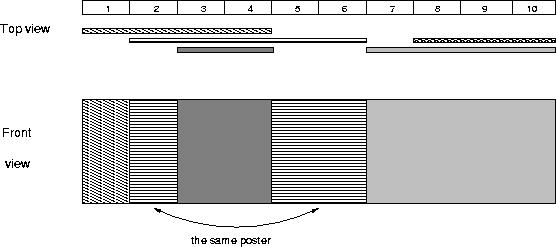
题意:给出一些海报,后贴的会把先贴的覆盖,问最多能看到多少张海报。
题解:
线段切割
学习了一个线段切割
其实很简单的。
具体看 IOI2004年薛矛的论文《剖析线段树与矩形切割》。
概括起来就是前面的线段不会影响后面的线段,所以从后面往前面推。对于每个线段,我们只考虑后面的线段对它的影响,影响有五类(论文第26页中有),我们可以将其简化为三类 :
不相交:
1.两个线段不相交。
相交:
2.前一个线段的左端点小于后一个线段的左端点(包括了 前一个线段覆盖了后一个线段的前半部分 和 前一个线段覆盖了后一个线段)
3.前一个线段的右端点大于后一个线段的右端点(包括了 前一个线段覆盖了后一个线段的后半部分 和 前一个线段覆盖了后一个线段)
具体看程序:
 #include<bits/stdc++.h>

 using namespace std;

 int N,x[],y[],ans[];

 int read()

 {

     int s=,fh=;char ch=getchar();

     while(ch<''||ch>''){if(ch=='-')fh=-;ch=getchar();}

     while(ch>=''&&ch<=''){s=s*+(ch-'');ch=getchar();}

     return s*fh;

 }

 void Cover(int l,int r,int k,int k1)

 {

     while(k<=N&&(r<x[k]||l>y[k]))k++;

     if(k>=N+){ans[k1]+=(r-l+);return;}

     if(l<x[k])Cover(l,x[k]-,k+,k1);

     if(r>y[k])Cover(y[k]+,r,k+,k1);

 }

 int main()

 {

     int T,i,tot;

     T=read();

     while(T--)

     {

         N=read();

         for(i=;i<=N;i++){x[i]=read();y[i]=read();}

         memset(ans,,sizeof(ans));

         for(i=N;i>=;i--)Cover(x[i],y[i],i+,i);

         tot=;

         for(i=;i<=N;i++)if(ans[i]>)tot++;

         printf("%d\n",tot);

     }

     fclose(stdin);

     fclose(stdout);

     return ;

 }
Poj 2528-Mayor's posters 线段切割的更多相关文章
- POJ.2528 Mayor's posters (线段树 区间更新 区间查询 离散化)
POJ.2528 Mayor's posters (线段树 区间更新 区间查询 离散化) 题意分析 贴海报,新的海报能覆盖在旧的海报上面,最后贴完了,求问能看见几张海报. 最多有10000张海报,海报 ...
- poj 2528 Mayor's posters 线段树+离散化技巧
poj 2528 Mayor's posters 题目链接: http://poj.org/problem?id=2528 思路: 线段树+离散化技巧(这里的离散化需要注意一下啊,题目数据弱看不出来) ...
- poj 2528 Mayor's posters 线段树区间更新
Mayor's posters Time Limit: 1 Sec Memory Limit: 256 MB 题目连接 http://poj.org/problem?id=2528 Descript ...
- POJ 2528 Mayor's posters(线段树+离散化)
Mayor's posters 转载自:http://blog.csdn.net/winddreams/article/details/38443761 [题目链接]Mayor's posters [ ...
- poj 2528 Mayor's posters 线段树+离散化 || hihocode #1079 离散化
Mayor's posters Description The citizens of Bytetown, AB, could not stand that the candidates in the ...
- POJ 2528 Mayor's posters (线段树+离散化)
Mayor's posters Time Limit: 1000MS Memory Limit: 65536K Total Submissions:75394 Accepted: 21747 ...
- POJ 2528 Mayor's posters(线段树,区间覆盖,单点查询)
Mayor's posters Time Limit: 1000MS Memory Limit: 65536K Total Submissions: 45703 Accepted: 13239 ...
- POJ 2528 Mayor's posters (线段树)
题目链接:http://poj.org/problem?id=2528 题目大意:有一个很上的面板, 往上面贴海报, 问最后最多有多少个海报没有被完全覆盖 解题思路:将贴海报倒着想, 对于每一张海报只 ...
- poj 2528 Mayor's posters(线段树)
题目:http://poj.org/problem?id=2528 题意:有一面墙,被等分为1QW份,一份的宽度为一个单位宽度.现在往墙上贴N张海报,每张海报的宽度是任意的, 但是必定是单位宽度的整数 ...
- POJ 2528 Mayor's posters (线段树区间更新+离散化)
题目链接:http://poj.org/problem?id=2528 给你n块木板,每块木板有起始和终点,按顺序放置,问最终能看到几块木板. 很明显的线段树区间更新问题,每次放置木板就更新区间里的值 ...
随机推荐
- CentOS7修改网卡为eth0
CentOS7修改网卡为eth0 1.编辑网卡信息 [root@linux-node2~]# cd /etc/sysconfig/network-scripts/ #进入网卡目录 [root@lin ...
- mysql 查找包含特定名字的表
SELECT distinct TABLE_NAME FROM INFORMATION_SCHEMA.COLUMNS WHERE TABLE_NAME LIKE '%medias%'
- Libnids---编写网络应用程序的利器
一.前言 Libnids是一个用于网络入侵检测开发的专业编程接口,它使用Libpcap进行数据包的捕获.同时,Libnids提供了TCP/IP数据流重组功能,因此省去了应用层自己考虑数据分片.重传等情 ...
- 接口Interface
接口的定义 声明接口的方式与声明类的方式相似,但使用的关键字是interface,而不是class interface IMyInterface { // 接口成员 } 访问修饰符关键字public ...
- gentoo下的wpa_supplicant无线网配置
在linux使用wpa_supplicant获得无线网的最痛苦的是莫过于去配置wpa_supplicant.conf文件了(当然对于linux老手这不算什么), 但是可以用一种简便的方法直接输入命令行 ...
- 已经安装php后,再增加扩展模块(不重新编辑php)
下面以安装curl为例,介绍具体安装步骤. 1.安装crul wget http://curl.haxx.se/download/curl-7.19.6.tar.gz tar -zxvf curl-7 ...
- 关于mac上的homebrew
首先它的安装指令并不难: /usr/bin/ruby -e "$(curl -fsSL https://raw.githubusercontent.com/Homebrew/install/ ...
- 自己编写的sublime text 3 插件
一些小功能,比较杂. 具体的功能在这里查看 1.本地环境的php运行结果获取. 2.快捷打开常用的文件,文件夹,url.(ctrl+shift+a) 3.常用的缩进转换. 下边是网络爬虫代码. #py ...
- win7系统cocos2dx 3.4 绑定自定义类到Lua
Cocos2d-x 3.0开始使用bindings-generator来生成c++类的lua绑定.bindings-generator基于tolua++,通过配置tools/tolua中的ini文件以 ...
- java版 正文抽取 基于文字连接比
package cn.tdt.crawl.jdbc; import java.util.regex.Matcher; import java.util.regex.Pattern; import or ...