
LCT[Link-Cut-Tree学习笔记]
部分摘抄于
FlashHu
candy99
所以文章篇幅较长 请有足够的耐心(不是
其实不用学好splay再学LCT的…/kk (至少现在我平衡树靠fhq)
也许我菜吧…LCT靠背板子 pushup靠理解…没救了/kk
简单讲讲LCT
至于树链剖分 建议在LCT之前学(?
反正我blog里也有
一【理论知识】
-Link-Cut-Tree(简称LCT)是解决动态树类问题一种数据结构
-Preferred Child:重儿子,重儿子与父亲节点在同一棵Splay中,一个节点最多只能有一个重儿子
-Preferred Edge:重边,连接父亲节点和重儿子的边
-Preferred Path :重链,由重边及重边连接的节点构成的链
-Auxiliary Tree(辅助树)
由一条重链上的所有节点所构成的Splay称作这条链的辅助树
每个点的键值为这个点的深度,即这棵Splay的中序遍历是这条链从链顶到链底的所有节点构成的序列
辅助树的根节点的父亲指向链顶的父亲节点,然而链顶的父亲节点的儿子并不指向辅助树的根节点
(也就是说父亲不认轻儿子只认重儿子,儿子都认父亲)
这条性质为后来的操作提供了依据
原树与辅助树的关系
原树中的重链 -> 辅助树中两个节点位于同一棵Splay中
原树中的轻链 -> 辅助树中子节点所在Splay的根节点的father指向父节点
注意原树与辅助树的结构并不相同
辅助树的根节点≠原树的根节点
辅助树中的father≠原树中的father
辅助树是不断变化的,重链和轻链不断变化
二【实现】
LCT用到的Splay和通常的还是有点不同,没有权值v,不进行查找操作,点编号就是原树的编号
因为是一个Splay森林,多条重链多个根,所以用isRoot(x)判断是否为根,判断isRoot(x)相当于判断x的父亲存不存在
-rotate只是设置g的儿子时判断isRoot(f)就行了
-splay需要pushDown了(因为没有kth了),也是判断isRoot(pa)
-Access和Cut更新了儿子关系,所以需要update
-Access 将一个点与原先的重儿子切断,并使这个原树上点到根路径上的边全都变为重边
所以 这个节点到根的路径上的所有节点形成了一棵Splay
便于操作或查询节点到根路径上的所有节点
实现:不断把x splay到当前Atree的根,然后它的右子树就是重儿子了,修改;用y辅助 注意:Access后x不一定为这颗Splay的根,因为中途x变fa了 维护了节点信息别忘更新
MakeRoot 将x设为原树的根实现:Access后splay到根,然后全在x的左子树上(权值是深度),区间翻转即可
FindRoot 找x所在原树根,判连通性 实现:MakeRoot后不断往左找(不需要pushDown?加上也可以啊。不加也对因为只是来判连通,判断是不是在一棵原树上,都不pushDown找到的还是同一个点吧)
Link 实现:MakeRoot(x)然后t[x].fa=y
Cut 实现:MakeRoot(x)然后Access(y) splay(y) ,x就在y的左儿子了,t[y].ch[0]=t[x].fa=0;
维护了节点信息别忘更新
对x到y路径上的点进行修改或查询
只需要对x进行Move_To_Root操作,然后对y进行Access+Splay操作,那么x到y路径上的所有点都在以y为根的子树上
因为Access后x和y重链在一棵Splay上,x深度比y小
====================================================================== 以上是 candy99 巨佬的总结内容(?
像树剖一样……将某一个儿子的连边划分为实边,而连向其他子树的边划分为虚边。
区别在于虚实是可以动态变化的,因此要使用更高级、更灵活的Splay来维护每一条由若干实边连接而成的实链。
基于性质更加优秀的实链剖分,LCT(Link-Cut Tree)应运而生。
LCT维护的对象其实是一个森林。
在实链剖分的基础下,LCT资磁更多的操作
- 查询、修改链上的信息(最值,总和等)
- 随意指定原树的根(即换根)
- 动态连边、删边
- 合并两棵树、分离一棵树(跟上面不是一毛一样吗)
- 动态维护连通性(代替并查集)
边分为实边和虚边,实边包含在Splay中,而虚边总是由一棵Splay指向另一个节点(指向该Splay中中序遍历最靠前的点在原树中的父亲)。
因为性质2,当某点在原树中有多个儿子时,只能向其中一个儿子拉一条实链(只认一个儿子),而其它儿子是不能在这个Splay中的。
那么为了保持树的形状,我们要让到其它儿子的边变为虚边,由对应儿子所属的Splay的根节点的父亲指向该点,而从该点并不能直接访问该儿子(认父不认子)。
接着往下看…
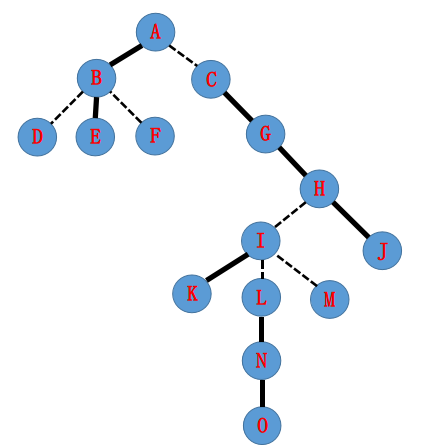
有一棵树,假设一开始实边和虚边是这样划分的(虚线为虚边)
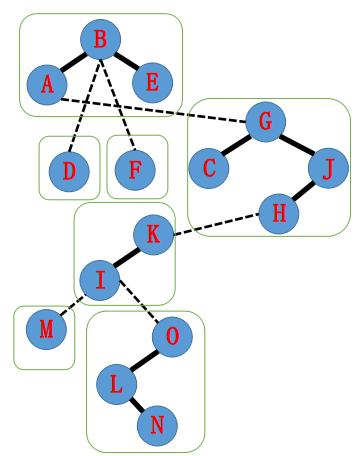
那么所构成的LCT可能会长这样(绿框中为一个Splay,可能不会长这样,但只要满足中序遍历按深度递增(性质1)就对结果无影响)
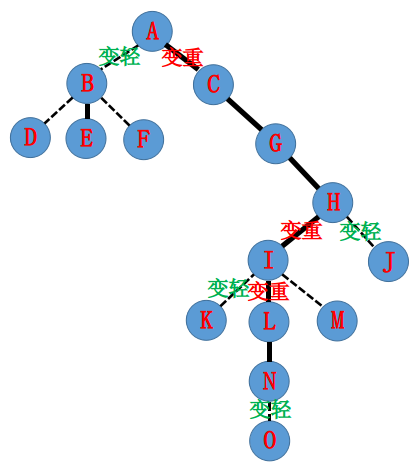
现在我们要access(N),把A−N的路径拉起来变成一条Splay。
因为性质2,该路径上其它链都要给这条链让路,也就是把每个点到该路径以外的实边变虚。
所以我们希望虚实边重新划分成这样。
然后怎么实现呢?
我们要一步步往上拉。
首先把splay(N),使之成为当前Splay中的根。
为了满足性质2,原来N−O的重边要变轻。
因为按深度O在N的下面,在Splay中O在N的右子树中,所以直接单方面将N的右儿子置为0(认父不认子)
然后就变成了这样——

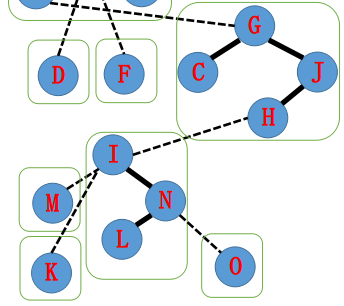
我们接着把N所属Splay的虚边指向的I(在原树上是L的父亲)也转到它所属Splay的根,splay(I)。
原来在I下方的重边I−K要变轻(同样是将右儿子去掉)。
这时候I−L就可以变重了。因为L肯定是在I下方的(刚才L所属Splay指向了I),所以I的右儿子置为N,满足性质1。
然后就变成了这样——
I指向H,接着splay(H),H的右儿子置为I。
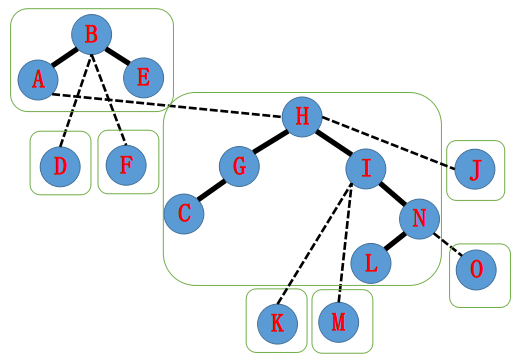
H指向A,接着splay(A),A的右儿子置为H。
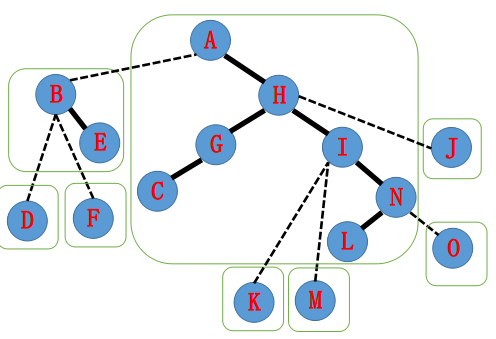
A−N的路径已经在一个Splay中了,大功告成!
代码其实很简单。循环处理,只有四步——
转到根;
换儿子;
更新信息;
当前操作点切换为轻边所指的父亲,转1
inline void access(int x) { for(int tp = 0 ; x ; x = fa[tp = x]) splay(x) , rs(x) = tp , pushup(x) ; }
只是把根到某个节点的路径拉起来并不能满足我们的需要。更多时候,我们要获取指定两个节点之间的路径信息。
然而一定会出现路径不能满足按深度严格递增的要求的情况。根据性质1,这样的路径不能在一个Splay中。
Then what can we do?
makeroot定义为换根,让指定点成为原树的根。
这时候就利用到access(x)和Splay的翻转操作。
access(x)后x在Splay中一定是深度最大的点对吧。
splay(x)后,x在Splay中将没有右子树(性质1)。于是翻转整个Splay,使得所有点的深度都倒过来了,x没了左子树,反倒成了深度最小的点(根节点),达到了我们的目的。
代码
inline void makeroot(int x) { access(x) ; splay(x) ; pushr(x) ; }
findroot(x)
找x所在原树的树根,主要用来判断两点之间的连通性(findroot(x)==findroot(y)表明x,y在同一棵树中)
inline int findroot(int x) { access(x) ; splay(x) ; while(ls(x)) { pushdown(x) ; x = ls(x) ; splay(x) ; } return x ; }
同样利用性质1,不停找左儿子,因为其深度一定比当前点深度小。
split(x,y)
神奇的makeroot已经出现,我们终于可以访问指定的一条在原树中的链啦!
split(x,y)定义为拉出x−y的路径成为一个Splay(本蒟蒻以y作为该Splay的根)
inline void split(int x , int y) { makeroot(x) ; access(y) ; splay(y) ; }
Link 和 Cut 就是字面意思 连边建边 具体写法
  inline void cut(int x , int y) { makeroot(x) ; if(findroot(y) == x && fa[y] == x && ! ls(y)) fa[y] = ls(x) = 0 , pushup(x) ; }

  inline void link(int x , int y) { makeroot(x) ; if(findroot(y) != x) fa[x] = y ; }
下面给板子和题目(?
#include<bits/stdc++.h>

using namespace std ;

const int N = 1e5 + 10 ;

int n , m , val[N] ;

inline int read() {

	register int x = 0 , f = 1 ;

	register char c = getchar() ;

	for( ; ! isdigit(c) ; c = getchar()) if(c == '-') f = -1 ;

	for( ; isdigit(c) ; c = getchar()) x = (x << 1) + (x << 3) + (c & 15) ;

	return x * f ;

}

class LCT {

public:

  int ch[N][2] , fa[N] , sum[N] , rev[N] ;

#define ls(x) ch[x][0]

#define rs(x) ch[x][1]

  inline bool isroot(int x) { return ls(fa[x]) != x && rs(fa[x]) != x ; }

  inline bool getr(int x) { return rs(fa[x]) == x ; }

  inline void pushup(int x) { sum[x] = sum[ls(x)] ^ sum[rs(x)] ^ val[x] ; }

  inline void pushr(int x) { rev[x] ^= 1 ; swap(ls(x) , rs(x)) ; }

  inline void pushdown(int x) { if(rev[x]) { if(ls(x)) pushr(ls(x)) ; if(rs(x)) pushr(rs(x)) ; rev[x] ^= 1 ; } }

  inline void rotate(int x) {

    int y = fa[x] , z = fa[y] , k = getr(x) , w = ch[x][k ^ 1] ; if(! isroot(y)) ch[z][getr(y)] = x ;

    fa[fa[fa[ch[ch[x][k ^ 1] = y][k] = w] = y] = x] = z ; pushup(y) ; pushup(x) ;

  }

  inline void pushall(int x) { if(! isroot(x)) pushall(fa[x]) ; pushdown(x) ; }

  inline void splay(int x) {

    pushall(x) ; while(! isroot(x)) { int y = fa[x] ; if(! isroot(y)) rotate(getr(x) ^ getr(y) ? x : y) ; rotate(x) ; }

  }

  inline void access(int x) { for(int tp = 0 ; x ; x = fa[tp = x]) splay(x) , rs(x) = tp , pushup(x) ; }

  inline void makeroot(int x) { access(x) ; splay(x) ; pushr(x) ; }

  inline void split(int x , int y) { makeroot(x) ; access(y) ; splay(y) ; }

  inline int findroot(int x) { access(x) ; splay(x) ; while(ls(x)) { pushdown(x) ; x = ls(x) ; splay(x) ; } return x ; }

  inline void cut(int x , int y) { makeroot(x) ; if(findroot(y) == x && fa[y] == x && ! ls(y)) fa[y] = ls(x) = 0 , pushup(x) ; }

  inline void link(int x , int y) { makeroot(x) ; if(findroot(y) != x) fa[x] = y ; }

  inline void change(int x , int y) { splay(x) ; val[x] = y ; }

  inline int query(int x , int y) { return split(x , y) , sum[y] ; }

} lct ;

signed main() {

  n = read() ; m = read() ;

  for(register int i = 1 ; i <= n ; i ++) cin >> val[i] ;

  for(register int i = 1 ; i <= m ; i ++) {

    int opt = read() ;

    if(opt == 0) { int x = read() , y = read() ; printf("%d\n" , lct.query(x , y)) ; }

    if(opt == 1) { int x = read() , y = read() ; lct.link(x , y) ; }

    if(opt == 2) { int x = read() , y = read() ; lct.cut(x , y) ; }

    if(opt == 3) { int x = read() , y = read() ; lct.change(x , y) ; }

  }

  return 0 ;

}
[国家集训队]Tree II
带修的LCT 就直接像线段树一样放标记然后搞一下更新就可以了
#pragma GCC optimize("Ofast")

#include <bits/stdc++.h>

using uint = unsigned int ;

using namespace std ;

const int N = 1e5 + 5 ;

const int Mod = 51061 ;

uint n , q , fa[N] , ch[N][2] , val[N] , sum[N] , sz[N] , mul[N] , add[N] ;

bool rev[N] ;

#define ls(x) ch[x][0]

#define rs(x) ch[x][1]

inline void Add(uint & x , uint y) { x += y ; x %= Mod ; }

inline void Mul(uint & x , uint y) { x *= y ; x %= Mod ; }

inline bool isroot(uint x) { return (ls(fa[x]) != x) && (rs(fa[x]) != x) ; }

inline void pushup(uint x) { sum[x] = (sum[ls(x)] + sum[rs(x)] + val[x]) ; sum[x] %= Mod ; sz[x] = (sz[ls(x)] + sz[rs(x)] + 1) ; }

inline void pushr(uint x) { swap(ls(x) , rs(x)) ; rev[x] ^= 1 ; }

inline void pushm(uint x , uint v) { Mul(sum[x] , v) ; Mul(val[x] , v) ; Mul(mul[x] , v) ; Mul(add[x] , v) ; }

inline void pusha(uint x , uint v) { Add(sum[x] , v * sz[x]) ; Add(val[x] , v) ; Add(add[x] , v) ; }

inline void pushdown(uint x) {

  if(mul[x] != 1) { pushm(ls(x) , mul[x]) ; pushm(rs(x) , mul[x]) ; mul[x] = 1 ; }

  if(add[x]) { pusha(ls(x) , add[x]) ; pusha(rs(x) , add[x]) ; add[x] = 0 ; }

  if(rev[x]) { if(ls(x)) pushr(ls(x)) ; if(rs(x)) pushr(rs(x)) ; rev[x] = 0 ; }

}

inline bool getr(uint x) { return rs(fa[x]) == x ; }

inline void rotate(uint x) { uint y = fa[x] , z = fa[y] , k = getr(x) , w = ch[x][k ^ 1] ;

  if(! isroot(y)) ch[z][getr(y)] = x ;

  ch[x][k ^ 1] = y ; ch[y][k] = w ;

  if(w) fa[w] = y ; fa[y] = x ; fa[x] = z ;

  pushup(y) ;

}

inline void pushall(uint x) { if(! isroot(x)) pushall(fa[x]) ; pushdown(x) ; }

inline void splay(uint x) { pushall(x) ;

  while(! isroot(x)) { uint y = fa[x] ;

    if(! isroot(y)) { rotate(getr(y) ^ getr(x) ? x : y) ; }

    rotate(x) ;

  } pushup(x) ;

}

inline void access(uint x) { for(uint tp = 0 ; x ; tp = x , x = fa[tp]) splay(x) , rs(x) = tp , pushup(x) ; }

inline void makeroot(uint x) { access(x) ; splay(x) ; pushr(x) ; }

inline void split(uint x , uint y) { makeroot(x) ; access(y) ; splay(y) ; }

inline void link(uint x , uint y) { makeroot(x) ; fa[x] = y ; }

inline void cut(uint x , uint y) { split(x , y) ; fa[x] = ls(y) = 0 ; }

signed main() {

  ios :: sync_with_stdio(false) ;

  cin.tie(nullptr) ;

  cout.tie(nullptr) ;

  cin >> n >> q ;

  for(register int i = 1 ; i <= n ; i ++) val[i] = mul[i] = 1 ;

  for(register int i = 1 ; i <= n - 1 ; i ++) { uint u , v ; cin >> u >> v ; link(u , v) ; }

  for(register int i = 1 ; i <= q ; i ++) {

    char c ; cin >> c ;

    if(c == '+') { uint u , v , w ; cin >> u >> v >> w ; split(u , v) ; pusha(v , w) ; }

    if(c == '-') { uint u , v , u2 , v2 ; cin >> u >> v >> u2 >> v2 ; cut(u , v) ; link(u2 , v2) ; }

    if(c == '*') { uint u , v , w ; cin >> u >> v >> w ; split(u , v) ; pushm(v , w) ; }

    if(c == '/') { uint u , v ; cin >> u >> v ;  split(u , v) ; cout << sum[v] << '\n' ; }

  }

  return 0 ;

}
板子…不说了
#include<bits/stdc++.h>

using namespace std ;

#define csp rp++

inline int read() { register int x = 0 , f = 1 ; register char c = getchar() ;

  for( ; ! isdigit(c) ; c = getchar()) if(c == '-') f = -1 ;

  for( ; isdigit(c) ; c = getchar()) x = (x << 1) + (x << 3) + (c & 15) ;

  return x * f ;

}

int n ;

const int N = 1e5 + 10 ;

int val[N] ;

int ch[N][2] ; int fa[N] ; int sum[N] ; bool rev[N] ;

#define ls(x) ch[x][0]

#define rs(x) ch[x][1]

inline bool isroot(int x) { return ls(fa[x]) != x && rs(fa[x]) != x ; }

inline bool getr(int x) { return rs(fa[x]) == x ; }

inline void pushup(int x) { sum[x] = sum[ls(x)] + sum[rs(x)] + val[x] ; }

inline void pushr(int x) {

  if(! rev[x]) return ;

  swap(ls(x) , rs(x)) ;

  rev[ls(x)] ^= 1 ; rev[rs(x)] ^= 1 ; rev[x] = 0 ;

}

inline void rotate(int x) {

  int y = fa[x] , z = fa[y] ;

  int k = getr(x) , w = ch[x][k ^ 1] ;

  ch[y][k] = w ; fa[w] = y ;

  if(! isroot(y)) ch[z][getr(y)] = x ;

  fa[x] = z ; ch[x][k ^ 1] = y ; fa[y] = x ;

  pushup(x) ; pushup(y) ;

}

inline void pushall(int x) { if(! isroot(x)) pushall(fa[x]) ; pushr(x) ; }

inline void splay(int x) {

  pushall(x) ;

  while(! isroot(x)) {

    int y = fa[x] , z = fa[y] ;

    if(! isroot(y)) rotate((ls(fa[x]) == x) ^ (ls(fa[y]) == y) ? x : y) ;

    rotate(x) ;

  } pushup(x) ;

}

inline void access(int x) { for( int tp = 0 ; x ; x = fa[tp = x]) splay(x) , rs(x) = tp , pushr(x) ; }

inline void makeroot(int x) { access(x) ; splay(x) ; rev[x] ^= 1 ; }

inline void split(int x , int y) { makeroot(x) ; access(y) ; splay(y) ; }

inline int findroot(int x) { access(x) ; splay(x) ; while(ls(x)) pushr(x) , x = ls(x) ; return x ; }

inline bool chk(int x , int y) { return findroot(x) == findroot(y) ; }

inline void link(int x , int y) { makeroot(x) ; fa[x] = y ; }

signed main() {

  n = read() ;

  for(register int i = 1 ; i <= n ; i ++) val[i] = read() ;

  for(register int t = read() ; t -- ; ) {

    char op[20] ; scanf("%s" , op + 1) ;

    int x = read() , y = read() ;

    if(op[1] == 'p') splay(x) , val[x] = y ;

    if(op[1] == 'b') { if(chk(x , y)) puts("no") ;

      else puts("yes") , link(x , y) ;

    }

    if(op[1] == 'e') {

      if(! chk(x , y)) puts("impossible") ;

      else split(x , y) , printf("%d\n" , sum[y]) ;

    }

  }

  return 0 ;

}
#include<bits/stdc++.h>

using namespace std ;

#define int long long

#define fi first

#define se second

#define pb push_back

inline int read() {

	register int x = 0 , f = 1 ;

	register char c = getchar() ;

	for( ; ! isdigit(c) ; c = getchar()) if(c == '-') f = -1 ;

	for( ; isdigit(c) ; c = getchar()) x = (x << 1) + (x << 3) + (c & 15) ;

	return x * f ;

}

template < typename T > inline bool cmax(T & x , T y) {

	return x < y ? (x = y) , 1 : 0 ;

}

template < typename T > inline bool cmin(T & x , T y) {

	return x > y ? (x = y) , 1 : 0 ;

}

template < typename T > inline bool cabs(T & x) {

	return x > 0 ? 1 : (x = - x) , 0 ;

}

inline int QP(int x , int y , int Mod) {

	int ans = 1 ;

	for( ; y ; y >>= 1 , x = (x * x) % Mod)

		if(y & 1) ans = (ans * x) % Mod ;

	return ans ;

}

int n , m ;

const static int N = 3e5 + 10 ;

int val[N] ;

class LCT {

public :

	int ch[N][2] ;  int fa[N] , sum[N] , rev[N] ;

	#define ls(x) ch[x][0]

	#define rs(x) ch[x][1]

	inline void push_up(int x) { sum[x] = sum[ls(x)] ^ sum[rs(x)] ^ val[x] ; }

	inline void rever(int x) { swap(ls(x) , rs(x)) ; rev[x] ^= 1 ; }

	inline void push_down(int x) { if(rev[x]) {if(ls(x)) rever(ls(x)) ; if(rs(x)) rever(rs(x)) ; rev[x] = 0 ; } }

	inline bool isroot(int x) { return ls(fa[x]) != x && rs(fa[x]) != x ; }

	inline void rotate(int x) {

		int fx = fa[x] , fy = fa[fx] , rs = (x == rs(fa[x])) , mus = ch[x][! rs] ;

		if(! isroot(fx)) ch[fy][fx == rs(fy)] = x ;

		ch[x][! rs] = fx ; ch[fx][rs] = mus ;

		if(mus) fa[mus] = fx ; fa[x] = fy  , fa[fx] = x ;

		push_up(fx) , push_up(x) ;

	}

	inline void pushall(int x) { if(! isroot(x)) pushall(fa[x]) ; push_down(x) ; }

	inline void splay(int x) {

		pushall(x) ;

		while(! isroot(x)) {

			int fx = fa[x] , fy = fa[fx] ;

			if(! isroot(fx)) rotate(((ls(fx) == x) ^ (ls(fy) == fx)) ? x : fx) ;

			rotate(x) ;

		}

	}

	inline void access(int x) { for(int tp = 0 ; x ; tp = x , x = fa[tp]) splay(x) , rs(x) = tp , push_up(x) ;}

	inline void make_root(int x) { access(x) ; splay(x) ; rever(x) ; }

	inline int find_root(int x){ access(x) ; splay(x) ; while(ls(x)) push_down(x) , x = ls(x) ; splay(x) ; return x ; }

	inline void split(int x , int y) { make_root(x) ; access(y) ; splay(y) ; }

	inline void cut(int x , int y) { make_root(x) ; if(find_root(y) == x && fa[y] == x && ! ls(y)) fa[y] = rs(x) = 0 , push_up(x) ; }

	inline void link(int x , int y) { make_root(x) ; if(find_root(y) != x) fa[x] = y ; }

} lct ;

inline int getopt() {

	register char c = getchar() ;

	string s = "" ;

	while(isspace(c)) c = getchar() ;

	while(! isspace(c)) s += c , c = getchar() ;

	if(s == "Connect") return 1 ;

	if(s == "Destroy") return 2 ;

	if(s == "Query") return 3 ;

}

signed main() {

	n = read() , m = read() ;

	for(register int i = 1 ; i <= m ; i ++) {

		int opt = getopt() ;

		int u = read() , v = read() ;

		if(opt == 1) lct.link(u , v) ;

		if(opt == 2) lct.cut(u , v) ;

		if(opt == 3) puts(lct.find_root(u) == lct.find_root(v) ? "Yes" : "No") ;

	}

	return 0 ;

}
因为颜色不超过20种所以20个LCT不断删边加边就可以了……边用map存一下
#include<bits/stdc++.h>

using namespace std ;

#define int long long

#define fi first

#define se second

#define pb push_back

inline int read() {

	register int x = 0 , f = 1 ;

	register char c = getchar() ;

	for( ; ! isdigit(c) ; c = getchar()) if(c == '-') f = -1 ;

	for( ; isdigit(c) ; c = getchar()) x = (x << 1) + (x << 3) + (c & 15) ;

	return x * f ;

}

template < typename T > inline bool cmax(T & x , T y) {

	return x < y ? (x = y) , 1 : 0 ;

}

template < typename T > inline bool cmin(T & x , T y) {

	return x > y ? (x = y) , 1 : 0 ;

}

template < typename T > inline bool cabs(T & x) {

	return x > 0 ? 1 : (x = - x) , 0 ;

}

inline int QP(int x , int y , int Mod) {

	int ans = 1 ;

	for( ; y ; y >>= 1 , x = (x * x) % Mod)

		if(y & 1) ans = (ans * x) % Mod ;

	return ans ;

}

int  n , m , c , k ;

const int N = 1e4 + 10 ;

int val[N] ;

class LCT {

	public :

	#define ls(x) ch[x][0]

	#define rs(x) ch[x][1]

	int fa[N] , ch[N][2] , rev[N] , cnt[N] , mx[N] ; int s[N] ; int top ;

	inline bool isroot(int x) { return ls(fa[x]) != x && rs(fa[x]) != x ; }

	inline void pushup(int x){mx[x]=val[x];

		if(ls(x)) cmax(mx[x],mx[ls(x)]);

		if(rs(x)) cmax(mx[x],mx[rs(x)]);

	}

	inline void pushdown(int x){

		if(x&&rev[x]){

			swap(ls(x),rs(x));

			rev[ls(x)]^=1,rev[rs(x)]^=1;

			rev[x]=0;

		}

	}

	inline void rotate(int x){

		int y=fa[x],z=fa[y],d=rs(y)==x;

		if(!isroot(y)) ch[z][rs(z)==y]=x;

		fa[x]=z;fa[y]=x;fa[ch[x][d^1]]=y,ch[y][d]=ch[x][d^1];ch[x][d^1]=y;

		pushup(y);

	}

	// inline void pushall(int x){if(!isroot(x))pushall(fa[x]);pushdown(x);}

	inline void splay(int x){

		// pushall(x);

		s[top=1]=x;

		for(int i=x;!isroot(i);i=fa[i])s[++top]=fa[i];

		while(top)pushdown(s[top--]);

		for(int y=fa[x],z=fa[y];!isroot(x);y=fa[x],z=fa[y]){

			if(!isroot(y))rotate((rs(y)==x)^(rs(z)==y)?x:y);

				rotate(x);

		}pushup(x);

		return ;

	}

	inline void access(int x){

		for(register int y = 0; x ; x = fa[y=x])

			splay(x),rs(x)=y,pushup(x);

		return ;

	}

	inline void makeroot(int x){ access(x);splay(x);rev[x]^=1;}

	inline void split(int x,int y){makeroot(x);access(y);splay(y);}

	inline void link(int x,int y){++ cnt[x] , ++ cnt[y] , makeroot(x),fa[x]=y;splay(x);}

	inline void cut(int x,int y){--cnt[x],--cnt[y],split(x,y),fa[x]=ls(y)=0,pushup(y);}

	inline int findroot(int x){access(x),splay(x),pushdown(x);while(ls(x))pushdown(x=ls(x));return x;}

	inline int query(int x,int y){split(x,y);return mx[y];}

} ;

LCT lct[15] ;

struct node{

	int u,v;

	inline bool operator <(const node & x) const {

		return u < x.u || (u == x.u && v < x.v) ;

	}

} ; map < node , int > mp ;

signed main() {

	n = read() , m = read() , c = read() ,k = read();

	for(register int i = 1 ; i <= n ; i ++) val[i] = read() ;

	for(register int i = 1 ; i <= m ; i ++) {

		int u = read() , v = read() , w = read() ;

		node edge1 = {u,v};

		node edge2 = {v,u};

		mp[edge1]=mp[edge2]=w;

		lct[w].link(u,v);

	}

	while(k -- ) {

		int opt = read() ;

		if(opt == 0) {

			int x = read() , w = read() ;

			val[x] = w ;

			for(register int i = 0 ; i < c ; i ++)

				lct[i].splay(x) ;

		}

		if(opt == 1) {

			int u = read(),v=read(),w = read() ;

			node edge1 = {u , v} ;

			node edge2 = {v , u} ;

			if(! mp.count(edge1)) { puts("No such edge.") ; continue ;}

			int x = mp[edge1] ;

			if(x == w) { puts("Success.") ; continue ;}

			if(lct[w].cnt[u]>=2 || lct[w].cnt[v]>=2) {

				puts("Error 1.") ;

				continue ;

			}

			if(lct[w].findroot(u) == lct[w].findroot(v)){

				puts("Error 2.") ;

				continue ;

			}

			puts("Success.");

			lct[x].cut(u , v) ;

			lct[w].link(u , v);

			mp[edge1]=mp[edge2]=w;

		}

		if(opt == 2){

			int w = read() , u = read() , v = read() ;

			if(lct[w].findroot(u) != lct[w].findroot(v)) {

				puts("-1") ;

				continue ;

			}

			printf("%lld\n" , lct[w].query(u,v)) ;

		}

	}

	return 0 ;

}
[AH2017/HNOI2017]单旋
这题有点烦 不太想讲…
每次单旋只会取maxormin,那么手玩发现,这样树的形态基本不变!
那么我们可以直接把x提上去,这是手动维护Spaly的形态,
我们想怎么统计答案呢?暴力跳显然是会T的,这里实质是查询点到根的距离,
可以考虑使用LCT维护,这样就直接查询点到根的路径长度就可以了
然后直接无脑set维护一下就可以了
// Isaunoya

#include<bits/stdc++.h>

using namespace std ;

#define int long long

#define fi first

#define se second

#define pb push_back

inline int read() {

  register int x = 0 , f = 1 ;

  register char c = getchar() ;

  for( ; ! isdigit(c) ; c = getchar()) if(c == '-') f = -1 ;

  for( ; isdigit(c) ; c = getchar()) x = (x << 1) + (x << 3) + (c & 15) ;

  return x * f ;

}

template < typename T > inline bool cmax(T & x , T y) {

	return x < y ? (x = y) , 1 : 0 ;

}

template < typename T > inline bool cmin(T & x , T y) {

	return x > y ? (x = y) , 1 : 0 ;

}

inline int QP(int x , int y , int Mod){ int ans = 1 ;

  for( ; y ; y >>= 1 , x = (x * x) % Mod)

    if(y & 1) ans = (ans * x) % Mod ;

  return ans ;

}

const int N = 1e6 + 10 ;

int ch[N][2] ;

int tot = 0 ;

int fa[N] , sub[N] , rt = 0 , cnt = 0 ;

bool rev[N] ; int size[N] , f[N] ;

int c[N][2] ;

#define ls(x) ch[x][0]

#define rs(x) ch[x][1]

inline bool isroot(int x) { return ls(fa[x]) != x && rs(fa[x]) != x ; }

inline void pushup(int x) { size[x] = size[ls(x)] + size[rs(x)] + 1 ; }

inline void pushr(int x) { if(! rev[x]) return ; rev[x] ^= 1 ; rev[ls(x)] ^= 1 ; rev[rs(x)] ^= 1 ; swap(ls(x) , rs(x)) ; }

inline void rotate(int x) {

  int y = fa[x] , z = fa[y] ;

  int qwq = rs(y) == x ? 1 : 0 ;

  if(! isroot(y)) ch[z][rs(z) == y] = x ;

  fa[x] = z ; fa[y] = x ; fa[ch[x][qwq ^ 1]] = y ; ch[y][qwq] = ch[x][qwq ^ 1] ;

  ch[x][qwq ^ 1] = y ; pushup(y) ; pushup(x) ;

}

inline void pushall(int x) { if(! isroot(x)) pushall(fa[x]) ; pushr(x) ; }

inline void splay(int x) {

  pushall(x) ;

  while(! isroot(x)) {

    int y = fa[x] , z = fa[y] ;

    if(! isroot(y)) rotate((ls(y) == x) ^ (ls(z) == y) ? x : y) ;

    rotate(x) ;

  }

}

inline void access(int x) {

  for( int tp = 0 ; x ; tp = x , x = fa[x]) splay(x) , rs(x) = tp , pushup(x) ;

}

inline void makeroot(int x) { access(x) ; splay(x) ; rev[x] ^= 1 ; }

inline void link(int x, int y) { if(! x || ! y) return ; makeroot(x) ; fa[x] = y ; }

inline void cut(int x , int y) { if(! x || ! y) return ; makeroot(x) ; access(y) ; splay(y) ; ls(y) = fa[x] = 0 ; pushup(x) ; pushup(y) ;  }

inline int query(int x) { makeroot(rt) ; access(x) ; splay(x) ; return size[x] ; }

set < int > s ;

typedef set <int> :: iterator IT ;

struct node { int flg , kk ; } a[N] ;

signed main() {

  int t = read() ; s.insert(INT_MAX) ; s.insert(INT_MIN) ;

  for( int i = 1 ; i <= t ; i ++ ) {

    a[i].flg = read() ; if(a[i].flg == 1) {

      a[i].kk = read() ;

      sub[++ tot] = a[i].kk ;

    }

  }

  sort(sub + 1 , sub + tot + 1) ;

  tot = unique(sub + 1 , sub + tot + 1) - sub - 1 ;

  for( int i = 1 ; i <= t ; i ++) {

    if(a[i].flg == 1) {

      a[i].kk = lower_bound(sub + 1 , sub + tot + 1 , a[i].kk) - sub ;

      if(! cnt) { ++ cnt ; rt = a[i].kk ; s.insert(rt) ; printf("1\n") ; continue ; }

      else {

        IT it = s.upper_bound(a[i].kk) ;

        int nxt = * it , dep = 0 , x ; -- it ;

        int pre = * it ;

        if(pre != INT_MIN) { int now = query(pre) ; if(now > dep) dep = now , x = pre ; }

        if(nxt != INT_MAX) { int now = query(nxt) ; if(now > dep) dep = now , x = nxt ; }

        printf("%lld\n" , dep + 1) ; c[x][a[i].kk > x] = a[i].kk ; f[a[i].kk] = x ;

        ++ cnt ; link(x , a[i].kk) ; s.insert(a[i].kk) ;

      }

    }

    if(a[i].flg == 2) {

      if(cnt == 1) { puts("1") ; continue ; }

      IT it = s.begin() ; ++ it ; int x = * it , y = c[x][1] , z = f[x] , k = query(x) ;

      if(rt != x) { cut(x , z) ; cut(x , y) ; link(x , rt) , link(z , y) ; f[x] = 0 ; c[x][1] = rt ; f[rt] = x ; rt = x ; c[z][0] = y ; f[y] = z ; }

      printf("%lld\n", k) ;

    }

    if(a[i].flg == 3) {

      if(cnt == 1) { puts("1") ; continue ; }

      IT it = s.end() ; -- it , -- it ; int x = * it , y = c[x][0] , z = f[x] , k = query(x) ;

      if(rt != x) { cut(x , z) ; cut(x , y) ; link(x , rt) ; link(z , y) ; f[x] = 0 ; c[x][0] = rt ; f[rt] = x ; rt = x ; c[z][1] = y ; f[y] = z ; }

      printf("%lld\n" , k) ;

    }

    if(a[i].flg == 4) {

      if(cnt == 1) { -- cnt ; puts("1") ; s.erase(s.find(rt)) ; rt = 0 ;continue ; }

      IT it = s.begin() ; ++ it ; int x = * it , y = c[x][1] , z = f[x] , k = query(x) ;

      cut(x , z) ; cut(x , y) ; link(y , z) ; cnt -- ; s.erase(s.find(x)) ;

      if(x == rt) { rt = y ; }

      c[x][0] = c[x][1] = f[x] = 0 ; c[z][0] = y ; f[y] = z ;

      printf("%lld\n" , k) ;

    }

    if(a[i].flg == 5) {

      if(cnt == 1) { cnt -- ; puts("1") ; s.erase(s.find(rt)) ; rt = 0 ; continue ; }

      IT it = s.end() ; -- it ; -- it ; int x = * it , y = c[x][0] , z = f[x] , k = query(x) ;

      cut(x , z) ; cut(x , y) ; link(y , z) ; cnt -- ; s.erase(s.find(x)) ;

      printf("%lld\n" , k) ;

      if(x == rt) { rt = y ; }

      c[x][0] = c[x][1] = f[x] = 0 ; c[z][1] = y ; f[y] = z ;

    }

  }

	return 0 ;

}
题意大概是这样,有m条无向边按输入顺序标号,如果一段区间\([l,r]\)上的无向边包含环就称区间\([l,r]\)是“加强区间”,求每条边分别在多少个“加强区间”内。
#include<bits/stdc++.h>

typedef long long LL ;

#define int long long

using namespace std ;

template < typename T > inline void read(T & x) { x = 0 ; int f = 1 ;

  register char c = getchar() ;

  while(! isdigit(c)) {

    if(c == '-') f = -1 ;

    c = getchar() ;

  }

  while(isdigit(c)) { x = (x << 1) + (x << 3) + (c & 15) ; c = getchar() ; }

  x *= f ; return ;

}

const int N = 4e5 + 10 ;

struct Edge { int u , v ; } e[N] ;

template < > inline void read < Edge > (Edge & x) {

  read(x.u) ; read(x.v) ; return void() ;

}

template < typename T > inline void print(T x) {

  if(x == 0) return putchar('0') , void() ;

  static int st[105] ;

  if(x < 0) putchar('-') , x = -x ;

  int tp = 0 ;

  while(x) st[++ tp] = x % 10 , x /= 10 ;

  while(tp) putchar(st[tp --] + '0') ;

  return ;

}

template < typename T > inline void sort(vector < T > & v) { sort(v.begin() , v.end()) ; }

template < typename T > inline void unique(vector < T > & v) { v.erase(unique(v.begin() , v.end()) , v.end()) ; }

inline int getdigit() {

  register char c = getchar() ;

  while(! isdigit(c)) c = getchar() ;

  return c - '0' ;

}

inline char getc() {

  register char c = getchar() ;

  while(! (c >= 'A' && c <= 'Z')) c = getchar() ;

  return c ;

}

inline int gcd(int x , int y) { return y == 0 ? x : gcd(y , x % y) ; }

const static LL Mod = LLONG_MAX ;

template < typename T , typename TT > inline void Add(T & x , TT y , T Mod = Mod) { x += y ; if(x >= Mod) x -= Mod ; }

template < typename T , typename TT > inline void Del(T & x , TT y , T Mod = Mod) { x -= y ; if(x < 0) x += Mod ; }

int n , m ;

int del[N] , del2[N] ;

template < typename T >

class LCT {

  public :

  int ch[N][2] , fa[N] ;

  int rev[N] , sum[N] ;

#define ls(x) ch[x][0]

#define rs(x) ch[x][1]

  inline bool isroot(int x) { return ls(fa[x]) != x && rs(fa[x]) != x ; }

  inline bool getr(int x) { return rs(fa[x]) == x ; }

  inline void pushup(int x) { return void() ; }

  inline void rever(int x) { rev[x] ^= 1 ; swap(ls(x) , rs(x)) ; }

  inline void pushr(int x) {

    if(! rev[x]) return ;

    rev[x] ^= 1 ;

    if(ls(x)) rever(ls(x)) ;

    if(rs(x)) rever(rs(x)) ;

    return void() ;

  }

  inline void rotate(int x) {

    int y = fa[x] , z = fa[y] ; int k = getr(x) ;

    if(! isroot(y)) ch[z][getr(y)] = x ;

    fa[x] = z ;

    ch[y][k] = ch[x][k ^ 1] ;

    fa[ch[y][k]] = y ;

    ch[x][k ^ 1] = y ;

    fa[y] = x ;

    // pushup(y) ; pushup(x) ;

    return void() ;

  }

  inline void pushall(int x) { if(! isroot(x)) pushall(fa[x]) ; return pushr(x) , void() ; }

  inline void splay(int x) {

    pushall(x) ;

    while(! isroot(x)) {

      int y = fa[x] , z = fa[y] ;

      if(! isroot(y)) rotate((getr(x) ^ getr(y)) ? x : y) ;

      rotate(x) ;

    }

    return void() ;

  }

  inline void acess(int x) { for( int tp = 0 ; x ; x = fa[tp = x]) splay(x) , rs(x) = tp ; return void() ; }

  inline void makeroot(int x) { acess(x) ; splay(x) ; rever(x) ; }

  inline int findroot(int x) { acess(x) ; splay(x) ; while(ls(x)) pushr(x) , x = ls(x) ; splay(x) ; return x ; }

  inline void link(int x , int y) { makeroot(x) ; fa[x] = y ; }

  inline void cut(int x , int y) {makeroot(x) ; acess(y) ; splay(y) ; if((ls(y) != x) && (! rs(ls(y)))) return void() ; fa[x] = ls(y) = 0 ; }

  // inline void query(int x , int y) { makeroot(x) ; acess(y) ; splay(y) ; return void() ; }

} ;

LCT < int > t ;

inline void solve(int l , int r , int _h , int _t) {

  if(l > r) return void() ;

  del[l ++] += _h ;

  del[++ r] -= _h ;

  del2[l] += _t ;

  del2[r] -= _t ;

  return void() ;

}

signed main() {

  // freopen("testdata.in" , "r" , stdin) ;

  read(m) ;

  for(register int i = 1 ; i <= m ; i ++) read(e[i]) ;

  int r = 1 ;

  for(register int l = 1 ; l <= m ; l ++) {

    while(r <= m) {

      int u = e[r].u , v = e[r].v ;

      if(t.findroot(u) == t.findroot(v)) { solve(l , r , m - r + 1 , 0) ; solve(r + 1 , m , m - r , - 1) ; break ; }

      else { t.link(u , v) ; } ++ r ;

    }

    t.cut(e[l].u , e[l].v) ;

  }

  int x = 0 , y = 0 ;

  for(register int i = 1 ; i <= m ; i ++) {

    x += del[i] , y += del2[i] , x += y ;

    print(x) , putchar(32) ;

  }

  return 0 ;

}
LCT 可以维护动态MST(动态最小生成树)
指最小生成树 思路大概是
如果不连通直接加 link一下的…
如果连通split提上去 然后判断大小关系来删边断边 如果满足最优性 则不变…
#include<bits/stdc++.h>

using namespace std ;

#define int long long

#define fi first

#define se second

#define pb push_back

inline int read() {

	register int x = 0 , f = 1 ;

	register char c = getchar() ;

	for( ; ! isdigit(c) ; c = getchar()) if(c == '-') f = -1 ;

	for( ; isdigit(c) ; c = getchar()) x = (x << 1) + (x << 3) + (c & 15) ;

	return x * f ;

}

template < typename T > inline bool cmax(T & x , T y) {

	return x < y ? (x = y) , 1 : 0 ;

}

template < typename T > inline bool cmin(T & x , T y) {

	return x > y ? (x = y) , 1 : 0 ;

}

template < typename T > inline bool cabs(T & x) {

	return x > 0 ? 1 : (x = - x) , 0 ;

}

inline int QP(int x , int y , int Mod) {

	int ans = 1 ;

	for( ; y ; y >>= 1 , x = (x * x) % Mod)

		if(y & 1) ans = (ans * x) % Mod ;

	return ans ;

}

int n , m  ;

const int N = 1e5 + 10 ;

struct node {

  int u , v , w , w2 ;

  inline bool operator <(const node & x ) const {

    return w < x.w ;

  }

} e[N] ;

int l[N] , r[N] ;

int f[N] ;

int idx ;

inline int find(int x) { return x == f[x] ? x : f[x] = find(f[x]) ;}

inline void merge(int x , int y) { return f[find(x)] = find(y) , void() ;}

class LCT {

public :

  int fa[N] , ch[N][2] , tag[N] ;

  int w[N] , id[N] ;

#define ls(x) ch[x][0]

#define rs(x) ch[x][1]

  inline bool getr(int x) { return rs(fa[x]) == x ; }

  inline bool isroot(int x) { return ls(fa[x]) != x && rs(fa[x]) != x ; }

  inline void pushr(int x) { tag[x] ^= 1 ; swap(ls(x) , rs(x)) ; }

  inline void pushup(int x) { id[x] = x ; if(w[id[ls(x)]] > w[id[x]]) id[x] = id[ls(x)] ; if(w[id[rs(x)]] > w[id[x]]) id[x] = id[rs(x)] ; }

  inline void pushdown(int x) { if(tag[x]) { tag[x] = 0 ; if(ls(x)) pushr(ls(x)) ; if(rs(x)) pushr(rs(x)) ; }}

  inline void rotate(int x) { int y = fa[x] , z = fa[y] , k = getr(x) ;

    if(!isroot(y)) ch[z][getr(y)] = x ;

    fa[x] = z ; fa[y] = x ; fa[ch[x][k ^ 1]] = y ; ch[y][k] = ch[x][k ^ 1] ; ch[x][k ^ 1] = y ;

    pushup(y) ;

  }

  inline void pushall(int x) { if(! isroot(x)) pushall(fa[x]) ; pushdown(x) ; }

  inline void splay(int x) {

    pushall(x) ;

    while(! isroot(x)) {

      int y = fa[x] ;

      if(! isroot(y)) rotate(getr(x) ^ getr(y) ? x : y) ;

        rotate(x) ;

    } pushup(x) ;

  }

  inline void access(int x) { for( int tp = 0 ; x ; rs(x) = tp , tp = x , x = fa[tp]) splay(x) ; }

  inline void makeroot(int x) { access(x) ; splay(x) ; pushr(x) ; }

  inline void split(int x , int y) { makeroot(x) ; access(y) ; splay(y) ; }

  inline int findroot(int x) { access(x) ; splay(x) ; while(ls(x)) x = ls(x) ; splay(x) ; return x ; }

  inline void link(int x , int y) { makeroot(x) ; if(findroot(y) != x) fa[x] = y ; }

  inline void cut(int x , int y) { makeroot(x) ; access(y) ; splay(y) ; if(ls(y) == x) ls(y) = fa[x] = 0 , pushup(y) ;}

  inline int query(int x , int y) {

		if(findroot(x) != findroot(y)) return INT_MAX ;

		split(x , y) ;

		return w[id[y]] ;

	}

	inline void Merge(int x , int y , int k) {

		if(findroot(x) ^ findroot(y)) { w[++ idx] = k ; link(l[idx] = x , idx) ; link(r[idx] = y , idx) ; return ; }

		split(x , y) ;

		int s = id[y] ;

		if(w[s] <= k) return ;

		cut(s , l[s] ) ;

		cut(s , r[s] ) ;

		w[s] = k ;

		link(l[s] = x , s) ;

		link(r[s] = y , s) ;

	}

} lct ;

signed main() {

	// freopen("testdata.in" , "r" , stdin) ;

	// freopen("testdata2.out" , "w" , stdout) ;

  n = read() , m = read() ;

  for(register int i = 1 ; i <= m ; i ++) {

    int u = read() , v = read() , w = read() , w2 = read() ;

    e[i] = {u , v , w , w2} ;

  }

  sort(e + 1 , e + m + 1) ;

  int ans = INT_MAX ;

  idx = n ;

	for(register int i = 1 ; i <= n ; i ++) f[i] = i ;

  for(register int i = 1 ; i <= m ; i ++) {

		lct.Merge(e[i].u , e[i].v , e[i].w2) ;

		cmin(ans , e[i].w + lct.query(1 , n)) ;

	}

	if(ans == INT_MAX) ans = -1 ;

	printf("%lld\n" , ans) ;

	return 0 ;

}
[WC2006]水管局长
每次删边的LCT不太好维护MST
所以每次考虑倒着
离线先kruskal跑出来(为了复杂度)
然后再一步步动态加边 最后倒着输出(
#include<bits/stdc++.h>

using namespace std ;

// #define int long long

#define fi first

#define se second

#define pb push_back

inline int read() {

	register int x = 0 , f = 1 ;

	register char c = getchar() ;

	for( ; ! isdigit(c) ; c = getchar()) if(c == '-') f = -1 ;

	for( ; isdigit(c) ; c = getchar()) x = (x << 1) + (x << 3) + (c & 15) ;

	return x * f ;

}

template < typename T > inline bool cmax(T & x , T y) {

	return x < y ? (x = y) , 1 : 0 ;

}

template < typename T > inline bool cmin(T & x , T y) {

	return x > y ? (x = y) , 1 : 0 ;

}

template < typename T > inline bool cabs(T & x) {

	return x > 0 ? 1 : (x = - x) , 0 ;

}

inline int QP(int x , int y , int Mod) {

	int ans = 1 ;

	for( ; y ; y >>= 1 , x = (x * x) % Mod)

		if(y & 1) ans = (ans * x) % Mod ;

	return ans ;

}

int n , m , q ;

int id ;

const int N = 3e5 + 5 ;

int l[N] , r[N] ;

struct node {

  int u , v , w ;

  inline bool operator < (const node& x ) const{ return w < x.w ; }

} e[1000005] ;

int f[100005] ;

map < int , int > p[100005] ;

struct que {

  int op , x , y , w ;

} qs[100005] ;

class LCT {

public :

  int fa[N] , ch[N][2] , tag[N] ;

  pair < int , int > val[N] , mn[N] ;

#define ls(x) ch[x][0]

#define rs(x) ch[x][1]

  inline bool getr(int x) { return rs(fa[x]) == x ; }

  inline bool isroot(int x) { return ls(fa[x]) != x && rs(fa[x]) != x ; }

  inline void pushr(int x) { tag[x] ^= 1 ; swap(ls(x) , rs(x)) ; }

  inline void pushup(int x) { mn[x] = max(val[x] , max(mn[ls(x)] , mn[rs(x)])) ; }

  inline void pushdown(int x) { if(tag[x]) { tag[x] = 0 ; if(ls(x)) pushr(ls(x)) ; if(rs(x)) pushr(rs(x)) ; }}

  inline void rotate(int x) { int y = fa[x] , z = fa[y] , k = getr(x) ;

    if(!isroot(y)) ch[z][getr(y)] = x ;

    fa[x] = z ; fa[y] = x ; fa[ch[x][k ^ 1]] = y ; ch[y][k] = ch[x][k ^ 1] ; ch[x][k ^ 1] = y ;

    pushup(y) ;

  }

  inline void pushall(int x) { if(! isroot(x)) pushall(fa[x]) ; pushdown(x) ; }

  inline void splay(int x) {

    pushall(x) ;

    while(! isroot(x)) {

      int y = fa[x] ;

      if(! isroot(y)) rotate(getr(x) ^ getr(y) ? x : y) ;

        rotate(x) ;

    } pushup(x) ;

  }

  inline void access(int x) { for( int tp = 0 ; x ; rs(x) = tp , tp = x , x = fa[tp]) splay(x) ; }

  inline void makeroot(int x) { access(x) ; splay(x) ; pushr(x) ; }

  inline void split(int x , int y) { makeroot(x) ; access(y) ; splay(y) ; }

  inline int findroot(int x) { access(x) ; splay(x) ; while(ls(x)) x = ls(x) ; splay(x) ; return x ; }

  inline void link(int x , int y) { makeroot(x) ; if(findroot(y) != x) fa[x] = y ; }

  inline void cut(int x , int y) { makeroot(x) ; access(y) ; splay(y) ; if(ls(y) == x) ls(y) = fa[x] = 0 , pushup(y) ;}

  inline pair < int , int > query(int x , int y) { split(x , y) ; return mn[y] ; }

} lct ;

inline int find(int x) { return x == f[x] ? x : f[x] = find(f[x]) ;}

signed main() {

  n = read() ; m = read() ; q = read() ;

  for(register int i = 1 ; i <= m ; i ++) {

    int u = read() , v = read() , w = read() ;

    if(u > v) swap(u , v) ;

    e[i] = {u , v , w} ;

    p[e[i].u][e[i].v] = e[i].w ;

  }

  for(register int i = 1 ; i <= q ; i ++) {

    qs[i].op = read() ;

    qs[i].x = read() ;

    qs[i].y = read() ;

    if(qs[i].x > qs[i].y) swap(qs[i].x , qs[i].y) ;

    if(qs[i].op == 2) {

      qs[i].w = p[qs[i].x][qs[i].y] ;

      p[qs[i].x].erase(qs[i].y) ;

    }

  }

  sort(e + 1 , e + m + 1) ;

  for(register int i = 1 ; i <= n ; i ++) f[i] = i ;

  id = n ;

  for(register int i = 1 ; i <= m ; i ++) {

    int u = e[i].u , v = e[i].v ;

    if(! p[u].count(v)) continue ;

    u = find(u) , v = find(v) ;

    if(u ^ v) {

      f[v] = u ;

      ++ id ;

      lct.val[id] = lct.mn[id] = make_pair(e[i].w , id) ;

      lct.link(id , l[id] = e[i].u) ;

      lct.link(id , r[id] = e[i].v) ;

    }

  }

  static int st[100005] , top = 0 ;

  for(register int i = q ; i ; -- i) {

    if(qs[i].op == 1) st[++ top] = (qs[i].x ^ qs[i].y) ? lct.query(qs[i].x , qs[i].y).first : 0 ;

    else {

      int x = qs[i].x , y = qs[i].y ;

      pair < int , int > d = lct.query(x , y) ;

      if(d.fi <= qs[i].w) continue ;

      int t = d.se ;

      lct.cut(l[t] , t) ;

      lct.cut(r[t] , t) ;

      ++ id ;

      lct.val[id] = lct.mn[id] = make_pair(qs[i].w , id) ;

      lct.link(l[id] = x , id) ;

      lct.link(r[id] = y , id) ;

    }

  }

  while(top) printf("%d\n" , st[top --]) ;

	return 0 ;

}
大概题意就是合并两个连通块 查询连通块内点到其他点的最大距离 对于这道题更简单 因为每次只有一个点和一个连通块合并 所以直接求两次距离即可 每个点的权值设为1 split后上面那个点的sum-1即为距离
#include<bits/stdc++.h>

using namespace std ;

#define int long long

#define fi first

#define se second

#define pb push_back

inline int read() {

	register int x = 0 , f = 1 ;

	register char c = getchar() ;

	for( ; ! isdigit(c) ; c = getchar()) if(c == '-') f = -1 ;

	for( ; isdigit(c) ; c = getchar()) x = (x << 1) + (x << 3) + (c & 15) ;

	return x * f ;

}

template < typename T > inline bool cmax(T & x , T y) {

	return x < y ? (x = y) , 1 : 0 ;

}

template < typename T > inline bool cmin(T & x , T y) {

	return x > y ? (x = y) , 1 : 0 ;

}

template < typename T > inline bool cabs(T & x) {

	return x > 0 ? 1 : (x = - x) , 0 ;

}

inline int QP(int x , int y , int Mod) {

	int ans = 1 ;

	for( ; y ; y >>= 1 , x = (x * x) % Mod)

		if(y & 1) ans = (ans * x) % Mod ;

	return ans ;

}

int q , m = 0 ;

const int N = 1000000 + 5 ;

int val[N] ;

class LCT {

	public :

	int ch[N][2] ; int fa[N] ; int size[N] ; int rev[N] ;

#define ls(x) ch[x][0]

#define rs(x) ch[x][1]

	inline void pushup(int rt) { size[rt] = size[ls(rt)] + size[rs(rt)] + 1 ; }

	inline void pushr(int rt) { rev[rt] ^= 1 ;swap(ls(rt) , rs(rt)) ; }

	inline void pushdown(int rt) {

		if(! rev[rt]) return ;

		rev[rt] ^= 1 ;

		if(ls(rt)) pushr(ls(rt)) ;

		if(rs(rt)) pushr(rs(rt)) ;

	}

	inline bool getr(int x) { return rs(fa[x]) == x ; }

	inline bool isroot(int x) { return ls(fa[x]) != x && rs(fa[x]) != x ; }

	inline void rotate(int x) {

		int y = fa[x] , z = fa[y] , rs = getr(x) , grs = getr(y) ;

		int son = ch[x][rs ^ 1] ;

		if(! isroot(y)) ch[z][grs] = x ;

		ch[y][rs] = son ; ch[x][rs ^ 1] = y ;

		fa[x] = z ; fa[y] = x ;

		if(son) fa[son] = y ; pushup(y) ;

	}

	inline void pushall(int x) { if(! isroot(x)) pushall(fa[x]) ; pushdown(x) ; }

	inline void splay(int x) {

		pushall(x) ;

		while(! isroot(x)) {

			if(! isroot(fa[x])) rotate(getr(fa[x]) ^ getr(x) ? x : fa[x]) ;

			rotate(x) ;

		} pushup(x) ;

	}

	inline void access(int x) { for(register int tp = 0 ; x ; tp = x , x = fa[tp]) splay(x) , rs(x) = tp , pushup(x) ; }

	inline void makeroot(int x) { access(x) ; splay(x) ;  pushr(x) ; }

	inline void split(int x , int y) { makeroot(y) ; access(x) ; splay(x) ; }

	inline void link(int x , int y) { if(! x || ! y || x == y) return ; split(x , y) ; fa[y] = x ; }

	inline void cut(int x , int y) { if(! x || ! y || x == y) return ; split(x , y) ; if(size[x] <= 2) ls(x) = fa[y] = 0 ;}

} lct ;

struct node{

	int u , v , w ;

} e[N] ;

int f[N] ;

inline int find(int x) { return x == f[x] ? x : f[x] = find(f[x]) ;}

inline int query(int x , int y) { lct.split(x , y) ; return lct.size[x] - 1 ;}

inline void Merge(int x , int y) {

	lct.link(x , y) ; f[x] = y = find(y) ;

	register int a = x , b = e[y].u , c = e[y].v , maxn = e[y].w , tmp ;

	tmp = query(a , b) ;

	if(cmax(maxn , tmp)) e[y].u = a , e[y].v = b ;

	tmp = query(a , c) ;

	if(cmax(maxn , tmp)) e[y].u = a , e[y].v = c ;

	tmp = query(b , c) ;

	if(cmax(maxn , tmp)) e[y].u = b , e[y].v = c ;

	e[y].w = maxn ;

}

inline int getopt() { register char c = getchar() ;

	while(c != 'Q' && c != 'B') c = getchar() ;

	return c == 'B' ;

}

signed main() {

	q = read() ;

	while(q --) {

		int opt = getopt() ;

		if(opt == 1) {

			int x = ++ m ;

			int y = read() ;

			e[x].u = e[x].v = x , f[x] = x ;

			if(~ y) Merge(x , y) ;

		}

		else {

			int x = read() , y = find(x) ;

			printf("%lld\n" , max(query(x , e[y].u) , query(x , e[y].v))) ;

		}

	}

	return 0 ;

}
LCT维护树的重心
首都
具体找法:类似树上二分,我们需要不断逼近树的重心的位置。记下lsum表示当前链中搜索区间左端点以左的子树大小,rsum表示右端点以右的。x的整个子树就表示了当前搜索区间,在中序遍历中x把搜索区间分成了左右两块(在Splay中对应x的左子树和右子树)。
如果x左子树的s加上lsum和x右子树的s加上rsum都不超过新树总大小的一半,那么x当然就是重心啦!当然,如果总大小是奇数,重心只会有一个,那就找到了。否则,因为必须编号最小,所以还要继续找下去。
当我们没有确定答案时,还要继续找下去,那么就要跳儿子了。x把整个链分成了左右两个部分,而重心显然会在大小更大的一部分中,这个也应该好证明。如果x左子树的s加上lsum小于x右子树的s加上rsum,那就跳右儿子继续找。这时候当前搜索区间减小了,搜索区间以外的部分增大了,lsum应该加上sz[x]+1。反之亦然。如果跳进了空儿子,那肯定所有情况都考虑完了,直接结束查找。
当然,重心找到了就还是要伸展一下,保证复杂度。
这一部分套用Splay的复杂度,是均摊\(O(\log N)\)的,总复杂度也就降到了\(O(N\log N)\)。
findroot实在很慢,于是可以写个并查集来维护每个点所在树的重心。
#include<bits/stdc++.h>

using namespace std ;

int n , m ;

const int N = 1e5 + 10 ;

const int INF = INT_MAX ;

int fa[N] , ch[N][2] , sz[N] , sum[N] , r[N] ;

#define ls(x) ch[x][0]

#define rs(x) ch[x][1]

inline bool isroot(int x) { return ls(fa[x]) != x && rs(fa[x]) != x ; }

inline bool getr(int x) { return rs(fa[x]) == x ; }

inline void pushup(int x) {

  sum[x] = sum[ls(x)] + sum[rs(x)] + sz[x] + 1 ;

}

inline void pushdown(int x) {

  if(! r[x]) return ;

  r[x] = 0 ; r[ls(x)] ^= 1 ; r[rs(x)] ^= 1 ;

  swap(ls(x) , rs(x)) ;

}

inline void rotate(int x) {

  int y = fa[x] , z = fa[y] , k = getr(x) , w = ch[x][k ^ 1] ;

  if(! isroot(y)) { ch[z][getr(y)] = x ; }

  fa[fa[fa[ch[ch[x][k ^ 1] = y][k] = w] = y] = x] = z ; pushup(y) ;

}

inline void pushall(int x) {

  if(! isroot(x)) pushall(fa[x]) ; pushdown(x) ;

}

inline void splay(int x) {

  pushall(x) ;

  while(! isroot(x)) {

    int y = fa[x] ;

    if(! isroot(y)) { rotate((getr(x) ^ getr(y)) ? x : y) ; }

    rotate(x) ;

  }

  pushup(x) ;

}

inline void access(int x) {

  for( int tp = 0 ; x ; x = fa[tp = x]) {

    splay(x) ;

    sz[x] += sum[rs(x)] ;

    sz[x] -= sum[rs(x) = tp] ;

    pushup(x) ;

  }

}

inline void makeroot(int x) {

  access(x) ; splay(x) ; r[x] ^= 1 ;

}

inline void split(int x , int y) {

  makeroot(x) ; access(y) ; splay(y) ;

}

inline void link(int x , int y){

  split(x , y) ; sz[fa[x] = y] += sum[x] ; pushup(y) ;

}

int f[N] ;

inline int find(int x) { return x == f[x] ? x : f[x] = find(f[x]) ; }

inline int upd(int x) {

  int l , r , j = sum[x] & 1 , Sum = sum[x] >> 1 ; int lsum = 0 , rsum = 0 ;

  int newp = INF , nowl = 0 , nowr = 0 ;

  while(x) {

    pushdown(x) ;

    nowl = sum[l = ls(x)] + lsum ;

    nowr = sum[r = rs(x)] + rsum ;

    if(nowl <= Sum && nowr <= Sum) {

      if(j) { newp = x ; break ; }

      else if(newp > x) { newp = x ; }

    }

    if(nowl < nowr) { lsum += sum[l] + sz[x] + 1 ; x = r ; }

    else { rsum += sum[r] + sz[x] + 1 ; x = l ; }

  }

  splay(newp) ;

  return newp ;

}

int ans = 0 ;

signed main() {

#ifdef _WIN64

  freopen("0.in" , "r" , stdin) ;

#endif

  ios :: sync_with_stdio(false) ;

  cin.tie(nullptr) ;

  cout.tie(nullptr) ;

  cin >> n >> m ;

  for(register int i = 1 ; i <= n ; i ++) { sum[i] = 1 ; f[i] = i ; ans ^= i ; }

  while(m --) {

    register char ch ; cin >> ch ;

    if(ch == 'A') {

      int x , y ; cin >> x >> y ;

      link(x , y) ;

      split(x = find(x) , y = find(y)) ;

      int z = upd(y) ;

      ans ^= x ^ y ^ z ;

      f[x] = f[y] = f[z] = z ;

    }

    if(ch == 'Q') {

      int x ; cin >> x ;

      cout << find(x) << '\n' ;

    }

    if(ch == 'X') {

      cin >> ch >> ch ;

      cout << ans << '\n' ;

    }

  }

}
最小差值生成树
给定一个标号为从 \(1\) 到 \(n\) 的、有 \(m\) 条边的无向图,求边权最大值与最小值的差值最小的生成树
要保证边权差最小,不妨假设当前边权为\(k\),则此时我们需要最小边权最大。
所以可以按照边权排序。
类似于求最小生成树的方法,我们每次加边后都需要判一下连通性,如果联通就减去边权中最小值。
至于如何求出所有边权中的最小值,因为已经排序,所以有下标小的点其点权一定小。
所以我们可以用 \(flg\) 数组来标记那些点已经被标记,然后类似与队列的一个一个弹??
当然,需要统计答案的时候,还要判断\(id_{num}\)
num(合并次数)(当前联通块数量是否为1)是否为\(n-1\)
区别与最小生成树的模板,因为我们有编号小的点且为边的点其越小,所以我们可以这样写\(pushup\)
inline void pushup(int x) { id[x] = x ;

    if(id[ls(x)] > n && (id[x] <= n || id[x] > id[ls(x)]))id[x] = id[ls(x)] ;

    if(id[rs(x)] > n && (id[x] <= n || id[x] > id[rs(x)])) id[x] = id[rs(x)] ;

  }
// Isaunoya

#include<bits/stdc++.h>

using namespace std ;

#define int long long

#define fi first

#define se second

#define pb push_back

inline int read() {

  register int x = 0 , f = 1 ;

  register char c = getchar() ;

  for( ; ! isdigit(c) ; c = getchar()) if(c == '-') f = -1 ;

  for( ; isdigit(c) ; c = getchar()) x = (x << 1) + (x << 3) + (c & 15) ;

  return x * f ;

}

template < typename T > inline bool cmax(T & x , T y) {

	return x < y ? (x = y) , 1 : 0 ;

}

template < typename T > inline bool cmin(T & x , T y) {

	return x > y ? (x = y) , 1 : 0 ;

}

inline int QP(int x , int y , int Mod){ int ans = 1 ;

  for( ; y ; y >>= 1 , x = (x * x) % Mod)

    if(y & 1) ans = (ans * x) % Mod ;

  return ans ;

}

int n , m ;

const int N = 4e5 + 10 ;

const int M = 4e5 + 10 ;

struct node { int u , v , w ; } e[M << 1] ;

inline bool cmp(node x , node y) {

  return x.w < y.w ;

}

bool flg[M] ;

class LCT {

public :

  int fa[M] , id[M] ;

  bool rev[M] ;

  int ch[M][2] ;

#define ls(x) ch[x][0]

#define rs(x) ch[x][1]

  inline bool isroot(int x) { return ls(fa[x]) != x && rs(fa[x]) != x ; }

  inline void pushup(int x) { id[x] = x ;

    if(id[ls(x)] > n && (id[x] <= n || id[x] > id[ls(x)]))id[x] = id[ls(x)] ;

    if(id[rs(x)] > n && (id[x] <= n || id[x] > id[rs(x)])) id[x] = id[rs(x)] ;

  }

  inline void rever(int x) { if(! rev[x]) return ; rev[x] ^= 1 ; rev[ls(x)] ^= 1 ; rev[rs(x)] ^= 1 ; swap(ls(x) , rs(x)) ; }

  inline void rotate(int x) { int y = fa[x] , z = fa[y] ;

    int qwq = rs(y) == x ; fa[x] = z ;

    if(! isroot(y)) ch[z][rs(z) == y] = x ;

    fa[ch[x][qwq ^ 1]] = y ; ch[y][qwq] = ch[x][qwq ^ 1] ;

    fa[y] = x ; ch[x][qwq ^ 1] = y ;

    pushup(y) , pushup(x) ;

  }

  inline void pushall(int x) { if(! isroot(x)) pushall(fa[x]) ; rever(x) ; }

  inline void Splay(int x) { pushall(x) ;

    while(! isroot(x)) {

      int y = fa[x] , z = fa[y] ;

      if(! isroot(y)) rotate((rs(z) == y) ^ (rs(y) == x) ? x : y) ;

      rotate(x) ;

    }

  }

  inline void access(int x) {for(int tp = 0 ; x ; tp = x , x = fa[tp]) Splay(x) , rs(x) = tp , pushup(x) ;}

  inline void makeroot(int x) { access(x) ; Splay(x) ; rev[x] ^= 1 ; rever(x) ; }

  inline int findroot(int x) {access(x) ; Splay(x) ; rever(x) ;

    while(ls(x)) rever(x = ls(x)) ;

    return x ;

  }

  inline void split(int x , int y) { makeroot(x) ; access(y) ; Splay(y) ; }

  inline bool chk(int x , int y) { makeroot(x) ; return findroot(y) != x ; }

  inline void link(int x , int y) { makeroot(x) ; fa[x] = y ; }

} lct ;

int st[M << 2] ;

int book[N << 1] ;

signed main() {

  n = read() ; m = read() ;

  for(register int i = 1 ; i <= m ; i ++) { int u = read() , v = read() , w = read() ;

    e[i] = {u , v , w} ;

  } sort(e + 1 , e + m + 1 , cmp) ;

  int idx = n , idnum = 0 ;

  int ll = 1 ; int ans = INT_MAX ;

  for(register int i = 1 ; i <= m ; i ++) {

    ++ idx ;

    int x , y ;

    x = e[i].u , y = e[i].v ;

    if(x == y) { flg[i] = 1 ; continue ; }

    if(lct.chk(x , y)) lct.link(x , idx) , lct.link(idx , y) , idnum ++ ;

    else {

      lct.split(x , y) ;

      int now = lct.id[y] ;

      flg[now - n] = 1 ; lct.Splay(now) ;

      lct.fa[lct.ls(now)] = lct.fa[lct.rs(now)] = 0 ;

      lct.link(x , idx) , lct.link(idx , y) ;

    } while(flg[ll] && ll <= i) ++ ll ;

    if(idnum >= n - 1) ans = min(ans , e[i].w - e[ll].w) ;

  } printf("%lld\n" , ans) ;

	return 0 ;

}
还有两题
- CF1137F Matches Are Not a Child's Play
- CF1172E Nauuo and ODT
先咕着 到时候补…
LCT[Link-Cut-Tree学习笔记]的更多相关文章
- Link Cut Tree学习笔记
从这里开始 动态树问题和Link Cut Tree 一些定义 access操作 换根操作 link和cut操作 时间复杂度证明 Link Cut Tree维护链上信息 Link Cut Tree维护子 ...
- LCT(link cut tree) 动态树
模板参考:https://blog.csdn.net/saramanda/article/details/55253627 综合各位大大博客后整理的模板: #include<iostream&g ...
- 【学习笔记】LCT link cut tree
大概就是供自己复习的吧 1. 细节讲解 安利两篇blog: Menci 非常好的讲解与题单 2.模板 把 $ rev $ 和 $ pushdown $ 的位置记清 #define lc son[x][ ...
- 学习笔记:Link Cut Tree
模板题 原理 类似树链剖分对重儿子/长儿子剖分,Link Cut Tree 也做的是类似的链剖分. 每个节点选出 \(0 / 1\) 个儿子作为实儿子,剩下是虚儿子.对应的边是实边/虚边,虚实时可以进 ...
- LCT总结——概念篇+洛谷P3690[模板]Link Cut Tree(动态树)(LCT,Splay)
为了优化体验(其实是强迫症),蒟蒻把总结拆成了两篇,方便不同学习阶段的Dalao们切换. LCT总结--应用篇戳这里 概念.性质简述 首先介绍一下链剖分的概念(感谢laofu的讲课) 链剖分,是指一类 ...
- 洛谷P3690 [模板] Link Cut Tree [LCT]
题目传送门 Link Cut Tree 题目背景 动态树 题目描述 给定n个点以及每个点的权值,要你处理接下来的m个操作.操作有4种.操作从0到3编号.点从1到n编号. 0:后接两个整数(x,y),代 ...
- LuoguP3690 【模板】Link Cut Tree (动态树) LCT模板
P3690 [模板]Link Cut Tree (动态树) 题目背景 动态树 题目描述 给定n个点以及每个点的权值,要你处理接下来的m个操作.操作有4种.操作从0到3编号.点从1到n编号. 0:后接两 ...
- $LCT$维护子树信息学习笔记
\(LCT\)维护子树信息学习笔记 昨天\(FDF\)好题分享投了 \([ZJOI2018]\)历史 这题. 然后我顺势学学这个姿势. 结果调了一年...于是写个笔记记录一下. 基本原理 比较显然地, ...
- link cut tree 入门
鉴于最近写bzoj还有51nod都出现写不动的现象,决定学习一波厉害的算法/数据结构. link cut tree:研究popoqqq那个神ppt. bzoj1036:维护access操作就可以了. ...
- P3690 【模板】Link Cut Tree (动态树)
P3690 [模板]Link Cut Tree (动态树) 认父不认子的lct 注意:不 要 把 $fa[x]$和$nrt(x)$ 混 在 一 起 ! #include<cstdio> v ...
随机推荐
- Spring Boot自动装配原理源码分析
1.环境准备 使用IDEA Spring Initializr快速创建一个Spring Boot项目 添加一个Controller类 @RestController public class Hell ...
- [terminal]终端仿真程序
char * szCommAry[COMM_NUM]={ //屏幕属性命令,23 "\x1b[12h",//禁止本端回显,键盘数据仅送给主机 "\x1b[12l" ...
- SpringBoot Jpa 分页查询最新配置方式
这是已经被废弃的接口 Sort sort = new Sort(Sort.Direction.DESC,"bean类中字段"); //创建时间降序排序 Pageable pagea ...
- 【大白话系统】MySQL 学习总结 之 缓冲池(Buffer Pool) 的设计原理和管理机制
一.缓冲池(Buffer Pool)的地位 在<MySQL 学习总结 之 InnoDB 存储引擎的架构设计>中,我们就讲到,缓冲池是 InnoDB 存储引擎中最重要的组件.因为为了提高 M ...
- D语言-随机数游戏
由于不会D语言的随机数,干脆core.stdc.stdlib调用stdlib.h 这里mark一下,类型转换是cast(D语言类型) NULL不能用,要用null import std.stdio; ...
- One Stage目标检测
在计算机视觉中,目标检测是一个难题.在大型项目中,首先需要先进行目标检测,得到对应类别和坐标后,才进行之后的各种分析.如人脸识别,通常是首先人脸检测,得到人脸的目标框,再对此目标框进行人脸识别.如果该 ...
- 使用Java8 Files类读写文件
Java8 Files类的newBufferedReader()和newBufferedWriter()方法 这两个方法接受Path类型的参数.Path 类是Java8 NIO中的接口.可以由Path ...
- Python3 (一) 基本类型
前言: 什么是代码? 代码是现实世界事物在计算机世界中的映射. 什么事写代码? 写代码是将现实世界中的事物用计算机语言来描述. 一.数字:整形与浮点型 整型:int 浮点型:float (没有单精度和 ...
- ELK-图示nginx中ip的地理位置
一.环境准备: ELK stack 环境一套 geolite数据库文件 二.下载geolite数据库(logstash机器上解压,logstash需调用): geolite官网:https://dev ...
- Angular解析json
一. 解析本地Json数据并展示(待定) 1. 创建服务{ 创建一个接口对象用于接收Json数据 通过HttpClient获得本地Json文件 } 2. 组件中引入服务调用服务方法拿文件用subscr ...