
t-SNE and PCA
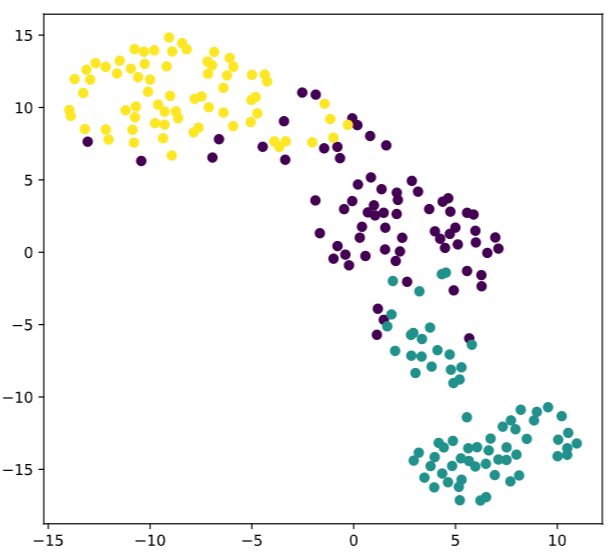
1.t-SNE
- t-分布领域嵌入算法
- 虽然主打非线性高维数据降维,但是很少用,因为
- 比较适合应用于可视化,测试模型的效果
- 保证在低维上数据的分布与原始特征空间分布的相似性高
因此用来查看分类器的效果更加
1.1 复现demo
# Import TSNE

from sklearn.manifold import TSNE

# Create a TSNE instance: model

model = TSNE(learning_rate=200)

# Apply fit_transform to samples: tsne_features

tsne_features = model.fit_transform(samples)

# Select the 0th feature: xs

xs = tsne_features[:,0]

# Select the 1st feature: ys

ys = tsne_features[:,1]

# Scatter plot, coloring by variety_numbers

plt.scatter(xs,ys,c=variety_numbers)

plt.show()
2.PCA
主成分分析是进行特征提取,会在原有的特征的基础上产生新的特征,新特征是原有特征的线性组合,因此会达到降维的目的,但是降维不仅仅只有主成分分析一种
- 当特征变量很多的时候,变量之间往往存在多重共线性。
- 主成分分析,用于高维数据降维,提取数据的主要特征分量
- PCA能“一箭双雕”的地方在于
- 既可以选择具有代表性的特征,
- 每个特征之间线性无关
- 总结一下就是原始特征空间的最佳线性组合
有一个非常易懂的栗子知乎
2.1 数学推理
可以参考【机器学习】降维——PCA(非常详细)
Making sense of principal component analysis, eigenvectors & eigenvalues
2.2栗子
sklearn里面有直接写好的方法可以直接使用
from sklearn.decomposition import PCA
# Perform the necessary imports

import matplotlib.pyplot as plt

from scipy.stats import pearsonr

# Assign the 0th column of grains: width

width = grains[:,0]

# Assign the 1st column of grains: length

length = grains[:,1]

# Scatter plot width vs length

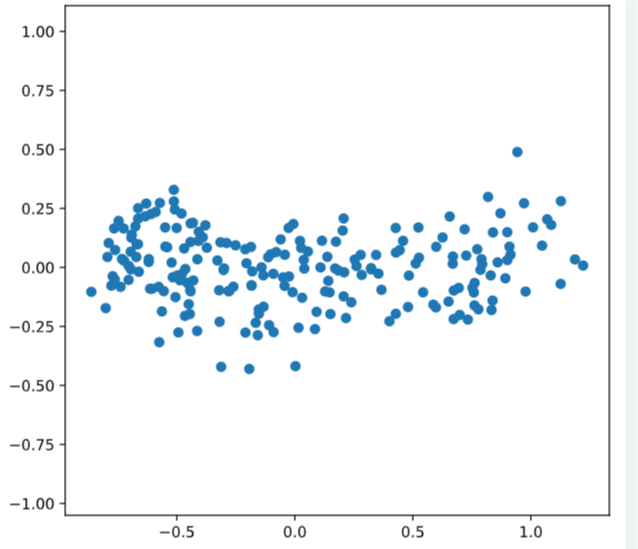
plt.scatter(width, length)

plt.axis('equal')

plt.show()

# Calculate the Pearson correlation

correlation, pvalue = pearsonr(width, length)

# Display the correlation

print(correlation)

# Import PCA

from sklearn.decomposition import PCA

# Create PCA instance: model

model = PCA()

# Apply the fit_transform method of model to grains: pca_features

pca_features = model.fit_transform(grains)

# Assign 0th column of pca_features: xs

xs = pca_features[:,0]

# Assign 1st column of pca_features: ys

ys = pca_features[:,1]

# Scatter plot xs vs ys

plt.scatter(xs, ys)

plt.axis('equal')

plt.show()

# Calculate the Pearson correlation of xs and ys

correlation, pvalue = pearsonr(xs, ys)

# Display the correlation

print(correlation)

<script.py> output:

    2.5478751053409354e-17
2.3intrinsic dimension
主成分的固有维度,其实就是提取主成分,得到最佳线性组合
2.3.1 提取主成分
.n_components_
提取主成分一般占总的80%以上,不过具体问题还得具体分析
# Perform the necessary imports

from sklearn.decomposition import PCA

from sklearn.preprocessing import StandardScaler

from sklearn.pipeline import make_pipeline

import matplotlib.pyplot as plt

# Create scaler: scaler

scaler = StandardScaler()

# Create a PCA instance: pca

pca = PCA()

# Create pipeline: pipeline

pipeline = make_pipeline(scaler,pca)

# Fit the pipeline to 'samples'

pipeline.fit(samples)

# Plot the explained variances

features =range( pca.n_components_)

plt.bar(features, pca.explained_variance_)

plt.xlabel('PCA feature')

plt.ylabel('variance')

plt.xticks(features)

plt.show()

2.3.2Dimension reduction with PCA
主成分降维
给一个文本特征提取的小例子
虽然我还不知道这个是啥,以后学完补充啊
# Import TfidfVectorizer

from sklearn.feature_extraction.text import TfidfVectorizer

# Create a TfidfVectorizer: tfidf

tfidf = TfidfVectorizer()

# Apply fit_transform to document: csr_mat

csr_mat = tfidf.fit_transform(documents)

# Print result of toarray() method

print(csr_mat.toarray())

# Get the words: words

words = tfidf.get_feature_names()

# Print words

print(words)

['cats say meow', 'dogs say woof', 'dogs chase cats']

<script.py> output:

    [[0.51785612 0.         0.         0.68091856 0.51785612 0.        ]

     [0.         0.         0.51785612 0.         0.51785612 0.68091856]

     [0.51785612 0.68091856 0.51785612 0.         0.         0.        ]]

    ['cats', 'chase', 'dogs', 'meow', 'say', 'woof']

<script.py> output:

    [[0.51785612 0.         0.         0.68091856 0.51785612 0.        ]

     [0.         0.         0.51785612 0.         0.51785612 0.68091856]

     [0.51785612 0.68091856 0.51785612 0.         0.         0.        ]]

    ['cats', 'chase', 'dogs', 'meow', 'say', 'woof']
t-SNE and PCA的更多相关文章
- Probabilistic PCA、Kernel PCA以及t-SNE
Probabilistic PCA 在之前的文章PCA与LDA介绍中介绍了PCA的基本原理,这一部分主要在此基础上进行扩展,在PCA中引入概率的元素,具体思路是对每个数据$\vec{x}_i$,假设$ ...
- 用scikit-learn学习主成分分析(PCA)
在主成分分析(PCA)原理总结中,我们对主成分分析(以下简称PCA)的原理做了总结,下面我们就总结下如何使用scikit-learn工具来进行PCA降维. 1. scikit-learn PCA类介绍 ...
- 主成分分析(PCA)原理总结
主成分分析(Principal components analysis,以下简称PCA)是最重要的降维方法之一.在数据压缩消除冗余和数据噪音消除等领域都有广泛的应用.一般我们提到降维最容易想到的算法就 ...
- 机器学习基础与实践(三)----数据降维之PCA
写在前面:本来这篇应该是上周四更新,但是上周四写了一篇深度学习的反向传播法的过程,就推迟更新了.本来想参考PRML来写,但是发现里面涉及到比较多的数学知识,写出来可能不好理解,我决定还是用最通俗的方法 ...
- 数据降维技术(1)—PCA的数据原理
PCA(Principal Component Analysis)是一种常用的数据分析方法.PCA通过线性变换将原始数据变换为一组各维度线性无关的表示,可用于提取数据的主要特征分量,常用于高维数据的降 ...
- 深度学习笔记——PCA原理与数学推倒详解
PCA目的:这里举个例子,如果假设我有m个点,{x(1),...,x(m)},那么我要将它们存在我的内存中,或者要对着m个点进行一次机器学习,但是这m个点的维度太大了,如果要进行机器学习的话参数太多, ...
- PCA、ZCA白化
白化是一种重要的预处理过程,其目的就是降低输入数据的冗余性,使得经过白化处理的输入数据具有如下性质:(i)特征之间相关性较低:(ii)所有特征具有相同的方差. 白化又分为PCA白化和ZCA白化,在数据 ...
- PCA 协方差矩阵特征向量的计算
人脸识别中矩阵的维数n>>样本个数m. 计算矩阵A的主成分,根据PCA的原理,就是计算A的协方差矩阵A'A的特征值和特征向量,但是A'A有可能比较大,所以根据A'A的大小,可以计算AA'或 ...
- 【统计学习】主成分分析PCA(Princple Component Analysis)从原理到实现
[引言]--PCA降维的作用 面对海量的.多维(可能有成百上千维)的数据,我们应该如何高效去除某些维度间相关的信息,保留对我们"有用"的信息,这是个问题. PCA给出了我们一种解决 ...
- 主成分分析 (PCA) 与其高维度下python实现(简单人脸识别)
Introduction 主成分分析(Principal Components Analysis)是一种对特征进行降维的方法.由于观测指标间存在相关性,将导致信息的重叠与低效,我们倾向于用少量的.尽可 ...
随机推荐
- 磁盘文件系统管理与LVM逻辑卷
一.磁盘以及分区管理 无论是Linux系统还是Windows系统.当现有硬盘的规划不能满足当前需求时.我们就需要将其重新规划和调整 实现上述操作我们就需要用到fdisk磁盘及分区管理工具.此工具是大多 ...
- pytorch之 activation funcion
import torch import torch.nn.functional as F from torch.autograd import Variable import matplotlib.p ...
- GNU make doc - 3.8
Note that the directory prefix (D), as described in Implicit Rule Search Algorithm, is appended (aft ...
- codewars--js--ten minutes walk
题目: You live in the city of Cartesia where all roads are laid out in a perfect grid. You arrived ten ...
- jQuery瀑布流插件masonry
项目要做荣誉证书的排版,宽度是统一的,但是高度不一致 采用瀑布流的效果来实现 默认先实现前15张,点击按钮再加载全部剩下的数据 效果图 首先是html部分,写好样式 <!-- 荣誉资质 --&g ...
- 初窥ECharts
近来趁着空闲时间了解了一下 ECharts.也顺带记录一番. 首先要从下载ECharts库,这个从官网可以直接下载. 引入ECharts.JS <head> <meta charse ...
- 在服务器上搭建远端git仓库
推荐使用运行Liunx的机器 请获取root权限后进行下面操作 安装git # 检查是否安装了git如果有版本号就无需再安装 git -v # 安装git sudo apt-get install g ...
- 使用 linux kernel +busybox 定制linux系统
目的: 了解linux的启动过程 主要内容: 1.grub 是启动程序的bootloader 2.linux-kernel 是linux的开源内核 3.busybox 是linux的工具集合 启动顺序 ...
- Python核心编程:《8个实践性建议》
前言 我们在用Python进行机器学习建模项目的时候,每个人都会有自己的一套项目文件管理的习惯,我自己也有一套方法,是自己曾经踩过的坑踩过的雷总结出来的,现在在这里分享一下给大家,因为很多伙伴是接触P ...
- JS的基本概念和数据类型
什么是 JavaScript 语言 Normal 0 7.8 磅 0 2 false false false EN-US ZH-CN X-NONE /* Style Definitions */ ta ...