
转载:EQ--biquad filter
http://www.musicdsp.org/files/Audio-EQ-Cookbook.txt
https://arachnoid.com/BiQuadDesigner/index.html
https://blog.csdn.net/hunterhuang2013/article/details/64443718
         Cookbook formulae for audio EQ biquad filter coefficients

----------------------------------------------------------------------------

           by Robert Bristow-Johnson  <rbj@audioimagination.com>

All filter transfer functions were derived from analog prototypes (that

are shown below for each EQ filter type) and had been digitized using the

Bilinear Transform.  BLT frequency warping has been taken into account for

both significant frequency relocation (this is the normal "prewarping" that

is necessary when using the BLT) and for bandwidth readjustment (since the

bandwidth is compressed when mapped from analog to digital using the BLT).

First, given a biquad transfer function defined as:

            b0 + b1*z^-1 + b2*z^-2

    H(z) = ------------------------                                  (Eq 1)

            a0 + a1*z^-1 + a2*z^-2

This shows 6 coefficients instead of 5 so, depending on your architechture,

you will likely normalize a0 to be 1 and perhaps also b0 to 1 (and collect

that into an overall gain coefficient).  Then your transfer function would

look like:

            (b0/a0) + (b1/a0)*z^-1 + (b2/a0)*z^-2

    H(z) = ---------------------------------------                   (Eq 2)

               1 + (a1/a0)*z^-1 + (a2/a0)*z^-2

or

                      1 + (b1/b0)*z^-1 + (b2/b0)*z^-2

    H(z) = (b0/a0) * ---------------------------------               (Eq 3)

                      1 + (a1/a0)*z^-1 + (a2/a0)*z^-2

The most straight forward implementation would be the "Direct Form 1"

(Eq 2):

    y[n] = (b0/a0)*x[n] + (b1/a0)*x[n-1] + (b2/a0)*x[n-2]

                        - (a1/a0)*y[n-1] - (a2/a0)*y[n-2]            (Eq 4)

This is probably both the best and the easiest method to implement in the

56K and other fixed-point or floating-point architechtures with a double

wide accumulator.

Begin with these user defined parameters:

    Fs (the sampling frequency)

    f0 ("wherever it's happenin', man."  Center Frequency or

        Corner Frequency, or shelf midpoint frequency, depending

        on which filter type.  The "significant frequency".)

    dBgain (used only for peaking and shelving filters)

    Q (the EE kind of definition, except for peakingEQ in which A*Q is

        the classic EE Q.  That adjustment in definition was made so that

        a boost of N dB followed by a cut of N dB for identical Q and

        f0/Fs results in a precisely flat unity gain filter or "wire".)

     _or_ BW, the bandwidth in octaves (between -3 dB frequencies for BPF

        and notch or between midpoint (dBgain/2) gain frequencies for

        peaking EQ)

     _or_ S, a "shelf slope" parameter (for shelving EQ only).  When S = 1,

        the shelf slope is as steep as it can be and remain monotonically

        increasing or decreasing gain with frequency.  The shelf slope, in

        dB/octave, remains proportional to S for all other values for a

        fixed f0/Fs and dBgain.

Then compute a few intermediate variables:

    A  = sqrt( 10^(dBgain/20) )

       =       10^(dBgain/40)     (for peaking and shelving EQ filters only)

    w0 = 2*pi*f0/Fs

    cos(w0)

    sin(w0)

    alpha = sin(w0)/(2*Q)                                       (case: Q)

          = sin(w0)*sinh( ln(2)/2 * BW * w0/sin(w0) )           (case: BW)

          = sin(w0)/2 * sqrt( (A + 1/A)*(1/S - 1) + 2 )         (case: S)

        FYI: The relationship between bandwidth and Q is

             1/Q = 2*sinh(ln(2)/2*BW*w0/sin(w0))     (digital filter w BLT)

        or   1/Q = 2*sinh(ln(2)/2*BW)             (analog filter prototype)

        The relationship between shelf slope and Q is

             1/Q = sqrt((A + 1/A)*(1/S - 1) + 2)

    2*sqrt(A)*alpha  =  sin(w0) * sqrt( (A^2 + 1)*(1/S - 1) + 2*A )

        is a handy intermediate variable for shelving EQ filters.

Finally, compute the coefficients for whichever filter type you want:

   (The analog prototypes, H(s), are shown for each filter

        type for normalized frequency.)

LPF:        H(s) = 1 / (s^2 + s/Q + 1)

            b0 =  (1 - cos(w0))/2

            b1 =   1 - cos(w0)

            b2 =  (1 - cos(w0))/2

            a0 =   1 + alpha

            a1 =  -2*cos(w0)

            a2 =   1 - alpha

HPF:        H(s) = s^2 / (s^2 + s/Q + 1)

            b0 =  (1 + cos(w0))/2

            b1 = -(1 + cos(w0))

            b2 =  (1 + cos(w0))/2

            a0 =   1 + alpha

            a1 =  -2*cos(w0)

            a2 =   1 - alpha

BPF:        H(s) = s / (s^2 + s/Q + 1)  (constant skirt gain, peak gain = Q)

            b0 =   sin(w0)/2  =   Q*alpha

            b1 =   0

            b2 =  -sin(w0)/2  =  -Q*alpha

            a0 =   1 + alpha

            a1 =  -2*cos(w0)

            a2 =   1 - alpha

BPF:        H(s) = (s/Q) / (s^2 + s/Q + 1)      (constant 0 dB peak gain)

            b0 =   alpha

            b1 =   0

            b2 =  -alpha

            a0 =   1 + alpha

            a1 =  -2*cos(w0)

            a2 =   1 - alpha

notch:      H(s) = (s^2 + 1) / (s^2 + s/Q + 1)

            b0 =   1

            b1 =  -2*cos(w0)

            b2 =   1

            a0 =   1 + alpha

            a1 =  -2*cos(w0)

            a2 =   1 - alpha

APF:        H(s) = (s^2 - s/Q + 1) / (s^2 + s/Q + 1)

            b0 =   1 - alpha

            b1 =  -2*cos(w0)

            b2 =   1 + alpha

            a0 =   1 + alpha

            a1 =  -2*cos(w0)

            a2 =   1 - alpha

peakingEQ:  H(s) = (s^2 + s*(A/Q) + 1) / (s^2 + s/(A*Q) + 1)

            b0 =   1 + alpha*A

            b1 =  -2*cos(w0)

            b2 =   1 - alpha*A

            a0 =   1 + alpha/A

            a1 =  -2*cos(w0)

            a2 =   1 - alpha/A

lowShelf: H(s) = A * (s^2 + (sqrt(A)/Q)*s + A)/(A*s^2 + (sqrt(A)/Q)*s + 1)

            b0 =    A*( (A+1) - (A-1)*cos(w0) + 2*sqrt(A)*alpha )

            b1 =  2*A*( (A-1) - (A+1)*cos(w0)                   )

            b2 =    A*( (A+1) - (A-1)*cos(w0) - 2*sqrt(A)*alpha )

            a0 =        (A+1) + (A-1)*cos(w0) + 2*sqrt(A)*alpha

            a1 =   -2*( (A-1) + (A+1)*cos(w0)                   )

            a2 =        (A+1) + (A-1)*cos(w0) - 2*sqrt(A)*alpha

highShelf: H(s) = A * (A*s^2 + (sqrt(A)/Q)*s + 1)/(s^2 + (sqrt(A)/Q)*s + A)

            b0 =    A*( (A+1) + (A-1)*cos(w0) + 2*sqrt(A)*alpha )

            b1 = -2*A*( (A-1) + (A+1)*cos(w0)                   )

            b2 =    A*( (A+1) + (A-1)*cos(w0) - 2*sqrt(A)*alpha )

            a0 =        (A+1) - (A-1)*cos(w0) + 2*sqrt(A)*alpha

            a1 =    2*( (A-1) - (A+1)*cos(w0)                   )

            a2 =        (A+1) - (A-1)*cos(w0) - 2*sqrt(A)*alpha

FYI:   The bilinear transform (with compensation for frequency warping)

substitutes:

                                  1         1 - z^-1

      (normalized)   s  <--  ----------- * ----------

                              tan(w0/2)     1 + z^-1

   and makes use of these trig identities:

                     sin(w0)                               1 - cos(w0)

      tan(w0/2) = -------------           (tan(w0/2))^2 = -------------

                   1 + cos(w0)                             1 + cos(w0)

   resulting in these substitutions:

                 1 + cos(w0)     1 + 2*z^-1 + z^-2

      1    <--  ------------- * -------------------

                 1 + cos(w0)     1 + 2*z^-1 + z^-2

                 1 + cos(w0)     1 - z^-1

      s    <--  ------------- * ----------

                   sin(w0)       1 + z^-1

                                      1 + cos(w0)     1         -  z^-2

                                  =  ------------- * -------------------

                                        sin(w0)       1 + 2*z^-1 + z^-2

                 1 + cos(w0)     1 - 2*z^-1 + z^-2

      s^2  <--  ------------- * -------------------

                 1 - cos(w0)     1 + 2*z^-1 + z^-2

   The factor:

                    1 + cos(w0)

                -------------------

                 1 + 2*z^-1 + z^-2

   is common to all terms in both numerator and denominator, can be factored

   out, and thus be left out in the substitutions above resulting in:

                 1 + 2*z^-1 + z^-2

      1    <--  -------------------

                    1 + cos(w0)

                 1         -  z^-2

      s    <--  -------------------

                      sin(w0)

                 1 - 2*z^-1 + z^-2

      s^2  <--  -------------------

                    1 - cos(w0)

   In addition, all terms, numerator and denominator, can be multiplied by a

   common (sin(w0))^2 factor, finally resulting in these substitutions:

      1         <--   (1 + 2*z^-1 + z^-2) * (1 - cos(w0))

      s         <--   (1         -  z^-2) * sin(w0)

      s^2       <--   (1 - 2*z^-1 + z^-2) * (1 + cos(w0))

      1 + s^2   <--   2 * (1 - 2*cos(w0)*z^-1 + z^-2)

   The biquad coefficient formulae above come out after a little

   simplification.

Biquadratic difference equation flow graph
(horizontal = time, vertical = data flow):

// perform one filtering step

double filter(double x) {

    y = b0 * x + b1 * x1 + b2 * x2 - a1 * y1 - a2 * y2;

    x2 = x1;

    x1 = x;

    y2 = y1;

    y1 = y;

    return (y);

}
This table outlines the properties of the available filter types:
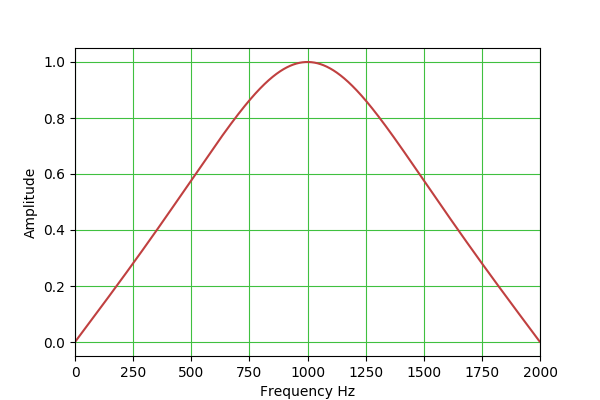
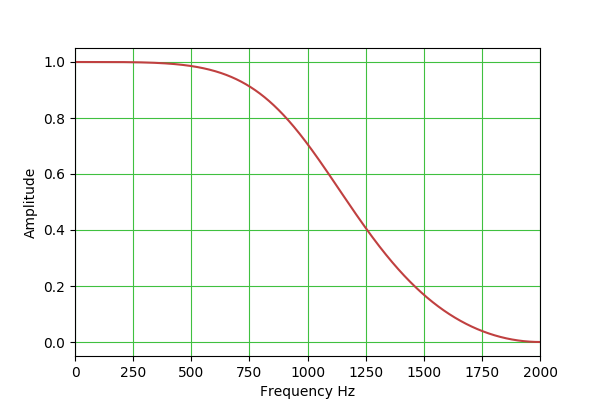
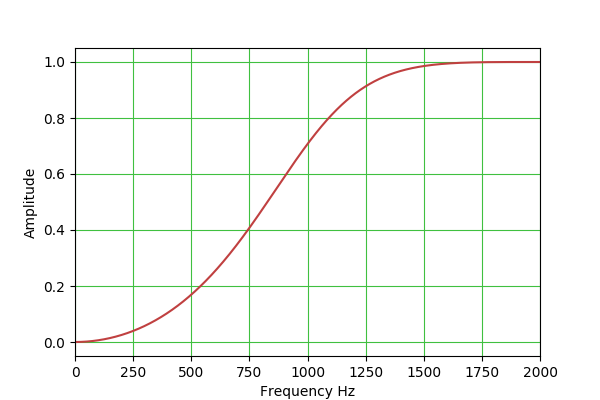
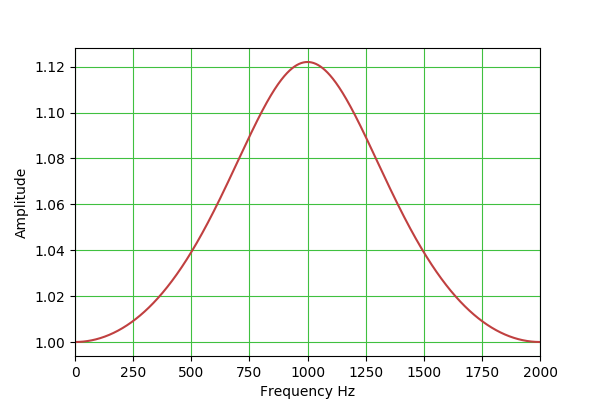
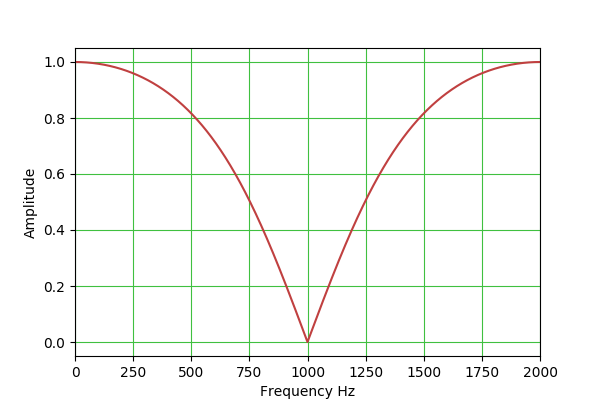
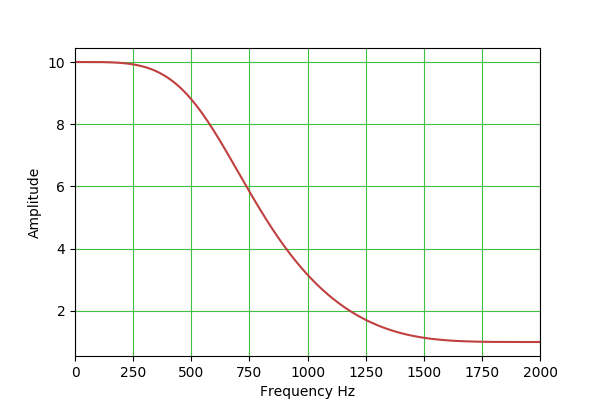
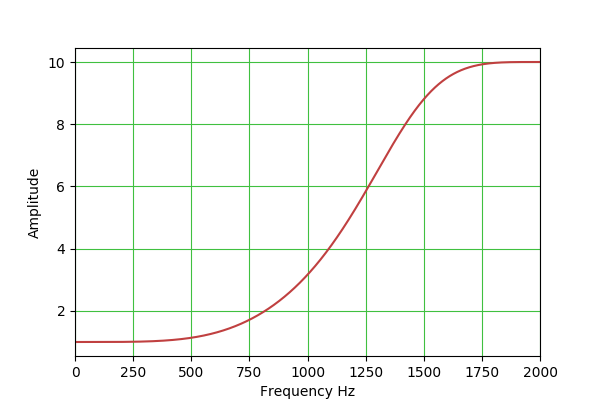
Filter Type Q adj Gain adj Comments Image Bandpass Y N The most generally useful filter type. Low-pass Y N For low-pass and high-pass biquadratic filters, one normally sets Q = 0.707 ($\frac{1}{\sqrt{2}}$) to achieve a Butterworth filter transfer function with a 3 DB drop at the specified operating frequency. Higher Q settings produce an often-undesirable peak near the center frequency and dynamic instability in operation. High-pass Y N Peak Y Y This filter is a bit tricky to set up, because both Q and gain are effective. The idea is that one can use the gain control to set a nonzero base gain level that applies to all frequencies, then use the frequency and Q controls to set a narrow peak to exceed that level. Note also that, with a negative gain setting, the relation between the plateau and peak is reversed. Notch Y N This filter is more or less the opposite of the "Peak" filter — it creates a narrow rejection band, the width of which is set by the Q control. (But no plateau as with "Peak".) Lowshelf N Y Lowshelf and highshelf filters provide a sort of "plateau" effect, under control of the gain setting, and not unlike the "Peak" filter described above. Note that negative gain settings reverse the identity of the filter — lowshelf becomes highshelf and the reverse. Highshelf N Y
转载:EQ--biquad filter的更多相关文章
- Digital biquad filter
Direct Form 1 The most straightforward implementation is the Direct Form 1, which has the following ...
- 【转载】CSS3 filter:drop-shadow滤镜与box-shadow区别应用
文章转载自 张鑫旭-鑫空间-鑫生活 http://www.zhangxinxu.com/wordpress/ 原文链接:http://www.zhangxinxu.com/wordpress/?p=5 ...
- jquery 常用选择器 回顾 ajax() parent() parents() children() siblings() find() eq() has() filter() next()
1. $.ajax() ajax 本身是异步操作,当需要将 异步 改为 同步时: async: false 2.parent() 父级元素 和 parents() 祖先元素 的区别 parent ...
- 【转载】CSS filter:hue-rotate色调旋转滤镜实现按钮批量生产
文章转载自 张鑫旭-鑫空间-鑫生活 http://www.zhangxinxu.com/ 原文链接:https://www.zhangxinxu.com/wordpress/2018/11/css-f ...
- [转载]OpenFileDialog对话框Filter属性
首先说明一个示例,分析一下Filter属性的构成:“ Excel文件|*.xls ”,前面的“Excel文件”成为标签,是一个可读的字符串,可以自定定义,“|*.xls”是筛选器,表示筛选文件夹中后缀 ...
- 【转载】Servlet Filter(过滤器)、Filter是如何实现拦截的、Filter开发入门
Servlet Filter(过滤器).Filter是如何实现拦截的.Filter开发入门 Filter简介 Filter也称之为过滤器,它是Servlet技术中最激动人心的技术,WEB开发人员通过F ...
- 转载:Angular的filter总结
过滤器(filter)正如其名,作用就是接收一个输入,通过某个规则进行处理,然后返回处理后的结果.主要用在数据的格式化上,例如获取一个数组 中的子集,对数组中的元素进行排序等.ng内置了一些过滤器,它 ...
- biquad filter实现
原始频谱: LPF: HPF: 代码: #include<stdio.h> #include<stdlib.h> #include<errno.h> #includ ...
- 转载:polyphase filter
http://www.ws.binghamton.edu/fowler/fowler%20personal%20page/ee521.htm http://www.ws.binghamton.edu/ ...
随机推荐
- windows命令提示符常用命令
1.进入某个磁盘 c: 进入c盘 d: 进入d盘 2.返回到根目录 cd \ 3.查看当钱路径下的文件和文件夹 dir 4.清空窗口内容 cls 5.关闭窗口 exit 6.返回上一级目录 cd . ...
- word的一些运用技巧
1.去除换行符 替换:^p > 空格
- HDFS的扩容
一.扩容 1.1横向扩容:加节点 https://www.cnblogs.com/the-roc/p/12362926.html 1.2纵向扩容:加硬盘 二.纵向扩容 2.1添加硬盘 2.2在关 ...
- vue.js中用npm安装vue-router时报错处理办法
当在使用npm安装东西的时候,最怕遇到的就是,电脑并不想和你说话,只向你抛出一大堆错误...比如在vue.js中用npm安装vue-router的时候,我就遇到 一脸蒙逼的我默默的念了一句:卧..槽. ...
- 深入理解IP之CIDR
现代IP基于分类的IP越来越少,而基于CIDR的方式的越来越多.那么可以看下面这篇文章: https://www.cnblogs.com/hark0623/p/6547432.html 这篇文章对CI ...
- jQuery---固定导航栏案例
固定导航栏案例 <!DOCTYPE html> <html> <head lang="en"> <meta charset="U ...
- LaTeX技巧007:每一章开始的header引用名言应该怎么做?
[问题描述] 看到很多论文的每一章开始的右上角都有一段名人名言, 我试验了很多次一直都搞不清楚是怎么搞?是用fancyhead么?谁可以说说呢? 多谢了 [解决方案] 使用epigraph宏包来制作即 ...
- springboot项目集成activity
1.按照上一篇博客,新建好springboot项目后,在项目pom.xml文件中添加activity依赖 <dependency> <groupId>org.activiti& ...
- 申请一个美国paypal账户
近期为了做PayPal支付,进口demo已经写好,就差一个美国PayPal账户进行支付测试,几经折腾,终于申请下来,附上参考链接: paypal官网: https://www.paypal.com ...
- 【Python】圆周率的计算
1.公式法 代码: #CalPiV1.py pi=0 N=100 for k in range(N): pi+=1/pow(16,k)*(\ 4/(8*k+1)-2/(8*k+4)-\ 1/(8*k ...