
c++实验3类和对象
实 验 3:
part 1:验证

part 2:graph
#include <iostream>

#include "graph.h"

using namespace std;

int main() {

    Graph graph1('*',);

    graph1.draw();

    system("pause");

    system("cls");

    Graph graph2('$',);

    graph2.draw();

    system("pause");

    return ;

}
main.cpp
// 类graph的实现

#include "graph.h"

#include <iostream>

using namespace std;

// 带参数的构造函数的实现

Graph::Graph(char ch, int n): symbol(ch), size(n) {

}

// 成员函数draw()的实现

// 功能:绘制size行,显示字符为symbol的指定图形样式

void Graph::draw() {

 for(int i=;i<=size;i++)

 {for(int j=;j<=size-i;j++)

     cout<<" ";

  for(int k=;k<*i-;k++)

     cout<<symbol;

  cout<<endl;

 }

}
graph.cpp
#ifndef GRAPH_H

#define GRAPH_H

// 类Graph的声明

class Graph {

    public:

        Graph(char ch, int n);   // 带有参数的构造函数

        void draw();     // 绘制图形

    private:

        char symbol;

        int size;

};

#endif
graph.h
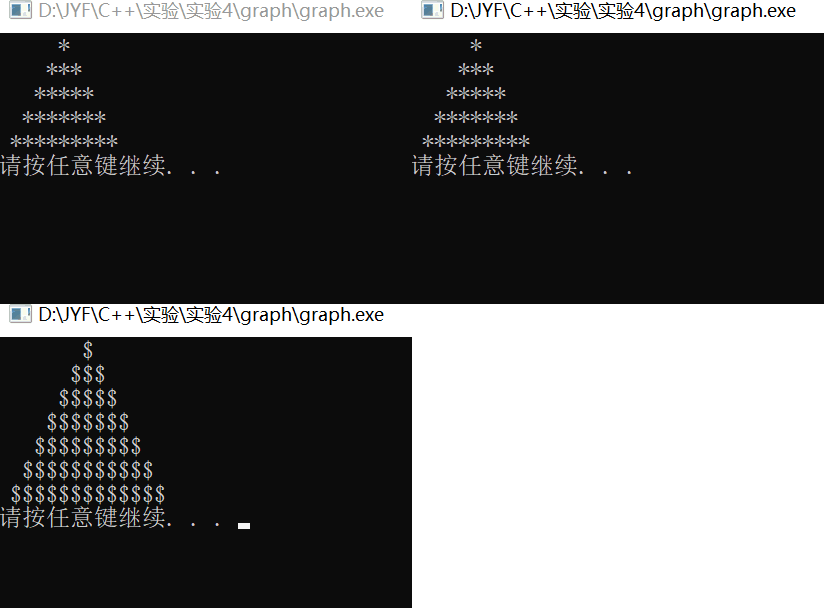
运行结果:
part 3:分数的加减乘除
#ifndef Fraction_H

#define Fraction_H

// 类Fraction的声明

class Fraction {

    public:

        Fraction(int t=, int b=):top(t),bottom(b){

        }// 带有参数的构造函数

        void add(Fraction a, Fraction b);

        void sub(Fraction a, Fraction b);

        void mul(Fraction a, Fraction b);

        void div(Fraction a, Fraction b);

        void compare(Fraction a, Fraction b);

        void show();

    private:

        int top;

        int bottom;

};

#endif
fraction.h
#include <iostream>

#include "fraction.h"

using namespace std;

int main()

{int x,y,m,n;

 Fraction a;

 a.show();

 Fraction b(,);

 b.show();

 Fraction c();

 c.show();

 cout<<"Input two score: "<<endl;

 cin>>x>>y;

 cin>>m>>n;

 while(y==||n==)

   {cout<<"ERROR!Please try again!"<<endl;

    cin>>x>>y;

    cin>>m>>n;

   }

 Fraction d(x,y);

 Fraction e(m,n);

 a.add(d,e);

 a.sub(d,e);

 a.mul(d,e);

 a.div(d,e);

 a.compare(d,e);

 return ;

}
main.cpp
#include"fraction.h"

#include<iostream>

using namespace std;

void Fraction::show(){

    if (top == ) cout << <<endl;

    else if (bottom == ) cout << top << endl;

    else cout << top << "/" << bottom << endl;

}

void Fraction::add(Fraction a, Fraction b){

    int gbs,m=a.bottom,n=b.bottom,t,r,fz,fm;

    if(m<n)

    {t=m;m=n;n=t;}

    r=m%n;

    while(r!=)

    {m=n;n=r;r=m%n;}

    gbs=a.bottom*b.bottom/n;

    fz=a.top*(gbs/a.bottom)+b.top*(gbs/b.bottom);

    fm=gbs;

    cout<<"add: "<<fz<<"/"<<fm<<endl;

}

void Fraction::sub(Fraction a, Fraction b){

    int gbs,m=a.bottom,n=b.bottom,t,r,fz,fm;

    if(m<n)

    {t=m;m=n;n=t;}

    r=m%n;

    while(r!=)

    {m=n;n=r;r=m%n;}

    gbs=a.bottom*b.bottom/n;

    fz=a.top*(gbs/a.bottom)-b.top*(gbs/b.bottom);

    fm=gbs;

    cout<<"sub: "<<fz<<"/"<<fm<<endl;

}

void Fraction::mul(Fraction a, Fraction b){

    int fz,fm;

    fz=a.top*b.top;

    fm=a.bottom*b.bottom;

    cout<<"mul: "<<fz<<"/"<<fm<<endl;

}

void Fraction::div(Fraction a, Fraction b){

    int fz,fm;

    fz=a.top*b.bottom;

    fm=b.top*a.bottom;

    cout<<"div: "<<fz<<"/"<<fm<<endl;

}

void Fraction::compare(Fraction a, Fraction b){

    int gbs,m=a.bottom,n=b.bottom,t,r,fz,fm;

    if(m<n)

    {t=m;m=n;n=t;}

    r=m%n;

    while(r!=)

    {m=n;n=r;r=m%n;}

    gbs=a.bottom*b.bottom/n;

    fz=a.top*(gbs/a.bottom)-b.top*(gbs/b.bottom);

    if(fz<)

      cout<<"compare: "<<a.top<<"/"<<a.bottom<<"<"<<b.top<<"/"<<b.bottom<<endl;

    else if(fz>)

            cout<<"compare: "<<a.top<<"/"<<a.bottom<<">"<<b.top<<"/"<<b.bottom<<endl;

         else

            cout<<"compare: "<<a.top<<"/"<<a.bottom<<"="<<b.top<<"/"<<b.bottom<<endl;

}
fraction.cpp
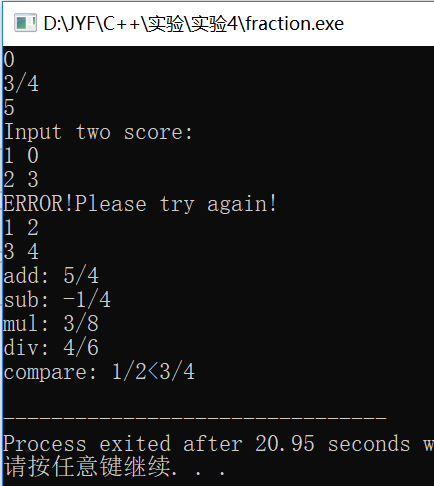
运行结果:
总结:
1、part3中有许多代码是重复的,目前还想不到好的解决方案。
2、在做题时,还是会翻阅书,参考样例,不够熟练。
3、学习了用项目。
评论:
1、https://www.cnblogs.com/shenqidetao/p/10742384.html
2、https://www.cnblogs.com/qsxsc/p/10742704.html
3、https://www.cnblogs.com/csc13813017371/p/10743961.html
c++实验3类和对象的更多相关文章
- 【C++ 实验5 类和对象】
1. #include <iostream> #include <vector> #include <string> using namespace std; // ...
- C++ 实验3 类和对象
Part 2 #ifndef GRAPH_H #define GRAPH_H class Graph { public: Graph(char ch, int n); void draw(); pri ...
- 【C++/实验三】类和对象
1.定义一个矩形类,有长,宽两个属性,有成员函数计算矩形的面积. 在该矩形类中,我做了5个主要的测试. 构造函数带默认值参数,利用默认值参数计算矩形面积:rectangle(double x=2.0, ...
- 第四周总结和实验二Java简单类与对象
实验目的 掌握类的定义,熟悉属性.构造函数.方法的使用,掌握用类作为类型声明变量和方法返回值: 理解类和对象的区别,掌握构造函数的使用,熟悉通过对象名引用实列的方法和属性: 理解static修饰对类. ...
- C++ Daily 《6》---- 类静态对象与函数静态对象
C++ 的一个哲学基础是,你不应该为你使用的东西付出代价. class 拥有一个 static 成员,即使从未被用到,它也会被构造和析构: 而 函数拥有一个 static 成员, 如果这个函数从未被调 ...
- iOS RunTime运行时(1):类与对象
Objective-C语言是一门动态语言,他将很多静态语言在编译和链接期做的事放到了运行时来处理.这种动态语言的优势在于:我们写代码更具有灵活性,如我们可以把消息转发给我们想要的对象,或者随意交换一下 ...
- JAVA入门第二季 第一章 类和对象
面向对象编程 Object Oriented Programming OOP 第一.什么是类和对象 在具体说明类和对象之前,先说说别的. 眼睛在人类身体上最为有用的器官.如果一个没有了眼睛,这个人与世 ...
- php学习小记2 类与对象
php类的一些特性: 1. 伪变量$this.$this是一个到主叫对象的引用.取值:该方法所从属的对象,可能是另外的对象(前提,当该方法被静态调用时).$this变量存在于一个类的非静态方法中,在静 ...
- 非常易于理解‘类'与'对象’ 间 属性 引用关系,暨《Python 中的引用和类属性的初步理解》读后感
关键字:名称,名称空间,引用,指针,指针类型的指针(即指向指针的指针) 我读完后的理解总结: 1. 我们知道,python中的变量的赋值操作,变量其实就是一个名称name,赋值就是将name引用到一个 ...
随机推荐
- python25 python的三目运算符
其他语言的三目运算符大类似: 条件 ? 条件为真返回值: 条件为假返回值 python不一样: 条件为真的返回值 if 条件 else 条件为假的返回值 或者 ...
- 在VMware上安装ubuntu——网络类型
安装虚拟机时,向导提示选择网络类型: 当使用仅主机模式网络时,虚拟机和物理机不能互相访问共享.
- Android(java)学习笔记4:线程的控制
1. 线程休眠: Java中线程休眠指让正在运行的线程暂停执行一段时间,进入阻塞状态,通过调用Thread类的静态方法sleep得以实现. 当线程调用sleep进入阻塞状态后,在其休眠的时间内,该线程 ...
- Android(java)学习笔记34:Android原理揭秘系列之View、ViewGroup
1. 作过Android 应用开发的朋友都知道,Android的UI界面都是由View和ViewGroup及其派生类组合而成的.其中,View是所有UI组件的基类,而ViewGroup是容纳这些组件的 ...
- swift 协议(结合扩展)的特点
协议的传统实现: 定义接口+实现协议 由抽象到具体: 协议的逆向实现(使用扩展): 由已存在的类型抽离部分功能作为协议,并让原体符合协议: 由具体到抽象: 向上抽离: 向上生成: 协议的缺省 ...
- pthread_create & pthread_exit
http://www.cppblog.com/saha/articles/189802.html 1. pthread_create #include <pthread.h> ...
- ACM-ICPC 2017 Asia HongKong 解题报告
ACM-ICPC 2017 Asia HongKong 解题报告 任意门:https://nanti.jisuanke.com/?kw=ACM-ICPC%202017%20Asia%20HongKon ...
- 【题解】UVA756 Biorhythms (中国剩余定理)
UVA756:https://www.luogu.org/problemnew/show/UVA756 思路 几乎是裸的中国剩余定理模板题 但是需要注意的是此题并不是求最小正整数解 而是求大于d的解 ...
- ffmpeg 学习
1.ffmpeg使用语法 命令格式: ffmpeg -i [输入文件名] [参数选项] -f [格式] [输出文件] ffmpeg [[options][`-i' input_file]] ...
- js标准对象
在JavaScript的世界里,一切都是对象. 但是某些对象还是和其他对象不太一样.为了区分对象的类型,我们用typeof操作符获取对象的类型,它总是返回一个字符串: typeof 123; //'n ...