
python队列的实现
队列是一种抽象数据结构,具有以下特点:
(1)具有先进先出的特性(FIFO)
(2)拥有两种基本操作,即加入和删除,而且使用front和rear两个指针来分别指向队列的前端和末尾。
队列的基本操作
create 创建空队列
add 将新数据加入队列的末尾,返回新队列
delete 删除队列前端的数据,返回新队列
front 返回队列前端的值
empty 若队列为空,则返回 ‘真’,否则返回 ‘假’
实现queue有两种方式可以用数组和链表
1.我们先用数组实现队列,数组实现队列的好处在于算法相当简单,但是也有缺点,数组无法根据队列的实际需要动态申请,
只能声明固定的大小。现在我们声明一个有限容量的数组
MAXSIZE=4            #定义队列的大小

queue=[0]*MAXSIZE

front=-1

rear=-1
(1)开始时,我们将front与rear都设置-1,当front = rear时,为空队列
| 事件说明 | front | rear | Q(0) | Q(1) | Q(2) | Q(3) |
| 空队列 | -1 | -1 |
(2)当加入dataA , front=-1,rear=0,没加入一个元素,将rear值加1:
| 加入dataA | -1 | 0 | dataA |
(3)加入dataB,dataC,front=-1,rear=2:
| 加入dataB、dataC | -1 | 2 | dataA | dataB | dabaC |
(4)取出dataA,front=0,rear=2,每取出一个元素,将front的值加1:
| 取出dataA | 0 | 2 | dataB | dataC |
(5)加入dataD,front=0,rear=3,此时rear=MAXSIZE-1 ,表示队列已满
| 加入dataD | 0 | 3 | dataB | dataC | dataD |
(6)取出dataB,front =1,rear=3:
| 取出dataB | 1 | 3 | dataC | dataD |
对于以上队列操作,可以用Python语言实现一个队列的操作
import sys

MAX=10            #定义队列的大小

queue=[0]*MAX

front=rear=-1

choice=''

while rear<MAX-1 and choice !='e':

    choice=input('[a]表示加入一个数值,[d]表示取出一个数值,[e]表示跳出此程序: ')

    if choice=='a':

        val=int(input('[请输入数值]: '))

        rear+=1

        queue[rear]=val

    elif choice=='d':

        if rear>front:

            front+=1

            print('[取出数值为]: [%d]' %(queue[front]))

            queue[front]=0

        else:

            print('[队列已经空了]')

            sys.exit(0)

    else:

        print()

print('------------------------------------------')

print('[输出队列中的所有元素]:')

if rear==MAX-1:

    print('[队列已满]')

elif front>=rear:

    print('没有')

    print('[队列已空]')

else:

    while rear>front:

        front+=1

        print('[%d] ' %queue[front],end='')

    print()

    print('------------------------------------------')

print()
执行结果如下
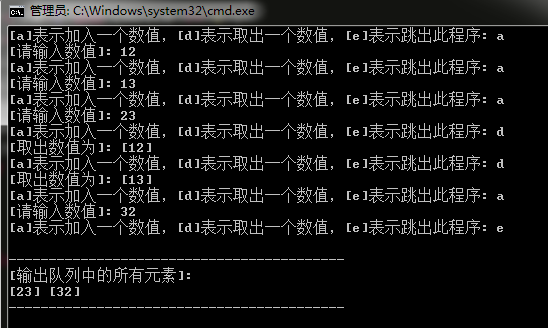
2用链表实现队列
我们以学生姓名和成绩的结构数据建立队列的节点,加上front和rear指针,这个类的声明如下:
class student:

    def __init__(self):

        self.name=' '*20

        self.score=0

        self.next=None

front=student()

rear=student()

front=None

rear=None
在队列中加入新节点等于加入到队列的末端,而删除节点就是将此队列的最前端的节点删除。添加和删除操作如下:
def enqueue(name, score):  # 把数据加入队列

    global front

    global rear

    new_data=student()  # 分配内存给新元素

    new_data.name=name  # 给新元素赋值

    new_data.score = score

    if rear==None:      # 如果rear为None,表示这是第一个元素

        front = new_data

    else:

        rear.next = new_data    # 将新元素连接到队列末尾

    rear = new_data         # 将rear指向新元素,这是新的队列末尾

    new_data.next = None    # 新元素之后无其他元素

def dequeue(): # 取出队列中的数据

    global front

    global rear

    if front == None:

        print('队列已空!')

    else:

        print('姓名:%s\t成绩:%d ....取出' %(front.name, front.score))

        front = front.next    # 将队列前端移到下一个元素
我们使用链表来设计一个队列的程序
class student:

    def __init__(self):

        self.name=' '*20

        self.score=0

        self.next=None

front=student()

rear=student()

front=None

rear=None

def enqueue(name, score):  # 把数据加入队列

    global front

    global rear

    new_data=student()  # 分配内存给新元素

    new_data.name=name  # 给新元素赋值

    new_data.score = score

    if rear==None:      # 如果rear为None,表示这是第一个元素

        front = new_data

    else:

        rear.next = new_data    # 将新元素连接到队列末尾

    rear = new_data         # 将rear指向新元素,这是新的队列末尾

    new_data.next = None    # 新元素之后无其他元素

def dequeue(): # 取出队列中的数据

    global front

    global rear

    if front == None:

        print('队列已空!')

    else:

        print('姓名:%s\t成绩:%d ....取出' %(front.name, front.score))

        front = front.next    # 将队列前端移到下一个元素

def show():     # 显示队列中的数据

    global front

    global rear

    ptr = front

    if ptr == None:

        print('队列已空!')

    else:

        while ptr !=None: # 从front到rear遍历队列

            print('姓名:%s\t成绩:%d' %(ptr.name, ptr.score))

            ptr = ptr.next

select=0

while True:

    select=int(input('(1)加入 (2)取出 (3)显示 (4)离开 => '))

    if select==4:

        break

    if select==1:

        name=input('姓名: ')

        score=int(input('成绩: '))

        enqueue(name, score)

    elif select==2:

        dequeue()

    else:

        show()
执行如下:
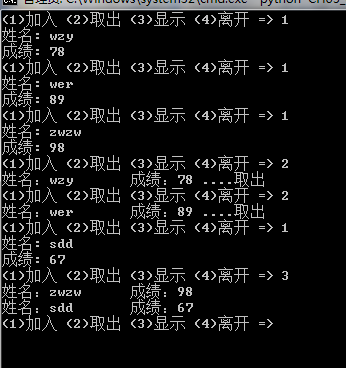
python队列的实现的更多相关文章
- Python队列服务 Python RQ Functions from the __main__ module cannot be processed by workers.
在使用Python队列服务 Python RQ 时候的报错: Functions from the __main__ module cannot be processed by workers. 原因 ...
- Python队列及在微信机器人中的应用
本文来源于i春秋学院,未经允许严禁转载. 最近打算更新微信机器人,发现机器人的作者将代码改进了很多,但去掉了sqlite数据库,需要自己根据需求设计数据库,跟作者沟通得到的建议是为了防止消息并发导致数 ...
- python队列Queue
Queue Queue是python标准库中的线程安全的队列(FIFO)实现,提供了一个适用于多线程编程的先进先出的数据结构,即队列,用来在生产者和消费者线程之间的信息传递 基本FIFO队列 clas ...
- Python 队列
import multiprocessing import time if __name__ == '__main__': # 创建消息队列 # 3: 表示消息队列最大个数 queue = multi ...
- python队列基本使用
Python queue队列 作用: 解耦:使程序直接实现松耦合,修改一个函数,不会有串联关系. 提高处理效率:FIFO = 现进先出,LIFO = 后入先出. 队列: 队列可以并发的派多个线程, ...
- python队列、线程、进程、协程
目录: 一.queue 二.线程 基本使用 线程锁 自定义线程池 生产者消费者模型(队列) 三.进程 基本使用 进程锁 进程数据共享 默认数据不共享 queues array Manager.dict ...
- python队列、线程、进程、协程(转)
原文地址: http://www.cnblogs.com/wangqiaomei/p/5682669.html 一.queue 二.线程 #基本使用 #线程锁 #自定义线程池 #生产者消费者模型(队列 ...
- python socket非阻塞及python队列Queue
一. python非阻塞编程的settimeout与setblocking+select 原文:www.th7.cn/Program/Python/201406/214922.shtml 侧面认证Py ...
- Python|队列Queue
一 前言 本文算是一次队列的学习笔记,Queue 模块实现了三种类型的队列,它们的区别仅仅是队列中元素被取回的顺序.在 FIFO 队列中,先添加的任务先取回.在 LIFO 队列中,最近被添加的元素先取 ...
随机推荐
- UVa10048_Audiophobia(最短路/floyd)(小白书图论专题)
解题报告 题意: 求全部路中最大分贝最小的路. 思路: 类似floyd算法的思想.u->v能够有另外一点k.通过u->k->v来走,拿u->k和k->v的最大值和u-&g ...
- Canny算法源码,欢迎交流
http://blog.csdn.net/jianxiong8814/article/details/1563109 http://blog.csdn.net/assuper/article/deta ...
- 【poj2774】Long Long Message
用个分隔符将两个字符串连接起来,再用后缀数组求出height数组的值,找出一个height值最大并且i与i-1的sa值分别在两串字符中就好 #include<algorithm> #inc ...
- RPC和微服务
1 什么是RPC 是remote procedure call的缩写. 2 什么是微服务 所谓的微服务就是说,把一个应用分解成一组小的服务,每个服务运行在自己的进程中.每个服务都可以单独部署,可以用自 ...
- linux 查看php扩展
php -i |less 查看配置文件在哪里,编译参数 php -m |less 查看php加载的模块 less可以自由的上下访问,比more要灵活一点. 如果不使用less,信息一次性给予,不太好查 ...
- bzoj 1497(最大权闭合子图)
1497: [NOI2006]最大获利 Time Limit: 5 Sec Memory Limit: 64 MBSubmit: 6410 Solved: 3099[Submit][Status] ...
- Spark 分布式环境---slave节点无法启动(已解决)
soyo@soyo-VPCCB3S1C:~$ start-slaves.sh soyo-slave01: starting org.apache.spark.deploy.worker.Worker, ...
- E20180127-hm
retain vt. 保持; 留在心中,记住; 雇用; 付定金保留;
- [Swift]二分法的两种方式
★★★★★★★★★★★★★★★★★★★★★★★★★★★★★★★★★★★★★★★★➤微信公众号:山青咏芝(shanqingyongzhi)➤博客园地址:山青咏芝(https://www.cnblogs. ...
- c++ swap函数
swap(a,b)也就是把a和b的值互换. 头文件:#include<algorithm>,swap要加using namespace std: