
Tomcat server.xml配置文件
server.xml配置文件:
<?xml version="1.0" encoding="UTF-8"?>
<!--
Licensed to the Apache Software Foundation (ASF) under one or more
contributor license agreements. See the NOTICE file distributed with
this work for additional information regarding copyright ownership.
The ASF licenses this file to You under the Apache License, Version 2.0
(the "License"); you may not use this file except in compliance with
the License. You may obtain a copy of the License at http://www.apache.org/licenses/LICENSE-2.0 Unless required by applicable law or agreed to in writing, software
distributed under the License is distributed on an "AS IS" BASIS,
WITHOUT WARRANTIES OR CONDITIONS OF ANY KIND, either express or implied.
See the License for the specific language governing permissions and
limitations under the License.
-->
<!-- Note: A "Server" is not itself a "Container", so you may not
define subcomponents such as "Valves" at this level.
Documentation at /docs/config/server.html
-->
<Server port="" shutdown="SHUTDOWN">
<Listener className="org.apache.catalina.startup.VersionLoggerListener" />
<!-- Security listener. Documentation at /docs/config/listeners.html
<Listener className="org.apache.catalina.security.SecurityListener" />
-->
<!--APR library loader. Documentation at /docs/apr.html -->
<Listener className="org.apache.catalina.core.AprLifecycleListener" SSLEngine="on" />
<!-- Prevent memory leaks due to use of particular java/javax APIs-->
<Listener className="org.apache.catalina.core.JreMemoryLeakPreventionListener" />
<Listener className="org.apache.catalina.mbeans.GlobalResourcesLifecycleListener" />
<Listener className="org.apache.catalina.core.ThreadLocalLeakPreventionListener" /> <!-- Global JNDI resources
Documentation at /docs/jndi-resources-howto.html
-->
<GlobalNamingResources>
<!-- Editable user database that can also be used by
UserDatabaseRealm to authenticate users
-->
<Resource name="UserDatabase" auth="Container"
type="org.apache.catalina.UserDatabase"
description="User database that can be updated and saved"
factory="org.apache.catalina.users.MemoryUserDatabaseFactory"
pathname="conf/tomcat-users.xml" />
</GlobalNamingResources> <!-- A "Service" is a collection of one or more "Connectors" that share
a single "Container" Note: A "Service" is not itself a "Container",
so you may not define subcomponents such as "Valves" at this level.
Documentation at /docs/config/service.html
-->
<Service name="Catalina"> <!--The connectors can use a shared executor, you can define one or more named thread pools-->
<!--
<Executor name="tomcatThreadPool" namePrefix="catalina-exec-"
maxThreads="" minSpareThreads=""/>
--> <!-- A "Connector" represents an endpoint by which requests are received
and responses are returned. Documentation at :
Java HTTP Connector: /docs/config/http.html
Java AJP Connector: /docs/config/ajp.html
APR (HTTP/AJP) Connector: /docs/apr.html
Define a non-SSL/TLS HTTP/1.1 Connector on port
-->
<Connector port="" protocol="HTTP/1.1"

               connectionTimeout=""

               redirectPort="" />
<!--1、 同一个应用配置8080 8081两个端口-->
<Connector port="" protocol="HTTP/1.1"
connectionTimeout=""
redirectPort="" />
<!-- A "Connector" using the shared thread pool-->
<!--
<Connector executor="tomcatThreadPool"
port="" protocol="HTTP/1.1"
connectionTimeout=""
redirectPort="" />
-->
<!-- Define a SSL/TLS HTTP/1.1 Connector on port
This connector uses the NIO implementation. The default
SSLImplementation will depend on the presence of the APR/native
library and the useOpenSSL attribute of the
AprLifecycleListener.
Either JSSE or OpenSSL style configuration may be used regardless of
the SSLImplementation selected. JSSE style configuration is used below.
-->
<!--
<Connector port="" protocol="org.apache.coyote.http11.Http11NioProtocol"
maxThreads="" SSLEnabled="true">
<SSLHostConfig>
<Certificate certificateKeystoreFile="conf/localhost-rsa.jks"
type="RSA" />
</SSLHostConfig>
</Connector>
-->
<!-- Define a SSL/TLS HTTP/1.1 Connector on port with HTTP/
This connector uses the APR/native implementation which always uses
OpenSSL for TLS.
Either JSSE or OpenSSL style configuration may be used. OpenSSL style
configuration is used below.
-->
<!--
<Connector port="" protocol="org.apache.coyote.http11.Http11AprProtocol"
maxThreads="" SSLEnabled="true" >
<UpgradeProtocol className="org.apache.coyote.http2.Http2Protocol" />
<SSLHostConfig>
<Certificate certificateKeyFile="conf/localhost-rsa-key.pem"
certificateFile="conf/localhost-rsa-cert.pem"
certificateChainFile="conf/localhost-rsa-chain.pem"
type="RSA" />
</SSLHostConfig>
</Connector>
--> <!-- Define an AJP 1.3 Connector on port -->
<Connector port="" protocol="AJP/1.3" redirectPort="" /> <!-- An Engine represents the entry point (within Catalina) that processes
every request. The Engine implementation for Tomcat stand alone
analyzes the HTTP headers included with the request, and passes them
on to the appropriate Host (virtual host).
Documentation at /docs/config/engine.html --> <!-- You should set jvmRoute to support load-balancing via AJP ie :
<Engine name="Catalina" defaultHost="localhost" jvmRoute="jvm1">
-->
<Engine name="Catalina" defaultHost="localhost"> <!--For clustering, please take a look at documentation at:
/docs/cluster-howto.html (simple how to)
/docs/config/cluster.html (reference documentation) -->
<!--
<Cluster className="org.apache.catalina.ha.tcp.SimpleTcpCluster"/>
--> <!-- Use the LockOutRealm to prevent attempts to guess user passwords
via a brute-force attack -->
<Realm className="org.apache.catalina.realm.LockOutRealm">
<!-- This Realm uses the UserDatabase configured in the global JNDI
resources under the key "UserDatabase". Any edits
that are performed against this UserDatabase are immediately
available for use by the Realm. -->
<Realm className="org.apache.catalina.realm.UserDatabaseRealm"
resourceName="UserDatabase"/>
</Realm> <Host name="localhost" appBase="webapps"
unpackWARs="true" autoDeploy="true">
<!--2、 此处加入context标签,可以直接使用localhost:8080访问到wlsweb项目-->
<Context path="" docBase="/wlsweb" />
<!-- SingleSignOn valve, share authentication between web applications
Documentation at: /docs/config/valve.html -->
<!--
<Valve className="org.apache.catalina.authenticator.SingleSignOn" />
--> <!-- Access log processes all example.
Documentation at: /docs/config/valve.html
Note: The pattern used is equivalent to using pattern="common" -->
<Valve className="org.apache.catalina.valves.AccessLogValve" directory="logs"
prefix="localhost_access_log" suffix=".txt"
pattern="%h %l %u %t "%r" %s %b" /> </Host>
</Engine>
</Service>
</Server>
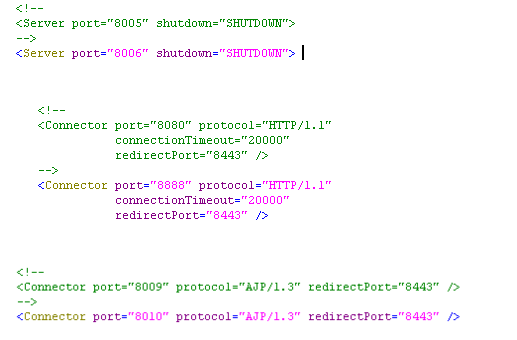
1)server.xml配置文件中第一个红色标记处加入如下内容:可以实现不同的端口访问同一个应用,如果想配置多个端口,继续在后面追加;
<Connector port="" protocol="HTTP/1.1"
connectionTimeout=""
redirectPort="" />
2)server.xml 配置文件第二个红色标记处加入如下内容:可以实现直接使用localhost+端口号访问项目,比如在webapps下放了一个wlsweb项目。想直接通过访问localhost:8080访问,可以直接在<host>里面加入如下内容:
<Context path="" docBase="/wlsweb" />
这样直接访问到了welweb不能再访问到ROOT。
3)一个电脑上配置两个或多个tomcat只需要复制一个副本,修改配置文件三处即可。否则会启动异常。
Tomcat server.xml配置文件的更多相关文章
- tomcat server.xml配置文件 解析
把服务拆分出来了. 前几天我也进行了拆分.可是当时服务起不来所以我想会不会有什么设置,使得这个服务在主机中只能启一个.然后我又找了一台服务器,也把代码放了进去.结果仿佛是我料想到的样子, ...
- tomcat设置默认欢迎页、server.xml配置文件中的标签理解
一:要求:输入网址,不加文件名便可以访问默认页面 (1)项目中只有静态文件 方法:更改tomcat下的conf目录下的web.xml文件,如下图: <welcom-file-list>元素 ...
- web服务器专题:tomcat(二)模块组件与server.xml 配置文件
web服务器专题:tomcat(二)模块组件与server.xml 配置文件 回顾: Web服务器专题:tomcat(一) 基础模块 一个Server.xml的实例 <?xml version= ...
- tomcat server.xml docbase workdir
在tomcat安装好后,只要把你的web项目copy到%TOMCAT_HOME%webapp下面就可以是使用啦!!其实还有种方法就是设定虚拟目录,即把项目的目录映射到tomcat中.这样做即可以不用重 ...
- tomcat——Server.xml
本机tomcat位置:D:\tomcat7\apache-tomcat-7.0.61 server.xml 位置:D:\tomcat7\apache-tomcat-7.0.61\conf 注意:ser ...
- Tomcat server.xml UTF-8配置
Tomcat server.xml UTF-8配置 <Connector port="8080" maxThreads="150" minSpareThr ...
- tomcat 的 server.xml配置文件
tomcat的配置文件在其安装后生成的conf目录下,其中主配置文件便是conf下的server.xml文件. server.xml文件由server->service->engine-& ...
- Tomcat下的Server.xml配置文件详解
自15年毕业到现在已经入行两年多了,一直以来没有深入的了解过tomcat的详细配置,只懂修改一下端口号.在网上找了些相关资料来支撑这篇文章,深入了解server.xml文件各配置的作用 <?xm ...
- 原 tomcat的server.xml配置文件中三个端口的作用
以Tomcat7.0为例, 在安装目录下. conf/server.xml 中可以配置三个端口号, 如果使用多个tomcat 是需要配置这三个. 该Connector 用于监听请求. protocol ...
随机推荐
- Luogu P1429 平面最近点对 【分治】By cellur925
题目传送门 题目大意:给定平面上n个点,找出其中的一对点的距离,使得在这n个点的所有点对中,该距离为所有点对中最小的.$n$<=100000. $Algorithm$ 最朴素的$n^2$枚举肯定 ...
- Android课程设计第四天ListView运用
注意:课程设计只为完成任务,不做细节描述~ 效果图 <?xml version="1.0" encoding="utf-8"?> <Relat ...
- Iahub and Xors Codeforces - 341D
二维线段树被卡M+T...于是去学二维树状数组区间更新区间查询 树状数组维护数列区间xor的修改.删除(就是把原问题改成一维): 以下p*i实际都指i个p相xor,即(i&1)*pa表示原数列 ...
- Hu矩
close all; clear all; I1=imread('lena.bmp'); angle=; T=[cos(angle),sin(angle),;-sin(angle),cos(angle ...
- h5-27-存储/读取JS对象
存储JS对象 <script type="text/javascript"> /*封装人员信息*/ function Person(id,name,age) { thi ...
- border 0px和border none的区别
border:0px这个表示的是边框为0像素,表示边框的像素 border:none 这个表示无边框(边框的绘制方式),边框的绘制方式有很多种:solid dashed等等
- C#中的委托(转)
C# 中的委托和事件 引言 委托 和 事件在 .Net Framework中的应用非常广泛,然而,较好地理解委托和事件对很多接触C#时间不长的人来说并不容易.它们就像是一道槛儿,过了这个槛的人,觉得真 ...
- JS进阶-特殊形式的函数-返回函数的函数/重写自己的函数
返回函数的函数 // 返回函数的函数 function a() { alert("aa"); return function () { alert("bb"); ...
- 批量部署Hadoop集群环境(1)
批量部署Hadoop集群环境(1) 1. 项目简介: 前言:云火的一塌糊涂,加上自大二就跟随一位教授做大数据项目,所以很早就产生了兴趣,随着知识的积累,虚拟机已经不能满足了,这次在服务器上以生产环境来 ...
- 自己动手实现Spring IoC框架
钻研Spring 源码也有一段时间了,对Spring IoC的实现原理理解算是比较透彻了,要实现一款IoC容器,简单的概括无非需要以下几个步骤: 1.定义用来描述bean的配置的Java类,例如我们有 ...