
【学时总结】 ◆学时 · I◆ A*算法
【学时·I】A*算法
■基本策略■
——A*(A Star)无非就是BFS的升级,当BFS都超时的时候……
同样以队列为基础结构,BFS使用FIFO队列(queue),而A*则使用优先队列(priority_queue)。与BFS的优化极其相似,但一般的BFS优化只是相当于使用了一个最优性剪枝,偶尔不会起到足够的优化所以就TLE了。
所以A*算法改进了其优先级的判定方法,使用了一个启发函数(没错,就是这么水的名字),它可以“乐观”地预估出一个从当前状态到达目标状态的代价,且此预估值必然小于等于实际值,否则A*算法就会出错。
■一般的搜索题■
这是A*的解题范围和其他搜索算法可以实现的解题范围的重叠域
◆永恒的经典◆ 八数码问题
· 以下引用自POJ 1077
 1  2  3  4


 5  6  7  8


 9 10 11 12


13 14 15  x
where the only legal operation is to exchange 'x' with one of the tiles with which it shares an edge. As an example, the following sequence of moves solves a slightly scrambled puzzle:
 1  2  3  4    1  2  3  4    1  2  3  4    1  2  3  4


 5  6  7  8    5  6  7  8    5  6  7  8    5  6  7  8


 9  x 10 12    9 10  x 12    9 10 11 12    9 10 11 12


13 14 11 15   13 14 11 15   13 14  x 15   13 14 15  x


           r->           d->           r->
The letters in the previous row indicate which neighbor of the 'x' tile is swapped with the 'x' tile at each step; legal values are 'r','l','u' and 'd', for right, left, up, and down, respectively.
Not all puzzles can be solved; in 1870, a man named Sam Loyd was famous for distributing an unsolvable version of the puzzle, and frustrating many people. In fact, all you have to do to make a regular puzzle into an unsolvable one is to swap two tiles (not counting the missing 'x' tile, of course).
In this problem, you will write a program for solving the less well-known 8-puzzle, composed of tiles on a three by three arrangement.
· 解析
这道题显然是一道搜索题,不过有一点变形……就难了许多。当然,这道题用BFS或者双向BFS能过,但是A*算法实际运行时间更优。
1.启发函数
作为整个A*算法的精华,这个函数显得十分重要,那么下面给出2个思路:
思路A: H()-当前状态有多少个元素不在正确位置; G()-当前搜索的深度,即用了的操作数; 最后一次操作将会在一次操作中将2个元素归位,所以启发函数F()=H()-1+G();
评价: 这个启发函数一定正确,但是通常与真实值相差过大,不是特别优;
思路B: H()-当前状态中位置不对的元素(不包含空位子)与正确位置的曼哈顿距离之和; G()-当前搜索的深度,即用了的操作数; 由于将一个元素归位至少需要H()次操作;
评价: 估测值与真实值较为接近,且不会超过真实值;
2.优先队列的定义
优先队列是A*算法所依赖的数据结构。STL的priority_queue能够实现自动排序,但有一个缺点——当需要输出路径时,STL的队列并没有提供访问删除了的元素的函数,因此无法通过记录“父亲”状态来输出路径,这时候就需要手写优先队列……QwQ
现在暂时不考虑这种尴尬情况,就当是只输出最短方案操作次数。那么我们需要一个结构体:
struct Node

{

	int pri,code,whe,dep;

	//优先级H(),八数码数字表示,空位的位置,搜索深度

}

bool operator <(Node A,Node B) {return A.pri+A.dep>B.pri+B.dep;}
这样定义了优先级过后就可以利用STL直接排序了~
3.如果代码不懂可以看这篇Blog:
Eight 八数码问题
· 源代码
仅供参考,如有不足(我知道写得复杂了点)请评论指出
/*Lucky_Glass*/

#include<cstdio>

#include<cstring>

#include<algorithm>

#include<queue>

using namespace std;

#define MOD 1000003

struct Node {int pri,code,whe,dep;}Push;

bool operator <(Node A,Node B) {return A.pri+A.dep>B.pri+B.dep;}

int num[10];

int MOve[4]={-3,-1,3,1};

long long ten_n[]={1,10,100,1000,10000,100000,1000000,10000000,100000000,1000000000,10000000000};

vector<int> vis[MOD];

inline int H(int n)

{

	int res=0;

	for(int i=9;i>0;i--,n/=10)

	{

		int v=n%10==0? 9:n%10;

		int x1=(i-1)/3+1,y1=i%3==0? 3:i%3;

		int x2=(v-1)/3+1,y2=v%3==0? 3:v%3;

		res+=abs(x1-x2)+abs(y1-y2);

	}

	return res;

}

inline long long change(int n,int a,int b)

{

	long long A=n%ten_n[9-a+1]/ten_n[9-a],B=n%ten_n[9-b+1]/ten_n[9-b],Ret;

	Ret=n-A*ten_n[9-a]-B*ten_n[9-b];

	Ret=Ret+B*ten_n[9-a]+A*ten_n[9-b];

	return Ret;

}

inline bool Find(int n)

{

	int m=n%MOD;

	for(int i=0;i<vis[m].size();i++)

		if(vis[m][i]==n)

			return true;

	vis[m].push_back(n);

	return false;

}

int main()

{

//	freopen("in.txt","r",stdin);

	priority_queue<Node> que;

	for(int i=0,j=0;i<9;i++)

	{

		scanf("%d",&num[j]);

		Push.code=Push.code*10+num[j];

		if(num[j]) j++;

		else Push.whe=i+1;

	}

	int End=0;

	for(int i=0,x;i<9;i++)

		scanf("%d",&x),End=10*End+x;

	Push.pri=H(Push.code);

	que.push(Push);

	while(!que.empty())

	{

		Node Top=que.top();que.pop();

		for(int i=0;i<4;i++)

		{

			Push=Top;

			Push.whe+=MOve[i];Push.dep++;

			if(Push.whe<=0 || Push.whe>9 || (i%2 && (Push.whe-1)/3!=(Top.whe-1)/3)) continue;

			Push.code=(int)change(Push.code,Push.whe,Top.whe);

			if(Find(Push.code)) continue;

			if(Push.code==End)

			{

				printf("%d",Push.dep);

				return 0;

			}

			Push.pri=H(Push.code);

			que.push(Push);

		}

	}

	puts("-1");

	return 0;

}
◆真正的难题◆ 15数码问题
BFS真的过不了了……
· 解析
这两道题唯一的区别就是数据规模,8数码的可能情况不超过9!种,但是15数码的可能情况是在16!种以内!所以只加上一般的判重并不能起到什么优秀的作用,所以用到了A*算法,启发函数和原来一样。但是……
人无完人,A*算法也是有缺陷的 QwQ
正如双向BFS,A*算法虽然在一般情况下较快,而这一般情况就是有解的情况。如果无解,双向搜索会退化为两个不相交的圆,既浪费空间又浪费时间;而A*算法会退化为普通的BFS(需要搜索完所有解),且比普通BFS慢——每次插入的时间复杂度为 O(log siz)。15数码仍然有无解的情况,所以为了避免超时(枚举出所有情况肯定会超时啊),我们需要预判:
bool If_ans(int brd[][4])

{

	int sum=0,siz=0,x,y,tmp[17]={};

	for(int i=0;i<4;i++)

		for(int j=0;j<4;j++)

		{

			tmp[siz++]=brd[i][j];

			if(!brd[i][j]) x=i,y=j;

		}

	for(int i=0;i<16;i++)

		for(int j=i+1;j<16;j++)

			if(tmp[j]<tmp[i] && tmp[j])

				sum++;

	if((sum+x)%2==0) return false;

	return true;

}
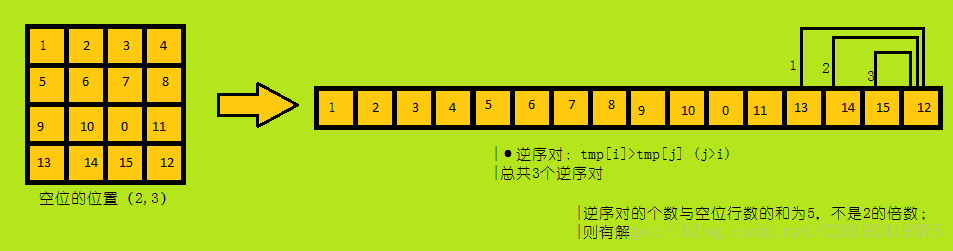
上面这段代码的意思就是——将4*4的15数码矩阵除去0后,每行相接形成一个链状表(tmp),求出逆序对的个数(sum),如果加上0的行数(行数从0开始)的和是二的倍数,则无解,否则有解。其实就是下面这样:
最为权威的英文证明:Workshop Java - Solvability of the Tiles Game
· 源代码
这段代码并不算优秀,实际上利用了 Uva 的数据漏洞,真正的解是 IDA*,之后再说
/*Lucky_Glass*/

#include<cstdio>

#include<cstring>

#include<algorithm>

#include<set>

#include<queue>

#include<iostream>

using namespace std;

const int mov[4][2]={{0,1},{0,-1},{1,0},{-1,0}};

const int fin[18][2]={{3,3},{0,0},{0,1},{0,2},{0,3},{1,0},{1,1},{1,2},{1,3},{2,0},{2,1},{2,2},{2,3},{3,0},{3,1},{3,2},{3,3}};

const char chr[]="RLDU";

struct state

{

	int pri,dep,x,y,brd[4][4];

	string ans;

	bool operator <(const state &cmp)const {return pri+dep>cmp.pri+cmp.dep;}

};

inline int Dis(int x,int y,int fx,int fy){return abs(x-fx)+abs(y-fy);}

int Get_pri(int brd[][4])

{

	int sum=0;

	for(int i=0;i<4;i++)

		for(int j=0;j<4;j++)

		{

			if(!brd[i][j] || (i==fin[brd[i][j]][0] && j==fin[brd[i][j]][1])) continue;

			sum+=Dis(i,j,fin[brd[i][j]][0],fin[brd[i][j]][1]);

		}

	return 4*sum;

}

bool If_ans(int brd[][4])

{

	int sum=0,siz=0,x,y,tmp[17]={};

	for(int i=0;i<4;i++)

		for(int j=0;j<4;j++)

		{

			tmp[siz++]=brd[i][j];

			if(!brd[i][j]) x=i,y=j;

		}

	for(int i=0;i<16;i++)

		for(int j=i+1;j<16;j++)

			if(tmp[j]<tmp[i] && tmp[j])

				sum++;

	if((sum+x)%2==0) return false;

	return true;

}

bool A_Star(state srt)

{

	priority_queue<state> que;

	state Top,Pus;

	que.push(srt);

	while(!que.empty())

	{

		Top=que.top();que.pop();

		for(int i=0;i<4;i++)

		{

			Pus=Top;Pus.x+=mov[i][0];Pus.y+=mov[i][1];

			if(Pus.x<0 || Pus.x>3 || Pus.y<0 || Pus.y>3) continue;

			swap(Pus.brd[Pus.x][Pus.y],Pus.brd[Top.x][Top.y]);

			Pus.dep++;

			if(Pus.dep>50) continue;

			Pus.ans+=chr[i];Pus.pri=Get_pri(Pus.brd);

			if(!Pus.pri) {cout<<Pus.ans<<endl;return true;}

			if(Pus.ans.size()>=2)

			{

				int f1=Pus.ans.size()-1,f2=Pus.ans.size()-2;

				if((Pus.ans[f1]=='U' && Pus.ans[f2]=='D') || (Pus.ans[f1]=='D' && Pus.ans[f2]=='U') || (Pus.ans[f1]=='L' && Pus.ans[f2]=='R') || (Pus.ans[f1]=='R' && Pus.ans[f2]=='L'))

					continue;

			}

			que.push(Pus);

		}

	}

	return false;

}

int main()

{

	int t;scanf("%d",&t);

	while(t--)

	{

		state srt;

		for(int i=0;i<4;i++)

			for(int j=0;j<4;j++)

			{

				scanf("%d",&srt.brd[i][j]);

				if(!srt.brd[i][j]) srt.x=i,srt.y=j;

			}

		if(!If_ans(srt.brd))

		{

			printf("This puzzle is not solvable.\n");

			continue;

		}

		srt.dep=0;srt.pri=0;

		if(!A_Star(srt)) printf("This puzzle is not solvable.\n");

	}

	return 0;

}
■k-短路问题■
其他的搜索拿这个题型没辙了 (`・ω・´)
◆一道版题◆ k-th shortest POJ 2449
(题目长在超链接里)
· 解析
其实就是标准的k短路。如果是一般的搜索肯定会TLE的,那么为什么A*可以完成呢?原因如下:
- A*算法利用优先队列,所以它按顺序找到的第k条路径一定是第k短的路径;
- 它最高的时间复杂度仅比BFS多 O(\log siz) ,所以时间复杂度并不高;
- 我们可以通过k次最短的路径查找只进行一次BFS;
与之前的算法不同,我们在原来的A*算法中会有判重,并舍弃优先级低的情况;但是由于K短路中,同一条路径可能走多次,以达到第k短的路径。比如下面:
但是这样也造成了一些麻烦,有时候是无解的:
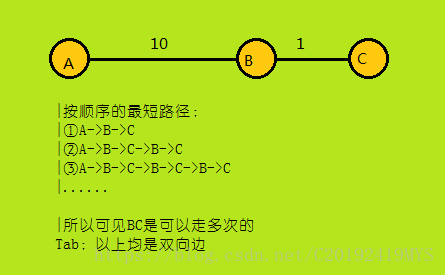
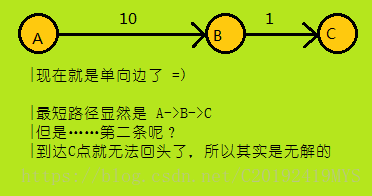
然后回到A*算法——由于我们按优先级排序,所以我们当前的队头元素一定是现在整个队列中最优的情况(前提是启发函数写对了);所以当我们第n次搜索到终点时,当前的路径就是第n短路径,为了避免意外,我们还可以先把到达终点的情况push到队列里,当整个操作完毕再次以到达终点的情况为队头时,说明它的确是第n短的。
根据这一性质,我们可以在队头元素是终点时,记录是第几次访问到终点,如果恰好是第n次,则返回答案——注意:此时虽然访问到终点,但还要把这种情况push进队列,否则反例见上图。
别急着写代码,有一个小坑。由于我们是判断队头是否为终点,所以当起点终点重合时,按题意应该不算最短路径,但当程序进入BFS时会记录一次。所以我们给出特判——当起点终点重合时,k++。
·源代码
/*Lucky_Glass*/

#include<cstdio>

#include<cstring>

#include<algorithm>

#include<queue>

#include<vector>

using namespace std;

#define POI 1000

struct Line{int v,len;};

struct state

{

	int u,dep,pri;

	bool operator <(const state cmp)const

	{

		if(cmp.pri==pri) return cmp.dep<dep;

		else return cmp.pri<pri;

	}

};

vector<Line> lec[POI+5],dis_lec[POI+5];

int n_poi,n_edg,srt,fin,kth,INF;

int dis[POI+5];

inline Line Make_Line(int v,int l){return Line{v,l};};

void SPFA()

{

	bool vis[POI+5]={};

	memset(dis,0x3f,sizeof dis);INF=dis[0];

	queue<int> que;

	dis[fin]=0;que.push(fin);

	while(!que.empty())

	{

		int Fro=que.front();que.pop();

		vis[Fro]=false;

		for(int i=0;i<dis_lec[Fro].size();i++)

		{

			int Pus=dis_lec[Fro][i].v;

			if(dis[Pus]>dis[Fro]+dis_lec[Fro][i].len)

			{

				dis[Pus]=dis[Fro]+dis_lec[Fro][i].len;

				if(!vis[Pus]) que.push(Pus),vis[Pus]=true;

			}

		}

	}

}

int A_Star()

{

	if(srt==fin) kth++;

	if(dis[srt]==INF) return -1;

	priority_queue<state> que;

	que.push(state{srt,0,dis[srt]});

	int tot=0;

	while(!que.empty())

	{

		state Top=que.top();que.pop();

		if(Top.u==fin)

		{

			tot++;

			if(tot==kth) return Top.dep;

		}

		for(int i=0;i<lec[Top.u].size();i++)

		{

			state Pus=Top;

			Pus.dep+=lec[Top.u][i].len;

			Pus.u=lec[Top.u][i].v;

			Pus.pri=dis[Pus.u]+Pus.dep;

			que.push(Pus);

		}

	}

	return -1;

}

int main()

{

	scanf("%d%d",&n_poi,&n_edg);

	for(int i=0,u,v,l;i<n_edg;i++)

		scanf("%d%d%d",&u,&v,&l),lec[u].push_back(Line{v,l}),dis_lec[v].push_back(Line{u,l});

	scanf("%d%d%d",&srt,&fin,&kth);

	SPFA();

	printf("%d\n",A_Star());

	return 0;

}
The End
Thanks for reading!
-Lucky_Glass
【学时总结】 ◆学时 · I◆ A*算法的更多相关文章
- 【学时总结】 ◆学时·II◆ IDA*算法
[学时·II] IDA*算法 ■基本策略■ 如果状态数量太多了,优先队列也难以承受:不妨再回头看DFS-- A*算法是BFS的升级,那么IDA*算法是对A*算法的再优化,同时也是对迭代加深搜索(IDF ...
- springMVC文件上传与下载(六)
1..文件上传 在springmvc.xml中配置文件上传解析器 <!-- 上传图片配置实现类,id必须为这个 --> <bean id="multipartResolve ...
- 如何使用和关闭onbeforeunload 默认的浏览器弹窗事件
Onunload,onbeforeunload都是在刷新或关闭时调用,可以在<script>脚本中通过 window.onunload来指定或者在<body>里指定.区别在于o ...
- 教师表(TEACHER.DBF)
20-27题使用的数据如表1和表2所示. 表1 教师表(TEACHER.DBF) 教师号 姓名 性别 籍贯 职称 年龄 工资/元 0001 王吉兵 男 江苏 讲师 27 2003.50 0002 张晓 ...
- 【学时总结】 ◆学时·III◆ 二分图
[学时·III] 二分图 ■基本策略■ 其实本质是图论中的网络流 二分图是两个由多个点组成的集合(上部和下部,且没有重叠),两个集合中的点不与该集合内其他的点连通,但和另一个集合内的点连通.我们称这两 ...
- 【学时总结&模板时间】◆学时·10 & 模板·3◆ AC自动机
◇学时·10 & 模板·3◇ AC自动机 跟着高中上课……讲AC自动机的扩展运用.然而连KMP.trie字典树都不怎么会用的我一脸懵逼<(_ _)> 花一上午自学了一下AC自动机 ...
- 【学时总结】◆学时·IX◆ 整体二分
◆学时·IX◆ 整体二分 至于我怎么了解到这个算法的……只是因为发现一道题,明显的二分查找,但是时间会爆炸,被逼无奈搜题解……然后就发现了一些东西QwQ ◇ 算法概述 整体二分大概是把BFS与二分查找 ...
- 【学时总结】◆学时·VIII◆ 树形DP
◆学时·VIII◆ 树形DP DP像猴子一样爬上了树……QwQ ◇ 算法概述 基于树的模型,由于树上没有环,满足DP的无后效性,可以充分发挥其强大统计以及计算答案的能力. 一般来说树形DP的状态定义有 ...
- 【学时总结】◆学时·VII◆ 高维DP
◆学时·VII◆ 高维DP 自学之余,偶遇DP…… ◇ 算法概述 顾名思义——一种处理多方面状态的DP,这种DP特点是……每一维的大小都不算太大(不然用dp数组存储下来内存会炸),而且枚举时容易超时… ...
随机推荐
- 微服务架构之spring cloud ribbon
现在负载均衡是通用的解决分压的技术方案,实现方式一般分为服务端或者客户端,服务端大部分是使用中间件实现,spring cloud ribbon 是一个客户端负载均衡组件.跟spring cloud e ...
- Linux扩展根目录下的空间
自己通过root创建了一个新用户,然而当我使用这个新用户时发现,/home/my中的空间只有几十M,完全不能满足我的使用,所以通过下面的方法扩展根下的空间. 我的本次操作,参考于 http://www ...
- Maven 安装 eclispe
-Dmaven.multiModuleProjectDirectory=$M2_HOME
- 在centos6.x上安装teamviewer
首先下载公钥: # wget http://www.teamviewer.com/link/?url=354858 # rpm --import TeamViewer_Linux_PubKey.asc ...
- HTML5-入门2。
文本样式 <b>加粗</b> <i>倾斜</i> <u>下划线</u> <s>删除线</s> < ...
- SVN合并时报错:合并跟踪不允许丢失子树Merge tracking not allowed with missing subtrees; try restoring these items
使用的是TortoiseSVN; Merge tracking not allowed with missing subtrees; try restoring these items 下面会有跟着几 ...
- c#多线程调用有参数的方法
Thread (ParameterizedThreadStart) 初始化 Thread 类的新实例,指定允许对象在线程启动时传递给线程的委托. Thread (ThreadStart) 初始 ...
- 使用 grep 的 -o 和 -E 选项进行正则的精确匹配
sed 命令可以很好的进行行匹配,但从某一行中精确匹配某些内容,则使用 grep 命令并辅以 -o 和 -E 选项可达到此目的.其中 -o 表示“only-matching”,即“仅匹配”之意.光用它 ...
- 编程语言——C----细节
2017-09-27 18:40:47 程序设计的基本概念 1.计算机语言:把人与计算机之间交流的语言叫做计算机语言 1)计算机语言分为高级语言和低级语言 2)高级语言:远离硬件 3)低级语言:贴近 ...
- 微软Charting图表控件 System.Web.UI.DataVisuliztion.Charting
一.概述 基于.NET Framework 3.5 SP1的图表控件--Chart,可在WinForm和WebForm下使用!需要引入System.Web.DataVisualization.dll ...