原文地址:http://blog.didispace.com/java-lombok-1/
关于Lombok,其实在网上可以找到很多如何使用的文章,但是很少能找到比较齐全的整理。我也一直寻思着想写一篇各个注解用法的总结,但是一直都没有付诸行动。今天看到了微信公众号”原力注入”推送的这篇文章,总结的内容很全,所以分享给所有关注我博客的朋友们。
Lombok简介
Project Lombok makes java a spicier language by adding ‘handlers’ that know >how to build and compile simple, boilerplate-free, not-quite-java code.
如Github上项目介绍所言,Lombok项目通过添加“处理程序”,使java成为一种更为简单的语言。作为一个Old Java Developer,我们都知道我们经常需要定义一系列的套路,比如定义如下的格式对象。
public class DataExample {
  private final String name;
  private int age;
  private double score;
  private String[] tags;
}
|
我们往往需要定义一系列的Get和Set方法最终展示形式如:
public class DataExample {
  private final String name;
  private int age;
  private double score;
  private String[] tags;
  public DataExample(String name) {
    this.name = name;
  }
  public String getName() {
    return this.name;
  }
  void setAge(int age) {
    this.age = age;
  }
  public int getAge() {
    return this.age;
  }
  public void setScore(double score) {
    this.score = score;
  }
  public double getScore() {
    return this.score;
  }
  public String[] getTags() {
    return this.tags;
  }
  public void setTags(String[] tags) {
    this.tags = tags;
  }
}
|
那我们有没有可以简化的办法呢,第一种就是使用IDEA等IDE提供的一键生成的快捷键,第二种就是我们今天介绍的 Lombok项目:
@Data
public class DataExample {
  private final String name;
  @Setter(AccessLevel.PACKAGE)
  private int age;
  private double score;
  private String[] tags;
}
|
Wow…这样就可以完成我们的需求,简直是太棒了,仅仅需要几个注解,我们就拥有了完整的GetSet方法,还包含了ToString等方法的生成。
Lombok安装
整个Lombok只有一个Jar包,可到这里下载:https://projectlombok.org/download
Lombok支持多种使用安装方式,这里我们讲最常见的对两大IDE的支持:
Eclipse (含延伸版本)
双击打开 lombok.jar (前提:你得装了JDK), 可见如下页面点击 Install/Update:
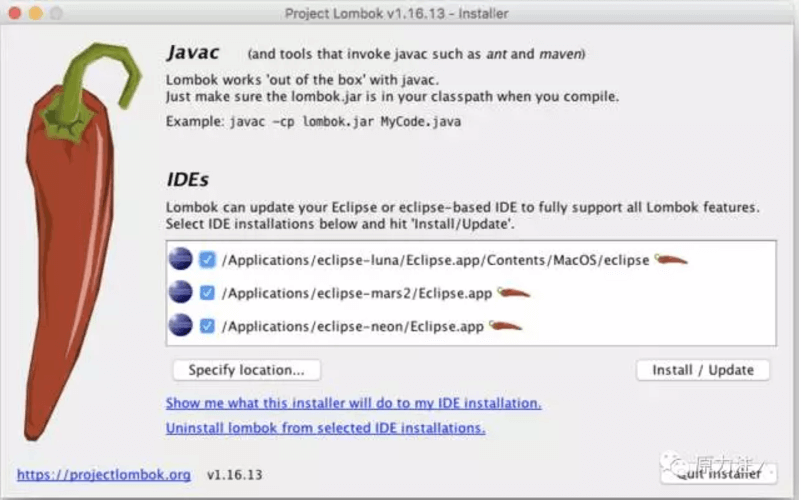
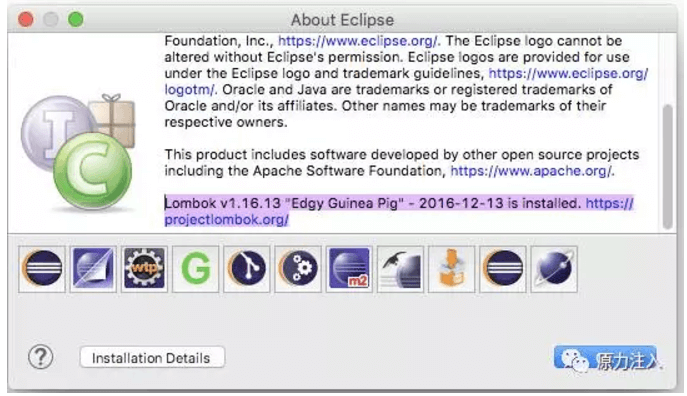
恭喜你,已经安装成功了。我们打开 Eclipse 的 About 页面我们可以看见。
IntelliJ IDEA
- 定位到 File > Settings > Plugins
- 点击 Browse repositories…
- 搜索 Lombok Plugin
- 点击 Install plugin
- 重启 IDEA
更多安装请参考:https://projectlombok.org/
Lombok使用
Lombok 其实也不能算是一个特别新的项目,从 2011 开始在中心仓库提供支持,现在也分为 stable 和 experimental 两个版本,本文侧重介绍 stable 功能:
val
如果对其他的语言有研究的会发现,很多语言是使用 var 作为变量申明,val作为常量申明。这里的val也是这个作用。
public String example() {
    val example = new ArrayList<String>();
    example.add("Hello, World!");
    val foo = example.get(0);
    return foo.toLowerCase();
}
|
翻译成 Java 程序是:
public String example() {
    final ArrayList<String> example = new ArrayList<String>();
    example.add("Hello, World!");
    final String foo = example.get(0);
    return foo.toLowerCase();
}
|
作者注:也就是类型推导啦。
@NonNull
Null 即是罪恶
public class NonNullExample extends Something {
  private String name;

  public NonNullExample(@NonNull Person person) {
    super("Hello");
    this.name = person.getName();
  }
}
|
翻译成 Java 程序是:
public class NonNullExample extends Something {
  private String name;

  public NonNullExample(@NonNull Person person) {
    super("Hello");
    if (person == null) {
      throw new NullPointerException("person");
    }
    this.name = person.getName();
  }
}
|
@Cleanup
自动化才是生产力
public class CleanupExample {
  public static void main(String[] args) throws IOException {
    @Cleanup InputStream in = new FileInputStream(args[0]);
    @Cleanup OutputStream out = new FileOutputStream(args[1]);
    byte[] b = new byte[10000];
    while (true) {
      int r = in.read(b);
      if (r == -1) break;
      out.write(b, 0, r);
    }
  }
}
|
翻译成 Java 程序是:
public class CleanupExample {
  public static void main(String[] args) throws IOException {
    InputStream in = new FileInputStream(args[0]);
    try {
      OutputStream out = new FileOutputStream(args[1]);
      try {
        byte[] b = new byte[10000];
        while (true) {
          int r = in.read(b);
          if (r == -1) break;
          out.write(b, 0, r);
        }
      } finally {
        if (out != null) {
          out.close();
        }
      }
    } finally {
      if (in != null) {
        in.close();
      }
    }
  }
}
|
作者注: JKD7里面就已经提供 try with resource
@Getter/@Setter
再也不写 public int getFoo() {return foo;}
public class GetterSetterExample {

  @Getter @Setter private int age = 10;

  @Setter(AccessLevel.PROTECTED) private String name;

  @Override public String toString() {
    return String.format("%s (age: %d)", name, age);
  }
}
|
翻译成 Java 程序是:
public class GetterSetterExample {

  private int age = 10;

  private String name;

  @Override public String toString() {
    return String.format("%s (age: %d)", name, age);
  }

  public int getAge() {
    return age;
  }

  public void setAge(int age) {
    this.age = age;
  }

  protected void setName(String name) {
    this.name = name;
  }
}
|
@ToString
Debug Log 最强帮手
@ToString(exclude="id")
public class ToStringExample {
  private static final int STATIC_VAR = 10;
  private String name;
  private Shape shape = new Square(5, 10);
  private String[] tags;
  private int id;

  public String getName() {
    return this.getName();
  }

  @ToString(callSuper=true, includeFieldNames=true)
  public static class Square extends Shape {
    private final int width, height;

    public Square(int width, int height) {
      this.width = width;
      this.height = height;
    }
  }
}
|
翻译后:
public class ToStringExample {
  private static final int STATIC_VAR = 10;
  private String name;
  private Shape shape = new Square(5, 10);
  private String[] tags;
  private int id;

  public String getName() {
    return this.getName();
  }

  public static class Square extends Shape {
    private final int width, height;

    public Square(int width, int height) {
      this.width = width;
      this.height = height;
    }

    @Override public String toString() {
      return "Square(super=" + super.toString() + ", width=" + this.width + ", height=" + this.height + ")";
    }
  }

  @Override public String toString() {
    return "ToStringExample(" + this.getName() + ", " + this.shape + ", " + Arrays.deepToString(this.tags) + ")";
  }
}
|
作者注:其实和 org.apache.commons.lang3.builder.ReflectionToStringBuilder 很像。
@NoArgsConstructor, @RequiredArgsConstructor and @AllArgsConstructor
@RequiredArgsConstructor(staticName = "of")
@AllArgsConstructor(access = AccessLevel.PROTECTED)
public class ConstructorExample<T> {
  private int x, y;
  @NonNull private T description;

  @NoArgsConstructor
  public static class NoArgsExample {
    @NonNull private String field;
  }
}
|
翻译后:
public class ConstructorExample<T> {
  private int x, y;
  @NonNull private T description;

  private ConstructorExample(T description) {
    if (description == null) throw new NullPointerException("description");
    this.description = description;
  }

  public static <T> ConstructorExample<T> of(T description) {
    return new ConstructorExample<T>(description);
  }

  @java.beans.ConstructorProperties({"x", "y", "description"})
  protected ConstructorExample(int x, int y, T description) {
    if (description == null) throw new NullPointerException("description");
    this.x = x;
    this.y = y;
    this.description = description;
  }

  public static class NoArgsExample {
    @NonNull private String field;

    public NoArgsExample() {
    }
  }
}
|
@Data
这个就相当的简单啦,因为我们发现@ToString, @EqualsAndHashCode, @Getter 都很常用,这个一个注解就相当于
@ToString
@EqualsAndHashCode
@Getter(所有字段)
@Setter (所有非final字段)
@RequiredArgsConstructor
|
@Value
@Value public class ValueExample {
  String name;
  @Wither(AccessLevel.PACKAGE) @NonFinal int age;
  double score;
  protected String[] tags;

  @ToString(includeFieldNames=true)
  @Value(staticConstructor="of")
  public static class Exercise<T> {
    String name;
    T value;
  }
}
|
翻译后:
public final class ValueExample {
  private final String name;
  private int age;
  private final double score;
  protected final String[] tags;

  @java.beans.ConstructorProperties({"name", "age", "score", "tags"})
  public ValueExample(String name, int age, double score, String[] tags) {
    this.name = name;
    this.age = age;
    this.score = score;
    this.tags = tags;
  }

  public String getName() {
    return this.name;
  }

  public int getAge() {
    return this.age;
  }

  public double getScore() {
    return this.score;
  }

  public String[] getTags() {
    return this.tags;
  }

  @java.lang.Override
  public boolean equals(Object o) {
    if (o == this) return true;
    if (!(o instanceof ValueExample)) return false;
    final ValueExample other = (ValueExample)o;
    final Object this$name = this.getName();
    final Object other$name = other.getName();
    if (this$name == null ? other$name != null : !this$name.equals(other$name)) return false;
    if (this.getAge() != other.getAge()) return false;
    if (Double.compare(this.getScore(), other.getScore()) != 0) return false;
    if (!Arrays.deepEquals(this.getTags(), other.getTags())) return false;
    return true;
  }

  @java.lang.Override
  public int hashCode() {
    final int PRIME = 59;
    int result = 1;
    final Object $name = this.getName();
    result = result * PRIME + ($name == null ? 43 : $name.hashCode());
    result = result * PRIME + this.getAge();
    final long $score = Double.doubleToLongBits(this.getScore());
    result = result * PRIME + (int)($score >>> 32 ^ $score);
    result = result * PRIME + Arrays.deepHashCode(this.getTags());
    return result;
  }

  @java.lang.Override
  public String toString() {
    return "ValueExample(name=" + getName() + ", age=" + getAge() + ", score=" + getScore() + ", tags=" + Arrays.deepToString(getTags()) + ")";
  }

  ValueExample withAge(int age) {    return this.age == age ? this : new ValueExample(name, age, score, tags);  }    public static final class Exercise<T> {    private final String name;    private final T value;        private Exercise(String name, T value) {      this.name = name;      this.value = value;    }        public static <T> Exercise<T> of(String name, T value) {      return new Exercise<T>(name, value);    }        public String getName() {      return this.name;    }        public T getValue() {      return this.value;    }        @java.lang.Override    public boolean equals(Object o) {      if (o == this) return true;      if (!(o instanceof ValueExample.Exercise)) return false;      final Exercise<?> other = (Exercise<?>)o;      final Object this$name = this.getName();      final Object other$name = other.getName();      if (this$name == null ? other$name != null : !this$name.equals(other$name)) return false;      final Object this$value = this.getValue();      final Object other$value = other.getValue();      if (this$value == null ? other$value != null : !this$value.equals(other$value)) return false;      return true;    }        @java.lang.Override    public int hashCode() {      final int PRIME = 59;      int result = 1;      final Object $name = this.getName();      result = result * PRIME + ($name == null ? 43 : $name.hashCode());      final Object $value = this.getValue();      result = result * PRIME + ($value == null ? 43 : $value.hashCode());      return result;    }        @java.lang.Override    public String toString() {      return "ValueExample.Exercise(name=" + getName() + ", value=" + getValue() + ")";    }  }}
|
我们发现了 @Value 就是 @Data 的不可变版本。至于不可变有什么好处。可有参看此篇(https://blogs.msdn.microsoft.com/ericlippert/2007/11/13/immutability-in-c-part-one-kinds-of-immutability/)
@Builder
我的最爱
@Builder
public class BuilderExample {
  private String name;
  private int age;
  @Singular private Set<String> occupations;
}
翻译后:

public class BuilderExample {
  private String name;
  private int age;
  private Set<String> occupations;

  BuilderExample(String name, int age, Set<String> occupations) {
    this.name = name;
    this.age = age;
    this.occupations = occupations;
  }

  public static BuilderExampleBuilder builder() {
    return new BuilderExampleBuilder();
  }

  public static class BuilderExampleBuilder {
    private String name;
    private int age;
    private java.util.ArrayList<String> occupations;

    BuilderExampleBuilder() {
    }

    public BuilderExampleBuilder name(String name) {
      this.name = name;
      return this;
    }

    public BuilderExampleBuilder age(int age) {
      this.age = age;
      return this;
    }

    public BuilderExampleBuilder occupation(String occupation) {
      if (this.occupations == null) {
        this.occupations = new java.util.ArrayList<String>();
      }

      this.occupations.add(occupation);
      return this;
    }

    public BuilderExampleBuilder occupations(Collection<? extends String> occupations) {
      if (this.occupations == null) {
        this.occupations = new java.util.ArrayList<String>();
      }

      this.occupations.addAll(occupations);
      return this;
    }

    public BuilderExampleBuilder clearOccupations() {
      if (this.occupations != null) {
        this.occupations.clear();
      }

      return this;
    }

    public BuilderExample build() {
      // complicated switch statement to produce a compact properly sized immutable set omitted.
      // go to https://projectlombok.org/features/Singular-snippet.html to see it.
      Set<String> occupations = ...;
      return new BuilderExample(name, age, occupations);
    }

    @java.lang.Override
    public String toString() {
      return "BuilderExample.BuilderExampleBuilder(name = " + this.name + ", age = " + this.age + ", occupations = " + this.occupations + ")";
    }
  }
}
|
builder是现在比较推崇的一种构建值对象的方式。
作者注:生成器模式
@SneakyThrows
to RuntimeException 小助手
public class SneakyThrowsExample implements Runnable {
  @SneakyThrows(UnsupportedEncodingException.class)
  public String utf8ToString(byte[] bytes) {
    return new String(bytes, "UTF-8");
  }

  @SneakyThrows
  public void run() {
    throw new Throwable();
  }
}
|
翻译后
public class SneakyThrowsExample implements Runnable {
  public String utf8ToString(byte[] bytes) {
    try {
      return new String(bytes, "UTF-8");
    } catch (UnsupportedEncodingException e) {
      throw Lombok.sneakyThrow(e);
    }
  }

  public void run() {
    try {
      throw new Throwable();
    } catch (Throwable t) {
      throw Lombok.sneakyThrow(t);
    }
  }
}
|
很好的隐藏了异常,有时候的确会有这样的烦恼,从某种程度上也是遵循的了 let is crash
@Synchronized
public class SynchronizedExample {
  private final Object readLock = new Object();

  @Synchronized
  public static void hello() {
    System.out.println("world");
  }

  @Synchronized
  public int answerToLife() {
    return 42;
  }

  @Synchronized("readLock")
  public void foo() {
    System.out.println("bar");
  }
}
|
翻译后
public class SynchronizedExample {
  private static final Object $LOCK = new Object[0];
  private final Object $lock = new Object[0];
  private final Object readLock = new Object();

  public static void hello() {
    synchronized($LOCK) {
      System.out.println("world");
    }
  }

  public int answerToLife() {
    synchronized($lock) {
      return 42;
    }
  }

  public void foo() {
    synchronized(readLock) {
      System.out.println("bar");
    }
  }
}
|
这个就比较简单直接添加了synchronized关键字就Ok啦。不过现在JDK也比较推荐的是 Lock 对象,这个可能用的不是特别多。
@Getter(lazy=true)
节约是美德
public class GetterLazyExample {
  @Getter(lazy=true) private final double[] cached = expensive();

  private double[] expensive() {
    double[] result = new double[1000000];
    for (int i = 0; i < result.length; i++) {
      result[i] = Math.asin(i);
    }
    return result;
  }
}
|
翻译后:
public class GetterLazyExample {
  private final java.util.concurrent.AtomicReference<java.lang.Object> cached = new java.util.concurrent.AtomicReference<java.lang.Object>();

  public double[] getCached() {
    java.lang.Object value = this.cached.get();
    if (value == null) {
      synchronized(this.cached) {
        value = this.cached.get();
        if (value == null) {
          final double[] actualValue = expensive();
          value = actualValue == null ? this.cached : actualValue;
          this.cached.set(value);
        }
      }
    }
    return (double[])(value == this.cached ? null : value);
  }

  private double[] expensive() {
    double[] result = new double[1000000];
    for (int i = 0; i < result.length; i++) {
      result[i] = Math.asin(i);
    }
    return result;
  }
}
|
@Log
再也不用写那些差不多的LOG啦
@Log
public class LogExample {

  public static void main(String... args) {
    log.error("Something's wrong here");
  }
}
|
@Slf4j
public class LogExampleOther {

  public static void main(String... args) {
    log.error("Something else is wrong here");
  }
}
|
@CommonsLog(topic="CounterLog")
public class LogExampleCategory {

  public static void main(String... args) {
    log.error("Calling the 'CounterLog' with a message");
  }
}
|
翻译后:
public class LogExample {
  private static final java.util.logging.Logger log = java.util.logging.Logger.getLogger(LogExample.class.getName());

  public static void main(String... args) {
    log.error("Something's wrong here");
  }
}
|
public class LogExampleOther {
  private static final org.slf4j.Logger log = org.slf4j.LoggerFactory.getLogger(LogExampleOther.class);

  public static void main(String... args) {
    log.error("Something else is wrong here");
  }
}
|
public class LogExampleCategory {
  private static final org.apache.commons.logging.Log log = org.apache.commons.logging.LogFactory.getLog("CounterLog");

  public static void main(String... args) {
    log.error("Calling the 'CounterLog' with a message");
  }
}
|
Lombok原理
说道 Lombok,我们就得去提到 JSR 269: Pluggable Annotation Processing API (https://www.jcp.org/en/jsr/detail?id=269) 。JSR 269 之前我们也有注解这样的神器,可是我们比如想要做什么必须使用反射,反射的方法局限性较大。首先,它必须定义@Retention为RetentionPolicy.RUNTIME,只能在运行时通过反射来获取注解值,使得运行时代码效率降低。其次,如果想在编译阶段利用注解来进行一些检查,对用户的某些不合理代码给出错误报告,反射的使用方法就无能为力了。而 JSR 269 之后我们可以在 Javac的编译期利用注解做这些事情。所以我们发现核心的区分是在 运行期 还是 编译期。

从上图可知,Annotation Processing 是在解析和生成之间的一个步骤。

上图是 Lombok 处理流程,在Javac 解析成抽象语法树之后(AST), Lombok 根据自己的注解处理器,动态的修改 AST,增加新的节点(所谓代码),最终通过分析和生成字节码。
关于原理我们大致上的描述下,如果有兴趣可以参考下方文档。
- JAVA8-让代码更优雅之List排序
先定义一个实体类 @Data @AllArgsConstructor @NoArgsConstructor public class Human { private String name; priv ...
- JDK8漫谈——代码更优雅
简介 lambda表达式,又称闭包(Closure)或称匿名方法(anonymous method).将Lambda表达式引入JAVA中的动机源于一个叫"行为参数"的模式.这种模式 ...
- lombok 简化java代码注解
lombok 简化java代码注解 安装lombok插件 以intellij ide为例 File-->Setting-->Plugins-->搜索"lombok plug ...
- Lombok简化Java代码
导包:import lombok.Data; Lombok简化Java代码: 在Lombok中,生成构造方法的annotation一共有三个:@NoArgsConstructor, @Required ...
- Lambda表达式, 可以让我们的代码更优雅.
在C#中, 适当地使用Lambda表达式, 可以让我们的代码更优雅. 通过lambda表达式, 我们可以很方便地创建一个delegate: 下面两个语句是等价的 Code highlighting p ...
- CSS 黑魔法小技巧,让你少写不必要的JS,代码更优雅
首页 登录注册 CSS 黑魔法小技巧,让你少写不必要的JS,代码更优雅 阅读 8113 收藏 927 2017-09-26 原文链接:github.com 腾讯云容器服务CSS,立 ...
- 用Assert(断言)封装异常,让代码更优雅(附项目源码)
有关Assert断言大家并不陌生,我们在做单元测试的时候,看业务事务复合预期,我们可以通过断言来校验,断言常用的方法如下: public class Assert { /** * 结果 = 预期 则正 ...
- 想让你的java代码更漂亮,用枚举吧
枚举是java 5之后添加的一个重要特性,这个特性不能提高性能,但是能让java程序员写出更优雅的代码. 我之前看到过挺多介绍java枚举的不错的帖子,我也来参与以下这个话题. 1. 枚举基本用法 / ...
- Lombok简化Java代码的好工具
lombok 的官方网址:http://projectlombok.org/ 关于lombok 的介绍,有几篇帖子,写得都很好 比如 http://www.blogjava.net/fancydeep ...
随机推荐
- SQL表之间复制数据、选出随机几条数据、删除重复数据、取得自增长列等操作
--表之间数据复制 SELECT* INTO yozhu FROM yo --复制一份表 SELECT* INTO yozhu1 FROM yo where 1<>1 --只复制表结构,无 ...
- 《JAVA与模式》之备忘录模式
一.备忘录(Memento)模式结构 备忘录对象是一个用来存储另外一个对象内部状态的快照(snapshot)的对象.备忘录模式的用意是在不破坏封装的条件下,将一个对象的状态捕捉住,并外部化,存储起来, ...
- JDBC连接SQLServer出现的异常
数据库连接. question1. java.lang.ClassNotFoundException: com.microsoft.sqlserver.jdbc.SQLServerDriver 异常 ...
- Redis快速入门及应用
Redis的使用难吗?不难,Redis用好容易吗?不容易.Redis的使用虽然不难,但与业务结合的应用场景特别多.特别紧,用好并不容易.我们希望通过一篇文章及Demo,即可轻松.快速入门并学会应用.一 ...
- SharePoint下在Feature中动态Register/Remove HttpModule
在SharePoint开发时,你会遇到这样一个问题,Global.asax去哪儿?怎样添加一个Global.asax?怎样在Application_Start这个事件处理程序里设置初始化?似乎在Vis ...
- Java Nashorn--Part 6
Nashorn 的 JavaScript 语言的扩展 正如我们所讨论的,Nashorn 是一个完全符合 ECMAScript 5.1 的实现.然而除此之外,Nashorn 还实现了很多 JavaScr ...
- 类名.class和getClass()区别
class叫做“类字面量”,因class是关键字, 所以class编译时确定,getclass()运行时根据实际实例确定.String.class 是能对类名的引用取得在内存中该类型class对象的引 ...
- 使用Python3自带工具2to3.py 转换 Python2.x 代码 到Python3
几乎所有的Python 2程序都需要一些修改才能正常地运行在Python 3的环境下.为了简化这个转换过程,Python 3自带了一个叫做2to3的实用脚本(Utility Script),这个脚本会 ...
- ASP.NET 的ClientIDMode属性
在ASP.NET 4.0之前我们总是要为控件的ClientID头疼,比如明明一个叫lblName的Label放在一个叫做grd的GridView里面后,在页面上改Label的ID就变成了诸如grd_c ...
- Android后台处理最佳实践(Best Practices for Background Jobs)
本课将告诉你如何通过后台加载来加速应用启动和降低应用耗电. 后台跑服务 除非你做了特殊指定,否则在应用中的大部分前台操作都是在一个特殊的UI线程里面进行的.这有可能会导致一些问题,因为长时间运行的操作 ...
