
POJ 3522 - Slim Span - [kruskal求MST]
题目链接:http://poj.org/problem?id=3522
Time Limit: 5000MS Memory Limit: 65536K
Description
Given an undirected weighted graph G, you should find one of spanning trees specified as follows.
The graph G is an ordered pair (V, E), where V is a set of vertices {v1, v2, …, vn} and E is a set of undirected edges {e1, e2, …, em}. Each edge e ∈ E has its weight w(e).
A spanning tree T is a tree (a connected subgraph without cycles) which connects all the n vertices with n − 1 edges. The slimness of a spanning tree T is defined as the difference between the largest weight and the smallest weight among the n − 1 edges of T.
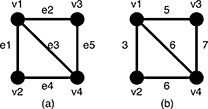
Figure 5: A graph G and the weights of the edges
For example, a graph G in Figure 5(a) has four vertices {v1, v2, v3, v4} and five undirected edges {e1, e2, e3, e4, e5}. The weights of the edges are w(e1) = 3, w(e2) = 5, w(e3) = 6, w(e4) = 6, w(e5) = 7 as shown in Figure 5(b).
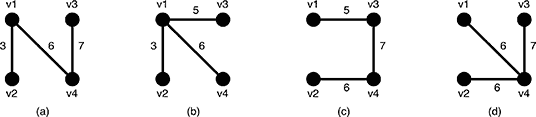
Figure 6: Examples of the spanning trees of G
There are several spanning trees for G. Four of them are depicted in Figure 6(a)~(d). The spanning tree Ta in Figure 6(a) has three edges whose weights are 3, 6 and 7. The largest weight is 7 and the smallest weight is 3 so that the slimness of the tree Ta is 4. The slimnesses of spanning trees Tb, Tc and Td shown in Figure 6(b), (c) and (d) are 3, 2 and 1, respectively. You can easily see the slimness of any other spanning tree is greater than or equal to 1, thus the spanning tree Td in Figure 6(d) is one of the slimmest spanning trees whose slimness is 1.
Your job is to write a program that computes the smallest slimness.
Input
The input consists of multiple datasets, followed by a line containing two zeros separated by a space. Each dataset has the following format.
| n | m | |
| a1 | b1 | w1 |
| ⋮ | ||
| am | bm | wm |
Every input item in a dataset is a non-negative integer. Items in a line are separated by a space. n is the number of the vertices and m the number of the edges. You can assume 2 ≤ n ≤ 100 and 0 ≤ m ≤ n(n − 1)/2. ak and bk (k = 1, …, m) are positive integers less than or equal to n, which represent the two vertices vak and vbk connected by the kth edge ek. wk is a positive integer less than or equal to 10000, which indicates the weight of ek. You can assume that the graph G = (V, E) is simple, that is, there are no self-loops (that connect the same vertex) nor parallel edges (that are two or more edges whose both ends are the same two vertices).
Output
For each dataset, if the graph has spanning trees, the smallest slimness among them should be printed. Otherwise, −1 should be printed. An output should not contain extra characters.
Sample Input
4 5

1 2 3

1 3 5

1 4 6

2 4 6

3 4 7

4 6

1 2 10

1 3 100

1 4 90

2 3 20

2 4 80

3 4 40

2 1

1 2 1

3 0

3 1

1 2 1

3 3

1 2 2

2 3 5

1 3 6

5 10

1 2 110

1 3 120

1 4 130

1 5 120

2 3 110

2 4 120

2 5 130

3 4 120

3 5 110

4 5 120

5 10

1 2 9384

1 3 887

1 4 2778

1 5 6916

2 3 7794

2 4 8336

2 5 5387

3 4 493

3 5 6650

4 5 1422

5 8

1 2 1

2 3 100

3 4 100

4 5 100

1 5 50

2 5 50

3 5 50

4 1 150

0 0
Sample Output
1

20

0

-1

-1

1

0

1686

50
在所有生成树里,找到“最大边权值 减去 最小边权值”最小的那棵生成树。
那么,对于已经某个确定的最小边的所有生成树,我们找到最小生成树,它的“最大边权值 减去 最小边权值”就是这些生成树里最小的。
然后,我们枚举最小边即可。
 #include<cstdio>

 #include<iostream>

 #include<algorithm>

 using namespace std;

 #define N 102

 #define M 5000

 #define INF 2147483647

 int n,m;

 struct Edge{

     int u,v,w;

 }e[M];

 bool cmp(Edge a,Edge b){return a.w<b.w;}

 int par[N];

 int find(int x){return( par[x]==x ? x : par[x]=find(par[x]) );}

 int kruskal(int st)//获得最小边,作为开始边

 {

     int i,cnt=;

     for (i=;i<=n;i++) par[i]=i;//初始化并查集

     for (i=st;i<m;i++)//遍历后面的每条边

     {

         int x=find(e[i].u),y=find(e[i].v);

         if (x != y){//如果这条边的连接的左右节点还未连通

             par[y]=x;//将这条边连通

             if (++cnt==n-) break;//边计数增加1,如果边数到达了n-1条,那么一棵生成树已完成,跳出

         }

     }

     if (cnt<n-) return -; //如果从开始边往后遍历,遍历完了所有边,依然无法产生一颗生成树,那么返回-1

     return e[i].w-e[st].w; //否则就返回这棵生成树的“最大边权值 减去 最小边权值”的值

 }

 int main()

 {

     while (scanf("%d%d",&n,&m) && n!=)

     {

         for (int i=;i<m;i++) scanf("%d%d%d",&e[i].u,&e[i].v,&e[i].w);

         sort(e,e+m,cmp);//把边按权值按从小到大排序

         int tmp,ans=INF;

         for (int i=;i<m;i++)//枚举最小边

         {

             tmp=kruskal(i);

             if(tmp==-) break;//如果从这条最小边开始已经无法产生生成树了,之后显然也不会有生成树了,那么我们就直接跳出即可

             if(tmp<ans) ans=tmp;//记录下最小的那个“最大边权值 减去 最小边权值”

         }

         if(ans==INF) printf("-1\n"); //如果答案没被更新过,那么显然连一棵生成树都没有,按题目要求打印-1

         else printf("%d\n",ans);//否则就打印出答案即可

     }

     return ;

 }

POJ 3522 - Slim Span - [kruskal求MST]的更多相关文章
- POJ 3522 Slim Span (Kruskal枚举最小边)
题意: 求出最小生成树中最大边与最小边差距的最小值. 分析: 排序,枚举最小边, 用最小边构造最小生成树, 没法构造了就退出 #include <stdio.h> #include < ...
- poj 3522 Slim Span (最小生成树kruskal)
http://poj.org/problem?id=3522 Slim Span Time Limit: 5000MS Memory Limit: 65536K Total Submissions ...
- POJ 3522 Slim Span 最小差值生成树
Slim Span Time Limit: 20 Sec Memory Limit: 256 MB 题目连接 http://poj.org/problem?id=3522 Description Gi ...
- POJ 3522 Slim Span(极差最小生成树)
Slim Span Time Limit: 5000MS Memory Limit: 65536K Total Submissions: 9546 Accepted: 5076 Descrip ...
- POJ 3522 ——Slim Span——————【最小生成树、最大边与最小边最小】
Slim Span Time Limit: 5000MS Memory Limit: 65536K Total Submissions: 7102 Accepted: 3761 Descrip ...
- POJ 3522 Slim Span
题目链接http://poj.org/problem?id=3522 kruskal+并查集,注意特殊情况比如1,0 .0,1.1,1 #include<cstdio> #include& ...
- POJ 3522 Slim Span 暴力枚举 + 并查集
http://poj.org/problem?id=3522 一开始做这个题的时候,以为复杂度最多是O(m)左右,然后一直不会.最后居然用了一个近似O(m^2)的62ms过了. 一开始想到排序,然后扫 ...
- POJ 3522 Slim Span 最小生成树,暴力 难度:0
kruskal思想,排序后暴力枚举从任意边开始能够组成的最小生成树 #include <cstdio> #include <algorithm> using namespace ...
- 最小生成树POJ3522 Slim Span[kruskal]
Slim Span Time Limit: 5000MS Memory Limit: 65536K Total Submissions: 7594 Accepted: 4029 Descrip ...
随机推荐
- 【函数式】Monads模式初探——for解析式
for表达式是monad语法糖 先看一组演示样例: case class Person(name: String, isMale: Boolean, children: Person*) val la ...
- 笔记--Wcf全面解析(上)---(1)
using System; using System.Collections.Generic; using System.Linq; using System.ServiceModel; using ...
- jumpserver安装及使用教程
我自己是jumpserver的新手,以下两个链接是比较好的教程: 安装教程:http://blog.csdn.net/wanglei_storage/article/details/51001810 ...
- RF变量列表类型@{}和${}列表类型的关系
总结:@{}列表类型和${}列表类型都可以表示list类型,均可以通过 set variable 和 create list 创建,区别主要是展示格式和引用格式: @{}类型可以通过 set vari ...
- Druid连接池基本配置及监控配置
1.配置Druid连接池,监控慢sql <!-- 数据源配置, 使用 Druid 数据库连接池 --> <bean name="dataSource" class ...
- requests 安装
requests 是用来发送 HTTP 请求的一个库,requests 是对 urllib 和 urllib2 进行封装的一个模块,用来取代 urllib 和 urllib2,可以使用以下两种方法安装 ...
- 网站前端性能优化之javascript和css
之前看过Yahoo团队写的一篇关于网站性能优化的文章,文章是2010年左右写的,虽然有点老,但是很多方面还是很有借鉴意义的.关于css的性能优化,他提到了如下几点: CSS性能优化 1.把样式表置于顶 ...
- [Ubuntu] APT - Advanced Packaging Tool 简明指南
Advanced Packaging Tool,一般简称为apt,是Debian GNU/Linux distribution及其变体版本中与核心库一道处理软件的安装和卸载. Ubuntu是Debia ...
- linux clamav杀毒软件的安装
一.概述 Linux比其它操作系统更稳定更安全.理论上Linux是有可能被病毒侵害的.但实际上 Linux机器几乎不可能遭受病毒的攻击.所以我这里的问题是为什么要为Linux准备防病毒软件,为了更好理 ...
- odbc数据源for mysql
1. 下载mysql适配器并安装 mysql-connector-odbc-3.51.20-win32.exe 2. 配置数据源 “开始” ->”管理工具“ -> “数据源(ODBC)”- ...