
BP网络中的反向传播
本文的主要参考:How the backpropagation algorithm works
下面是BP网络的参数结构示意图
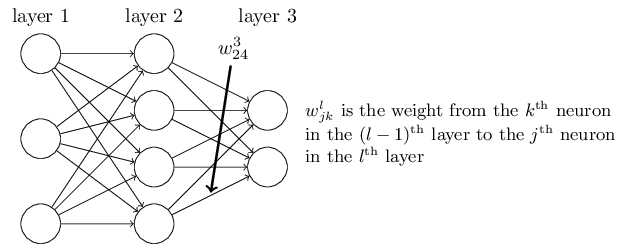
首先定义第l层网络第j个神经元的输出(activation)

为了表示简便,令

则有alj=σ(zlj),其中σ是激活函数
定义网络的cost function,其中的n是训练样本的个数。

下面主要介绍使用反向传播来求取cost function相对于权重wij和偏置项bij的导数。
显然,当输入已知时,cost function只是权值w和偏置项b的函数。这里为了方便推倒,首先计算出∂C/∂zlj,令

由于alj=σ(zlj),所以显然有
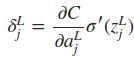
式中的L表示最后一层网络,即输出层。如果只考虑一个训练样本,则cost function可表示为
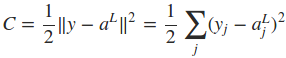
如果将输出层的所有输出看成一个列向量,则δjL可以写成下式,Θ表示向量的点乘

下面最关键的问题来了,如何同过δl+1求取δl。这里就用到了∂C/∂zlj这一重要的中间表达,推倒过程如下
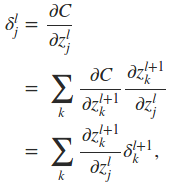

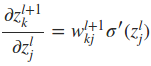
因此,最终有
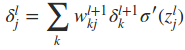
写成向量的形式为

利用与上面类似的推倒,可以得到

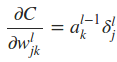
将上面重要的公式用矩阵乘法形式再表达一遍




式中Σ'(zL)是主对角线上的元素为σ'(zLj)的对角矩阵。求取了cost function相对于权重wij和偏置项bij的导数之后,便可以使用一些基于梯度的优化算法对网络的权值进行更新。下面是一个2输入2输出的一个BP网络的代码示例,实现的是对输入的每个元素进行逻辑取反操作。
 import numpy as np

 def tanh(x):

     return np.tanh(x)

 def tanh_prime(x):

     x = np.tanh(x)

     return 1.0 - x ** 2

 class Network(object):

     def __init__(self, sizes):

         self.num_layers = len(sizes)

         self.sizes = sizes

         # self.biases is a column vector

         # self.weights' structure is the same as in the book: http://neuralnetworksanddeeplearning.com/chap2.html

         self.biases = [np.random.randn(y, 1) for y in sizes[1:]]

         self.weights = [np.random.randn(y, x)

                         for x, y in zip(sizes[:-1], sizes[1:])]

     def feedforward(self, a):

         """Return the output of the network if "a" is input."""

         for b, w in zip(self.biases, self.weights):

             a = sigmoid(np.dot(w, a) + b)

         return a

     def update_mini_batch(self, mini_batch, learning_rate = 0.2):

         """Update the network's weights and biases by applying

         gradient descent using backpropagation to a single mini batch.

         The "mini_batch" is a list of tuples "(x, y)"."""

         nabla_b = [np.zeros(b.shape) for b in self.biases]

         nabla_w = [np.zeros(w.shape) for w in self.weights]

         # delta_nabla_b is dC/db, delta_nabla_w is dC/dw

         for x, y in mini_batch:

             delta_nabla_b, delta_nabla_w = self.backprop(x, y)

             nabla_b = [nb + dnb for nb, dnb in zip(nabla_b, delta_nabla_b)]

             nabla_w = [nw + dnw for nw, dnw in zip(nabla_w, delta_nabla_w)]

         self.weights = [w - (learning_rate/len(mini_batch)) * nw

                         for w, nw in zip(self.weights, nabla_w)]

         self.biases = [b - (learning_rate/len(mini_batch)) * nb

                        for b, nb in zip(self.biases, nabla_b)]

     def backprop(self, x, y):

         """Return a tuple ``(nabla_b, nabla_w)`` representing the

         gradient for the cost function C_x.  ``nabla_b`` and

         ``nabla_w`` are layer-by-layer lists of numpy arrays, similar

         to ``self.biases`` and ``self.weights``."""

         nabla_b = [np.zeros(b.shape) for b in self.biases]

         nabla_w = [np.zeros(w.shape) for w in self.weights]

         # feedforward

         activation = x

         activations = [x]   # list to store all the activations, layer by layer

         zs = []             # list to store all the z vectors, layer by layer

         # After this loop, activations = [a0, a1, ..., aL], zs = [z1, z2, ..., zL]

         for b, w in zip(self.biases, self.weights):

             z = np.dot(w, activation) + b

             zs.append(z)

             activation = sigmoid(z)

             activations.append(activation)

         # backward pass

         # delta = deltaL .* sigma'(zL)

         delta = self.cost_derivative(activations[-1], y) * \

                 sigmoid_prime(zs[-1])

         # dC/dbL = delta

         # dC/dwL = deltaL * a(L-1)^T

         nabla_b[-1] = delta

         nabla_w[-1] = np.dot(delta, activations[-2].transpose())

         '''Note that the variable l in the loop below is used a little

         differently to the notation in Chapter 2 of the book. Here,

         l = 1 means the last layer of neurons, l = 2 is the

         second-last layer, and so on. It's a renumbering of the

         scheme in the book, used here to take advantage of the fact

         that Python can use negative indices in lists.'''

         # z = z(L-l+1), here, l start from 2, end with self.num_layers-1, namely, L-1

         # delta = delta(L-l+1) = w(L-l+2)^T * delta(L-l+2) .* z(L-l+1)

         # nabla_b[L-l+1] = delta(L-l+1)

         # nabla_w[L-l+1] = delta(L-l+1) * a(L-l)^T

         for l in xrange(2, self.num_layers):

             z = zs[-l]

             sp = sigmoid_prime(z)

             delta = np.dot(self.weights[-l + 1].transpose(), delta) * sp

             nabla_b[-l] = delta

             nabla_w[-l] = np.dot(delta, activations[-l - 1].transpose())

         return (nabla_b, nabla_w)

     def evaluate(self, test_data):

         """Return the number of test inputs for which the neural

         network outputs the correct result. Note that the neural

         network's output is assumed to be the index of whichever

         neuron in the final layer has the highest activation."""

         test_results = self.feedforward(test_data)

         return test_results

     def cost_derivative(self, output_activations, y):

         return (output_activations - y)

 #### Miscellaneous functions

 def sigmoid(z):

     return 1.0/(1.0 + np.exp(-z))

 # derivative of the sigmoid function

 def sigmoid_prime(z):

     return sigmoid(z) * (1 - sigmoid(z))

 if __name__ == '__main__':

     nn = Network([2, 2, 2])

     X = np.array([[0, 0],

                   [0, 1],

                   [1, 0],

                   [1, 1]])

     y = np.array([[1, 1],

                   [1, 0],

                   [0, 1],

                   [0, 0]])

     for k in range(40000):

         if k % 10000 == 0:

             print 'epochs:', k

         # Randomly select a sample.

         i = np.random.randint(X.shape[0])

         nn.update_mini_batch(zip([np.atleast_2d(X[i]).T], [np.atleast_2d(y[i]).T]))

     for e in X:

         print(e, nn.evaluate(np.atleast_2d(e).T))
运行结果
epochs:

epochs:

epochs:

epochs:

(array([, ]), array([[ 0.98389328],

       [ 0.97490859]]))

(array([, ]), array([[ 0.97694707],

       [ 0.01646559]]))

(array([, ]), array([[ 0.03149928],

       [ 0.97737158]]))

(array([, ]), array([[ 0.01347963],

       [ 0.02383405]]))
BP网络中的反向传播的更多相关文章
- 神经网络中的反向传播法--bp【转载】
from: 作者:Charlotte77 出处:http://www.cnblogs.com/charlotte77/ 一文弄懂神经网络中的反向传播法——BackPropagation 最近在看深度学 ...
- 一文弄懂神经网络中的反向传播法——BackPropagation【转】
本文转载自:https://www.cnblogs.com/charlotte77/p/5629865.html 一文弄懂神经网络中的反向传播法——BackPropagation 最近在看深度学习 ...
- 一文弄懂神经网络中的反向传播法——BackPropagation
最近在看深度学习的东西,一开始看的吴恩达的UFLDL教程,有中文版就直接看了,后来发现有些地方总是不是很明确,又去看英文版,然后又找了些资料看,才发现,中文版的译者在翻译的时候会对省略的公式推导过程进 ...
- [转] 一文弄懂神经网络中的反向传播法——BackPropagation
在看CNN和RNN的相关算法TF实现,总感觉有些细枝末节理解不到位,浮在表面.那么就一点点扣细节吧. 这个作者讲方向传播也是没谁了,666- 原文地址:https://www.cnblogs.com/ ...
- PyTorch中在反向传播前为什么要手动将梯度清零?
对于torch中训练时,反向传播前将梯度手动清零的理解 简单的理由是因为PyTorch默认会对梯度进行累加.至于为什么PyTorch有这样的特点,在网上找到的解释是说由于PyTorch的动态图和aut ...
- 一文弄懂神经网络中的反向传播法(Backpropagation algorithm)
最近在看深度学习的东西,一开始看的吴恩达的UFLDL教程,有中文版就直接看了,后来发现有些地方总是不是很明确,又去看英文版,然后又找了些资料看,才发现,中文版的译者在翻译的时候会对省略的公式推导过程进 ...
- 【机器学习】反向传播算法 BP
知识回顾 1:首先引入一些便于稍后讨论的新标记方法: 假设神经网络的训练样本有m个,每个包含一组输入x和一组输出信号y,L表示神经网络的层数,S表示每层输入的神经元的个数,SL代表最后一层中处理的单元 ...
- 反向传播(BP)算法理解以及Python实现
全文参考<机器学习>-周志华中的5.3节-误差逆传播算法:整体思路一致,叙述方式有所不同: 使用如上图所示的三层网络来讲述反向传播算法: 首先需要明确一些概念, 假设数据集\(X=\{x^ ...
- 神经网络之反向传播算法(BP)公式推导(超详细)
反向传播算法详细推导 反向传播(英语:Backpropagation,缩写为BP)是"误差反向传播"的简称,是一种与最优化方法(如梯度下降法)结合使用的,用来训练人工神经网络的常见 ...
随机推荐
- shell学习五十天----查看进程ps命令
进程列表 列出进程中最重要的命令便是进程状态命令:ps. ps命令是进程状态(Process Status)的缩写.ps命令用来列出系统中当前执行的那些进程.ps命令列出的是当前那些进程的快照,就是执 ...
- Amazon宣布将MXNet作为AWS的深度学习框架——貌似性能比tf高啊
Amazon公司的Werner Vogels于上周宣布Amazon深度学习框架将会正式选用MXNet,并且AWS将会通过增加源代码贡献.改进文档以及支持来自其它框架的可视化.开发以及迁移工具,为实现M ...
- 摘要提取算法——本质上就是pagerank,选择rank最高的句子作为摘要,如果结合word2vec应该有非常好的效果
最近需要做一些文本摘要的东西,选取了TextRank(论文参见<TextRank: Bringing Order into Texts>)作为对比方案,该方案可以很方便的使用Python相 ...
- hdoj--3635--Dragon Balls(并查集记录深度)
Dragon Balls Time Limit: 2000/1000 MS (Java/Others) Memory Limit: 32768/32768 K (Java/Others) Tot ...
- 2017-3-11 leetcode 217 219 228
ji那天好像是周六.....吃完饭意识到貌似今天要有比赛(有题解当然要做啦),跑回寝室发现周日才开始233333 =========================================== ...
- oracle连接数不够解决
ora-12516: TNS: 监听程序找不到符合协议堆栈要求的可用处理程 看到如上错误出现,就要查看是否是是数据库连接数被占满了 具体的查询sql如下: select count(*) from v ...
- C#操作QQ邮箱发送电子邮件原来这么简单。。。。
在贴代码之前,首先需要给QQ邮箱开服务IMAP/SMTP服务,详细开通方法见 "开通方法"(可能需要发送收费短信,所以只要开通这一个服务就好了). 这边主要就是为了一个服务的授权码 ...
- First step in troubleshooting complex issues: Define and scope your issue properly
最近在查调试相关资料的时候,无意看到Tess的一篇关于如何快速分析复合场景问题的博文,感觉很实用,Mark备忘. My 9 questions for a pretty thorough proble ...
- Canvas实现环形进度条
Canvas实现环形进度条 直接上代码: <canvas width="200" height="200" >60%</canvas> ...
- ML一些简单的资源
参考文献及推荐阅读 维基百科,http://en.wikipedia.org/wiki/K-nearest_neighbor_algorithm: 机器学习中的相似性度量,http://www.cnb ...