
kaggle 实战 (1): PCA + KNN 手写数字识别
本文采用PCA+KNN的方法进行kaggle手写数字识别,训练数据共有42000行,每行代表一幅数字图片,共有784列(一副数字图像是28*28像素,将一副图像展开为一行即784),更多关于Digit Recognizer项目的介绍https://www.kaggle.com/c/digit-recognizer
由于训练数据量太大,直接采用KNN非常耗时,采用PCA降维的方法,选取25个维度,跑完全部数据只需200秒左右。
加载package
# This Python 3 environment comes with many helpful analytics libraries installed

# It is defined by the kaggle/python docker image: https://github.com/kaggle/docker-python

# For example, here's several helpful packages to load in

import numpy as np # linear algebra

import pandas as pd # data processing, CSV file I/O (e.g. pd.read_csv)

import matplotlib.pyplot as plt # import de Matplotlib

from IPython.display import display

from PIL import Image

# Input data files are available in the "../input/" directory.

# For example, running this (by clicking run or pressing Shift+Enter) will list the files in the input directory

import os

print(os.listdir("../input"))

# Any results you write to the current directory are saved as output.
read data
train=pd.read_csv('../input/train.csv')

train.shape

submission = pd.read_csv('../input/test.csv')

test=pd.read_csv('../input/test.csv')

test.shape

y_train = train['label']

y_train.head()

x_train=train.drop(['label'], axis=1)

x_train.head() # affiche le tableau ci-dessous

X_submission =test
PCA 降维探索
pca = PCA(200)

pca_full = pca.fit(x_train)

plt.plot(np.cumsum(pca_full.explained_variance_ratio_))

plt.xlabel('# of components')

plt.ylabel('Cumulative explained variance')
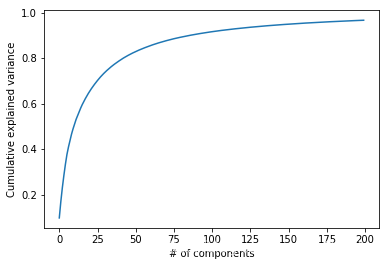
选择50维度, 拆分数据为训练集,测试机
pca = PCA(n_components=50)

X_train_transformed = pca.fit_transform(x_train)

X_submission_transformed = pca.transform(x_test)

from sklearn.model_selection import train_test_split

X_train_pca, X_test_pca, y_train_pca, y_test_pca = train_test_split(X_train_transformed, y_train, test_size=0.2, random_state=13)
KNN PCA降维和K值筛选
components = [5, 10, 15, 20, 25, 30, 35, 40, 45, 50]

neighbors = [1, 2, 3, 4, 5, 6, 7]

scores = np.zeros( (components[len(components)-1]+1, neighbors[len(neighbors)-1]+1 ) )
from sklearn.neighbors import KNeighborsClassifier

for component in components:

    for n in neighbors:

        knn = KNeighborsClassifier(n_neighbors=n)

        knn.fit(X_train_pca[:,:component], y_train_pca)

        score = knn.score(X_test_pca[:,:component], y_test_pca)

        #predict = knn.predict(X_test_pca[:,:component])

        scores[component][n] = score

        print('Components = ', component, ', neighbors = ', n,', Score = ', score)

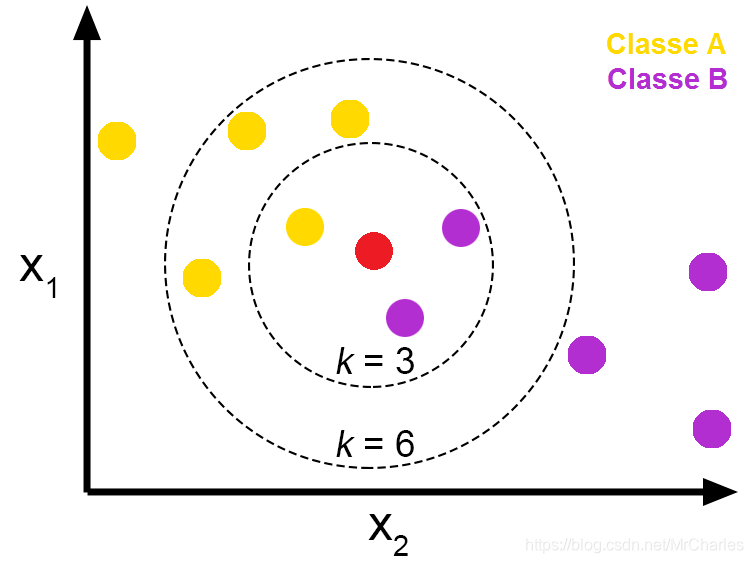
k 值的意义:
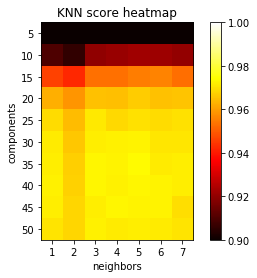
分析k & 维度 vs 精度
scores = np.reshape(scores[scores != 0], (len(components), len(neighbors)))

x = [0, 1, 2, 3, 4, 5, 6]

y = [0, 1, 2, 3, 4, 5, 6, 7, 8, 9]

plt.rcParams["axes.grid"] = False

fig, ax = plt.subplots()

plt.imshow(scores, cmap='hot', interpolation='none', vmin=.90, vmax=1)

plt.xlabel('neighbors')

plt.ylabel('components')

plt.xticks(x, neighbors)

plt.yticks(y, components)

plt.title('KNN score heatmap')

plt.colorbar()

plt.show()
预测
knn = KNeighborsClassifier(n_neighbors=5)

knn.fit(X_train_pca[:, :35], y_train_pca)

predict_labels = knn.predict(X_submission_transformed[:, :35])
对于PCA维度的选取:在多次尝试后,采用35个维度,效果较好。需要注意的是,PCA处理后的训练数据和原始数据是不同的,所以采用PCA处理数据后,并不是选取的维度越多精确度就越好。k 选5 可以达到很好效果
生成提交文件
Submission = pd.DataFrame({

        "ImageId": range(1, predict_labels.shape[0]+1),

        "Label": predict_labels

    })

Submission.to_csv("KnnMnistSubmission.csv", index=False)

Submission.head(5)
kaggle 实战 (1): PCA + KNN 手写数字识别的更多相关文章
- 机器学习(二)-kNN手写数字识别
一.kNN算法是机器学习的入门算法,其中不涉及训练,主要思想是计算待测点和参照点的距离,选取距离较近的参照点的类别作为待测点的的类别. 1,距离可以是欧式距离,夹角余弦距离等等. 2,k值不能选择太大 ...
- 10,knn手写数字识别
# 导包 import numpy as np import matplotlib.pyplot as plt from sklearn.neighbors import KNeighborsClas ...
- KNN手写数字识别
import numpy as np import matplotlib .pyplot as plt from sklearn.neighbors import KNeighborsClassifi ...
- 一看就懂的K近邻算法(KNN),K-D树,并实现手写数字识别!
1. 什么是KNN 1.1 KNN的通俗解释 何谓K近邻算法,即K-Nearest Neighbor algorithm,简称KNN算法,单从名字来猜想,可以简单粗暴的认为是:K个最近的邻居,当K=1 ...
- Kaggle竞赛丨入门手写数字识别之KNN、CNN、降维
引言 这段时间来,看了西瓜书.蓝皮书,各种机器学习算法都有所了解,但在实践方面却缺乏相应的锻炼.于是我决定通过Kaggle这个平台来提升一下自己的应用能力,培养自己的数据分析能力. 我个人的计划是先从 ...
- K近邻实战手写数字识别
1.导包 import numpy as np import operator from os import listdir from sklearn.neighbors import KNeighb ...
- 深度学习之PyTorch实战(3)——实战手写数字识别
上一节,我们已经学会了基于PyTorch深度学习框架高效,快捷的搭建一个神经网络,并对模型进行训练和对参数进行优化的方法,接下来让我们牛刀小试,基于PyTorch框架使用神经网络来解决一个关于手写数字 ...
- KNN实现手写数字识别
KNN实现手写数字识别 博客上显示这个没有Jupyter的好看,想看Jupyter Notebook的请戳KNN实现手写数字识别.ipynb 1 - 导入模块 import numpy as np i ...
- 用MXnet实战深度学习之一:安装GPU版mxnet并跑一个MNIST手写数字识别
用MXnet实战深度学习之一:安装GPU版mxnet并跑一个MNIST手写数字识别 http://phunter.farbox.com/post/mxnet-tutorial1 用MXnet实战深度学 ...
随机推荐
- 运维生涯中总有一次痛彻心扉的rm命令
为了防止误操作,配置rm命令别名,同时可以进行恢复删除文件 1. 在/tmp目录下新建两个目录,命名为:.trash,tools cd /tmp/ mkdir .trash mkdir tools 2 ...
- 【Python】- scrapy 爬取图片保存到本地、且返回保存路径
https://blog.csdn.net/xueba8/article/details/81843534
- Redis数据结构之字典-dict
dict是Redis服务器中出现最为频繁的复合型数据结构,除hash使用dict之外,整个Redis数据库中所有的key和value也会组成一个全局字典,还有带过期时间的key集合也是一个字典. zs ...
- hdu6354 /// 线段树
题目大意: 给定n m x y z 长度为n的序列初始为0 接下来m个操作 l r v 将l r区间内比v小的数都变成v l r v由x y z和给定的函数生成 线段树维护区间 最大值 最小值 再加 ...
- 三.Python数据类型详述
Python第三节数据类型详述 一.多变量赋值 python允许多变量赋值 多变量赋相同的值a = b = c = 1 多变量赋不同的值a, b, c = 1, 2, "fuckyou&qu ...
- linux常用命令-3文件与目录相关命令
cd .. #返回上一级目录 cd ../.. #返回上两级目录 cd - #返回上次所在目录 cp file1 file2 #将file1复制为file2 cp -a dir1 dir2 #复制一个 ...
- python 编写暴力破解mysql用户名密码
本文摘自别人的,自己运行调试了一下#!/user/bin/env python#-*- coding:utf-8 -*- import pymysql#导入连接数据库的模块import sys cla ...
- 理解TCP/IP,SOCKET,HTTP,FTP,RMI,RPC,webservic
TCP/IP:网络宽带,传输数据的基础协议,所有得数据要在网络上传输都是基于TCP/IP协议(或UDP),才能送达到指定的目的地(IP,服务器硬件地址). SOCKET:SOCKET只是面对编程人员的 ...
- 用jQuery,ajax,实现三级联动封装JS的文件
// JavaScript Document $(document).ready(function(e) { //找到ID=SANJI的DIV,造三个下拉扔进去 var str = "< ...
- 下面是一段delphi代码,你在c# 中引入api 即可
procedure TForm1.Button1Click(Sender: TObject);var i:HWND; cs:CREATESTRUCT;begin// i := FindWindowEx ...