
MNIST机器学习入门【学习笔记】
平台信息:
PC:ubuntu18.04、i5、anaconda2、cuda9.0、cudnn7.0.5、tensorflow1.10、GTX1060
作者:庄泽彬(欢迎转载,请注明作者)
说明:本文是在tensorflow社区的学习笔记,MNIST 手写数据入门demo
一、MNIST数据的下载,使用代码的方式:
input_data.py文件内容:
# Copyright 2015 Google Inc. All Rights Reserved.

#

# Licensed under the Apache License, Version 2.0 (the "License");

# you may not use this file except in compliance with the License.

# You may obtain a copy of the License at

#

#     http://www.apache.org/licenses/LICENSE-2.0

#

# Unless required by applicable law or agreed to in writing, software

# distributed under the License is distributed on an "AS IS" BASIS,

# WITHOUT WARRANTIES OR CONDITIONS OF ANY KIND, either express or implied.

# See the License for the specific language governing permissions and

# limitations under the License.

# ==============================================================================

"""Functions for downloading and reading MNIST data."""

from __future__ import absolute_import

from __future__ import division

from __future__ import print_function

import gzip

import os

import numpy

from six.moves import urllib

from six.moves import xrange  # pylint: disable=redefined-builtin

SOURCE_URL = 'http://yann.lecun.com/exdb/mnist/'

def maybe_download(filename, work_directory):

  """Download the data from Yann's website, unless it's already here."""

  if not os.path.exists(work_directory):

    os.mkdir(work_directory)

  filepath = os.path.join(work_directory, filename)

  if not os.path.exists(filepath):

    filepath, _ = urllib.request.urlretrieve(SOURCE_URL + filename, filepath)

    statinfo = os.stat(filepath)

    print('Successfully downloaded', filename, statinfo.st_size, 'bytes.')

  return filepath

def _read32(bytestream):

  dt = numpy.dtype(numpy.uint32).newbyteorder('>')

  return numpy.frombuffer(bytestream.read(4), dtype=dt)[0]

def extract_images(filename):

  """Extract the images into a 4D uint8 numpy array [index, y, x, depth]."""

  print('Extracting', filename)

  with gzip.open(filename) as bytestream:

    magic = _read32(bytestream)

    if magic != 2051:

      raise ValueError(

          'Invalid magic number %d in MNIST image file: %s' %

          (magic, filename))

    num_images = _read32(bytestream)

    rows = _read32(bytestream)

    cols = _read32(bytestream)

    buf = bytestream.read(rows * cols * num_images)

    data = numpy.frombuffer(buf, dtype=numpy.uint8)

    data = data.reshape(num_images, rows, cols, 1)

    return data

def dense_to_one_hot(labels_dense, num_classes=10):

  """Convert class labels from scalars to one-hot vectors."""

  num_labels = labels_dense.shape[0]

  index_offset = numpy.arange(num_labels) * num_classes

  labels_one_hot = numpy.zeros((num_labels, num_classes))

  labels_one_hot.flat[index_offset + labels_dense.ravel()] = 1

  return labels_one_hot

def extract_labels(filename, one_hot=False):

  """Extract the labels into a 1D uint8 numpy array [index]."""

  print('Extracting', filename)

  with gzip.open(filename) as bytestream:

    magic = _read32(bytestream)

    if magic != 2049:

      raise ValueError(

          'Invalid magic number %d in MNIST label file: %s' %

          (magic, filename))

    num_items = _read32(bytestream)

    buf = bytestream.read(num_items)

    labels = numpy.frombuffer(buf, dtype=numpy.uint8)

    if one_hot:

      return dense_to_one_hot(labels)

    return labels

class DataSet(object):

  def __init__(self, images, labels, fake_data=False):

    if fake_data:

      self._num_examples = 10000

    else:

      assert images.shape[0] == labels.shape[0], (

          "images.shape: %s labels.shape: %s" % (images.shape,

                                                 labels.shape))

      self._num_examples = images.shape[0]

      # Convert shape from [num examples, rows, columns, depth]

      # to [num examples, rows*columns] (assuming depth == 1)

      assert images.shape[3] == 1

      images = images.reshape(images.shape[0],

                              images.shape[1] * images.shape[2])

      # Convert from [0, 255] -> [0.0, 1.0].

      images = images.astype(numpy.float32)

      images = numpy.multiply(images, 1.0 / 255.0)

    self._images = images

    self._labels = labels

    self._epochs_completed = 0

    self._index_in_epoch = 0

  @property

  def images(self):

    return self._images

  @property

  def labels(self):

    return self._labels

  @property

  def num_examples(self):

    return self._num_examples

  @property

  def epochs_completed(self):

    return self._epochs_completed

  def next_batch(self, batch_size, fake_data=False):

    """Return the next `batch_size` examples from this data set."""

    if fake_data:

      fake_image = [1.0 for _ in xrange(784)]

      fake_label = 0

      return [fake_image for _ in xrange(batch_size)], [

          fake_label for _ in xrange(batch_size)]

    start = self._index_in_epoch

    self._index_in_epoch += batch_size

    if self._index_in_epoch > self._num_examples:

      # Finished epoch

      self._epochs_completed += 1

      # Shuffle the data

      perm = numpy.arange(self._num_examples)

      numpy.random.shuffle(perm)

      self._images = self._images[perm]

      self._labels = self._labels[perm]

      # Start next epoch

      start = 0

      self._index_in_epoch = batch_size

      assert batch_size <= self._num_examples

    end = self._index_in_epoch

    return self._images[start:end], self._labels[start:end]

def read_data_sets(train_dir, fake_data=False, one_hot=False):

  class DataSets(object):

    pass

  data_sets = DataSets()

  if fake_data:

    data_sets.train = DataSet([], [], fake_data=True)

    data_sets.validation = DataSet([], [], fake_data=True)

    data_sets.test = DataSet([], [], fake_data=True)

    return data_sets

  TRAIN_IMAGES = 'train-images-idx3-ubyte.gz'

  TRAIN_LABELS = 'train-labels-idx1-ubyte.gz'

  TEST_IMAGES = 't10k-images-idx3-ubyte.gz'

  TEST_LABELS = 't10k-labels-idx1-ubyte.gz'

  VALIDATION_SIZE = 5000

  local_file = maybe_download(TRAIN_IMAGES, train_dir)

  train_images = extract_images(local_file)

  local_file = maybe_download(TRAIN_LABELS, train_dir)

  train_labels = extract_labels(local_file, one_hot=one_hot)

  local_file = maybe_download(TEST_IMAGES, train_dir)

  test_images = extract_images(local_file)

  local_file = maybe_download(TEST_LABELS, train_dir)

  test_labels = extract_labels(local_file, one_hot=one_hot)

  validation_images = train_images[:VALIDATION_SIZE]

  validation_labels = train_labels[:VALIDATION_SIZE]

  train_images = train_images[VALIDATION_SIZE:]

  train_labels = train_labels[VALIDATION_SIZE:]

  data_sets.train = DataSet(train_images, train_labels)

  data_sets.validation = DataSet(validation_images, validation_labels)

  data_sets.test = DataSet(test_images, test_labels)

  return data_sets
新建test.py调用input_data.py进行下载手写识别的数据
#!/usr/bin/env python2

# -*- coding: utf-8 -*-

"""

Created on Thu Oct 11 23:10:15 2018

@author: zhuang

"""

import input_data

mnist = input_data.read_data_sets("MNIST_data/", one_hot=True)
注意test.py与input_data.py要放在同一个目录下,运行test.py之后会在当前目录生成MNIST_data/ 存放下载的数据,下载的内容如下图

二、使用tensorflow构建模型进行训练
新建mnist-test.py内容如下:
#!/usr/bin/env python2

# -*- coding: utf-8 -*-

"""

Created on Fri Oct 12 11:43:37 2018

@author: zhuang

"""

import input_data

import tensorflow as tf

mnist = input_data.read_data_sets("MNIST_data/", one_hot=True)

x = tf.placeholder("float",[None,784])

w = tf.Variable(tf.zeros([784,10]))

b = tf.Variable(tf.zeros([10]))

y = tf.nn.softmax(tf.matmul(x,w)+b)

# 计算交叉熵

y_ = tf.placeholder("float",[None,10])

cross_entropy = -tf.reduce_sum(y_*tf.log(y))

#梯度下降算法,以0.01的学习率更新参数

train_step = tf.train.GradientDescentOptimizer(0.01).minimize(cross_entropy)

init = tf.initialize_all_variables()

sess = tf.Session()

sess.run(init)

#训练模型1000次

for i in range(1000):

    batch_xs,batch_ys = mnist.train.next_batch(100)

    sess.run(train_step,feed_dict={x:batch_xs,y_:batch_ys})

#评估模型

correct_prediction = tf.equal(tf.argmax(y,1),tf.argmax(y_,1))

accuracy = tf.reduce_mean(tf.cast(correct_prediction,"float"))

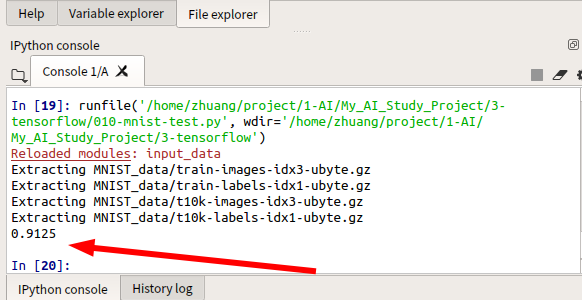
print sess.run(accuracy,feed_dict={x:mnist.test.images,y_:mnist.test.labels})
我们构建的模型手写识别的准确率在91%z左右
MNIST机器学习入门【学习笔记】的更多相关文章
- 机器学习入门学习笔记:(一)BP神经网络原理推导及程序实现
机器学习中,神经网络算法可以说是当下使用的最广泛的算法.神经网络的结构模仿自生物神经网络,生物神经网络中的每个神经元与其他神经元相连,当它“兴奋”时,想下一级相连的神经元发送化学物质,改变这些神经元的 ...
- [转]MNIST机器学习入门
MNIST机器学习入门 转自:http://wiki.jikexueyuan.com/project/tensorflow-zh/tutorials/mnist_beginners.html?plg_ ...
- tensorfllow MNIST机器学习入门
MNIST机器学习入门 这个教程的目标读者是对机器学习和TensorFlow都不太了解的新手.如果你已经了解MNIST和softmax回归(softmax regression)的相关知识,你可以阅读 ...
- Hadoop入门学习笔记---part4
紧接着<Hadoop入门学习笔记---part3>中的继续了解如何用java在程序中操作HDFS. 众所周知,对文件的操作无非是创建,查看,下载,删除.下面我们就开始应用java程序进行操 ...
- Hadoop入门学习笔记---part3
2015年元旦,好好学习,天天向上.良好的开端是成功的一半,任何学习都不能中断,只有坚持才会出结果.继续学习Hadoop.冰冻三尺,非一日之寒! 经过Hadoop的伪分布集群环境的搭建,基本对Hado ...
- PyQt4入门学习笔记(三)
# PyQt4入门学习笔记(三) PyQt4内的布局 布局方式是我们控制我们的GUI页面内各个控件的排放位置的.我们可以通过两种基本方式来控制: 1.绝对位置 2.layout类 绝对位置 这种方式要 ...
- PyQt4入门学习笔记(一)
PyQt4入门学习笔记(一) 一直没有找到什么好的pyqt4的教程,偶然在google上搜到一篇不错的入门文档,翻译过来,留以后再复习. 原始链接如下: http://zetcode.com/gui/ ...
- Hadoop入门学习笔记---part2
在<Hadoop入门学习笔记---part1>中感觉自己虽然总结的比较详细,但是始终感觉有点凌乱.不够系统化,不够简洁.经过自己的推敲和总结,现在在此处概括性的总结一下,认为在准备搭建ha ...
- Hadoop入门学习笔记---part1
随着毕业设计的进行,大学四年正式进入尾声.任你玩四年的大学的最后一次作业最后在激烈的选题中尘埃落定.无论选择了怎样的选题,无论最后的结果是怎样的,对于大学里面的这最后一份作业,也希望自己能够尽心尽力, ...
- Scala入门学习笔记三--数组使用
前言 本篇主要讲Scala的Array.BufferArray.List,更多教程请参考:Scala教程 本篇知识点概括 若长度固定则使用Array,若长度可能有 变化则使用ArrayBuffer 提 ...
随机推荐
- iOS-数据缓存(转载)
一.关于同一个URL的多次请求 有时候,对同一个URL请求多次,返回的数据可能都是一样的,比如服务器上的某张图片,无论下载多少次,返回的数据都是一样的. 上面的情况会造成以下问题 (1)用户流量的浪费 ...
- 新购买的vps应该做的几件事情
1. 修改root密码 passwd root 2.新建用户 useradd vinentguo 3.配置免密码登陆 .使用新建用户登陆vps. mkdir ~/.ssh/ch ...
- 【xargs -i】复制文件夹中前100个文件
复制前一万个文件到 tmp 下 |xargs -i cp {} /tmp 复制后一万个文件到 tmp 下 |xargs -i cp {} /tmp 查看linux下文件夹文件数目 ls -l |gre ...
- Assign the task---hdu3974(线段树优化+dfs)
题目链接:http://acm.hdu.edu.cn/showproblem.php?pid=3974 题意就是:公司有n个员工,关系有n-1个,T x y 代表把工作y交给员工x: 员工可以把工作交 ...
- CentOS 7设置Samba共享目录
1. 安装Samba服务 yum -y install samba # 查看yum源中Samba版本 yum list | grep samba # 查看samba的安装情况 rpm -qa | gr ...
- kubernetes实战(十四):k8s持久化部署gitlab集成openLDAP登录
1.基本概念 使用k8s安装gitlab-ce,采用GlusterFS实现持久化(注意PG使用的是NFS存储,使用动态存储重启postgresql的pod后无法成功启动pg,待解决),并集成了open ...
- byte处理的几种方法
/** * 字符串转16进制byte * @param * @return * @throws Exception * @author hw * @date 2018/10/19 9:47 */ pr ...
- application实例
application详解及实例 application对象用来在多个程序或者是多个用户之间共享数据,用户使用的所有application对象都是一样的,这与session对象不同.服务器一旦启动,就 ...
- [LeetCode] 680. Valid Palindrome II_Easy tag: Two Pointers
Given a non-empty string s, you may delete at most one character. Judge whether you can make it a pa ...
- 关闭WPS启动时显示的在线模板
关闭WPS启动时显示的在线模板 以WPS2016为例,如下图: 操作步骤如下: ①点击在线模板页面右下方的"设置"选项 ②"设置"界面打开后,选择启动WPS默认 ...