
关于RequestDispatcher的原理
RequestDispatcher简介
public interface RequestDispatcher

{

    public void forward(ServletRequest request, ServletResponse response)

            throws ServletException, IOException;

    public void include(ServletRequest request, ServletResponse response)

            throws ServletException, IOException;

}
RequestDispatcher.forward(request, response)
public class User{

      private String name;

      private int age;

      public String getName(){

            return name ;

      }

      public void setName( String name ){

            this .name = name ;

      }

      public int getAge() {

            return age ;

      }

      public void setAge( int age ){

            this .age = age ;

      }

}
UsersServlet.java
public class UsersServlet extends HttpServlet {

      private static final long serialVersionUID = 1L ;

protected void doGet (HttpServletRequest request, HttpServletResponse response) throws ServletException , IOException {

            /*****************一般实际开发这些用户数据都是从数据库查出来的*********/

            List <User > users = new ArrayList <> ();

            User u1 = new User () ;

            u1 .setAge ( 20) ;

            u1 .setName ( "Bob") ;

            User u2 = new User () ;

            u2 .setAge ( 21) ;

            u2 .setName ( "Tony") ;

            users .add ( u1) ;

            users .add ( u2) ;

            /*********************************************/

            request .setAttribute ( "users", users) ;   //对request 进制预处理准备工作

            request .getRequestDispatcher ( "users.jsp").forward( request , response );//转发到users.jsp,让他去具体响应
   }
}
<%@ page   contentType= "text/html; charset=UTF-8" pageEncoding ="UTF-8" trimDirectiveWhitespaces= "true"

          session ="true" %>

<%@ taglib prefix= "c" uri = "http://java.sun.com/jsp/jstl/core"   %>

<!DOCTYPE html>

< html>

<head>

<meta http-equiv = "Content-Type" content ="text/html; charset=UTF-8">

<title> 用户列表</title>

</head>

<body>

<p> -----------------转发到的资源users.jsp产生的响应数据------------------ </p>

< c:forEach var ="user" items= " ${users}" >

用户姓名:${user.name}  用户年龄:${user.age}  <br />

</ c:forEach>

</body>

</html>
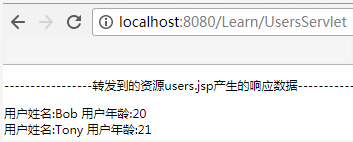
例子2:不使用Attribute,使用Paramter向转发的资源传递参数。
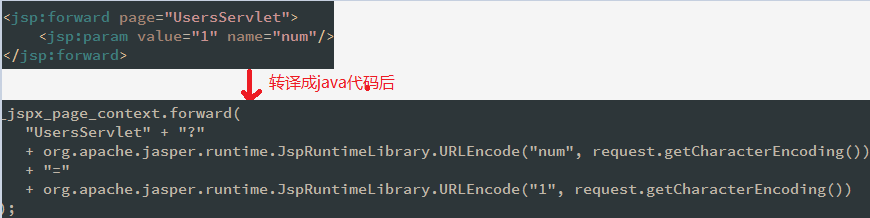
虽然request对象没有setParameter方法来设置参数,但是我们可以在转发的URL后通过QueryString 的方式添加。JSP中的<jsp:foward>标签下的<jsp:param>标签就是使用的这个原理。
AimServlet.java
public class AimServlet extends HttpServlet {

      private static final long serialVersionUID = 1L ;

      protected void doGet( HttpServletRequest request , HttpServletResponse response) throws ServletException , IOException {

           request .getRequestDispatcher ( "foo.jsp?num=1") . forward( request , response );

      }

}
foo.jsp
<%@ page   contentType= "text/html; charset=UTF-8" pageEncoding ="UTF-8" trimDirectiveWhitespaces= "true"

          session ="true" %>

<%@ taglib prefix= "c" uri = "http://java.sun.com/jsp/jstl/core"   %>

<! DOCTYPE html>

<html>

<head>

<meta http-equiv = "Content-Type" content ="text/html; charset=UTF-8">

<title> 标题</title>

</head>

<body>

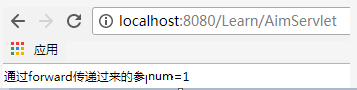
通过forward传递过来的参num=${param.num}

</body>

</html>
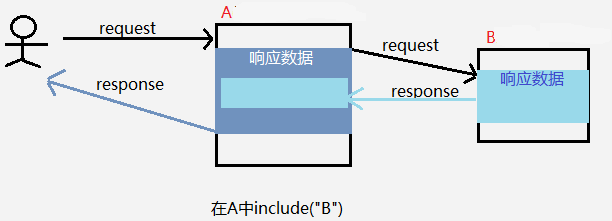
RequestDispatcher.include(request, response)
注意事项:
1、被包含者不能设置ServletResponse的响应状态和响应头(否则并不会产生效果),因为这些都是包含者做的事,被包含者只需要产生响应数据解可以了。
2、不同于 forward中的request的传递特性:在被包含的资源中从request中获取请求路径相关的信息,发现依然是原始请求的路径,也就是浏览器地址栏相关的路径,也就是说被包含的资源获得的request对象的路径属性和原始请求资源的路径一样(见下面的例子1)。其它的API调用也是一样的(Attribute 和Parameter)。
例子1
TargetServlet.java
public class TargetServlet extends HttpServlet {

      private static final long serialVersionUID = 1L ;

      protected void doGet( HttpServletRequest request , HttpServletResponse response) throws ServletException , IOException {

            response .setContentType ( "text/html;charset=utf-8" );

            PrintWriter out = response .getWriter () ;

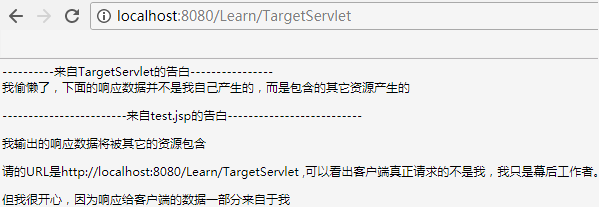
            out .println ( "----------来自TargetServlet的告白----------------<br />" ) ;

            out .print ( "我偷懒了,下面的响应数据并不是我自己产生的,而是包含的其它资源产生的<br/>" ) ;

            request .getRequestDispatcher ( "test.jsp") . include( request , response );

            out .flush () ;

            out .close () ;

      }

}
test.jsp
<%@ page    contentType= "text/html; charset=UTF-8" pageEncoding = "UTF-8" trimDirectiveWhitespaces = "true"

          session = "false"

%>

<p> ------------------------来自test.jsp的告白-------------------------- </p>

<p> 我输出的响应数据将被其它的资源包含 </p>

请的URL是 <%= request.getRequestURL().toString() %> ,可以看出客户端真正请求的不是我,我只是幕后工作者。

<p> 但我很开心,因为响应给客户端的数据一部分来自于我 </p>
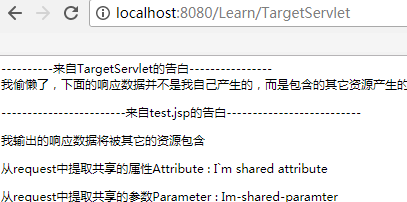
例子2:通过包含路径后追加QueryString来向被包含资源传递参数,以及通过request.setAttribute传递属性。
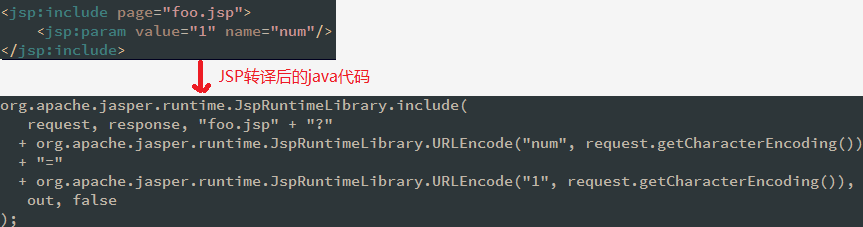
同样, JSP中的<jsp:include>标签下的<jsp:param>标签就是通过在含路径后追加QueryString达到的传递参数的效果。
public class TargetServlet extends HttpServlet {

      private static final long serialVersionUID = 1L ;

      protected void doGet( HttpServletRequest request , HttpServletResponse response) throws ServletException , IOException {

            response .setContentType ( "text/html;charset=utf-8" );

            PrintWriter out = response .getWriter () ;

            out .println ( "----------来自TargetServlet的告白----------------<br />" ) ;

            out .print ( "我偷懒了,下面的响应数据并不是我自己产生的,而是包含的其它资源产生的<br/>" ) ;

            request .setAttribute ( "sharedatt", "I`m shared attribute") ;

            request .getRequestDispatcher ( "test.jsp?sharedparam=Im-shared-parameter" ). include (request , response ) ;

            out .flush () ;

            out .close () ;

      }

}
<%@ page    contentType= "text/html; charset=UTF-8" pageEncoding = "UTF-8" trimDirectiveWhitespaces = "true"

          session = "false"

%>

<p> ------------------------来自test.jsp的告白-------------------------- </p>

<p> 我输出的响应数据将被其它的资源包含 </p>

<p> 从request中提取共享的属性Attribute : <%= request.getAttribute("s haredatt") %>

<p> 从request中提取共享的参数Parameter : <%= request.getParameter("sharedparam" ) %>
欢迎转载,请注明出处:www.cnblogs.com/lulipro
为了获得更好的阅读体验,请访问原博客地址。
限于本人水平,如果文章和代码有表述不当之处,还请不吝赐教。
代码钢琴家
关于RequestDispatcher的原理的更多相关文章
- JavaWeb——关于RequestDispatcher的原理
RequestDispatcher简介 RequestDispatcher 代表请求的派发者.它有2个动作:forward 和 include .客户端对于任何一个请求,可以根据业务逻辑需要,选择不同 ...
- 【Servlet】关于RequestDispatcher的原理
RequestDispatcher简介 RequestDispatcher 代表请求的派发者.它有2个动作:forward 和 include .客户端对于任何一个请求,可以根据业务逻辑需要,选择不同 ...
- Tomcat 的 ErrorPage 实现原理分析
使用Tomcat,一定见到过404,500的时候,见到过Tomcat提供的错误页面,例如请求的资源找不到的时候,响应状态码为404,这个时候的错误页面是这样的: 这些错误页面是 如何生成及定位展示的 ...
- Spring MVC中DispatcherServlet工作原理探究
转:http://blog.csdn.net/zhouyuqwert/article/details/6853730 下面类图将主要的类及方法抽离出来,以便查看方便,根据类的结构来说明整个请求是如何工 ...
- HttpServletResponse HttpServletRequest RequestDispatcher
HttpServletResponse HttpServletRequest RequestDispatcher 07. 五 / J2EE / 没有评论 一.以字节为单位向客户端发送中文数据1.服 ...
- SpringMVC——使用RequestDispatcher.include()和HttpServletResponseWrapper动态获取jsp输出内容
介绍本篇内容前,先抛出我遇到的问题或者说是需求!(精读阅读本篇可能花费您15分钟,略读需5分钟左右) 一:需求说明 有一个Controller有两个方法 第一个方法通过指定的路径和参数去渲染jsp内容 ...
- Nginx原理和配置总结
一:前言 Nginx是一款优秀的HTTP服务器和反向代理服务器,除却网上说的效率高之类的优点,个人的切身体会是Nginx配置确实简单而且还好理解,和redis差不多,比rabbitmq好理解太多了: ...
- 【spring】- springmvc 工作原理
原理 本质是将DispatcherServlet及关联的Spring上下文环境的初始化工作织入Servlet的生命周期内,将外部WEB请求转换为Spring Bean能处理的形式,然后将处理后的结果借 ...
- Velocity工作原理解析和优化
在MVC开发模式下,View离不开模板引擎,在Java语言中模板引擎使用得最多是JSP.Velocity和FreeMarker,在MVC编程开发模式中,必不可少的一个部分是V的部分.V负责前端的页面展 ...
随机推荐
- CONSOLE_SCREEN_BUFFER_INFO 结构体
CONSOLE_SCREEN_BUFFER_INFO结构体 来源:https://msdn.microsoft.com/en-us/library/ms682093(v=vs.85).aspx 作用 ...
- 关于frameset的一些小总结
如果我们在一个页面需要由多个子页面一同组成,那么我们可以通过frameset标签来嵌套别的页面 例如 这样的页面布局的思路是: 1,先将页面分为上下两部分也就是 A B 2,再将B部分分为左右两部分 ...
- swift3.0 基础练习-构造对象并按要求进行排序(struct)
struct练手 构造10个学生(要求有学生的姓名.数学成绩.英语成绩),按照学生英语和数学平均分的成绩从小到大输出学生的姓名.数学成绩.英语成绩及平均分 创建一个学生构造体,包含 姓名 name 数 ...
- ASPCMS改造中
10月中旬的时候,芹芹大神给我接了个做网站的活,一番商量过后,我以低得说出来丢人TT的价格接了.主要是想借此摸清网站制作的一条龙服务. 目前根据ASPCMS开源管理系统,做了个大致的构架,下面上草图: ...
- 【LeetCode题解】动态规划:从新手到专家(一)
文章标题借用了Hawstein的译文<动态规划:从新手到专家>. 1. 概述 动态规划( Dynamic Programming, DP)是最优化问题的一种解决方法,本质上状态空间的状态转 ...
- zabbix 配置发送邮件报警
标签:监控/SQLServer/Windows 概述 本篇文章主要介绍如何配置zabbix借助外部邮件进行发送邮件报警,zabbix通过配置文件调用mailx来进行邮件的发送.在Centos6以上的版 ...
- [COGS 2051] 王者之剑
Saber大法吼 2051. 王者之剑 ★★★☆ 输入文件:Excalibur.in 输出文件:Excalibur.out 简单对比时间限制:1 s 内存限制:256 MB [题目描述 ...
- VerilogHDL可综合设计的注意事项
可综合的语法已经记录得差不多了,剩下一些遗留的问题,在这里记录一下吧. 一.逻辑设计 (1)组合逻辑设计 下面是一些用Verilog进行组合逻辑设计时的一些注意事项: ①组合逻辑可以得到两种常用的RT ...
- github 发布项目
自己开发了一个插件或项目,需要发布到github上,之前看到很多文章,但是都会有一些问题,经过自己多次尝试,想分享给初学者们. 首先你需要一个github账号,所有还没有的话先去注册吧! 官网:htt ...
- jQuery serializeArray()方法改写多维对象以及自定义
jQuery客户端表单数据获取 jq在进行客户端表单数据获取我们通常用serialize或者是serizlizeArray(),两种方法,可是在serizlizeArray()返回的数据是一个数组,数 ...