
Paper | No-reference Quality Assessment of Deblocked Images
目录
发表在2016年Neurocomputing。
摘要
JPEG is the most commonly used image compression standard. In practice, JPEG images are easily subject to blocking artifacts at low bit rates. To reduce the blocking artifacts, many deblocking algorithms have been proposed. However, they also introduce certain degree of blur, so the deblocked images contain multiple distortions. Unfortunately, the current quality metrics are not designed for multiply distorted images, so they are limited in evaluating the quality of deblocked images. To solve the problem, this paper presents a no-reference (NR) quality metric for deblocked images. A DeBlocked Image Database (DBID) is first built with subjective Mean Opinion Score (MOS) as ground truth. Then a NR DeBlocked Image Quality (DBIQ) metric is proposed by simultaneously evaluating blocking artifacts in smooth regions and blur in textured regions. Experimental results conducted on the DBID database demonstrate that the proposed metric is effective in evaluating the quality of deblocked images, and it significantly outperforms the existing metrics. As an application, the proposed metric is further used for automatic parameter selection in image deblocking algorithms.
结论
Image deblocking has been extensively researched for removing blocking artifacts in JPEG images. However, the quality evaluation of such deblocked images is still an open problem. In this paper, we have presented a no-reference quality model for evaluating the quality of deblocked images. Blocking artifacts in smooth regions and blur effects in textured regions are considered in the proposed model. It is a moment-based metric, where the Tchebichef moments are used to achieve: (1) block classification, (2) blocking artifact evaluation, and (3) blur evaluation. We have also built a deblocked image database DBID to compare the performances of image deblocking algorithms, and also to verify the performance of the proposed method. The experimental results have demonstrated that the proposed method is effective in evaluating the quality of deblocked images, and it significantly outperforms the state-of-the-art blocking artifact metrics, blur metrics and general-purpose NR image quality metrics. As an application of the proposed model, we have also used DBIQ for automatic parameter tuning in image deblocking algorithm, producing very promising results.
In this work, the proposed quality model is based on the Tchebichef moments of gray-scale images. However, color also affects the quality of deblocked images, so the performance of the proposed metric could be further enhanced by incorporating color information. A straightforward way to improve DBIQ is to use quaternion-type moments [51]. Furthermore, the presented work mainly focus on deblocked JPEG images. More general deblocking scenarios, e.g., deblocking loop filter in H.264/AVC, will be investigated in future work.
要点
我们讨论JPEG压缩图像的块效应。
许多去块效应方法都会引入模糊,导致图像中存在多重失真。然而,现存质量指标都只局限于单一失真(比如块效应),没有考虑模糊等其他失真。
为了解决这一问题,本文针对去块效应的图像(deblocked images),提出了一种无参考质量评价指标:NR DeBlocked Image Quality(DBIQ)。
方法核心:同时评估平滑区域的块效应,以及纹理区域的模糊程度。
具体而言,作者采用了切比雪夫矩(Tchebichef moments),同时实现了块分类、块效应评估和模糊程度评估。
本文还有建库等贡献。作者将预测的指标用于去块效应算法,发现实验结果有所提升,证明了该指标的有效性。
局限:只考虑了灰度图像;只考虑了JPEG图像。
故事背景
作者观察了借助去块效应算法[14]得到的图像,发现:去块效应图像的平滑区域容易遭受(残留)块效应影响,而纹理区域容易变模糊。
The deblocked images are contaminated by both blocking artifacts and blur. Blocking artifacts mainly affect the quality of smooth regions and blur mainly affects the quality of textured regions.
基于此观察,作者提出用离散切比雪夫矩,同时评估块效应和模糊。
本文方法(DBIQ)
DBIQ由两部分组成:
块效应指标RMB[26],是当时最好的检测块效应指标;
基于矩的模糊检测模块。
整体框图:
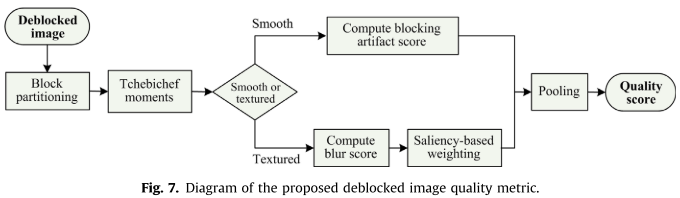
流程大致如下:
- 首先,deblocked图像被不重叠地分为\(8 \times 8\)的目标块。\(8 \times 8\)应该是JPEG编码块的尺寸。
对于每一个目标块,计算切比雪夫矩。根据非直流分量的平方和(the sum of squared non-DC moment, SSM),决定该块的类型:平滑还是纹理。
对于平滑块,我们通过RMB方法计算块效应指数。
对于纹理块,我们通过本文的方法计算模糊效应指数。作者还加入了显著性图。
两个得分通过池化,得到最终得分。
博主更关注块效应的检测,因此跑去看块效应质量评估论文啦。
Paper | No-reference Quality Assessment of Deblocked Images的更多相关文章
- Paper | Quality assessment of deblocked images
目录 1. 故事 2. 失真变化 3. 方法(PSNR-B) 4. 实验 这篇文章提出了一个PSNR-B指标,旨在衡量 压缩图像的块效应强度 或 去块效应后的残留块效应强度(比较去块效应算法的优劣). ...
- Paper | Blind Quality Assessment Based on Pseudo-Reference Image
目录 1. 技术细节 1.1 失真识别 1.2 得到对应的PRI并评估质量 块效应 模糊和噪声 1.3 扩展为通用的质量评价指标--BPRI 归一化3种质量评分 判断失真类型 加权求和 2. 总结 这 ...
- [论文笔记] Methodologies for Data Quality Assessment and Improvement (ACM Comput.Surv, 2009) (1)
Carlo Batini, Cinzia Cappiello, Chiara Francalanci, and Andrea Maurino. 2009. Methodologies for data ...
- Paper | BLIND QUALITY ASSESSMENT OF COMPRESSED IMAGES VIA PSEUDO STRUCTURAL SIMILARITY
目录 1. 技术细节 1.1 得到MDI 1.2 判别伪结构,计算伪结构相似性 2. 实验 动机:作者认为,基于块的压缩会产生一种伪结构(pseudo structures),并且不同程度压缩产生的伪 ...
- [论文笔记] Methodologies for Data Quality Assessment and Improvement (ACM Comput.Surv, 2009) (2)
本篇博文主要对DMQ(S3.7)的分类进行了研读. 1. 这个章节提出了一种DQM的分类法(如下图) 由上图可见,该分类法的分类标准是对assessment & improvement阶段的支 ...
- Quality assessment and quality control of NGS data
http://www.molecularevolution.org/resources/activities/QC_of_NGS_data_activity_new table of contents ...
- Paper | Predicting the Quality of Images Compressed After Distortion in Two Steps
目录 1. 问题本质剖析 2. 方法细节 图像质量评估大佬AC Bovik的论文,发表在2019 TIP上. 考虑的问题:对于有参考图像质量评估(R-IQA)任务,参考图像有时是有损的.这会导致评估的 ...
- {ICIP2014}{收录论文列表}
This article come from HEREARS-L1: Learning Tuesday 10:30–12:30; Oral Session; Room: Leonard de Vinc ...
- ITU-T G.1080 IPTV的体验质量(QoE)要求 (Quality of experience requirements for IPTV services)
IPTV的服务质量(QoE)要求 Quality of experience requirements for IPTV services Summary This Recommendation de ...
随机推荐
- 【LOJ2402】「THUPC 2017」天天爱射击 / Shooting(整体二分)
点此看题面 大致题意: 有\(n\)个区间,每个区间有一个权值,当权值变成\(0\)时消失.每个时刻将覆盖某一位置的所有区间权值减\(1\),求每个时刻有多少个区间在这一刻消失. 前言 整体二分裸题啊 ...
- Codeforces Round #599 (Div. 2) A. Maximum Square 水题
A. Maximum Square Ujan decided to make a new wooden roof for the house. He has
- C#开发BIMFACE系列26 服务端API之获取模型数据11:获取单个面积分区信息
系列目录 [已更新最新开发文章,点击查看详细] 在<C#开发BIMFACE系列25 服务端API之获取模型数据9:获取楼层对应面积分区列表>一文中介绍了如何获取单个模型中单个楼层包 ...
- COM 编程基础
DirectX 采用了 COM 标准.而 DirectShow 是一套完全基于 COM 的应用系统.要想深入学习 DirectShow,掌握一些 COM 编程的基础知识是必不可少的. 一.COM 是什 ...
- 使用layer.msg 时间设置不起作用
前几天使用layer.msg设置时间后发现不起作用,这里记录一下. 开始出错误的代码: 后面查看文档后得知调用layer.msg后如果有后续操作需要写在function()中: //eg1 layer ...
- PHP 高级面试题 - 如果没有 mb 系列函数,如何切割多字节字符串
需求 如果需要将可能含有中文的字符串进行拆分成数组,我们下面以 utf-8 编码为例. 解决方案一 我习惯的方法可能是: mb_internal_encoding("UTF-8") ...
- Saiku嵌入页面plugin=true效果自定义实现(二十七)
Saiku嵌入页面使用 自定义实现 Plugin=true 效果 saiku嵌入页面plugin=true时数据不显示(plugin=false或者不设定plugin的值时数据显示正常)这个问题困扰了 ...
- Anaconda安装第三方库与pip和conda 添加国内源
Anaconda安装第三方库 PIP使用命令 Anaconda命令 pip和conda 添加国内源 1:PIP相关命令 卸载 pip uninstall XXX 1.升级pip python -m p ...
- 06-Django视图
什么是视图? 视图就是应用中views.py文件中的函数,视图函数的第一个参数必须是request(HttpRequest)对象.返回的时候必须返回一个HttpResponse对象或子对象(包含Htt ...
- Jenkins 在 Tomcat 运行访问路径设置
问题 最近用 Tomcat 搭建了个 Jenkins ,但是访问的时候需要端口加 /jenkins/ 才能进行访问.我们是直接将 Jenkins.war 包放在 webapps下的. 我们想直接通过不 ...