
sklearn 可视化模型的训练测试收敛情况和特征重要性
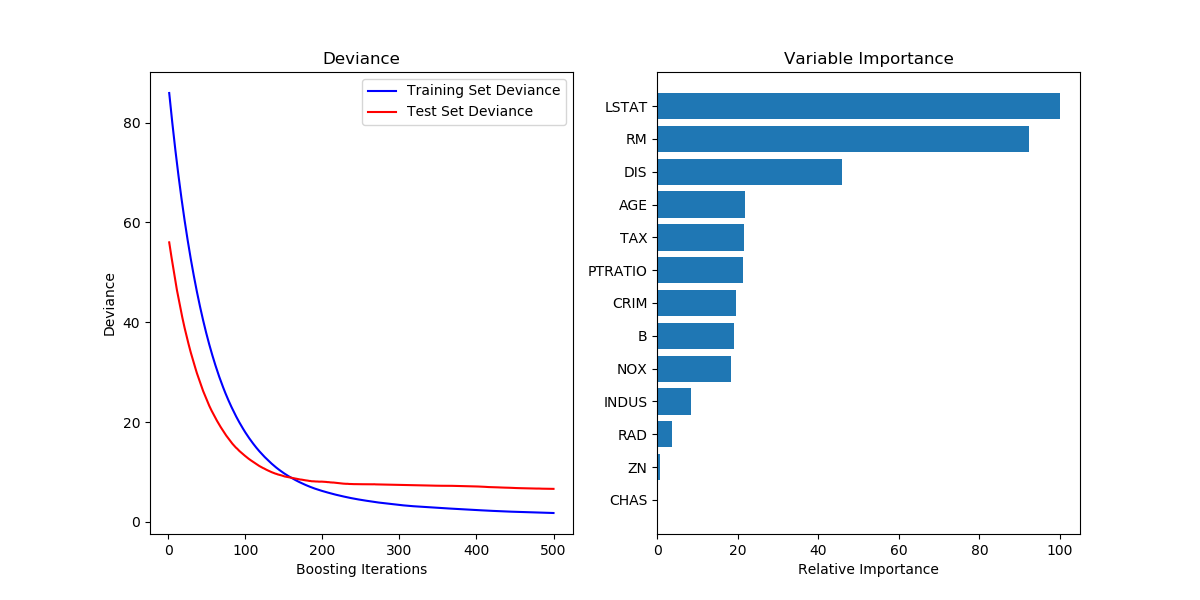
show the code:
# Plot training deviance

def plot_training_deviance(clf, n_estimators, X_test, y_test):

    # compute test set deviance

    test_score = np.zeros((n_estimators,), dtype=np.float64)

    for i, y_pred in enumerate(clf.staged_predict(X_test)):

        test_score[i] = clf.loss_(y_test, y_pred)

    plt.figure(figsize=(12, 6))

    plt.subplot(1, 2, 1)

    plt.title('Deviance')

    train_score = clf.train_score_

    logging.info("len(train_score): %s" % len(train_score))

    logging.info(train_score)

    logging.info("len(test_score): %s" % len(test_score))

    logging.info(test_score)

    plt.plot(np.arange(n_estimators) + 1, train_score, 'b-',

             label='Training Set Deviance')

    plt.plot(np.arange(n_estimators) + 1, test_score, 'r*', label='Test Set Deviance')

    plt.legend(loc='upper right')

    plt.xlabel('Boosting Iterations')

    plt.ylabel('Deviance')

    plt.show()

# Plot feature importance

def plot_feature_importance(clf, feature_names):

    feature_importance = clf.feature_importances_

    # make importances relative to max importance

    feature_importance = 100.0 * (feature_importance / feature_importance.max())

    sorted_idx = np.argsort(feature_importance)

    pos = np.arange(sorted_idx.shape[0]) + .5

    plt.subplot(1, 2, 2)

    plt.barh(pos, feature_importance[sorted_idx], align='center')

    # plt.yticks(pos, feature_names[sorted_idx])

    plt.yticks(pos, [feature_names[idx] for idx in sorted_idx])

    plt.xlabel('Relative Importance')

    plt.title('Variable Importance')

    plt.show()

class Train(object):

    def __init__(self, data_file):

        self.data_file = data_file

        self.x_fields = ["xxx", "xxx", "xxx"]

        self.x_features, self.y_labels = self.load_data()

    def load_data(self):

        x_features, y_labels = [], []

        # ......

        return x_features, y_labels

    def train_model(self):

        model = GradientBoostingRegressor(random_state=42)

        model.fit(self.x_features, self.y_labels)

        y_pred = model.predict(self.x_features)

        logging.info("mean_squared_error: %.6f" % mean_squared_error(self.y_labels, y_pred))

        logging.info("mean_squared_log_error: %.6f" % mean_squared_log_error(self.y_labels, y_pred))

        plot_training_deviance(clf=model, n_estimators=model.get_params()["n_estimators"], X_test=self.x_features, y_test=self.y_labels)

        # 输出feature重要性

        logging.info("feature_importances_: %s" % model.feature_importances_)

        plot_feature_importance(clf=model, feature_names=self.x_fields)
参考的是sklearn中的样例: Gradient Boosting regression — scikit-learn 0.19.2 documentation
画出的图如下所示:
sklearn 可视化模型的训练测试收敛情况和特征重要性的更多相关文章
- 【集成学习】sklearn中xgboost模块中plot_importance函数(绘图--特征重要性)
直接上代码,简单 # -*- coding: utf-8 -*- """ ################################################ ...
- 使用 TensorBoard 可视化模型、数据和训练
使用 TensorBoard 可视化模型.数据和训练 在 60 Minutes Blitz 中,我们展示了如何加载数据,并把数据送到我们继承 nn.Module 类的模型,在训练数据上训练模型,并在测 ...
- sklearn——train_test_split 随机划分训练集和测试集
sklearn——train_test_split 随机划分训练集和测试集 sklearn.model_selection.train_test_split随机划分训练集和测试集 官网文档:http: ...
- 机器学习使用sklearn进行模型训练、预测和评价
cross_val_score(model_name, x_samples, y_labels, cv=k) 作用:验证某个模型在某个训练集上的稳定性,输出k个预测精度. K折交叉验证(k-fold) ...
- pytorch seq2seq模型训练测试
num_sequence.py """ 数字序列化方法 """ class NumSequence: """ ...
- 学习笔记TF016:CNN实现、数据集、TFRecord、加载图像、模型、训练、调试
AlexNet(Alex Krizhevsky,ILSVRC2012冠军)适合做图像分类.层自左向右.自上向下读取,关联层分为一组,高度.宽度减小,深度增加.深度增加减少网络计算量. 训练模型数据集 ...
- Python 3 利用 Dlib 19.7 和 sklearn机器学习模型 实现人脸微笑检测
0.引言 利用机器学习的方法训练微笑检测模型,给一张人脸照片,判断是否微笑: 使用的数据集中69张没笑脸,65张有笑脸,训练结果识别精度在95%附近: 效果: 图1 示例效果 工程利用pytho ...
- sklearn保存模型的两种方式
sklearn 中模型保存的两种方法 一. sklearn中提供了高效的模型持久化模块joblib,将模型保存至硬盘. from sklearn.externals import joblib # ...
- sklearn保存模型-【老鱼学sklearn】
训练好了一个Model 以后总需要保存和再次预测, 所以保存和读取我们的sklearn model也是同样重要的一步. 比如,我们根据房源样本数据训练了一下房价模型,当用户输入自己的房子后,我们就需要 ...
随机推荐
- SQLServer中char、varchar、nchar、nvarchar比较
转自:http://www.cnblogs.com/bluesky_blog/archive/2009/07/31/1535722.html 对于程序中的string型字段,SQLServer中有ch ...
- Object-C开发之instancetype和id关键字
一.什么是instancetypeinstancetype是clang 3.5开始,clang提供的一个关键字,表示某个方法返回的未知类型的Objective-C对象.我们都知道未知类型的的对象可以用 ...
- linux及安全第四周总结——20135227黄晓妍
总结部分: 用户态和内核态: 前提知识:cpu有几种不同指令执行的级别 用户态:代码的掌控范围受限制 内核态:高级别,代码课执行特权指令,访问任意物理地址. 权限设置的意义:没有的话,系统容易啊崩溃, ...
- 详解KMP算法【转】
本文转载自:http://www.cnblogs.com/yjiyjige/p/3263858.html KMP算法应该是每一本<数据结构>书都会讲的,算是知名度最高的算法之一了,但很可惜 ...
- Dubbo 只注册,只订阅
只注册场景: 某一个服务,被注册中心的一些服务依赖,但是该服务不提供给消费者调用,这个时候使用只注册,注册到注册中心,注册中心内部服务可以调用该服务,但是消费者不可以.(这个服务是被调用方) 只订阅场 ...
- mysql的隔离性和锁
INNODB的隔离性质 INNODB的事务支持4种隔离机制,分别是 READ UNCOMMITTED, READ COMMITTED, REPEATABLE READ, and SERIALIZABL ...
- nodejs v8引擎
Node.js 线程你理解的可能是错的 本文代码运行环境 系统:MacOS High Sierra Node.js:10.3.0 复制代码 Node.js是单线程的,那么Node.js启动后线程数是1 ...
- PHP中__autoload()与spl_autoload_register()函数的用法与区别
_autoload() 函数在PHP文档中的解释是试图使用尚未被定义的类时自动调用.通过调用此函数,脚本引擎在 PHP 出错失败前有了最后一个机会加载所需的类. 如何理解这句话,我们首先看下面一个简单 ...
- 读书笔记:提高C++性能的编程技术
Efficient C++ Performance Programming Techniques 第1章 跟踪范例 1.1 关注点 本章引入的实际问题为:定义一个简单的Trace类,将当前函数名输出到 ...
- python 操作Excel表格,解压zip包,压缩zip包,目录遍历
import zipfile import os,shutil import openpyxl file_list_pos="" fileName="" zip ...