
slave IO流程之一:mysql登陆过程(mysql_real_connect)
最近看了slave IO的源码,发现slave IO的写relay log貌似是单线程单连接的,这让我有点小失望。
slave IO的主函数是handle_slave_io,处理流程如下:
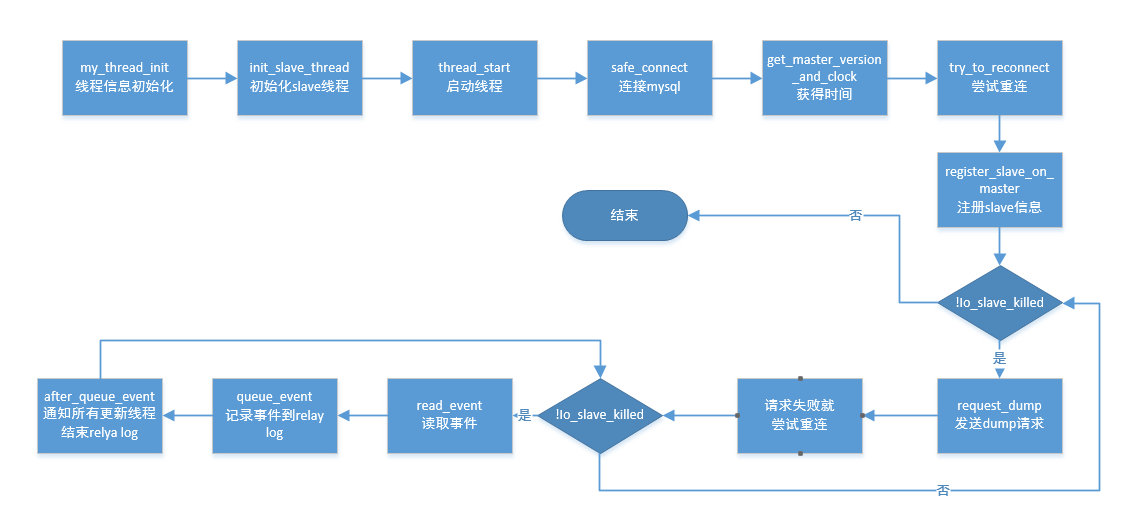
图1 handle_slave_io处理流程
我们这次主要要完成safe_connect以及try_to_reconnet用到的核心函数 mysql_real_connect流程的探索。
一、mysql_real_connect流程
在这之前我们需要弄明白连接mysql需要那几步操作,参考自官网的文档(http://dev.mysql.com/doc/internals/en/plain-handshake.html),据说连接时需要以下操作:

图2 mysql_real_connect操作流程
1.建立与mysql的连接
对于需要连接的建立一个监听端口,然后建立与链表中的所有服务端建立连接,并绑定到监听端口
   if (!net->vio &&

       (!mysql->options.protocol ||

        mysql->options.protocol == MYSQL_PROTOCOL_SOCKET) &&

       (unix_socket || mysql_unix_port) &&

       (!host || !strcmp(host,LOCAL_HOST)))

   {

     my_socket sock= socket(AF_UNIX, SOCK_STREAM, );

     DBUG_PRINT("info", ("Using socket"));

     if (sock == SOCKET_ERROR)

     {

       set_mysql_extended_error(mysql, CR_SOCKET_CREATE_ERROR,

                                unknown_sqlstate,

                                ER(CR_SOCKET_CREATE_ERROR),

                                socket_errno);

       goto error;

     }

     net->vio= vio_new(sock, VIO_TYPE_SOCKET,

                       VIO_LOCALHOST | VIO_BUFFERED_READ);

     if (!net->vio)

     {

       DBUG_PRINT("error",("Unknow protocol %d ", mysql->options.protocol));

       set_mysql_error(mysql, CR_CONN_UNKNOW_PROTOCOL, unknown_sqlstate);

       closesocket(sock);

       goto error;

     }

     host= LOCAL_HOST;

     if (!unix_socket)

       unix_socket= mysql_unix_port;

     host_info= (char*) ER(CR_LOCALHOST_CONNECTION);

     DBUG_PRINT("info", ("Using UNIX sock '%s'", unix_socket));

     memset(&UNIXaddr, , sizeof(UNIXaddr));

     UNIXaddr.sun_family= AF_UNIX;

     strmake(UNIXaddr.sun_path, unix_socket, sizeof(UNIXaddr.sun_path)-);

     if (vio_socket_connect(net->vio, (struct sockaddr *) &UNIXaddr,

                            sizeof(UNIXaddr), get_vio_connect_timeout(mysql)))

     {

       DBUG_PRINT("error",("Got error %d on connect to local server",

               socket_errno));

       set_mysql_extended_error(mysql, CR_CONNECTION_ERROR,

                                unknown_sqlstate,

                                ER(CR_CONNECTION_ERROR),

                                unix_socket, socket_errno);

       vio_delete(net->vio);

       net->vio= ;

       goto error;

     }

     mysql->options.protocol=MYSQL_PROTOCOL_SOCKET;

   }
 for (t_res= res_lst; t_res; t_res= t_res->ai_next)

     {

       DBUG_PRINT("info", ("Create socket, family: %d  type: %d  proto: %d",

                           t_res->ai_family, t_res->ai_socktype,

                           t_res->ai_protocol));

       sock= socket(t_res->ai_family, t_res->ai_socktype, t_res->ai_protocol);

       if (sock == SOCKET_ERROR)

       {

         DBUG_PRINT("info", ("Socket created was invalid"));

         /* Try next address if there is one */

         saved_error= socket_errno;

         continue;

       }

       if (client_bind_ai_lst)

       {

         struct addrinfo* curr_bind_ai= NULL;

         DBUG_PRINT("info", ("Attempting to bind socket to bind address(es)"));

         /*

            We'll attempt to bind to each of the addresses returned, until

            we find one that works.

            If none works, we'll try the next destination host address

            (if any)

         */

         curr_bind_ai= client_bind_ai_lst;

         while (curr_bind_ai != NULL)

         {

           /* Attempt to bind the socket to the given address */

           bind_result= bind(sock,

                             curr_bind_ai->ai_addr,

                             curr_bind_ai->ai_addrlen);

           if (!bind_result)

             break;   /* Success */

           DBUG_PRINT("info", ("bind failed, attempting another bind address"));

           /* Problem with the bind, move to next address if present */

           curr_bind_ai= curr_bind_ai->ai_next;

         }

         if (bind_result)

         {

           /*

             Could not bind to any client-side address with this destination

              Try the next destination address (if any)

           */

           DBUG_PRINT("info", ("All bind attempts with this address failed"));

           saved_error= socket_errno;

           closesocket(sock);

           continue;

         }

         DBUG_PRINT("info", ("Successfully bound client side of socket"));

       }

       /* Create a new Vio object to abstract the socket. */

       if (!net->vio)

       {

         if (!(net->vio= vio_new(sock, VIO_TYPE_TCPIP, flags)))

         {

           set_mysql_error(mysql, CR_OUT_OF_MEMORY, unknown_sqlstate);

           closesocket(sock);

           freeaddrinfo(res_lst);

           if (client_bind_ai_lst)

             freeaddrinfo(client_bind_ai_lst);

           goto error;

         }

       }

       /* Just reinitialize if one is already allocated. */

       else if (vio_reset(net->vio, VIO_TYPE_TCPIP, sock, NULL, flags))

       {

         set_mysql_error(mysql, CR_UNKNOWN_ERROR, unknown_sqlstate);

         closesocket(sock);

         freeaddrinfo(res_lst);

         if (client_bind_ai_lst)

           freeaddrinfo(client_bind_ai_lst);

         goto error;

       }

       DBUG_PRINT("info", ("Connect socket"));

       status= vio_socket_connect(net->vio, t_res->ai_addr,

                                  (socklen_t)t_res->ai_addrlen,

                                  get_vio_connect_timeout(mysql));

       /*

         Here we rely on vio_socket_connect() to return success only if

         the connect attempt was really successful. Otherwise we would

         stop trying another address, believing we were successful.

       */

       if (!status)

         break;

       /*

         Save either the socket error status or the error code of

         the failed vio_connection operation. It is necessary to

         avoid having it overwritten by later operations.

       */

       saved_error= socket_errno;

       DBUG_PRINT("info", ("No success, try next address."));

     }
2.读取初始握手报文
  if ((pkt_length=cli_safe_read(mysql, NULL)) == packet_error)

   {

     if (mysql->net.last_errno == CR_SERVER_LOST)

       set_mysql_extended_error(mysql, CR_SERVER_LOST, unknown_sqlstate,

                                ER(CR_SERVER_LOST_EXTENDED),

                                "reading initial communication packet",

                                socket_errno);

     goto error;

   }

   pkt_end= (char*)net->read_pos + pkt_length;

   /* Check if version of protocol matches current one */

   mysql->protocol_version= net->read_pos[];

   DBUG_DUMP("packet",(uchar*) net->read_pos,);

   DBUG_PRINT("info",("mysql protocol version %d, server=%d",

              PROTOCOL_VERSION, mysql->protocol_version));

   if (mysql->protocol_version != PROTOCOL_VERSION)

   {

     set_mysql_extended_error(mysql, CR_VERSION_ERROR, unknown_sqlstate,

                              ER(CR_VERSION_ERROR), mysql->protocol_version,

                              PROTOCOL_VERSION);

     goto error;

   }

   server_version_end= end= strend((char*) net->read_pos+);

   mysql->thread_id=uint4korr((uchar*) end + );

   end+=;

   /*

     Scramble is split into two parts because old clients do not understand

     long scrambles; here goes the first part.

   */

   scramble_data= end;

   scramble_data_len= AUTH_PLUGIN_DATA_PART_1_LENGTH + ;

   scramble_plugin= NULL;

   end+= scramble_data_len;

   if (pkt_end >= end + )

     mysql->server_capabilities=uint2korr((uchar*) end);

   if (pkt_end >= end + )

   {

     /* New protocol with 16 bytes to describe server characteristics */

     mysql->server_language=end[];

     mysql->server_status=uint2korr((uchar*) end + );

     mysql->server_capabilities|= uint2korr((uchar*) end + ) << ;

     pkt_scramble_len= end[];

     if (pkt_scramble_len < )

     {

       set_mysql_error(mysql, CR_MALFORMED_PACKET,

                       unknown_sqlstate);        /* purecov: inspected */

       goto error;

     }

   }

   end+= ;

   if (mysql_init_character_set(mysql))

     goto error;
3.发送回复握手报文
通过run_plugin_auth发送回复握手报文
   mpvio.mysql_change_user= data_plugin == ;

   mpvio.cached_server_reply.pkt= (uchar*)data;

   mpvio.cached_server_reply.pkt_len= data_len;

   mpvio.read_packet= client_mpvio_read_packet;

   mpvio.write_packet= client_mpvio_write_packet;

   mpvio.info= client_mpvio_info;

   mpvio.mysql= mysql;

   mpvio.packets_read= mpvio.packets_written= ;

   mpvio.db= db;

   mpvio.plugin= auth_plugin;

   MYSQL_TRACE(AUTH_PLUGIN, mysql, (auth_plugin->name));

   res= auth_plugin->authenticate_user((struct st_plugin_vio *)&mpvio, mysql);
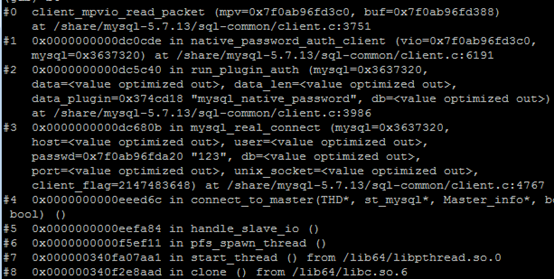
 static int native_password_auth_client(MYSQL_PLUGIN_VIO *vio, MYSQL *mysql)

 {

   int pkt_len;

   uchar *pkt;

   DBUG_ENTER("native_password_auth_client");

   if (((MCPVIO_EXT *)vio)->mysql_change_user)

   {

     /*

       in mysql_change_user() the client sends the first packet.

       we use the old scramble.

     */

     pkt= (uchar*)mysql->scramble;

     pkt_len= SCRAMBLE_LENGTH + ;

   }

   else

   {

     /* read the scramble */

     if ((pkt_len= vio->read_packet(vio, &pkt)) < )

       DBUG_RETURN(CR_ERROR);

     if (pkt_len != SCRAMBLE_LENGTH + )

       DBUG_RETURN(CR_SERVER_HANDSHAKE_ERR);

     /* save it in MYSQL */

     memcpy(mysql->scramble, pkt, SCRAMBLE_LENGTH);

     mysql->scramble[SCRAMBLE_LENGTH] = ;

   }

   if (mysql->passwd[])

   {

     char scrambled[SCRAMBLE_LENGTH + ];

     DBUG_PRINT("info", ("sending scramble"));

     scramble(scrambled, (char*)pkt, mysql->passwd);

     if (vio->write_packet(vio, (uchar*)scrambled, SCRAMBLE_LENGTH))

       DBUG_RETURN(CR_ERROR);

   }

   else

   {

     DBUG_PRINT("info", ("no password"));

     if (vio->write_packet(vio, , )) /* no password */

       DBUG_RETURN(CR_ERROR);

   }

   DBUG_RETURN(CR_OK);

 }
先通过read_packet获得挑战码,再通过scramble加密,然后通过write_packet发送回复握手报文。
client_mpvio_write_packet->send_client_reply_packet,该函数是发送回复握手报文。
4.读入认证回复报文
  /* read the OK packet (or use the cached value in mysql->net.read_pos */

   if (res == CR_OK)

     pkt_length= (*mysql->methods->read_change_user_result)(mysql);

   else /* res == CR_OK_HANDSHAKE_COMPLETE */

     pkt_length= mpvio.last_read_packet_len;
最后通过cli_read_change_user_result即cli_safe_read读取ok报文
5.选择数据库
 int STDCALL

 mysql_select_db(MYSQL *mysql, const char *db)

 {

   int error;

   DBUG_ENTER("mysql_select_db");

   DBUG_PRINT("enter",("db: '%s'",db));

   if ((error=simple_command(mysql,COM_INIT_DB, (const uchar*) db,

                             (ulong) strlen(db),)))

     DBUG_RETURN(error);

   my_free(mysql->db);

   mysql->db=my_strdup(key_memory_MYSQL,

                       db,MYF(MY_WME));

   DBUG_RETURN();

 }
以command报文的形式发送命令数据
二、 登陆阶段所用到的报文格式
1.初始握手报文
               [0a] protocol version

 string[NUL]    server version

               connection id

 string[]      auth-plugin-data-part-

               [] filler

               capability flags (lower  bytes)

   if more data in the packet:

               character set

               status flags

               capability flags (upper  bytes)

   if capabilities & CLIENT_PLUGIN_AUTH {

               length of auth-plugin-data

   } else {

               []

   }

 string[]     reserved (all [])

   if capabilities & CLIENT_SECURE_CONNECTION {

 string[$len]   auth-plugin-data-part- ($len=MAX(, length of auth-plugin-data - ))

   if capabilities & CLIENT_PLUGIN_AUTH {

 string[NUL]    auth-plugin name

   }
(1)协议的版本
(2)协议的版本名
(3)连接id其实是线程的id
(4)挑战码的第一部分(用于登陆密码加密)
(5)不用关注
(6)标志位的最低两个,该标志会确定较多信息后面的capabilities就是该标志为
(8)字符集编号,其实就是采用什么样的字符集,如utf8等等
(9)服务器状态编码
(10)标志位的较高两位
(12)挑战码总长度(用于登陆密码加密,是一个可选项)
(16)都是0,不用关注
(18)第二段挑战码(用于登陆密码加密,是一个可选项)
(20)挑战码生成名(是一个可选项)
2.回复握手报文
               capability flags, CLIENT_PROTOCOL_41 always set

               max-packet size

               character set

 string[]     reserved (all [])

 string[NUL]    username

   if capabilities & CLIENT_PLUGIN_AUTH_LENENC_CLIENT_DATA {

 lenenc-int     length of auth-response

 string[n]      auth-response

   } else if capabilities & CLIENT_SECURE_CONNECTION {

               length of auth-response

 string[n]      auth-response

   } else {

 string[NUL]    auth-response

   }

   if capabilities & CLIENT_CONNECT_WITH_DB {

 string[NUL]    database

   }

   if capabilities & CLIENT_PLUGIN_AUTH {

 string[NUL]    auth plugin name

   }

   if capabilities & CLIENT_CONNECT_ATTRS {

 lenenc-int     length of all key-values

 lenenc-str     key

 lenenc-str     value

    if-more data in 'length of all key-values', more keys and value pairs

   }
(1)收到的capability flags
(2)最大报文长度,这是与mysql服务器协商的
(3)字符集
(4)不需要关注
(5)登陆的用户名
(7)(8)一般选项为此选项,即加密的密码报文
下面的报文在本文件发送中没有用到
3.认证回复报文
 Type    Name    Description

 int<>    header    [] or [fe] the OK packet header

 int<lenenc>    affected_rows    affected rows

 int<lenenc>    last_insert_id    last insert-id

 if capabilities & CLIENT_PROTOCOL_41 {

   int<>    status_flags    Status Flags

   int<>    warnings    number of warnings

 } elseif capabilities & CLIENT_TRANSACTIONS {

   int<>    status_flags    Status Flags

 }

 if capabilities & CLIENT_SESSION_TRACK {

   string<lenenc>    info    human readable status information

   if status_flags & SERVER_SESSION_STATE_CHANGED {

     string<lenenc>    session_state_changes    session state info

   }

 } else {

   string<EOF>    info    human readable status information

 }
slave IO流程之一:mysql登陆过程(mysql_real_connect)的更多相关文章
- slave IO流程之二:注册slave请求和dump请求
slave IO流程已经在http://www.cnblogs.com/onlyac/p/5815566.html中有介绍 这次我们要探索注册slave请求和dump请求的报文格式和主要流程. 一.注 ...
- 乌龙之MySQL slave IO status:connecting
搭建了一个主从,状态一直如下: 检查错误日志报错如下: review搭建过程,语法并没有问题. 检查用户及网络,也没有问题: so?what is the cause ? 等等....貌似上面搭建用的 ...
- MySQL主从配置This operation cannot be performed with a running slave io thread; run STOP SLAVE IO_THREAD FOR CHANNEL '' first.
MySQL主从配置This operation cannot be performed with a running slave io thread; run STOP SLAVE IO_THREAD ...
- MySQL关闭过程详解和安全关闭MySQL的方法
MySQL关闭过程详解和安全关闭MySQL的方法 www.hongkevip.com 时间: -- : 阅读: 整理: 红客VIP 分享到: 红客VIP(http://www.hongkevip.co ...
- 【数据库开发】在Windows上和Linux上配置MySQL的过程
[数据库开发]在Windows上和Linux上配置MySQL的过程 标签(空格分隔): [编程开发] 首先是在Windows上尝试用QT进行MySQL数据库开发,结果总出现driver不能load的错 ...
- Mysql加锁过程详解(1)-基本知识
Mysql加锁过程详解(1)-基本知识 Mysql加锁过程详解(2)-关于mysql 幻读理解 Mysql加锁过程详解(3)-关于mysql 幻读理解 Mysql加锁过程详解(4)-select fo ...
- Mysql加锁过程详解(4)-select for update/lock in share mode 对事务并发性影响
Mysql加锁过程详解(1)-基本知识 Mysql加锁过程详解(2)-关于mysql 幻读理解 Mysql加锁过程详解(3)-关于mysql 幻读理解 Mysql加锁过程详解(4)-select fo ...
- MySQL解析过程、执行过程
转载:https://student-lp.iteye.com/blog/2152601 https://www.cnblogs.com/cdf-opensource-007/p/6502556.ht ...
- IO流程及优化
http://blog.csdn.net/xypzwl/article/details/51416883 一.存储设备的存储原理 机械硬盘: 机械硬盘使用磁性物质作为存储介质,用N.S极性来代表0或1 ...
随机推荐
- Linux SHELL 命令入门题目答案(一)
1.如何使用shell 打印 “Hello World!” (1)如果你希望打印 !,那就不要将其放入双引号中,或者你可以通过转义字符转义(2)echo 'hello world!' 使用单引号ech ...
- 本地xdebug调试搭建 Laravel+homestead+phpstorm
1.在homestead virtual box安装和配置xdebug 先在终端运行vagrant up 和 vagrant ssh,ssh远程到homestead,然后复制以下代码到一个shell文 ...
- JavaScript对象状态
有限状态机(Finite-state machine)是一个非常有用的模型,可以模拟世界上大部分事物. 简单说,它有三个特征: * 状态总数(state)是有限的. * 任一时刻,只处在一种状态之中. ...
- swift-string(字符串的一些语法)
1 isEmpty 返回一个布尔值,确定该字符串是否为空 2 hasPrefix(prefix: String) 函数检查给定的参数字符串是否以 string 为前缀 3 hasSuffix(suff ...
- How to make your assembly more secure from referencing by unauthorized bits
Now the security has a trend to become more and more important in our daily work, hence I did some r ...
- ruby开发环境配置
环境:win7 64位 软件:Ruby2.2.5,devkit对应版本,rubygems,rails 一:安装Ruby 1.在这个网站:http://rubyinstaller.org/downloa ...
- Ant环境变量配置
Ant环境变量配置 1.新建系统变量ANT_HOME 变量名: ANT_HOME 变量值: D:\biancheng\apache-ant-1.7.1 2.修改PATH 变量值最后面 ...
- 在linux下Ant的环境配置
Ant(英文全称为another neat tool,另一个简洁的工具)是一个基于Java的生成工具,Ant将会被应用到Java项目中. 同样的,现在要来安装Ant(最近要安装的东西还蛮多的=m=), ...
- Python 爬虫2——环境配置
关于环境配置的操作,其实非常简单,假如不使用第三方的框架的话,只需要安装Python即可完成后续的操作. 一.Python的安装和配置: windows系统的安装配置过程如下,假如是Mac系统,可参考 ...
- HTML5、canvas颜色拾取器
效果图: 代码: <!doctype html> <html lang="en"> <head> <meta charset=" ...