
Python函数式编程中map()、reduce()和filter()函数的用法
Python中map()、reduce()和filter()三个函数均是应用于序列的内置函数,分别对序列进行遍历、递归计算以及过滤操作。这三个内置函数在实际使用过程中常常和“行内函数”lambda函数联合使用,我们首先介绍下lambda函数。
1、lambda函数
lambda函数的Python3.x API文档
lambda
An anonymous inline function consisting of a single expression which is evaluated when the function is called. The syntax to create a lambda function is lambda [arguments]: expression
由文档可知,lambda函数是匿名行内函数,其语法为lambda [arguments]: expression,比如:
f = lambda x, y : x * y #定义了函数f(x, y) = x * y其非匿名函数表达如下:
def f(x, y):

    return x * y
2、map()函数
map()函数的Python3.x API文档
map(function, iterable, ...)
Return an iterator that applies function to every item of iterable, yielding the results. If additional iterable arguments are passed, function must take that many arguments and is applied to the items from all iterables in parallel. With multiple iterables, the iterator stops when the shortest iterable is exhausted. For cases where the function inputs are already arranged into argument tuples, see itertools.starmap().
map()函数的输入是一个函数function以及一个或多个可迭代的集合iterable,在Python 2.x中map()函数的输出是一个集合,Python 3.x中输出的是一个迭代器。map()函数主要功能为对iterable中的每个元素都进行function函数操作,并将所有的返回结果放到集合或迭代器中。function如果是None,则其作用等同于zip()。
例如:
>>> a = map(lambda x, y : x * y, range(3), range(3))

>>> b = list(a)

>>> print(b)

[0, 1, 4]
在Python 2.x中则不需要 b = list(a),因为在Python 2.x中map()函数的输出直接就是一个集合。
map()函数的具体执行过程图如图1所示。
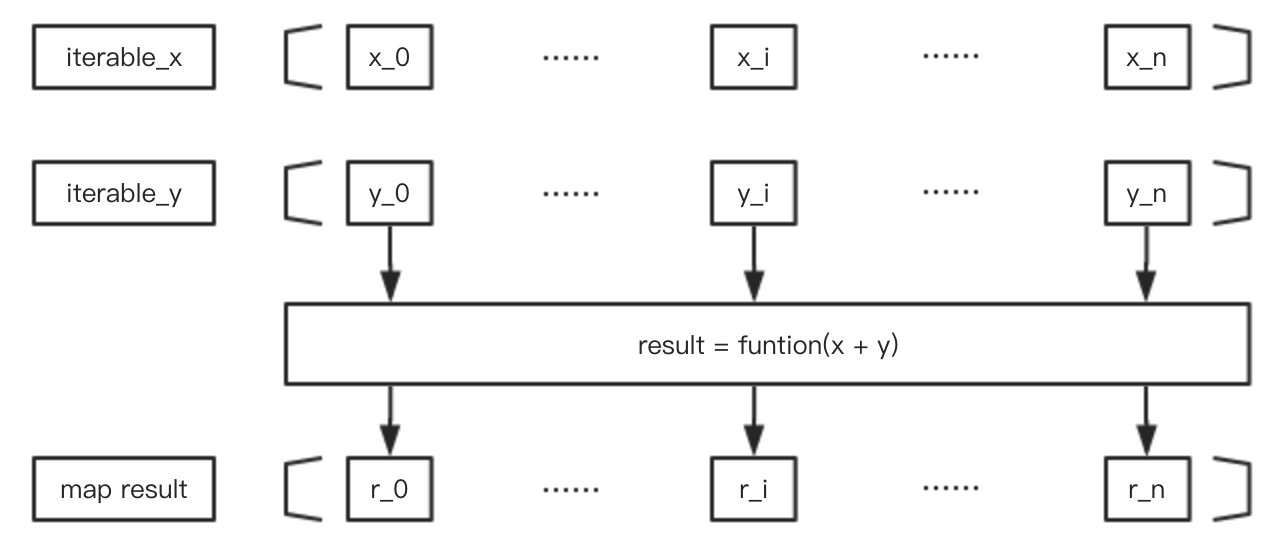
图 1 map()函数的具体执行过程图
由图1可看出,使用map函数时,两个可迭代的集合中的元素可以并行进行计算。
对于两个可迭代的集合的元素个数不一致的情况,map()函数会自动截断更长的那个集合,并只计算两个集合对应的元素,比如:
>>> a = map(lambda x, y : x * y, range(3), range(2))

>>> b = list(a)

>>> print(b)

[0, 1]
3、reduce()函数
reduce()函数的Python3.x API文档
functools.reduce(function, iterable[, initializer])
Apply function of two arguments cumulatively to the items of sequence, from left to right, so as to reduce the sequence to a single value. For example, reduce(lambda x, y: x+y, [1, 2, 3, 4, 5]) calculates ((((1+2)+3)+4)+5). The left argument, x, is the accumulated value and the right argument, y, is the update value from the sequence. If the optional initializer is present, it is placed before the items of the sequence in the calculation, and serves as a default when the sequence is empty. If initializer is not given and sequence contains only one item, the first item is returned.
reduce()函数的输入是一个函数function、一个可迭代的集合iterable以及一个可选的初始项initializer,输出为一个值。不同于map()函数对序列中的元素进行逐一遍历,reduce()函数对序列中的元素进行递归计算。比如:
>>> from functools import reduce

>>> a = reduce(lambda x, y : x * y, [1, 2, 3])

>>> print(a)

6
在 Python3 中,reduce() 函数已经被从全局名字空间里移除了,它现在被放置在 functools模块里,如果想要使用它,则需要通过引入 functools 模块来调用 reduce() 函数。
reduce() 函数的具体执行过程图如图2所示。
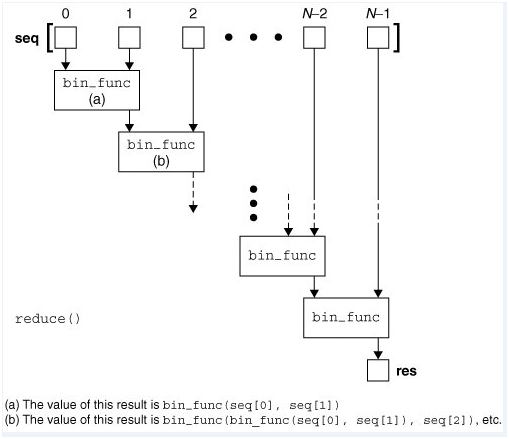
图2 reduce() 函数的具体执行过程图
由图2可以看出,reduce()函数先将可迭代集合中的前两个元素进行function操作运算,然后将运算结果与第三个元素再进行function操作运算,以此类推,直到迭代完集合中所有的元素,最终返回递归结果。
4、filter()函数
filter()函数的Python3.x API文档
filter(function, iterable)
Construct an iterator from those elements of iterable for which function returns true. iterable may be either a sequence, a container which supports iteration, or an iterator. If function is None, the identity function is assumed, that is, all elements of iterable that are false are removed. Note that filter(function, iterable) is equivalent to the generator expression (item for item in iterable if function(item)) if function is not Noneand (item for item in iterable if item) if function is None.
See itertools.filterfalse() for the complementary function that returns elements of iterable for which function returns false.
filter()函数的输入为一个函数function和一个可迭代的集合iterable,在Python 2.x中filter()函数的输出是一个集合,Python 3.x中输出的是一个filter类。顾名思义,filter()函数主要是对指定可迭代集合进行过滤,筛选出集合中符合条件的元素。比如:
>>> a = filter(lambda x: x > 3 and x < 6, range(7))

>>> print(a)

<filter object at 0x108bf2390>

>>> b = list(a)

>>> print(b)

[4, 5]
5、map()、reduce()和filter()与for
在Python的函数式编程中的map()、reduce()和filter()函数,均可用for循环来实现,那么为什么还需要map()、reduce()和filter()函数呢?
主要是因为Python的for命令效率不高且复杂,而map()、reduce()和filter()更为高效和简洁,map()、reduce()和filter()的循环速度比Python内置的for或while循环要快得多,其执行速度相当于C语言。
def demo_for():

    x = [x for x in range(100000)]

    y = [y for y in range(100000)]

    result = []

    for i in range(100000):

        result.append(x[i] + y[i])

    return result

def demo_map():

    a = map(lambda x, y: x + y, range(100000), range(100000))

return list(a)在以上的十万个元素的对比计算中,demo_map的执行效率比demo_for的高2倍之多。厦门叉车修理公司
Python函数式编程中map()、reduce()和filter()函数的用法的更多相关文章
- Python函数式编程,map/reduce,filter和sorted
什么是函数式编程? 与面向对象编程(Object-oriented programming)和过程式编程(Procedural programming)并列的编程范式. 最主要的特征是,函数是第一等公 ...
- Python学习札记(二十一) 函数式编程2 map/reduce
参考:map/reduce Note 1.map():map()函数接收两个参数,一个是函数,一个是Iterable.map将传入的函数依次作用到序列的每个元素,并把结果作为新的Iterator返回. ...
- Python“函数式编程”中常用的函数
1.map(func,seq[,seq,...]) 对序列中的每个元素应用函数,python2中map()返回的是列表,python3中返回的是迭代器,可以用list()转换成列表.以下例子为pyth ...
- 转自:Python函数式编程指南(二):函数
2. 从函数开始 2.1. 定义一个函数 如下定义了一个求和函数: 1 2 def add(x, y): return x + y 关于参数和返回值的语法细节可以参考其他文档,这里就略过了. ...
- map,reduce和filter函数
numArray = [1, 2, 3, 4, 5] def ercifang(x): return x ** 2 def map_test(func, numArray): li = [] for ...
- Python函数式编程(一):高级函数
首先有一个高级函数的知识. 一个函数可以接收另一个函数作为参数,这种函数就称之为高阶函数. def add(x, y, f): return f(x) + f(y) 当我们调用add(-, , abs ...
- Python函数式编程——map()、reduce()
文章来源:http://www.pythoner.com/46.html 提起map和reduce想必大家并不陌生,Google公司2003年提出了一个名为MapReduce的编程模型[1],用于处理 ...
- (转)Python函数式编程——map()、reduce()
转自:http://www.jianshu.com/p/7fe3408e6048 1.map(func,seq1[,seq2...]) Python 函数式编程中的map()函数是将func作用于se ...
- Python 函数式编程 & Python中的高阶函数map reduce filter 和sorted
1. 函数式编程 1)概念 函数式编程是一种编程模型,他将计算机运算看做是数学中函数的计算,并且避免了状态以及变量的概念.wiki 我们知道,对象是面向对象的第一型,那么函数式编程也是一样,函数是函数 ...
随机推荐
- 集合之Map总结
在前面LZ详细介绍了HashMap.HashTable.TreeMap的实现方法,从数据结构.实现原理.源码分析三个方面进行阐述,对这个三个类应该有了比较清晰的了解,下面LZ就Map做一个简单的总结. ...
- python file的3中读法
f.read() 整个文件读入到内存,全部放入到一个string中 f.readlines() 文件全部内容解析成行列表,自带\n,需要print i, f.readline()一行一行,返回字符串 ...
- JDK(九)JDK1.7源码分析【集合】HashMap的死循环
前言 在JDK1.7&1.8源码对比分析[集合]HashMap中我们遗留了一个问题:为什么HashMap在调用resize() 方法时会出现死循环?这篇文章就通过JDK1.7的源码来分析并解释 ...
- Handlebars模板引擎
介绍 Handlebars 是 JavaScript 一个语义模板库,通过对view和data的分离来快速构建Web模板.它采用"Logic-less template"(无逻辑模 ...
- [图解tensorflow源码] Session::Run() 分布式版本
- Unity3D游戏开发从零单排(三) - 极速创建狂拽酷炫的游戏地形
提要 在Unity工作流程内,地形是一个必不可少的重要元素.不论是游戏或虚拟现实都会使用到各种类型的地形效果,在这个教学中我们须要了解到地形的制作基本概念与,当中对于Unity的地形操作部分须要大量的 ...
- 面向对象之static关键字
static概念 static它是静态修饰符,一般用来修饰类中的成员. static特点 1.多个对象共享一个static成员变量.一个对象将static成员变量值修改了,其他对象中的static成员 ...
- Linux—文件命令之touch命令
下面总结一下对于文件的操作命令: satat命令:用于显示文件的详细信息,包括文件.设备.gid.各种时间等. 命令格式:stat filename touch 的两个功能: 1.新建文件,如需建立特 ...
- 用C挑战无准备写2048
下午在刷题过程中,忽然想写2048了,以弥补以前写的那个千多行的,所以简单思考了一下准备采取的数据结构就开始了,本以为一个小时能搞定,结果后面改bug还是多花了些时间.因为在医院,所以声音不敢太大,如 ...
- 第十周课下作业-IPC
第十周课下作业-IPC 题目:研究Linux下IPC机制:原理,优缺点,每种机制至少给一个示例,提交研究博客的链接 共享内存 管道 FIFO 信号 消息队列 共享内存 共享内存允许两个或多个进程进程共 ...