
torch.cat()和torch.stack()
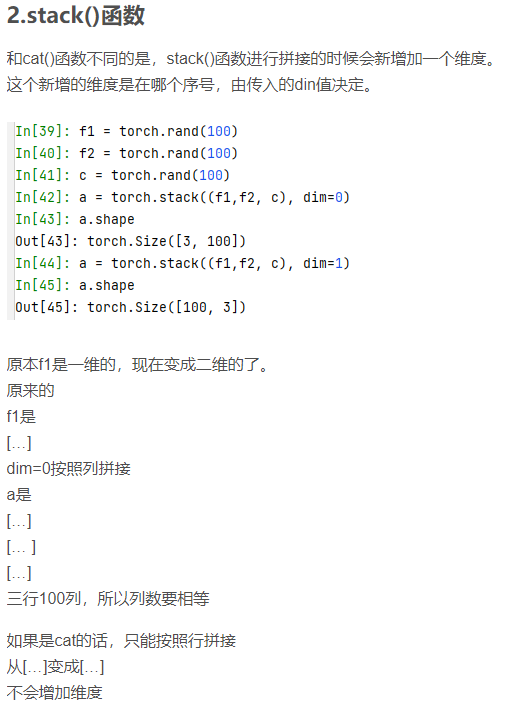
torch.cat() 和 torch.stack()略有不同
torch.cat(tensors,dim=0,out=None)→ Tensor
torch.cat()对tensors沿指定维度拼接,但返回的Tensor的维数不会变,可理解为续接;
torch.stack(tensors,dim=0,out=None)→ Tensor
torch.stack()同样是对tensors沿指定维度拼接,但返回的Tensor会多一维,可理解为叠加;
————————————————
版权声明:本文为CSDN博主「进阶媛小吴」的原创文章,遵循CC 4.0 BY-SA版权协议,转载请附上原文出处链接及本声明。
原文链接:https://blog.csdn.net/wuli_xin/article/details/118972316
torch.cat((a,b),dim=1)和torch.cat((a,b)axis=1)一样。
同理:torch.stack((a,b),dim=1)和torch.stack((a,b)axis=1)一样。
zz=torch.rand(100)#默认zz是列向量。而非行向量。
上述3行的情况,自己已经实际实验过。

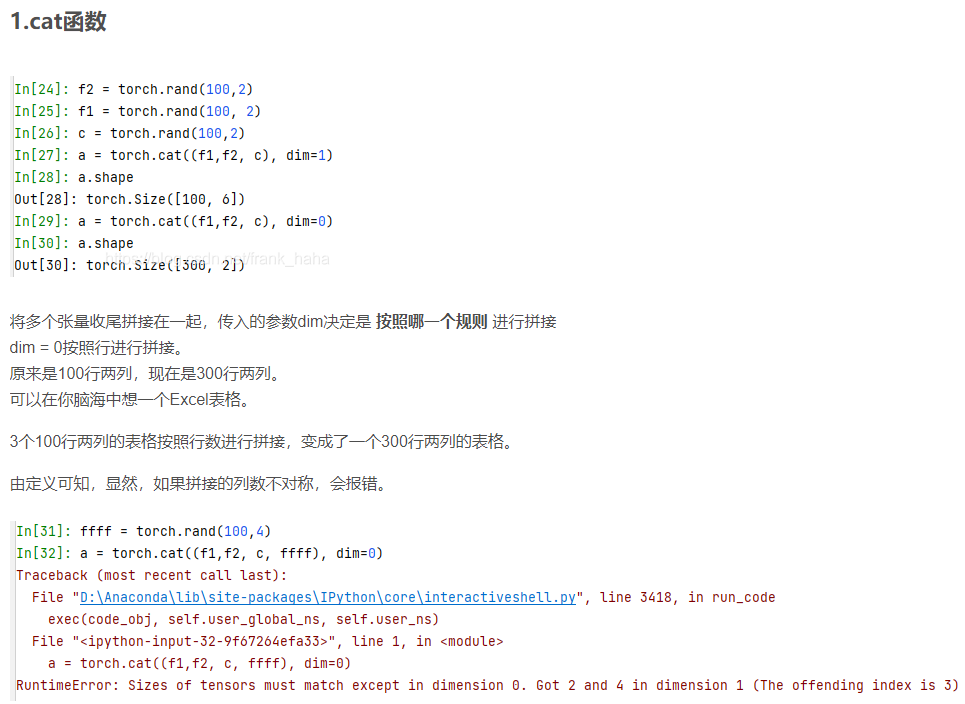
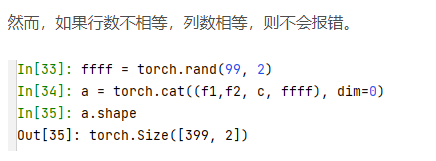
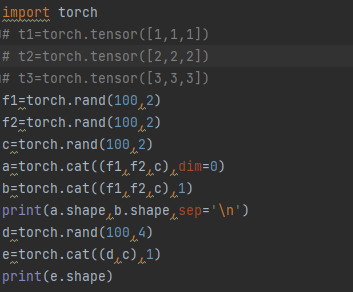
结果为:

上述行数相同d,c,在第一维度也即列上拼接时,能拼接成100行六列的tensor.
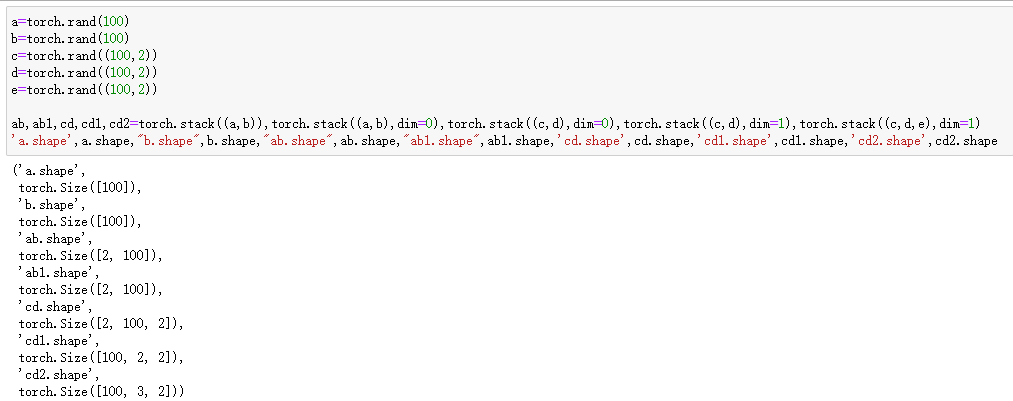
import torch

a=torch.rand(100)

b=torch.rand(100)

c=torch.rand((100,2))

d=torch.rand((100,2))

e=torch.rand((100,2))

ab,ab1,cd,cd1,cd2,cd3=torch.stack((a,b)),torch.stack((a,b),dim=0),torch.stack((c,d),dim=0),torch.stack((c,d),dim=1),torch.stack((c,d,e),axis=1),torch.stack((c,d,e),dim=-1)

'a.shape',a.shape,"b.shape",b.shape,"ab.shape",ab.shape,"ab1.shape",ab1.shape,'cd.shape',cd.shape,'cd1.shape',cd1.shape,'cd2.shape',cd2.shape,cd3.shape
此处需注意的是:torch.stack((c,d,e),dim=-1)和torch.stack((c,d,e),dim=2)结果是一样的;
('a.shape',

 torch.Size([100]),

 'b.shape',

 torch.Size([100]),

 'ab.shape',

 torch.Size([2, 100]),

 'ab1.shape',

 torch.Size([2, 100]),

 'cd.shape',

 torch.Size([2, 100, 2]),

 'cd1.shape',

 torch.Size([100, 2, 2]),

 'cd2.shape',

 torch.Size([100, 3, 2]),

 torch.Size([100, 2, 3]))
import torch

# t1=torch.tensor([1,1,1])

# t2=torch.tensor([2,2,2])

# t3=torch.tensor([3,3,3])

f1=torch.tensor([[1,2,3],[4,5,6]])

f2=torch.tensor([[7,8,9],[10,11,12]])

c=torch.tensor([[13,14,15],[16,17,18]])

# a=torch.cat((f1,f2,c),dim=0)

# b=torch.cat((f1,f2,c),1)

# print(a.shape,b.shape,sep='\n')

# d=torch.rand(100,4)

# e=torch.cat((d,c),1)

# print(e.shape)

g=torch.stack((f1,f2,c),0)

g1=torch.stack((f1,f2,c),1)

print(f1.shape,f2.shape,c.shape)

print('g: ',g.shape,g,sep='\n')

print('g1: ',g1.shape,g1,sep='\n')

输出结果为:

torch.Size([2, 3]) torch.Size([2, 3]) torch.Size([2, 3])

g:

torch.Size([3, 2, 3])#本来3个,就3个;本来2行3列就两行三列;只不过把他们放到一起,变成了3维的,多了一个维度;个人理解,可能有误。

tensor([[[ 1,  2,  3],

         [ 4,  5,  6]],

        [[ 7,  8,  9],

         [10, 11, 12]],

        [[13, 14, 15],

         [16, 17, 18]]])

g1:

torch.Size([2, 3, 3])#把本来的三个中,每个的第一列拼在一块;第二列拼在一块;再把拼过后的第一列和第二列分别作为一个二维矩阵; 个人理解,可能有误。

tensor([[[ 1,  2,  3],

         [ 7,  8,  9],

         [13, 14, 15]],

        [[ 4,  5,  6],

         [10, 11, 12],

         [16, 17, 18]]])
import torch

# t1=torch.tensor([1,1,1])

# t2=torch.tensor([2,2,2])

# t3=torch.tensor([3,3,3])

f1=torch.tensor([[1,2,3],[4,5,6]])

f2=torch.tensor([[7,8,9],[10,11,12]])

c=torch.tensor([[13,14,15],[16,17,18]])

# a=torch.cat((f1,f2,c),dim=0)

# b=torch.cat((f1,f2,c),1)

# print(a.shape,b.shape,sep='\n')

# d=torch.rand(100,4)

# e=torch.cat((d,c),1)

# print(e.shape)

g=torch.stack((f1,f2,c),0)

g1=torch.stack((f1,f2,c),2)

print(f1.shape,f2.shape,c.shape)

print('g: ',g.shape,g,sep='\n')

print('g1: ',g1.shape,g1,sep='\n')

输出结果:

torch.Size([2, 3]) torch.Size([2, 3]) torch.Size([2, 3])

g:

torch.Size([3, 2, 3])

tensor([[[ 1,  2,  3],

         [ 4,  5,  6]],

        [[ 7,  8,  9],

         [10, 11, 12]],

        [[13, 14, 15],

         [16, 17, 18]]])

g1:

torch.Size([2, 3, 3])

tensor([[[ 1,  7, 13],

         [ 2,  8, 14],

         [ 3,  9, 15]],

        [[ 4, 10, 16],

         [ 5, 11, 17],

         [ 6, 12, 18]]])
import torch

# t1=torch.tensor([1,1,1])

# t2=torch.tensor([2,2,2])

# t3=torch.tensor([3,3,3])

f1=torch.tensor([[1,2,3],[4,5,6]])

f2=torch.tensor([[7,8,9],[10,11,12]])

c=torch.tensor([[13,14,15],[16,17,18]])

# a=torch.cat((f1,f2,c),dim=0)

# b=torch.cat((f1,f2,c),1)

# print(a.shape,b.shape,sep='\n')

# d=torch.rand(100,4)

# e=torch.cat((d,c),1)

# print(e.shape)

g=torch.stack((f1,f2,c),0)

g1=torch.stack((f1,f2,c),3)#此处dim=3,或比3大的任何正数,都是如下报错结果。

print(f1.shape,f2.shape,c.shape)

print('g: ',g.shape,g,sep='\n')

print('g1: ',g1.shape,g1,sep='\n')

输出结果:

Traceback (most recent call last):

  File "<input>", line 17, in <module>

IndexError: Dimension out of range (expected to be in range of [-3, 2], but got 3)
此外:
如果,torch.stack()的维度dim输入的是-1,-2,-3,也都可以正确输出结果。但是如果输入比-3小的任何数则会报错;具体如下:
import torch

# t1=torch.tensor([1,1,1])

# t2=torch.tensor([2,2,2])

# t3=torch.tensor([3,3,3])

f1=torch.tensor([[1,2,3],[4,5,6]])

f2=torch.tensor([[7,8,9],[10,11,12]])

c=torch.tensor([[13,14,15],[16,17,18]])

# a=torch.cat((f1,f2,c),dim=0)

# b=torch.cat((f1,f2,c),1)

# print(a.shape,b.shape,sep='\n')

# d=torch.rand(100,4)

# e=torch.cat((d,c),1)

# print(e.shape)

g=torch.stack((f1,f2,c),0)

g1=torch.stack((f1,f2,c),-1) #此时,维度是-1

print(f1.shape,f2.shape,c.shape)

print('g: ',g.shape,g,sep='\n')

print('g1: ',g1.shape,g1,sep='\n')

输出结果为:

torch.Size([2, 3]) torch.Size([2, 3]) torch.Size([2, 3])

g:

torch.Size([3, 2, 3])

tensor([[[ 1,  2,  3],

         [ 4,  5,  6]],

        [[ 7,  8,  9],

         [10, 11, 12]],

        [[13, 14, 15],

         [16, 17, 18]]])

g1:

torch.Size([2, 3, 3])

tensor([[[ 1,  7, 13],

         [ 2,  8, 14],

         [ 3,  9, 15]],

        [[ 4, 10, 16],

         [ 5, 11, 17],

         [ 6, 12, 18]]])
torch.stack()的维度dim输入的是--2;
输出结果为:

torch.Size([2, 3]) torch.Size([2, 3]) torch.Size([2, 3])

g:

torch.Size([3, 2, 3])

tensor([[[ 1,  2,  3],

         [ 4,  5,  6]],

        [[ 7,  8,  9],

         [10, 11, 12]],

        [[13, 14, 15],

         [16, 17, 18]]])

g1:

torch.Size([2, 3, 3])

tensor([[[ 1,  2,  3],

         [ 7,  8,  9],

         [13, 14, 15]],

        [[ 4,  5,  6],

         [10, 11, 12],

         [16, 17, 18]]])
torch.stack()的维度dim输入的是-3;
torch.Size([2, 3]) torch.Size([2, 3]) torch.Size([2, 3])

g:

torch.Size([3, 2, 3])

tensor([[[ 1,  2,  3],

         [ 4,  5,  6]],

        [[ 7,  8,  9],

         [10, 11, 12]],

        [[13, 14, 15],

         [16, 17, 18]]])

g1:

torch.Size([3, 2, 3])

tensor([[[ 1,  2,  3],

         [ 4,  5,  6]],

        [[ 7,  8,  9],

         [10, 11, 12]],

        [[13, 14, 15],

         [16, 17, 18]]])
import torch

# t1=torch.tensor([1,1,1])

# t2=torch.tensor([2,2,2])

# t3=torch.tensor([3,3,3])

f1=torch.tensor([[1,2,3],[4,5,6]])

f2=torch.tensor([[7,8,9],[10,11,12]])

c=torch.tensor([[13,14,15],[16,17,18]])

# a=torch.cat((f1,f2,c),dim=0)

# b=torch.cat((f1,f2,c),1)

# print(a.shape,b.shape,sep='\n')

# d=torch.rand(100,4)

# e=torch.cat((d,c),1)

# print(e.shape)

g=torch.stack((f1,f2,c),0)

g1=torch.stack((f1,f2,c),-4)#此处是dim=-4,小于-4的任何负数,输出类似的结果。

print(f1.shape,f2.shape,c.shape)

print('g: ',g.shape,g,sep='\n')

print('g1: ',g1.shape,g1,sep='\n')

输出结果为:

Traceback (most recent call last):

  File "<input>", line 17, in <module>

IndexError: Dimension out of range (expected to be in range of [-3, 2], but got -4)
import torch

a=torch.rand(100)

b=torch.rand(100)

c=torch.stack((a,b))

d=torch.stack((a,b),dim=0)

e=torch.stack((a,b),dim=1)

f=torch.cat((a,b))

f1=torch.cat((a,b),dim=0)

# f2=torch.cat((a,b),dim=1)#错误提示:Dimension out of range (expected to be in range of [-1, 0], but got 1)

c.size,c.size(),c.shape,d.shape,e.shape,f.shape,f.size(),f1.shape

#从输出结果可看出,torch.rand(100)生成的是100行1列的数据,也即是一个列向量;concat沿着已有的维度拼接,stack在新创建的维度上拼接;

#输出:

(<function Tensor.size>,

 torch.Size([2, 100]),

 torch.Size([2, 100]),

 torch.Size([2, 100]),

 torch.Size([100, 2]),

 torch.Size([200]),

 torch.Size([200]),

 torch.Size([200]))
torch.cat()和torch.stack()的更多相关文章
- torch.stack()与torch.cat()
torch.stack():http://www.45fan.com/article.php?aid=1D8JGDik5G49DE1X torch.stack()个人理解:属于先变形再cat的操作,所 ...
- torch.cat拼接 stack拼接 分块chunk
torch.cat拼接 stack拼接 分块chunk 待办 https://blog.csdn.net/qq_39709535/article/details/80803003 stack dim理 ...
- Pytorch中的torch.cat()函数
cat是concatnate的意思:拼接,联系在一起. 先说cat( )的普通用法 如果我们有两个tensor是A和B,想把他们拼接在一起,需要如下操作: C = torch.cat( (A,B),0 ...
- Pytorch的torch.cat实例
import torch 通过 help((torch.cat)) 可以查看 cat 的用法 cat(seq,dim,out=None) 其中 seq表示要连接的两个序列,以元组的形式给出,例如:se ...
- 从 relu 的多种实现来看 torch.nn 与 torch.nn.functional 的区别与联系
从 relu 的多种实现来看 torch.nn 与 torch.nn.functional 的区别与联系 relu多种实现之间的关系 relu 函数在 pytorch 中总共有 3 次出现: torc ...
- 【Pytorch】关于torch.matmul和torch.bmm的输出tensor数值不一致问题
发现 对于torch.matmul和torch.bmm,都能实现对于batch的矩阵乘法: a = torch.rand((2,3,10))b = torch.rand((2,2,10))### ma ...
- [pytorch笔记] torch.nn vs torch.nn.functional; model.eval() vs torch.no_grad(); nn.Sequential() vs nn.moduleList
1. torch.nn与torch.nn.functional之间的区别和联系 https://blog.csdn.net/GZHermit/article/details/78730856 nn和n ...
- Pytorch本人疑问(1) torch.nn和torch.nn.functional之间的区别
在写代码时发现我们在定义Model时,有两种定义方法: torch.nn.Conv2d()和torch.nn.functional.conv2d() 那么这两种方法到底有什么区别呢,我们通过下述代码看 ...
- torch.rand、torch.randn、torch.normal、torch.linespace
torch.rand(*size, *, out=None, dtype=None, layout=torch.strided, device=None, requires_grad=False) # ...
随机推荐
- js原生的Ajax
js原生的Ajax其实就是围绕浏览器内内置的Ajax引擎对象进行学习的,要使用js原 生的Ajax完成异步操作,有如下几个步骤: 1)创建Ajax引擎对象 2)为Ajax引擎对象绑定监听(监听服务器已 ...
- eclipse/myeclipse注释模板的修改
本文转自:http://kaminlee.iteye.com/blog/1101938 Window --> Java --> Code Style --> Code Templat ...
- 在react项目中使用redux-thunk,react-redux,redux;使用总结
先看是什么,再看怎么用: redux-thunk是一个redux的中间件,用来处理redux中的复杂逻辑,比如异步请求: redux-thunk中间件可以让action创建函数先不返回一个action ...
- 带码农《手写Mybatis》进度3:实现映射器的注册和使用
作者:小傅哥 博客:https://bugstack.cn 沉淀.分享.成长,让自己和他人都能有所收获!
- Java之JDBC详谈(数据库)
详细介绍了数据库的JDBC操作,并且整理了具体方法,有代码实现与详细注释.
- HCIE笔记-第八节-传输层协议
传输层:实现"端到端"的服务 应用到应用 端口 = port [逻辑端口] 基于应用级别的互访,就是 端口到端口的互访. 传输层 = 0-65535[端口范围] === TCP/U ...
- Blazor Bootstrap 组件库浏览器通知组件介绍
通知组件 通过浏览器API发送通知信息 , 桌面浏览器表现为右下角系统提示框弹出消息, 移动浏览器表现为弹窗或者到消息列表, blazor页面不在前台也可以通过本组件提醒用户. DEMO https: ...
- 关于Swagger优化
背景 尽管.net6已经发布很久了,但是公司的项目由于种种原因依旧基于.net Framework.伴随着版本迭代,后端的api接口不断增多,每次在联调的时候,前端开发叫苦不迭:"小胖,你们 ...
- C# 滑动验证码|拼图验证|SlideCaptcha
使用背景: 关于滑动验证码的使用场所还是非常多的,如: 调取短信接口之前,和 注册请求之前 或者 频繁会调用的接口 都需要加这个拼图验证.这里先上一下效果图吧(心中无码,自然高清). 话不多说,开撸! ...
- linux 下通过fork实现后台运行进程
1 # 通常建议使用双fork方法.在每个fork处,父级退出,子级继续 2 3 #!/usr/bin/env python 4 5 import time,platform 6 7 import o ...