
soundtouch 变速算法matlab实现
soundtouch变速主要采用WSOLA算法来进行变速。
http://www.surina.net/soundtouch/
https://blog.csdn.net/suhetao/article/details/5863477
The principle of WSOLA refer to following figure:
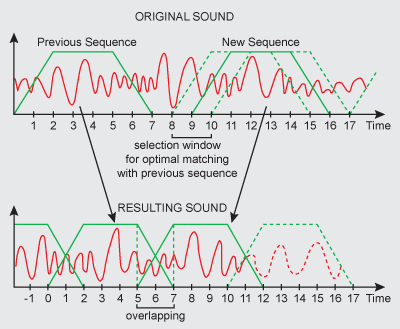
There are three important parameter: SequenceMs, overlapMs, seekWindowMs.
These parameters affect to the time-stretch algorithm as follows:
- DEFAULT_SEQUENCE_MS: This is the default length of a single processing sequence in milliseconds which determines the how the original sound is chopped in the time-stretch algorithm. Larger values mean fewer sequences are used in processing. In principle a larger value sounds better when slowing down the tempo, but worse when increasing the tempo and vice versa.
By default, this setting value is calculated automatically according to tempo value.
- DEFAULT_SEEKWINDOW_MS: The seeking window default length in milliseconds is for the algorithm that seeks the best possible overlapping location. This determines from how wide a sample "window" the algorithm can use to find an optimal mixing location when the sound sequences are to be linked back together.
The bigger this window setting is, the higher the possibility to find a better mixing position becomes, but at the same time large values may cause a "drifting" sound artifact because neighboring sequences can be chosen at more uneven intervals. If there's a disturbing artifact that sounds as if a constant frequency was drifting around, try reducing this setting.
By default, this setting value is calculated automatically according to tempo value.
- DEFAULT_OVERLAP_MS: Overlap length in milliseconds. When the sound sequences are mixed back together to form again a continuous sound stream, this parameter defines how much the ends of the consecutive sequences will overlap with each other.
This shouldn't be that critical parameter. If you reduce the DEFAULT_SEQUENCE_MS setting by a large amount, you might wish to try a smaller value on this.
function out = check_limits(in, min, max)
if in < min
out = min;
else if in > max
out = max;
else
out = in;
end
end
function [seekWindowLength, seekLength, overlapLength] = calcSeqParams(fs, tempo)
overlapMs = 8;
autoseq_tempo_low = 0.5;
autoseq_tempo_top = 2.0;
autoseq_at_min = 90;
autoseq_at_max = 40;
autoseq_k =(autoseq_at_max - autoseq_at_min) / (autoseq_temp_top - auto_temp_low);
autoseq_c = autoseq_at_min -autoseq_k * autoseq_temp_low;
autoseek_at_min = 20;
autoseek_at_max = 15;
autoseek_k =(autoseek_at_max - autoseek_at_min) / (autoseq_temp_top - auto_temp_low);
autoseek_c = autoseek_at_min -autoseek_k * autoseq_temp_low;
%calc sequenceMs
seq = autoseq_c + autoseq_k * tempo;
seq = check_limits(seq, autoseq_at_max, autoseq_at_min);
sequenceMs = round(seq);
seek= autoseek_c + autoseek_k * tempo;
seek= check_limits(seek, autoseek_at_max, autoseek_at_min);
seekMs = round(seek)
seekWindowLength = sequenceMs * fs / 1000;
seekLength = seekMs * fs /1000;
overlapLength = overlapMs * fs / 1000;
overlapLength = overlapLength - mod(overlapLength, 8);
end
function corr = calcCrossCorr(mixingSeg, compareSeg)
len = length(compareSeg(:,1));
corr = 0;
norm = 0;
for i = 1: 1 : len
corr = corr + mixingSeg(i) * compareSeg(i);
norm = norm + mixingSeg(i) * mixingSeg(i);
end
corr = corr / sqrt(norm);
end
function offset = seekBestOverlapPosition(seekWindow, compareSeg, overlapLength, seekLength)
bestCorr = calcCrossCorr(seekWindow(1:overlapLength, 1), compareSeg);
offset = 1;
for i = 2 : 1 : seekLength
corr = calcCrossCorr(seekWindow(i:i + overlapLength, 1), compareSeg);
if corr > bestCorr
bestCorr = corr;
offset = i;
end
end
end
function output = overlap(rampUp, rampDown)
len=length(rampDown);
for i = 1:1:len
output(i,1) = rampUp(i) * i / len + rampDown(i) * (len - i) / len;
end
end
function [output, outpos, lastCompare, inpos] = processSamples(input, inputLen, expectOutputLen, compareSeg, overlapLength, seekLength, seekWindowLength, tempo, isBeginning)
nominalSkip = tempo * (seekWindowLength - overlapLength);
sampleReq = max(round(nominalSkip) + overlapLength, seekWindow);
inpos = 1;
outpos = 1;
offset = 0;
skipFract = 0;
while inputLen - inpos >= sampleReq
if isBeginning == 0
offset = seekBestOverlapPosition(input(inpos : inpos + overlapLength + seekLength - 1, 1), compareSeg, overlapLength, seekLength);
output(outpos:outpos + overlapLength - 1, 1) = overlap(input(inpos + offset : inpos + offset + overlapLength - 1, 1), compareseg);
ouputpos = outpos + overlapLength;
offset = offset + overlapLength;
else
isBeginning = 0;
skip = round(tempo * overlapLength);
skipFract = skipFract - skip;
end
temp = (seekWindowLength - 2 * overlapLength);
if outpos + tmep < expectOutputLen
output(outpos : outpos + temp - 1, 1) = input (inpos + offset : inpos + offset + temp - 1, 1);
outpos = outpos + temp;
else
output(outpos : expectOutputLen, 1) = input (inpos + offset : inpos + offset + expectOutputLen- outpos, 1);
outpos = expectOutputLen;
beak;
end
compareSeg = input (inpos + offset + temp: inpos + offset + temp +overlapLength - 1, 1);
skipFract = skipFract + nominalSkip;
ovlSkip = floor(skipFract);
skipFract = skipFract - ovlSkip;
inpos = inpos + ovlSkip;
end
lastCompare = compareSeg;
end
function output = changeTempo(input, fs, tempo)
inputLen = length(input(:,1));
outputLen = round(inputLen / tempo);
output = zeros(outputLen, 1);
[seekWindowLength, seekLength, overlapLength] = calcSeqParams(fs, tempo);
isBeginning = 1;
compareBuf = zeros(overlapLength, 1);
expectOutLen = outputLen;
[output, outpos, compareBuf, inpos] = processSamples(input, inputLen, expectOutLen, compareBuf, overlapLength, seekLength, seekWindowLength, tempo, isBeginning);
remainningSamples = inputLen - inpos;
%append zeros to the remainning data
remainningLen = remainningSamples + 200 * 128;
remainningInput = zeros(remainningLen, 1);
remainningInput(1:remainningSamples, 1) = input(inpos:inpos + remainningSamples - 1, 1);
if outputLen > outpos
expectOutLen = outputLen - outpos + 1;
isBeginning = 0;
[tempOutput, tempOutpos, compareBuf, inpos] = processSamples(remainingInput, remainingInputLen, expectOutLen, compareBuf, overlapLength, seekLength, seekWindowLength, tempo, isBeginning);
output(outpos:outputLen, 1) = tempOutput(1: tempOutpos);
end
end
main.m:
clc;
clear all;
[input fs] = wavread('test.wav');
tempo = 2;
output = changeTempo(input, fs, tempo);
wavwrite(output, fs, 'output.wav');
soundtouch 变速算法matlab实现的更多相关文章
- soundtouch变速wsola算法之改进
soundtouch变速算法很类似sola算法,细看才知道是wsola算法. 上个星期有个需求,将该变速应用到直播的包处理,有点类似于webrtc的netEQ处理机制. 直接使用soundtouch, ...
- OLA音频变速算法的仿真与剖析
前段时间,在尝试音乐节拍数的提取时,终于有了突破性的进展,效果基本上比市面上的许多商业软件还要好,在作节拍数检测时,高频信息作用不大, 通过重采样减小运算量.重采样让我想起了在学校里面做的变速变调算法 ...
- 标准差分进化算法matlab程序实现(转载)
标准差分进化算法matlab程序实现 自适应差分演化算法方面的Matlab和C++代码及论文 差分进化算法 DE-Differential Evolution matlab练习程序(差异演化DE) [ ...
- 密度峰值聚类算法MATLAB程序
密度峰值聚类算法MATLAB程序 凯鲁嘎吉 - 博客园 http://www.cnblogs.com/kailugaji/ 密度峰值聚类算法简介见:[转] 密度峰值聚类算法(DPC) 数据见:MATL ...
- GWO(灰狼优化)算法MATLAB源码逐行中文注解(转载)
以优化SVM算法的参数c和g为例,对GWO算法MATLAB源码进行了逐行中文注解. tic % 计时器 %% 清空环境变量 close all clear clc format compact %% ...
- 每天进步一点点------Alpha半透明图形叠加算法Matlab+Verilog实现
Alpha图形叠加算法Matlab+Verilog实现 1.1. Alpha算法的研究 Alpha通道是一个8位的灰度通道,该通道用256级灰度来记录图像中的透明度信息,定义透明.不透明和半透明区域, ...
- 医学CT图像特征提取算法(matlab实现)
本科毕设做的是医学CT图像特征提取方法研究,主要是肺部CT图像的特征提取.由于医学图像基本为灰度图像,因此我将特征主要分为三类:纹理特征,形态特征以及代数特征,每种特征都有对应的算法进行特征提取. 如 ...
- 蚁群算法matlab实现
大家好,我是小鸭酱,博客地址为:http://www.cnblogs.com/xiaoyajiang 以下用matlab实现蚁群算法: %蚂蚁算法test %用产生的一个圆上的十个点来检验蚂蚁 ...
- 多源最短路Floyd 算法————matlab实现
弗洛伊德(Floyd)算法是一种用于寻找给定的加权图中顶点间最短路径的算法.该算法名称以创始人之一.1978年图灵奖获得者.斯坦福大学计算机科学系教授罗伯特·弗洛伊德命名. 基本思想 通过Floyd计 ...
随机推荐
- windows server2008 IIS下目录 [ application/database.php ] 不可写!解决
windows server2008目录 [ application/database.php ] 不可写!解决 在服务器上找到网站根目录 网站用的thinkphp的框架 属性 -- ...
- ES6之常用开发知识点:入门(一)
ES6介绍 ES6, 全称 ECMAScript 6.0 ,2015.06 发版. let 和 const命令 let命令 let 命令,用来声明变量.它的用法类似于var,区别在于var声明的变量全 ...
- Lucene使用IKAnalyzer分词
1.分析器 所有分析器最终继承的类都是Analyzer 1.1 默认标准分析器:StandardAnalyzer 在我们创建索引的时候,我们使用到了Index ...
- 轻量级RPC设计与实现第一版
什么是RPC RPC (Remote Procedure Call Protocol), 远程过程调用,通俗的解释就是:客户端在不知道调用细节的情况下,调用存在于远程计算机上的某个对象,就像调用本地应 ...
- 剑指offer-面试题8-二叉树的下一个节点-二叉树
/* 题目: 给定一棵二叉树和其中一个节点,找出中序遍历的下一个节点. */ /* 思路: 两种情况: 节点存在右子树:节点右子树的最左节点: 节点不存在右子树,节点向上一直找父节点或祖父节点,直到其 ...
- Java(四)输出和输入函数
介绍一下Java里简单常用的输入输出方法. Java的输出函数很简单,直接调用System类的out对象的print函数即可. 代码: System.out.print(a);//输出变量a的值 Sy ...
- .net mvc 使用 aspose.cells导出数据
public class AsposeCellsHelper { public Workbook workBook; public Worksheet worksheet; Style style; ...
- js返回时间差
function CalcTimeSub(endTime, startTime, type) { var bool = endTime == defaultDateTime || startTime ...
- spark.streaming.kafka.maxRatePerPartition的理解
spark.streaming.kafka.maxRatePerPartition设定对目标topic每个partition每秒钟拉取的数据条数. 假设此项设为1,批次间隔为10s,目标topic只有 ...
- Android View框架的draw机制
概述 Android中View框架的工作机制中,主要有三个过程: 1.View树的测量(measure) Android View框架的measure机制 2.View树的布局(layout)Andr ...